TL;DR:
- Winter is the only stretch of the year long enough to build real strength. Heavy lifting needs 8 to 12 weeks to pay off on the bike, and those weeks are hard to find once the trails dry out.
- The research is consistent: two heavy lower-body sessions a week improve how efficiently you pedal, how hard you can sprint, and how long you can hold a hard effort, without adding body weight or hurting your aerobic fitness.
- The movements that transfer to the trail are the basics. Squat, hinge, single-leg work, pushing, pulling, grip, and a core that holds the bike steady over roots and rocks.
- Keep the engine running with two or three aerobic sessions a week, mostly easy, with one hard interval day. A full winter off the bike costs 8 to 16% of your aerobic capacity.
- Once riding season starts, one short lifting session a week keeps nearly everything you built. Riders who stop lifting in April are back where they started by July.
Why Winter is Where Next Season Gets Decided
Mountain biking asks for an odd mix of fitness. You need an aerobic engine for the climbs, strength to drive the bike through rock gardens and compressions, grip that holds on through a 10-minute descent, and a core that keeps your body position steady when the trail is trying to knock you off it. Cross-country racers spend more than 80% of race time above their lactate threshold, with heart rates averaging close to 90% of maximum, and researchers who have studied the sport attribute part of that intensity to something road riders never deal with: constant isometric work from the arms and trunk just to keep the bike pointed where it should go.
Riding builds a lot of that. What riding does not build well is raw strength, and strength is the piece that takes the longest to develop. The studies that show lifting improves cycling performance all run 8 weeks or longer, and the biggest gains show up in programs that last 12 to 25 weeks. Those are winter numbers. Nobody with a packed summer of rides, trips and races is going to add two heavy gym sessions a week in June and recover from them.
Winter also happens to be when the body is ready for it. After a season of riding, your aerobic system is at its peak and your legs are tired of pedaling. A few months of different stress, with the bike playing a supporting role, is how you come out of March with more than you had in October.
Picture your first proper spring ride after a winter of nothing. The first climb hurts more than you remember. The arms pump up halfway down the first real descent. By the second lap you are sitting more, pedaling squares, and taking lines you would have jumped last fall. That is detraining, and it is avoidable.
What the Science Says About Lifting for Riders
For a long time cyclists treated the gym as something that would make them heavy and slow. Norwegian researchers spent the better part of a decade testing that belief, and the belief lost. We covered the road-cycling side of that research in Weight Training for Cyclists: Why Lifting Makes You Faster; what follows is the mountain bike version.
In a 2010 study of competitive cyclists, eight weeks of heavy half squats (4 sets of 4 reps, three times a week) improved cycling economy by 4.8% and extended time to exhaustion at a hard, fixed power by 17%. Body weight did not change. VO2max did not change. The riders simply used less oxygen to produce the same power, and could hold a hard pace longer.
A 2015 study of elite cyclists ran the experiment for 25 weeks. The lifting group improved peak sprint power, peak aerobic power, power at lactate threshold, and average power in a 40-minute all-out test. The group that only rode improved none of those. The lifters also changed how they pedaled, producing peak torque earlier in the pedal stroke, and the riders whose stroke changed most were the ones whose 40-minute power improved most.
In 2025, a systematic review of 17 controlled studies covering 262 trained cyclists pulled all of this together. Heavy strength training (loads at or above 80% of one-rep max) improved cycling efficiency, anaerobic power, and performance in time trials and time-to-exhaustion tests. It had no effect, positive or negative, on VO2max. The authors note the overall certainty of evidence is low, which is a fair description of most sports science, but the direction of the findings has not changed in 15 years.
The gains in every one of these studies came from heavy loads and low reps, in the 4-to-10 rep range, and none came from circuits of 20 bodyweight squats. And once you have built the strength, one session a week keeps it. Cyclists who lifted twice a week over a 12-week winter block and then dropped to once a week during the season held onto their muscle and strength for at least 13 weeks of racing, and kept improving their 40-minute power while the non-lifting group plateaued.
The Movements That Transfer to the Trail
Ask experienced riders and coaches what gym work changed their riding and the same short list comes back every time. None of it is exotic.
Squats, in Every Flavor
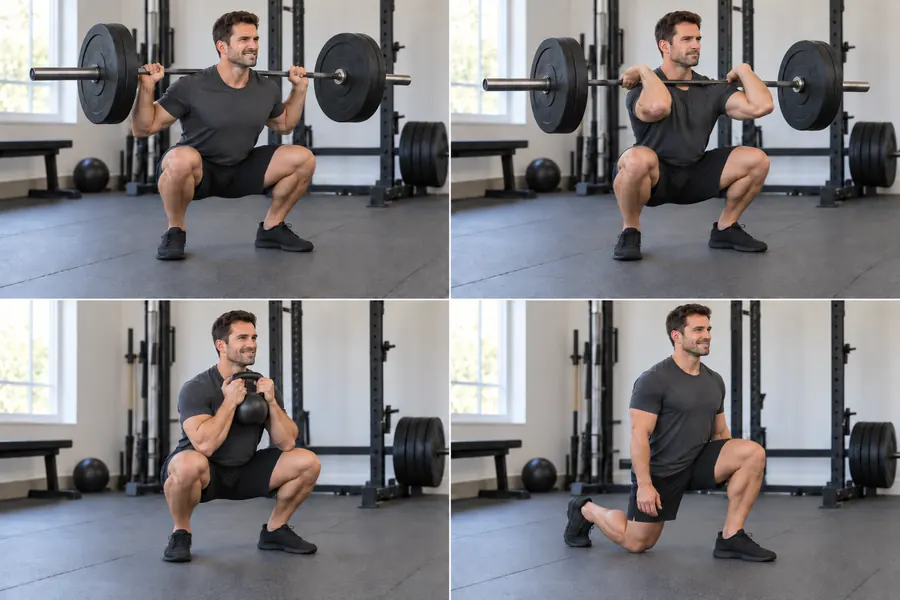
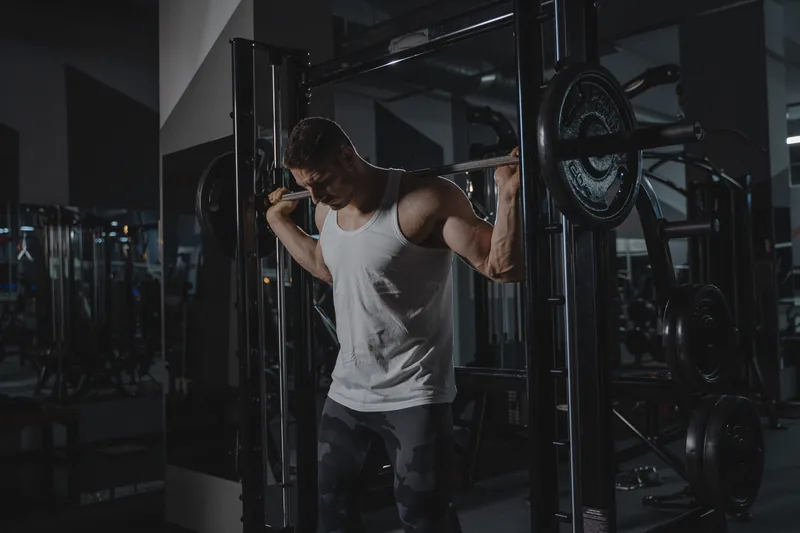
Back squat, front squat, goblet squat, split squat. The squat pattern is the steep-climb pattern and the big-compression pattern, and stronger legs are a large part of becoming a better climber. It is also the movement with the most direct research behind it for cyclists, since the half squat was the exercise used in the studies above. If you only have time for one lift, this is it.
Load it heavy, with 4 to 6 sets of 4 to 6 reps once you have a few weeks of practice under you. Depth to roughly parallel is enough. Riders who have never squatted with a barbell should start with a goblet squat holding a dumbbell or kettlebell at the chest, which teaches an upright torso and stops the knees from caving.
The Hinge: Deadlifts and Kettlebell Swings
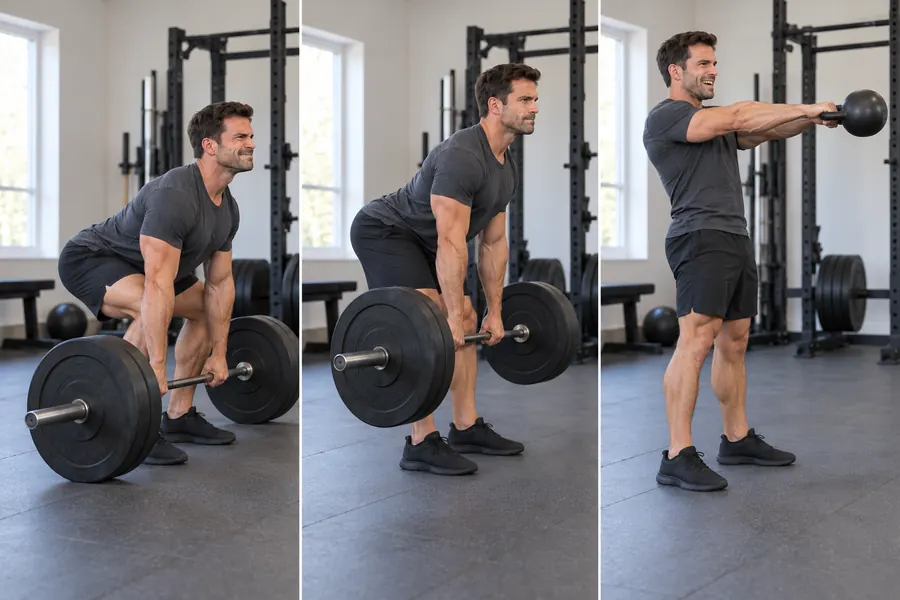
The deadlift builds the posterior chain, meaning hamstrings, glutes and the whole length of the back. On the bike, that chain is what holds the attack position on a long descent without your low back folding. Riders who add deadlifts tend to report the same two things: their body position stops collapsing late in rides, and the nagging low-back ache they assumed was part of the sport goes away.
The trap bar (hex bar) deadlift is the friendliest version for people who are new to the lift or who have a cranky back, because it keeps the load centered. Romanian deadlifts, where the bar stays close to the legs and the knees stay soft, isolate the hamstrings and are a good second hinge. Heavy kettlebell swings train the same muscles with more speed, and double as a conditioning tool when you do them in sets of 15 to 20.
Single-Leg Work
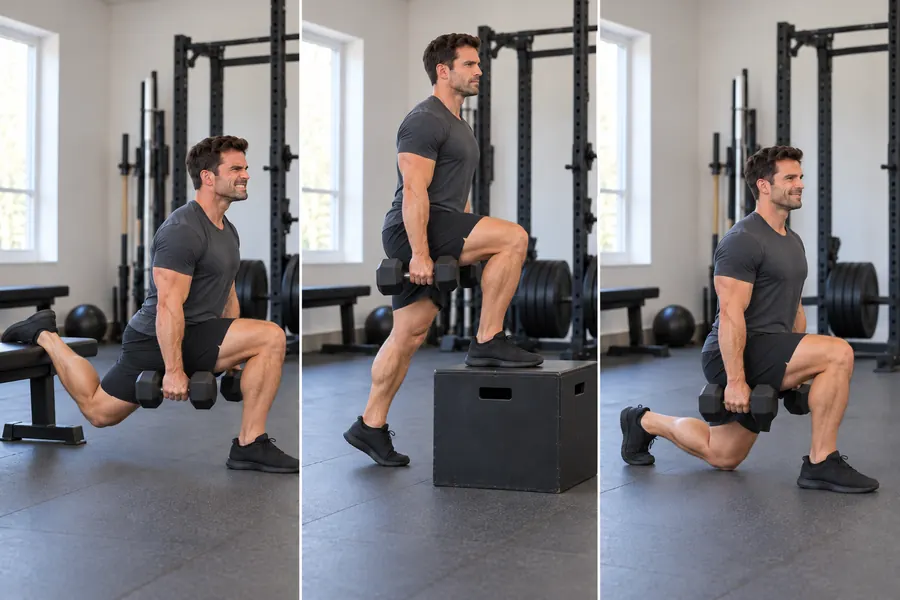
Pedaling is a single-leg activity, and so is almost everything you do standing on the pedals through a technical section, where one foot is forward, your weight is shifting side to side, and your hips are doing most of the balancing. Bulgarian split squats (rear foot elevated on a bench, dumbbell in one or both hands), step-ups onto a knee-high box, and walking lunges expose strength imbalances between legs that two-legged lifts hide. Nearly every rider who adds them finds one side is noticeably weaker. Two sets of 8 to 10 per leg, after your main squat or hinge, is plenty.
Pushing: Push-Ups and Bench Press
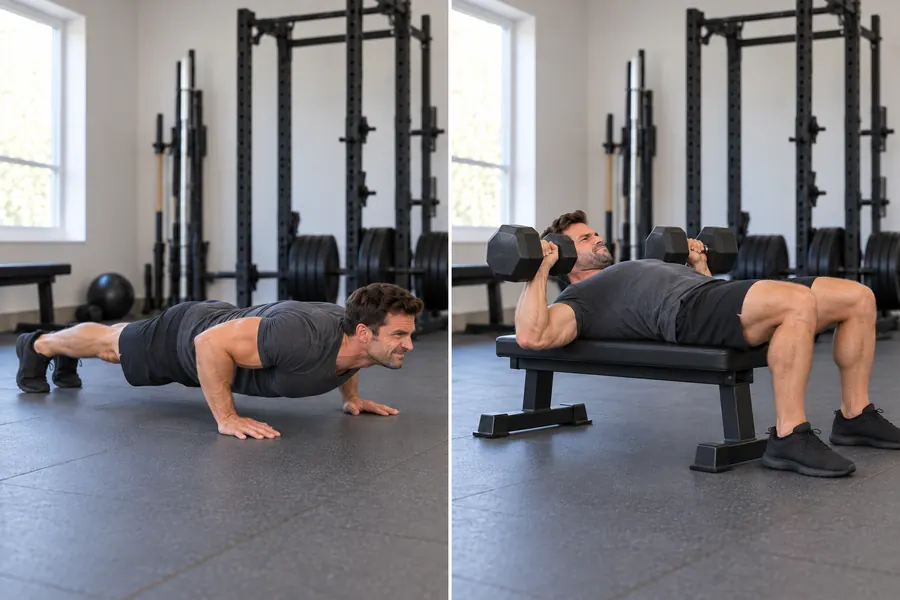
This is the one road cyclists skip and mountain bikers cannot. A strong press is what stops a front-wheel stuff from turning into a trip over the bars. When the fork dives into a hole and your weight pitches forward, the difference between riding it out and eating dirt is often whether your chest and triceps can push you back behind the bars in a quarter of a second.
Push-ups cover most of this, and they travel. To make them more bike-specific, do them on gymnastics rings or with your hands on a heavy resistance band stretched between two posts, so the surface moves under you and your shoulders have to stabilize the way they do on a rough trail. Add a flat dumbbell bench press on heavy days.
Pulling: Rows and Pull-Ups
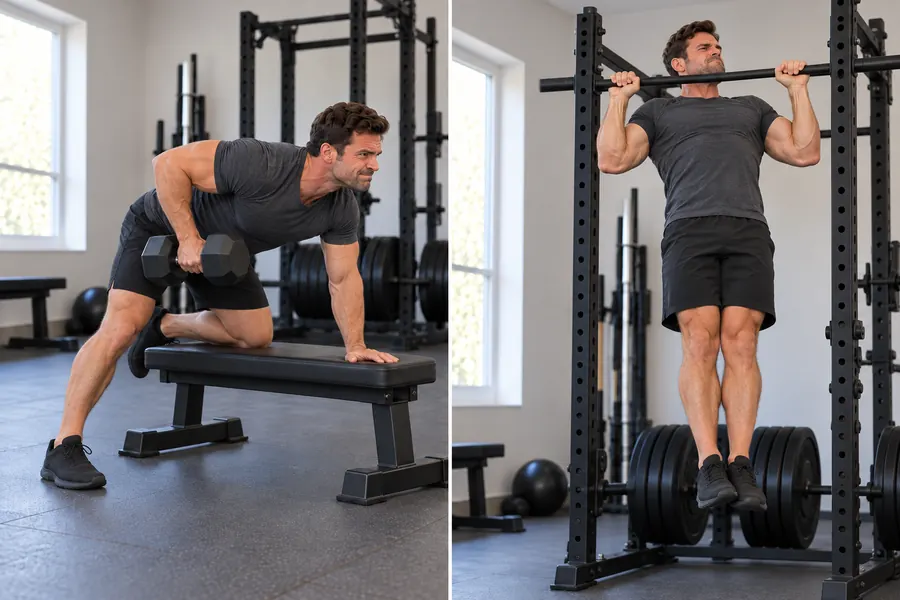
Rows (barbell, dumbbell, cable or a rowing machine) and pull-ups build the upper back and the biceps you use to manual, bunny hop, and haul a 50-pound e-bike through a switchback. They also balance out all the pushing and keep your shoulders healthy. A simple rule: for every set of pressing, do a set of pulling.
Grip and Forearms
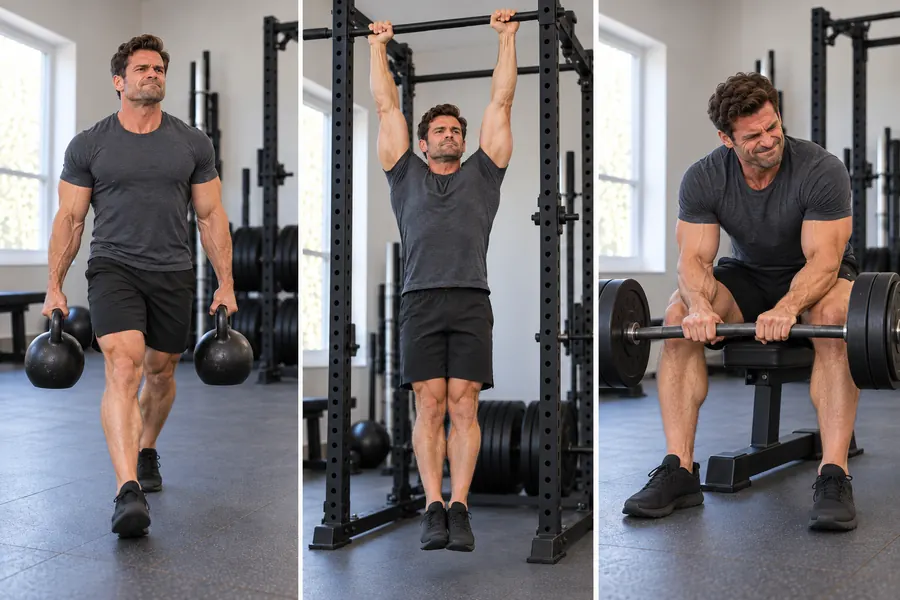
Arm pump, that burning, locked-up forearm feeling on long descents, is a blood-flow problem. Sustained gripping squeezes the forearm muscles hard enough to restrict their own circulation, metabolic waste builds up, and grip strength falls off a cliff right when you need it most. The fix is partly bike setup (lever angle, grip size, suspension that absorbs small chatter), partly technique (loosen your hands, breathe, brake in controlled pulses rather than death-gripping), and partly training.
Farmer’s carries with heavy dumbbells or kettlebells, dead hangs from a pull-up bar, and a wrist roller build grip endurance in a way that trainer miles never will. One rider’s favorite: sit on a bench, forearms on your knees, and roll a loaded barbell down to the fingertips and back up into a wrist curl for 3 sets of 10 to 15. Riders who do forearm work consistently say they can finally relax their hands on a descent, and relaxed hands are faster hands.
Core, Trained for Stiffness Rather Than Crunches
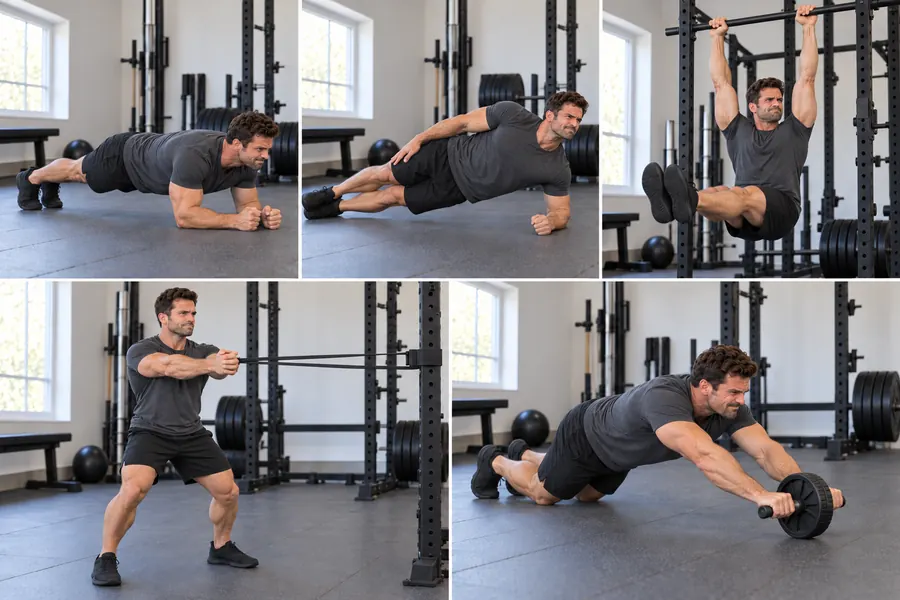
A weak trunk forces your arms and hands to carry weight they should not be carrying. That shows up as hand numbness, arm pump, and sloppy form when you get tired. Coaches who work with downhill and enduro racers point out that the fastest riders in the world are not bulky, but they are strong from the core outward, and that is where off-season time should go.
In a 2026 study of young female mountain bikers, eight weeks of off-season trunk training, three 30-minute sessions a week, improved trunk strength and reduced how much the bike swayed side to side under them while pedaling. Less sideways wobble is less wasted energy.
Front planks, side planks, hanging leg raises, Pallof presses (resisting rotation against a cable or band), and ab-wheel rollouts all train the trunk to stay rigid while the limbs move, which is exactly its job on the bike. Two or three of these at the end of every gym session is enough.
The Kettlebell Shortcut
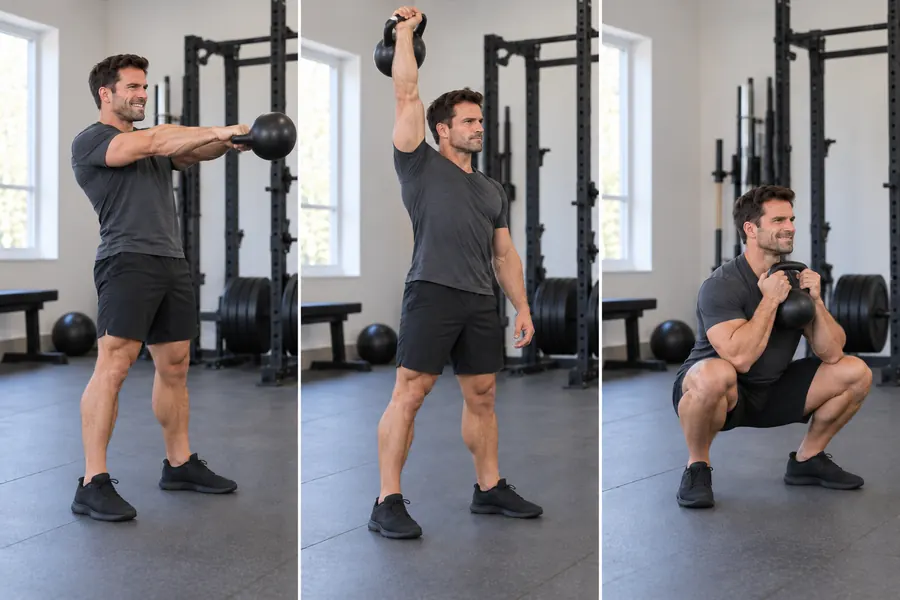
If the whole barbell thing feels like too much, a single heavy kettlebell and three moves (the swing, the clean and press, and the goblet squat) cover the hinge, the push, the squat, the grip and the core in 25 minutes. Riders in their 40s and 50s who train at home with kettlebells often say it changed their riding more than anything else they tried. It is not a replacement for heavy barbell squats if maximum strength is the goal, but it beats a winter of nothing by a wide margin.
How to Put a Winter Together
Here is a four-month template built around the research, assuming the trails close in November and open again in March. Adjust the dates for where you live.
November: Learn the Movements (3 to 4 Weeks)
Two or three gym sessions a week. Moderate weights, 3 sets of 8 to 12 reps on squats, deadlifts or trap-bar deadlifts, split squats, push-ups or bench, rows, and core. The purpose is to groove technique and let tendons and connective tissue adapt before the heavy loads arrive. Expect soreness in week one; it fades quickly.
December and January: Get Strong (8 Weeks)
Two heavy sessions a week, and no more. Each session is built around one squat and one hinge at 4 to 6 sets of 4 to 6 reps, heavy enough that you could do only one or two more reps when the set ends. Follow with single-leg work, a press, a pull, grip, and core. Rest 2 to 3 minutes between heavy sets. Add a little weight to the main lifts each week. This is the block where the cycling-economy gains in the studies came from, and 8 weeks is the minimum to see them.
February: Turn Strength into Speed (4 Weeks)
Drop the weight to around 60% of your heavy loads and move it fast. Jump squats, box jumps, kettlebell swings, medicine ball slams, and explosive step-ups convert the strength you built into the quick, punchy power you need for a steep pitch or a sprint out of a corner (more on that in How to build explosive cycling power). Keep the volume low: 3 to 5 sets of 3 to 5 reps, with full rest. Keep one heavy squat or deadlift set in each session so the strength does not fade.
March Onward: Maintain
One session a week, 30 to 40 minutes. One heavy squat or hinge at 2 to 3 sets of 4 to 6, a press, a pull, core, done. This is the dose that kept cyclists strong through 13 weeks of racing in the Norwegian research. Skip it and you will be measurably weaker by midsummer. If you race, this is also when the spring comeback plan takes over the riding side of the calendar.
Fitting It Around the Bike
Lifting and riding compete for the same recovery. A few rules make them coexist:
- Put heavy legs and hard rides on the same day, with the ride first if both are hard, and leave the next day easy. Two hard days back to back is how you end up too sore to ride well, which is the most common complaint from riders who add the gym and then quit. Stack enough of those days and you are on the road to overtraining syndrome.
- Never do a heavy leg session the day before a long or technical ride.
- Easy aerobic rides can go anywhere, including the day after lifting. Spinning easy helps the soreness.
- If something hurts in a joint rather than a muscle, stop. Winter is for building, not rehabbing. Our cycling injury prevention tips cover the usual suspects.
- Short on hours? How to build cycling fitness in limited time shows how to fit the riding half into a busy week.
Keep the Engine Running
Strength is the winter priority, but it does not replace aerobic fitness, and aerobic fitness goes away faster than most riders think. Blood volume drops within days of stopping, VO2max is down around 5% after a week or so off, and several studies show declines of 8 to 16% after a few weeks. The better trained you are, the more you lose. Regaining it takes two to three times longer than losing it.
You do not need a lot to hold it. Two or three aerobic sessions a week is enough, and how you distribute the intensity is more important than the total hours. A nine-week comparison of well-trained endurance athletes found that a polarized approach, roughly 80% of sessions easy and 20% hard with little time in the middle, raised VO2peak by 11.7% and time to exhaustion by 17%. Athletes who trained mostly at a moderate, threshold-type intensity, the “kind of hard” pace most riders drift into on every ride, saw no improvement at all.
For a mountain biker, that means:
- Two easy sessions a week of 60 to 90 minutes where you can hold a conversation the whole time. Trainer, fat bike, gravel, cross-country skiing, running, or a hike all count.
- One hard session a week. Six weeks of either long intervals or short sprints improved simulated race performance in cross-country racers, with longer intervals (4 to 5 minutes at a very hard pace, equal rest, 4 to 6 repeats) having a slight edge. The Norwegian 4x4 is the simplest version of that session. On a trainer these are 30 to 45 minutes door to door.
If you have a trainer, this is its season. We also have a guide to building a pain cave on any budget, and if you would rather be outside, here is how to train in the cold without turning winter riding into a misery. For a periodized plan aimed at a specific early-season race, see Winter training tips to crush your race goals.
Skills Do Not Have to Hibernate
Fitness gets you to the top of the climb. Skills get you down it. Winter is a good time to work on both, because the pressure is off.
- Pump track and skatepark laps. An hour of pumping rollers and berms without pedaling is one of the hardest and most useful workouts in mountain biking. It teaches you to generate speed from your hips and legs rather than your pedals, and it burns out every muscle you use on a descent. Many towns now have paved pump tracks that stay rideable all winter.
- Indoor bike parks. If there is one within a day’s drive, a weekend there in January pays off in March.
- Parking-lot drills. Track stands, slow-speed figure eights, manuals, and bunny hops over a stick need 20 minutes and a dry patch of asphalt.
- Trail work. A day with a shovel and a McLeod is a full-body workout, your local trail association needs the help, and you will ride the trail differently once you know how it was built.
- Mobility. Ten minutes of hip flexor, hamstring, thoracic spine and wrist mobility after each gym session keeps the new strength usable in a riding position. Start with the 10 stretches every cyclist should be doing.
- Brush up on trail safety. A winter of new strength is wasted on a spring crash; our mountain bike riding safety tips are a quick refresher before the first real ride.
A Note for Riders Over 40
Past 40, you cannot ride yourself into fitness the way you could at 25. Muscle mass declines roughly 8% per decade after 40 if you do nothing about it, and the fast-twitch fibers that produce punchy trail power shrink first. Riding slows the aerobic decline but does almost nothing for the muscle loss. Riders in their 40s and 50s who describe the biggest changes from lifting are not describing better race results; they are describing feeling solid on the bike again, no low-back pain after long rides, and the ability to ride hard three or four days a week without falling apart.
Older lifters also lose strength faster during breaks, so the once-a-week maintenance session in season is less optional with every birthday. Protein helps too: aim for a palm-sized serving at every meal, and more on lifting days, and creatine is one of the few supplements with solid evidence behind it for holding onto muscle with age. For the bigger picture on riding and aging, see Cycling Might Be the Closest Thing We Have to an Anti-Aging Pill and, if you are newer to the sport, Want to start cycling after 50? Here’s how.
Common Winter Mistakes
- Going too hard in the gym. Riders who treat every session like a CrossFit competition end up too sore to ride and conclude lifting does not work. Two heavy sessions a week, with one or two reps left in the tank on every set, is the recipe in the research.
- Chasing size. Look at the fastest downhill racers in the world. Few of them are bulky. The target is strength, and heavy weights at low reps build it with little added bulk. In the studies above, body weight did not change.
- Skipping the upper body. Road riders can get away with legs-only. Mountain bikers who do will find out on the first steep, rough descent.
- Only riding the trainer. Trainer miles keep the engine running and do nothing for your grip, your core, or your handling. Pair them with the gym and the pump track.
- Stopping cold in March. Everything you build over winter is gone by July without the weekly maintenance session.
- Ignoring the setup. If your forearms blow up on every descent, check brake lever angle (wrist straight in line with the forearm), grip diameter, and suspension small-bump compliance before assuming you just need stronger arms.
Protect the Bike You are Training For
A stronger rider rides faster and takes bigger lines, and a winter of training is a sizable investment in a sport where a single crash can total a frame. A standalone mountain bike policy covers crash damage, theft, and transit, with optional liability, medical gap, and uninsured motorist coverage, each elected before the accident, for the days when the trail or the road does not cooperate. Get a quote before the trails open, so the first ride of spring is only about the riding.
Policy terms, conditions and availability vary by state. This article is for general information and is not insurance, medical or training advice. Consult a physician before starting a new exercise program.
Frequently Asked Questions
- Can I lift without getting heavier and slower on the climbs?
- Yes, with heavy, low-rep training. Studies in competitive and elite cyclists consistently report no change in body weight after 8 to 25 weeks of lifting, with improved power-to-weight as a result. Bodybuilding-style training (high reps, short rest, many sets) is what adds mass, and that is not what is being recommended here.
- How many days a week do I need in the gym?
- Two during the build phase, one in season. More than two heavy sessions a week leaves too little recovery for riding, and the research shows no added benefit from a third.
- I only have dumbbells and a kettlebell at home. Is that enough?
- For most riders, yes. Goblet squats, kettlebell swings, single-arm rows, Bulgarian split squats, push-ups, and farmer’s carries cover every pattern. You will eventually outgrow a single kettlebell on squats and hinges, which is when a gym membership or a barbell starts to earn its keep.
- How long before I notice a difference on the trail?
- Most riders feel more stable on the bike within four to six weeks, mainly from core and upper-body work. The pedaling-efficiency gains in the studies showed up at the 8-week mark. Give the full winter block before judging.
- Should I keep lifting once the trails open?
- Yes, once a week. That single session preserved muscle, strength, and the performance gains through 13 weeks of racing in well-trained cyclists. It takes 30 to 40 minutes.
- I have never lifted. Where do I start?
- Spend November with lighter weights and higher reps learning the squat, hinge, push and pull patterns, ideally with a few sessions from a coach who can watch your form. Start every lift lighter than you think you need to. The weight goes up quickly once technique is solid.
- Does this apply to e-bikes?
- More than you might expect. A 50-pound e-bike is harder to lift over a log, haul through a switchback, and muscle around in the air than a 30-pound trail bike, and riders who switch to an e-MTB often report their upper body and grip are the first things to give out. The same movements apply; the pulling and grip work moves up the priority list.