


One Policy for Every Crash
A slide on a wet descent, an overlapped wheel on a group ride, a pile-up in a crit. A crash can cost you the bike, a trip to the ER, or someone else's bill. One policy covers all three.
Your Bike
Repaired at the retail cost of the repair, labor included. If it cannot be fixed, paid at the value you insured it for, with no depreciation.
Your Injuries
Medical gap coverage pays the deductible and copays your health plan leaves you with. If the driver who hit you has no insurance or did not stop, uninsured motorist coverage pays.
Someone Else's Loss
If the crash is your fault, liability coverage pays for the other rider's injuries or the car you hit, up to $500,000, and defends you.
What Is Bicycle Crash Insurance?
Insurance that repairs or replaces your bike after a crash, regardless of fault.

A crash is over in a second and expensive for months. A carbon frame, a wheelset, and a shifter can add up to the price of a used car, and a homeowners policy does not cover accidental damage to your own bike at all. Bicycle crash insurance does: the bike is repaired at retail cost or replaced at the value you insured it for, regardless of fault.
Crash coverage is part of the core policy, which is all-risk, meaning anything not specifically excluded is covered: crash and accidental damage, theft (subject to the policy's locking conditions), and loss or damage in transit by car, airline, or courier. Fault does not affect the claim. A crash you caused on a wet corner is handled the same way as one a driver caused, and physical damage claims are subject to your deductible.
Racing is covered on the same terms once competitive use is elected on the bike, and Class 1, Class 2, and Class 3 e-bikes are insured like any other bicycle. Policies start at $9 a month.
How a Crash Claim Is Paid
When the bike can be fixed, the claim pays for the repair. When it cannot, the claim pays what you insured it for.
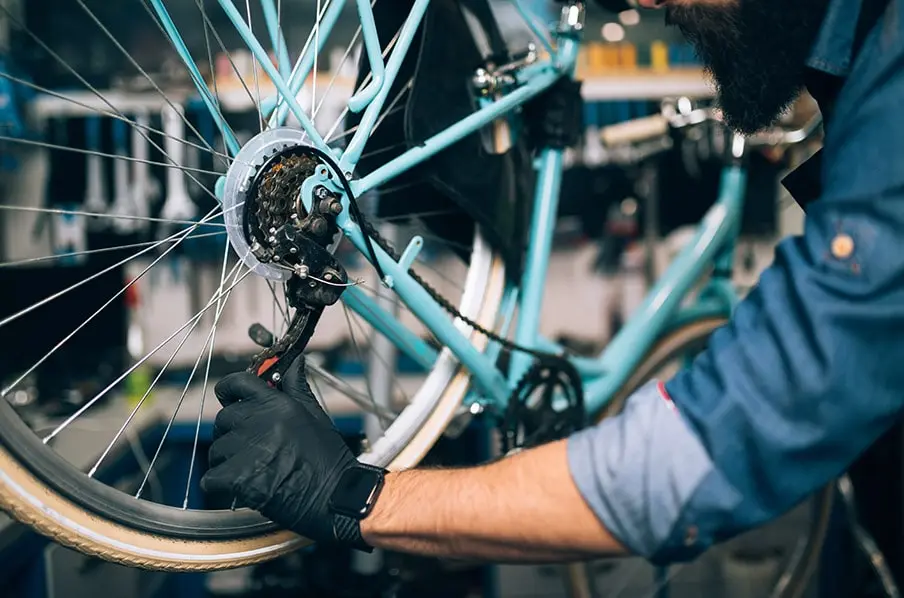
What counts as a crash. Going down on the road or trail, a collision with a car, another rider, or a fixed object, in training, on a group ride, or in a race.
A repairable bike is repaired at retail cost. The claim pays the retail cost of the repair: parts, labor, tax, and shipping, minus your deductible. $2,000 in covered damage with a $200 deductible pays $1,800. You choose the shop.
A total loss pays the insured value. If the bike cannot be repaired safely, the claim pays the value you insured it for, minus your deductible. There is no depreciation for age or mileage.
Whether a crash ends up as a repair or a replacement usually comes down to the frame.
Frames After a Crash
A damaged frame is handled like any other damaged part. The rest of the bike stays yours.
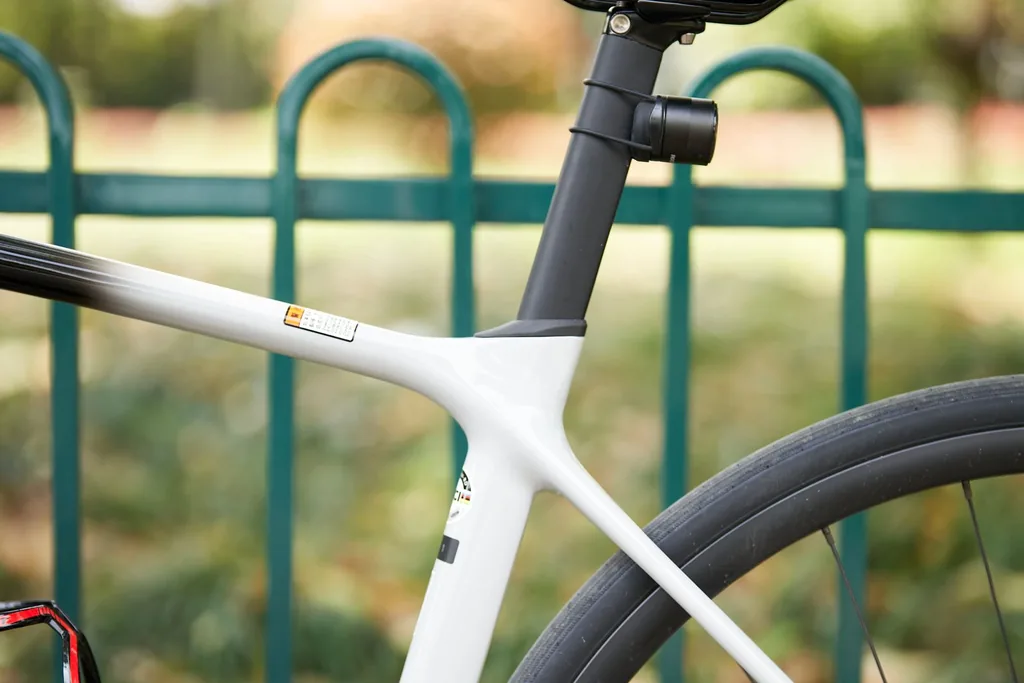
A damaged frame does not total the bike. The frame is the most expensive part on the bike, but it is still one part. The claim pays to repair it when that can be done safely, and to replace it when it cannot. The components you already own go back on. The bike is a total loss only when it cannot be repaired safely, or when the repair would cost more than the value you insured it for.
Partial damage is handled in kind. When the damage is confined to one section, that section is what the claim addresses: a full-suspension rear triangle damaged beyond repair is replaced as a rear triangle.
The labor is part of the claim. Stripping the frame and building the bike back up is covered along with the frame itself, so you are not left paying the shop to put the bike back together. Damage found later, such as a power meter that stops reading after the rebuild, is handled as a supplemental claim without a second deductible.
What stays outside. Marring, scratching, and denting that do not impair how the bike rides are cosmetic and not covered.
When the Crash Costs More Than the Bike
The core policy covers the bike. Three optional coverages cover the rest of the bill.

Your medical bills. Health insurance pays after the deductible, and one ER visit can eat the whole thing. Medical gap coverage pays that deductible and the copays, directly to you. Medical gap insurance →
A driver who cannot pay. When the driver who hit you has no insurance, too little, or did not stop, uninsured motorist coverage pays your medical expenses, physical therapy, and lost wages. Uninsured motorist insurance →
A crash you caused. Liability coverage pays for the other person's injuries or property and defends you if you are sued, with limits from $25,000 to $500,000. Liability insurance →
Crashes in Races and Events
Racing is where most riders take the most risk, and where other policies stop.
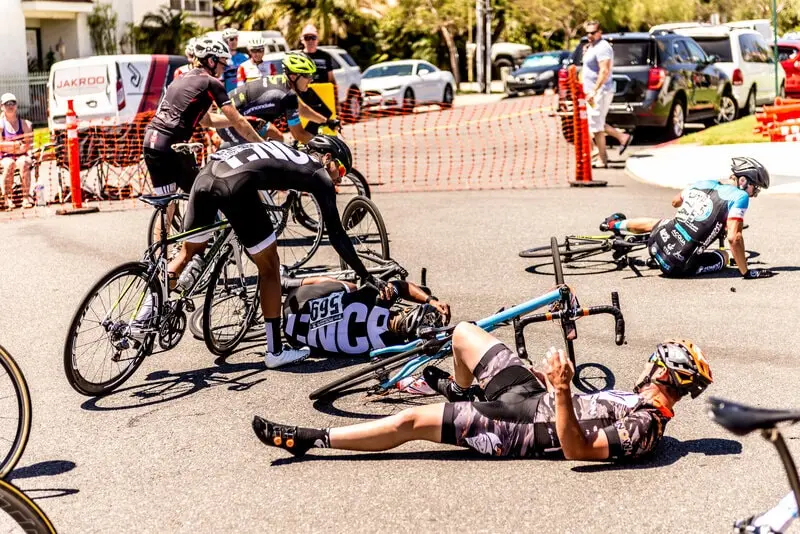
Racing is normal use, once it is elected. Select competitive use on the policy and crash damage in a race is covered on the same terms as any other crash: the rider who cooks the last corner and takes you down with them does not have to be your fault to be your claim.
The extras racers care about. Entry fee reimbursement up to $500 when a covered loss keeps you out of an event you have already paid for, and a $250 rental bike allowance for covered losses more than 50 miles from home. Spare parts such as a race wheelset are covered up to $500 per loss, with a $1,000 policy term limit.
Elect it before the season starts. Racing coverage protects the bike in competition and cannot be added after a crash to cover one. USA Cycling, USA Triathlon, and IMBA members get a 10% discount on every insured bike. Details on our bicycle racing insurance page.
What Is Not Covered
Every exclusion is written into the policy, so you know where crash coverage stops before you buy.
Damage that is not an accident. Wear and tear, mechanical breakdown, corrosion, latent defects, and tire failure from road damage are not sudden or accidental, so they are not claims. Neither is cosmetic damage that does not affect how the bike rides.
Riding under the influence. Losses while riding at or above your state's blood alcohol limit for motor vehicles are excluded.
Intentional damage and criminal acts. Damage you cause to the bike deliberately is not an accident, so it is not a claim. Neither is a loss that happens while the bike is being used to commit a crime.
Commercial use. Delivery and courier work suspends coverage for as long as the bike is used that way.
Racing without the election. Crash damage in a race or organized competition is covered only when racing coverage was elected on the bike before the event.
What to Do After a Crash
The first hour decides most claims. Five steps, in order.
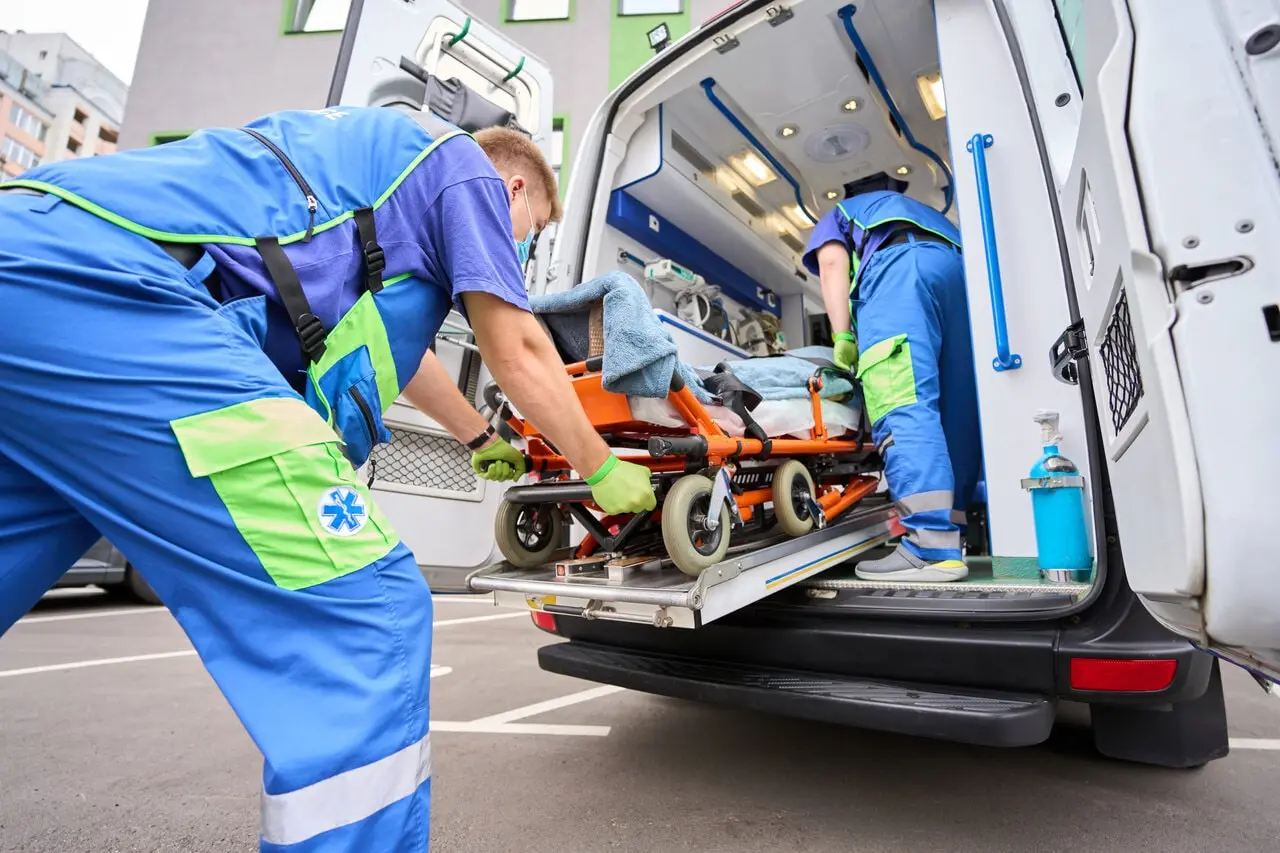
1. Get safe and call 911 when anyone is hurt or a vehicle is involved. A police report is the backbone of any claim that involves a driver.
2. Collect the evidence. Witnesses' names and numbers, the details of any driver involved, and photos of the scene and the bike before anything is moved. Say what happened to the police, and only to the police.
3. See a doctor the same day. Get checked even if you feel fine: adrenaline hides injuries, and a same-day record is the evidence any claim starts from.
4. Keep the bike as it is. Do not repair it before it has been inspected. Get a shop estimate and photos of the damage from several angles.
5. Report the claim right away. Follow the steps on our claims page. A claims manager contacts you within two business days, and most claims are paid in less than 14 business days. If a driver was involved, read what to do if you are hit by a car before you speak to their insurer, and consider one of our legal partners.
We cover all types of bikes
Whether you ride the tarmac or shred the gnar, dodge pedestrians, or cruise the beach, you're a member of a special club of people who appreciate the world in a primal way – on two wheels. To keep you rolling, we address the specific risks associated with your discipline.
Road bikes
Light and aerodynamic, equipped with skinny tires and optimized for long days in the saddle.
E-bikes
Electrically-assisted Class 1, 2, and 3 e-bikes with maximum assisted speed of up to 28 mph.
Commuter bikes
Simple, reliable bikes designed specifically for urban environments.
Mountain bikes
Rugged, resilient, and incredibly fun. Equipped with suspension and designed to offroad, tackle technical terrain and jumps.
Gravel bikes
Drop bar bikes capable of going on both pavement and unprepared terrain, even mild singletrack.
Triathlon bikes
Exceptionally aerodynamic and lightweight, these speed machines are designed with one goal in mind: go fast.
Trikes
Three-wheeled bicycles are known for additional stability and versatility.
Recumbent bikes
Two and three wheeled bikes with a leisurely leaning back seating position.
Cargo bikes
The SUVs of the two-wheeled world, these bikes are designed to carry heavy loads, including groceries and passengers.
Coverages and Features
Velosurance offers must-have protection such as accidental damage, theft, or loss in transit. Each policy can be customized by adding additional coverages such as liability protection, uninsured motorist, and medical payments.
Bicycles are very easy to steal and equally difficult to recover, and even a hefty U-lock doesn’t guarantee your bike is still there when you return. Velosurance provides peace of mind if it is stolen or damaged in the process.
Bike theft insurance →Our policy will pay to replace your ride if it is accidentally damaged and beyond repair, including damage that occurs while being carried on or in your vehicle. If it can be repaired, we will pay all the costs associated with the bike's repair, including tax, labor, and shipping, minus the deductible. Cosmetic damage that does not affect safety is excluded.
Bicycle crash insurance →Our policy optional coverage purchase will protect and defend you from your personal liability (injury, sickness, death, or damage to property, including fire damage) that you are found legally liable for. Coverage limits offered: $25,000, $50,000, $100,000, $300,000 or $500,000 per occurrence.
E-bike liability insurance →If you’re hurt and require medical attention, our optional medical gap will take care of your medical bills, up to the selected limit. The payments are paid directly to you to supplement the deductible of your personal health insurance policy.
Medical gap insurance →Depreciation is a hidden deductible that increases every year and is applied if the bicycle is stolen or totaled. No one is ever happy with an Actual Cash Value insurance settlement: the bike is first devalued, and then a deductible is applied, resulting in a reimbursement that is far less than the cost of a replacement. We reimburse without depreciation, for the cost of a replacement that is of like, kind, and quality similar to your totaled bike.
One of the scariest things that can happen to a cyclist is getting hit by a car. This coverage will pay for medical expenses, physical therapy, mental health services, lost wages, and other expenses that arise from a bicycle-car accident.
Uninsured motorist insurance →We cover all electrically assisted Class 1, 2, and 3 bikes with a maximum assisted speed of 28 mph. All protections available for conventional bicycles also apply to electric ones.
E-bike insurance →Bikes often get damaged in transit by personal vehicles, airlines, or courier services. Filing a claim with the airlines and courier services is a notoriously difficult process with a questionable outcome. We cover the insured bicycle for loss or damage while it's on its way to or from your destination by air or road. Even if it falls off a vehicle rack or is hit in a rear-end accident, it is covered, no arguments.
Bicycle travel coverage →If you go down in a crash, we cover your ride as well as your apparel, such as helmet, shoes, glasses, or riding kit that are torn up, and pay up to $500 per accident and $1,000 per term. Spare parts that are not installed, such as a spare wheelset, are also covered up to $500 per loss and $1,000 per year.
Our policy does not piggypack on any coverage you may already have, such as homeowners policies. Filing a claim won’t impact your rates with other carriers. With home insurance premiums rising each year in the U.S., it’s wise to reserve that policy for major incidents, because no matter how valuable your bike is, it’s still a lot cheaper than a kitchen fire or a flooded basement.
We cover the insured bike at all times, anywhere in the USA and Canada, and can be extended worldwide on request. There are no exclusions on the time of day or limitations on how long it can be stored away from home. 24/7/365 means every minute of every day, no matter where or when.
In the heat of a race, the focus on speed often outweighs concerns for safety, leaving little margin for error. If you go down in a crash, this optional coverage takes care of repairs or replacement. If you use your bike in a competitive environment, this is a no-brainer because it offers protection in the highest-risk category.
Bicycle racing insurance →If your travels take you beyond the USA and Canada, for a small additional premium, this option extends the physical loss and damage protection, including loss or damage caused by an airline, to any country in the world.
International coverage →You can lend it to anyone you choose, and it will be covered. The bike and the person riding it are covered as if it were you riding it‚ this includes theft and crash damage as well as any purchased optional coverages.
We do not dictate what type or brand of lock must be used to protect your ride from theft – you are welcome to use any lock that you trust. The best security is provided by metal locks combined with a high-quality chain. Securing your ride to a solid and immovable object, such as a bike rack, with a high-quality lock will send the thief onto the one secured with a more vulnerable lock.
Why Velosurance Is the Better Policy After a Crash
Homeowners and renters policies do not cover crash damage to your own bike, and any claim on one goes on your home insurance record. A standalone bike policy keeps the bike and the claim on a policy of their own.
| Policy Coverage |  | Homeowner/Renters Policy |
|---|---|---|
| Insured at Full Value | Yes | Possibly |
| Crash Damage | Yes | No |
| Theft Coverage | Yes | Limited |
| Theft by Force | Yes | No |
| Theft of Accessories | Yes | Limited |
| Theft Away From Home | Yes | Possibly |
| Uninsured Motorist | Yes | No |
| Personal Liability | Yes | Possibly |
| Permissive Use Policy | Yes | No |
| Replacement Rental | Yes | No |
| Event Fee Return | Yes | No |
| Cycling Apparel Coverage | Yes | No |
| Medical Payments | Yes | Possibly |
| Racing Coverage | Yes | No |
| E-bikes | Yes | No |
| Coverage in-transit | Yes | No |
| USAC, USAT and IMBA Member Discount | Yes | No |
| FREE INSTANT QUOTE |
Not all insurance policies provide the same level of protection, and many people only discover gaps in their coverage after filing a claim. We’ve done the hard work of reviewing the fine print. To see how plans compare, check out our insurance comparison.
Client satisfaction is our #1 goal, and we strive to deliver the best experience every time. Here's what our clients say about Velosurance:


Velosurance really stepped up and put me at ease. The claim was fast and easy. I am insuring all my bikes now.

Check out Velosurance reviews to see what people are saying about us.
Frequently Asked Questions
- Does bicycle insurance cover crashes?
- Yes. Crash and accidental damage to the bike is part of the core policy, which is all-risk, meaning anything not specifically excluded is covered. The bike is repaired at the retail cost of the repair, including labor, or paid at the value you insured it for, with no depreciation if it is a total loss, minus your deductible. Crashes in races are covered on the same terms once racing coverage is elected on the bike.
- Is my bike covered if the crash was my fault?
- Yes. Fault does not affect the claim. A crash you caused on a descent, a wet corner, or a curb is handled the same way as one a driver caused, and the policy covers the bike on a road or trail, in a group ride or a race, and in transit by car, airline, or courier. Physical damage claims are subject to your deductible.
- What does a crash damage claim pay?
- A repairable bike is paid at the retail cost of the repair, including parts, labor, tax, and shipping, minus your deductible: $2,000 in covered damage with a $200 deductible pays $1,800. A total loss pays the value you insured the bike for, with no depreciation. Cycling apparel damaged in the same crash is covered up to $500 per loss, with a $1,000 policy term limit.
- Is my bike covered if it is damaged on the way to a ride?
- Yes. Loss or damage in transit is part of the core policy, whether the bike is on your car rack, checked with an airline, or shipped with a courier, and the claim is handled the same way as any other crash damage claim, minus your deductible. That protection is worth having: airline baggage liability is capped at $4,700 on domestic flights, and sporting equipment is commonly excluded from damage liability entirely.
- Am I covered if I crash in a race?
- Yes, when racing coverage is elected on the bike. Crash damage in a race is then covered on the same terms as any other crash, and the policy adds entry fee reimbursement up to $500 and a $250 rental bike allowance for covered losses more than 50 miles from home. Racing coverage must be elected before the event, so add it before the season starts.
- Is a damaged carbon frame repaired or replaced?
- Either way, the frame is made whole. A damaged carbon frame is inspected by a carbon repair expert: when it can be made safe, it is repaired, and when it cannot, it is replaced. The labor to disassemble and reassemble the bike is part of the claim, and if you would rather not repair, you can put the reimbursement toward a new frame.
- Does crash coverage apply to Class 1, Class 2, and Class 3 e-bikes?
- Yes. Class 1 (pedal assist to 20 mph), Class 2 (throttle to 20 mph), and Class 3 (pedal assist to 28 mph) e-bikes get the same crash damage coverage as a conventional bike: repaired at the retail cost of the repair or paid at the value you insured it for, with no depreciation, minus your deductible. The policy covers e-bikes with a maximum assisted speed of 28 mph; high-power electric dirt bikes are outside it.
- What should I do right after a crash?
- Get safe, and call 911 when anyone is hurt or a vehicle is involved: a police report is the backbone of any claim with a driver in it. Collect witnesses' details, photograph the scene and the bike before anything is moved, and see a doctor the same day. Keep the damaged bike as it is until it has been inspected, then start the claim on our claims page.
Insure the bike before the crash
Crash damage is covered from the day the policy starts, and racing coverage cannot be added after the crash it would have paid for. Set it up today, from $9 a month, and the next crash is a claim instead of a bill.