TL;DR:
A pain cave is nothing more exotic than a dedicated spot where you can ride indoors without setting anything up first. That last part matters: the moment your trainer lives in a closet and has to be dragged out and dialed in, most workouts die before they start. You can build a perfectly good pain cave for under $500 by pairing the bike you already own with a wheel-on smart trainer, a box fan, and a free training app, or for even less with a basic fluid trainer and a heart rate monitor. Around $1,200 gets you a direct-drive smart trainer, real cooling, a desk, and a Zwift subscription, which is the setup most indoor riders eventually settle on. North of $2,500 buys a dedicated smart bike, heart-rate-controlled cooling, and a big screen. The gear matters less than you might think, though. Consistency is what makes you faster, and the whole point of a pain cave is to remove every excuse not to ride.
Ask any cyclist what keeps them from riding more and the answer is rarely motivation. It is life. A busy parent cannot vanish for a three-hour ride between school pickup and dinner. A rider in a bustling city may love the sport but not love gambling with rush-hour traffic every time they clip in. Across half the country, freezing temperatures lock bikes indoors for months, and increasingly, wildfire smoke and poor air quality do the same in summer. The desire to train is there; the conditions rarely cooperate.
A trainer erases every one of those obstacles. No daylight required, no traffic to survive, no weather to check, no minimum time commitment to make the ride worth it. Forty-five free minutes at 9 p.m. become a real, structured workout instead of a wasted window. That is the promise of a pain cave: a corner of your home where the bike is always ready, and the only variable left is whether you show up. Here is how to build one, whether you have $300 to spend or $5,000.
First, shop your own house
Before spending a dollar, take inventory. The most expensive item in any pain cave is the bike, and you already own one. A phone, tablet, or laptop you already have makes a fine display. That dusty TV in the guest room is an upgrade. A household fan works until you decide you need something stronger, a yoga mat protects the floor as well as a branded trainer mat, and an old towel draped over the top tube will save your headset bearings from the surprising amount of sweat you are about to produce. If you own a spin bike or a basic stationary bike from the pandemic era, that can work too; more on bridging those into training apps in the software section below.
The one thing worth checking before you buy any trainer: your rear axle type (quick release or thru-axle) and the number of speeds on your cassette. Nearly every trainer sold today supports both axle standards with included adapters, but it takes thirty seconds to confirm and saves a return shipment.
The three budgets
Prices below are US street prices as of mid-2026 and will drift with sales; indoor training gear is heavily discounted every spring and around the holidays. Each build sheet assumes you already own a bike and a phone or laptop.
The starter cave: $350 to $550
The goal here is simple: get riding indoors with real resistance control and spend as little as possible. A wheel-on smart trainer clamps your bike’s rear wheel against a roller, measures (or estimates) your power, and automatically adjusts resistance to match the app you are riding in. The Wahoo Kickr Snap ($300) and Elite Tuo ($320) are the standards, and the used market is flooded with lightly ridden direct-drive trainers from riders who upgraded, so check local classifieds before buying new. Wheel-on trainers wear out road tires quickly, so plan on a $40 trainer-specific tire or sacrifice a worn one.
There is an even cheaper route: skip the smart trainer entirely. A basic fluid trainer costs $150 to $230 new, and used ones sell for well under $100 because so many riders replaced them with smart trainers. Its resistance ramps naturally with wheel speed, so it feels reasonably road-like even with no electronics. Pair it with cadence and speed sensors and a heart rate monitor, roughly $100 to $130 for all three, and you can do real structured training by heart rate zones with nothing but a workout plan and a stopwatch. Apps like Zwift and Rouvy can even estimate your wattage from the speed sensor and a known trainer model, a feature called virtual power, so the virtual worlds are not off limits. What you give up is resistance control: the trainer will not simulate hills or hold a target wattage for you. What you keep is most of your money.
Cooling is not optional. Indoors, with no airflow, your body loses its main way of shedding heat, your heart rate climbs, and the workout falls apart. A $25 box fan is the single highest-value purchase in indoor cycling. Pair the setup with MyWhoosh, a genuinely free training app, and your total software cost is zero.
| Item | Example | Price |
|---|---|---|
| Your current bike | The one in the garage | $0 |
| Wheel-on smart trainer | Wahoo Kickr Snap, Elite Tuo, or used | $250–$330 |
| Or fluid trainer + sensors | Used fluid trainer, HR strap, cadence sensor | $150–$320 |
| Trainer tire | Any trainer-specific tire, or a worn tire | $0–$40 |
| Fan | Box fan or Lasko high-velocity | $25–$50 |
| Mat | Yoga mat or budget trainer mat | $0–$35 |
| Front wheel riser | Included with many trainers, or a book | $0–$15 |
| Display | Your phone, tablet, or laptop | $0 |
| Software | MyWhoosh | Free |
| Total | $175–$470 |
The committed cave: $1,000 to $1,500
This is the sweet spot, and the tier where most of the indoor cycling world lives. The centerpiece is a direct-drive smart trainer: your rear wheel comes off and the bike mounts directly to the trainer’s own cassette, which means accurate power measurement (within 1 to 2 percent), quiet operation, no tire wear, and resistance that can simulate climbs of 16 percent or more. The market in 2026 is spoiled for choice: the JetBlack Victory at $399 punches far above its price, the Zwift Hub One at $499 includes a virtual-shifting cog that works with any drivetrain, and the Wahoo Kickr Core 2 at $549 is the default recommendation for most riders.
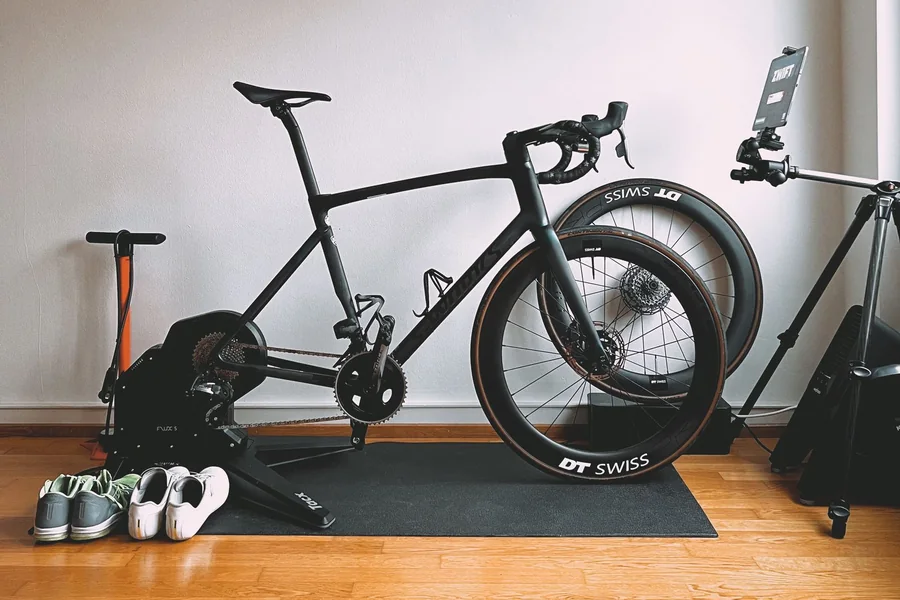
The rest of the budget goes to comfort, which is what actually determines whether you keep showing up. Two fans beat one (one at your front wheel, one at your chest). A proper trainer desk puts your screen, remote, and snacks at handlebar height; the KOM Cycling desk at $110 does what the $300 versions do. A chest-strap heart rate monitor adds a data channel every training app can use. If the household TV is negotiable, know that budget streaming sticks like a Fire Stick or Chromecast cannot run training apps themselves; the app always runs on your phone, tablet, or laptop. The cleanest paths to the big screen are an HDMI cable from a laptop, mirroring your phone to a stick or AirPlay-capable TV (works, but expect a touch of lag), or an Apple TV box at about $130, the only TV device that runs Zwift natively.
| Item | Example | Price |
|---|---|---|
| Your current bike | Or a used beater dedicated to the trainer | $0 |
| Direct-drive smart trainer | JetBlack Victory, Zwift Hub One, Kickr Core 2 | $400–$550 |
| Cassette | Skip if the trainer includes a Zwift Cog | $0–$60 |
| Fans (2) | Lasko high-velocity | $50–$100 |
| Trainer mat | Purpose-built, dampens noise too | $40–$60 |
| Trainer desk | KOM Cycling desk or a music stand | $20–$110 |
| Heart rate monitor | Chest strap, Bluetooth and ANT+ | $50–$80 |
| Display | TV via laptop HDMI or Apple TV, or tablet | $0–$150 |
| Software (annual) | Zwift or Rouvy | $129–$200 |
| Total | $690–$1,310 |
The dream cave: $2,500 and up
At this tier the trainer stops borrowing your bike. A dedicated smart bike means no setup, no drivetrain wear, and a machine the whole household can ride by adjusting a few clamps. The Zwift Ride with Kickr Core 2 at $1,300 made smart bikes almost affordable; the Wahoo Kickr Bike and Tacx Neo Bike (both around $3,500 to $4,000) add gradient simulation that physically tilts the bike beneath you. If you would rather keep riding your own bike, a flagship trainer like the Tacx Neo 3M ($1,400) with built-in motion or the Wahoo Kickr V6 paired with the Kickr Climb gradient simulator ($700) gets you the same immersion.
The rest is theater and comfort, and after month three of a long winter, theater and comfort are the difference between training and quitting. The Wahoo Kickr Headwind ($250) is a fan that reads your heart rate and blows harder as you work harder. A rocker plate (around $500) lets the bike sway naturally and saves your saddle contact points on long rides. A wall-mounted TV, an Apple TV running Zwift natively, and a proper desk complete the room. Many riders at this tier run two subscriptions: Zwift for racing and group rides, TrainerRoad for structured intervals.
| Item | Example | Price |
|---|---|---|
| Smart bike | Zwift Ride + Kickr Core 2, Kickr Bike, Neo Bike | $1,300–$4,000 |
| Or flagship trainer + extras | Tacx Neo 3M, or Kickr V6 + Kickr Climb | $1,300–$2,000 |
| Smart fan | Wahoo Kickr Headwind | $250 |
| Rocker plate | KOM Cycling RPV1 (skip with a motion trainer) | $0–$500 |
| Big screen + streamer | TV plus Apple TV | $400–$800 |
| Trainer desk | Wahoo Kickr Desk or KOM desk | $110–$300 |
| Heart rate monitor | Dual-band chest strap | $80–$100 |
| Heavy-duty mat | Full-size trainer mat | $60–$90 |
| Software (annual) | Zwift plus TrainerRoad | $200–$410 |
| Total | $2,400–$6,500 |
The software: where the pain actually lives
The trainer provides resistance; the software provides the reason to keep pedaling. Broadly, apps split into two camps: virtual worlds that make indoor riding social and game-like, and structured training platforms that treat the trainer as a precision workout tool.
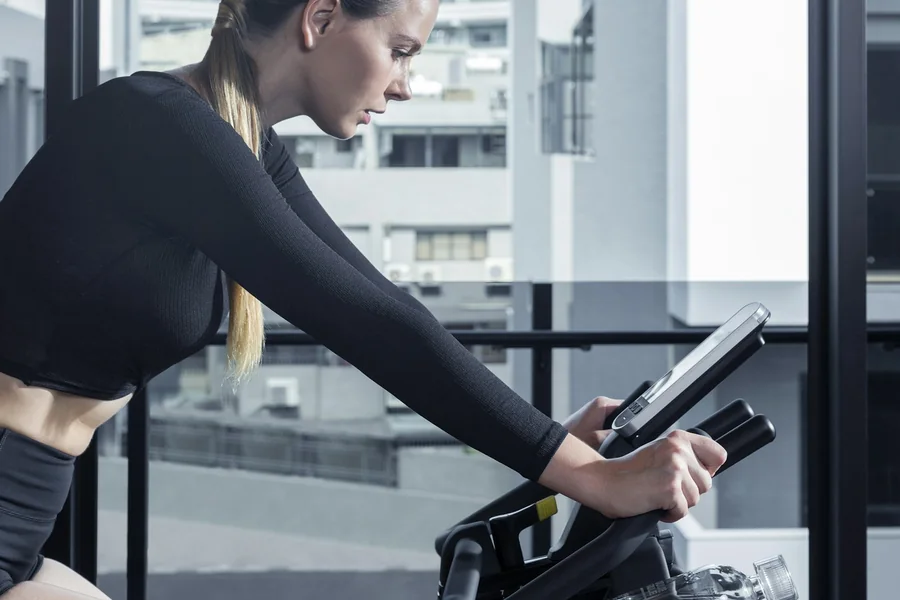
Zwift ($19.99/month or $199.99/year) remains the default. Its virtual worlds, group rides, and racing scene are unmatched, and for many riders the social pull is what gets them on the bike at 6 a.m. Rouvy ($15/month or $129/year) trades cartoon worlds for augmented video of real roads and famous climbs, and its family plan is the best value in the category. TrainerRoad ($21.99/month or $209.99/year) offers no scenery at all, just adaptive, science-driven interval training; it is the choice for riders chasing measurable fitness gains. TrainingPeaks Virtual, built from the well-regarded indieVelo platform, comes bundled with a TrainingPeaks Premium subscription ($134.99/year) and offers some of the most realistic racing physics available, plus free access every first Tuesday of the month.
If you would rather not pay at all, you have real options. MyWhoosh is a full Zwift-style virtual world, with structured workouts and paid racing series, and it is completely free. Golden Cheetah is free, open-source software beloved by data nerds: it connects to ANT+ trainers and sensors, runs ERG-mode workouts, and offers deeper performance analytics than any subscription app. And if your indoor bike is a spin bike or budget stationary bike rather than a trainer, the QZ app (qdomyos-zwift, a few dollars, built on an open-source project) can bridge many consumer exercise bikes into Zwift, Rouvy, and MyWhoosh, turning pandemic-era hardware into a functioning pain cave.
Most paid apps offer free trials of 14 to 30 days. A sensible path: start free on MyWhoosh, figure out whether virtual worlds or structured workouts motivate you, then pay for the one app that matches.
Small details that make a big difference
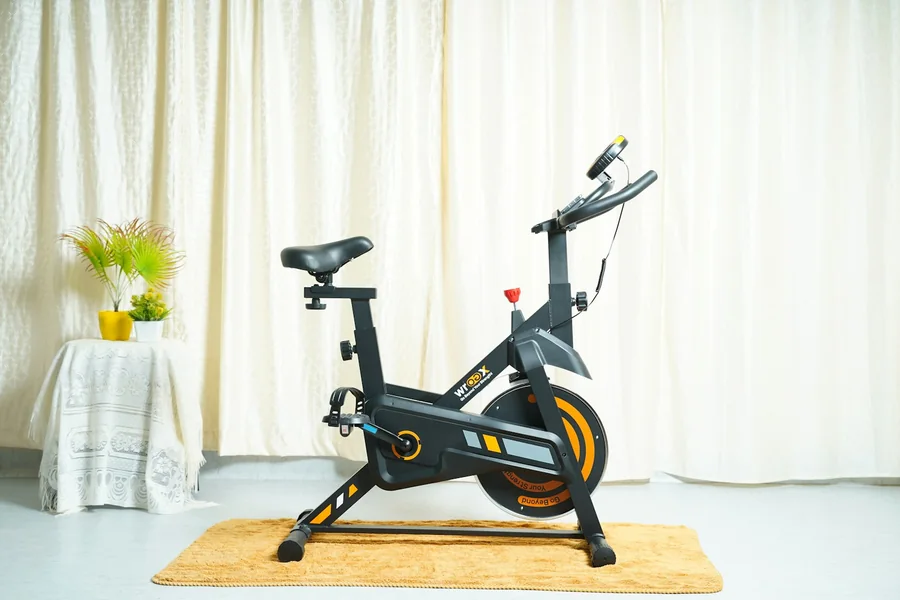
Whatever the budget, a few cheap details separate a pain cave you use from a pain cave you avoid. Airflow first: position a fan at chest height, and buy a second one before you buy anything else. Sweat management next: a towel over the bars, a headband, and a weekly wipe-down of the bike, because sweat is corrosive and trainer bikes rust from the inside out. Ventilation matters more than temperature; a cracked window beats air conditioning. If you live above someone, a thick mat plus a direct-drive trainer keeps the peace better than any apology note. And put your setup somewhere you can leave it assembled permanently, even if that spot is ugly. A pain cave in the corner of the laundry room that is always ready beats a beautiful one you have to build every time.
Frequently Asked Questions
- How much does it cost to build a pain cave?
- Anywhere from about $175 to over $6,000. A used fluid trainer, sensors, and a fan get you started for under $200; most riders eventually settle around $1,000 to $1,500 with a direct-drive smart trainer; a dedicated smart bike setup runs $2,500 and up.
- Do I need a smart trainer to use Zwift?
- No. A speed sensor on a supported non-smart trainer lets Zwift estimate your power, a feature called virtual power. A smart trainer makes the experience much better, with accurate power and resistance that follows the terrain, but it is not the price of entry.
- Is a wheel-on or direct-drive trainer better?
- Direct-drive is quieter, more accurate, and wears no tire, and it is what most riders should buy if the budget allows. Wheel-on trainers cost roughly half as much and are the sensible starting point; budget for a trainer tire.
- What is the best free indoor cycling app?
- MyWhoosh, a completely free Zwift-style virtual world with structured workouts. If you care more about data than scenery, the open-source Golden Cheetah runs workouts and offers deeper analytics than any subscription app.
- Can I use a spin bike or basic stationary bike with training apps?
- Often, yes. The QZ app bridges many consumer exercise bikes into Zwift, Rouvy, and MyWhoosh. Check its compatibility list for your model; power accuracy varies, but it turns idle pandemic-era hardware into a working pain cave.