TL;DR:
Creatine is one of the most studied, safest supplements on the shelf, and you do not need to race to benefit from it. For everyday cyclists it does two useful things: it sharpens short, hard efforts (sprints, punchy climbs, jumping on a group-ride surge), and it helps you build and hold onto muscle as you age. That second benefit matters more for ordinary riders than any race result. What it will not do is make your long, steady rides faster or raise your VO₂ max. The trade-off is a small amount of water weight, usually half a kilo to a kilo and a half. For most recreational riders, a plain creatine monohydrate at 3 to 5 grams a day is a cheap, low-risk addition. Climbers obsessed with grams, and anyone with kidney issues, should think twice.
Creatine is not an exotic chemical. It is a compound your body already makes and that you eat in meat and fish. Most of it is stored in your muscles, where it does one specific job: helping regenerate energy during short, intense efforts.
Every muscle contraction is powered by a molecule called adenosine triphosphate (ATP). When a muscle fires, it breaks off one of ATP’s three phosphate groups to release energy, leaving behind adenosine diphosphate (ADP). To keep producing force, the muscle has to reattach a phosphate and turn that ADP back into ATP, and it has to do so within fractions of a second. This is where creatine comes in. It is stored in muscle as phosphocreatine, which donates its phosphate to ADP (via the enzyme creatine kinase) to regenerate ATP almost instantly. Think of phosphocreatine as a small, fast-discharging battery that recharges your energy supply between efforts. The catch is that this store is limited: it only covers roughly 5 to 15 seconds of all-out effort before it runs low.
Supplementing tops up those stores. The International Society of Sports Nutrition (ISSN), a professional body of sports nutrition researchers, reports creatine can raise muscle phosphocreatine by around 20%. In plain terms: you can hold high power a little longer, and recover faster between hard efforts so your fifth surge feels closer to your first.
What the science says creatine does for cyclists
It helps short, hard efforts
This is where the evidence is strongest. Studies in trained cyclists consistently show creatine improves peak and repeated sprint power. A 2025 crossover trial in trained cyclists found creatine monohydrate improved sprint performance, and a classic study by Vandebuerie and colleagues (1998) showed creatine loading boosted repeated sprint power even after exhausting endurance riding. It did not, however, increase endurance capacity itself.
For an everyday rider, “sprint power” is not just about racing to a finish line. It is closing the gap to the group up the road, attacking a short steep climb without blowing up, getting back up to speed after a stop sign or light, or holding the wheel when the pace lifts. Creatine helps with exactly those repeated, punchy moments.
It does not make your steady endurance faster
Be clear-eyed about the limits. Creatine does not meaningfully improve VO₂ max, lactate threshold, or steady time-trial performance at a fixed pace. A study by Tomcik and colleagues (2018) found improved end-of-race sprint power but no improvement in overall time-trial time, partly because of the extra body mass. If your typical ride is a long, even-paced spin, creatine is not the thing that will make it faster.

The reason most everyday riders should care: muscle and aging
If you are a recreational cyclist, the most compelling case for creatine may have nothing to do with sprinting. After about age 50, most people lose muscle and strength to a process called sarcopenia. That decline quietly erodes pedaling power, balance, and how quickly you bounce back between rides.
A 2025 meta-analysis in the European Review of Aging and Physical Activity pooled 20 randomized trials and 1,093 older adults (average ages 55 to 84, and notably 69% women, a group creatine research usually ignores). The finding: adding creatine to an exercise routine produced significantly greater strength gains than exercise alone, with perfect agreement across all 20 studies. That level of consistency is rare in exercise science.
Two details make this especially relevant to cyclists. First, the strength benefit landed specifically in the legs and back (leg press and lat pulldown improved; arm and chest exercises did not). The lower body is exactly what aging hits hardest and what drives the bike. Second, the benefit showed up only in people who actually trained. Creatine without exercise did nothing. It amplifies the work; it does not replace it.
One honest boundary: the same research found no added benefit in frail or pre-frail older adults. The strong, consistent result applies to healthy, active people who ride and train, which describes most everyday cyclists reading this.
What about the weight gain?
This is the trade-off that worries cyclists most, and it is real but small. Creatine pulls water into your muscle cells, so the scale typically rises 0.5 to 1.5 kg, mostly in the first week or two. It is not fat, and it is not bloat under the skin. It is intracellular water in the muscle itself.
Here is the part that matters for riders: cycling is a non-weight-bearing sport. Unlike running, where every extra gram costs you on every stride, a little water weight has far less impact on the bike on flat or rolling terrain. The one genuine exception is sustained climbing, where power-to-weight is everything. If your goal event is a big mountain day and you are counting grams, the water weight can offset the benefit. For everyone else, it is a minor cost for a meaningful upside.
Is creatine safe? Sorting fact from fear
The most common worry, “is it bad for my kidneys?”, rests on a mix-up between two similar words. Creatine is the supplement. Creatinine is a waste marker doctors measure to check kidney function. Taking creatine can nudge your creatinine reading up without your kidneys working any harder. The marker moves, the organ does not.
The safety record backs this up. The ISSN position stand concludes creatine monohydrate is safe and well tolerated even at high intakes over years of use in healthy people. The 2025 older-adult meta-analysis found zero adverse kidney or liver events across 20 studies lasting up to two years. The only consistent side effect was mild stomach discomfort during the high-dose loading phase.
The sensible caveat: creatine is not a medical product, and this is general information, not medical advice. If you have kidney disease, take medication that affects your kidneys, or have any clinician-directed dietary restriction, talk to your doctor before starting.
How to actually take it
Buy plain creatine monohydrate
Despite flashier and pricier options (HCl, ethyl ester, “buffered” blends), creatine monohydrate is the most researched and works as well as anything. When choosing a product:
- Look for third-party testing. NSF Certified for Sport or Informed Sport means the label is accurate and it is screened for banned substances.
- Keep it plain. Ideally the only ingredient is creatine monohydrate. Skip stimulant blends and proprietary mixes.
- Micronized powder dissolves more easily and may be gentler on the stomach.
- Creapure on the label signals a high-purity source many tested brands use.
Pick a dosing approach
The simple way (recommended for most riders): take 3 to 5 grams a day, every day. It takes about 3 to 4 weeks to fully saturate your muscles, but it avoids the bloating and stomach upset that loading can cause.
The fast way (loading): take about 20 grams a day, split into four 5-gram doses, for 5 to 7 days, then drop to 3 to 5 grams daily. You saturate faster but are more likely to feel GI discomfort and see the water weight arrive quickly. There is no long-term advantage, just speed.
How to actually mix it
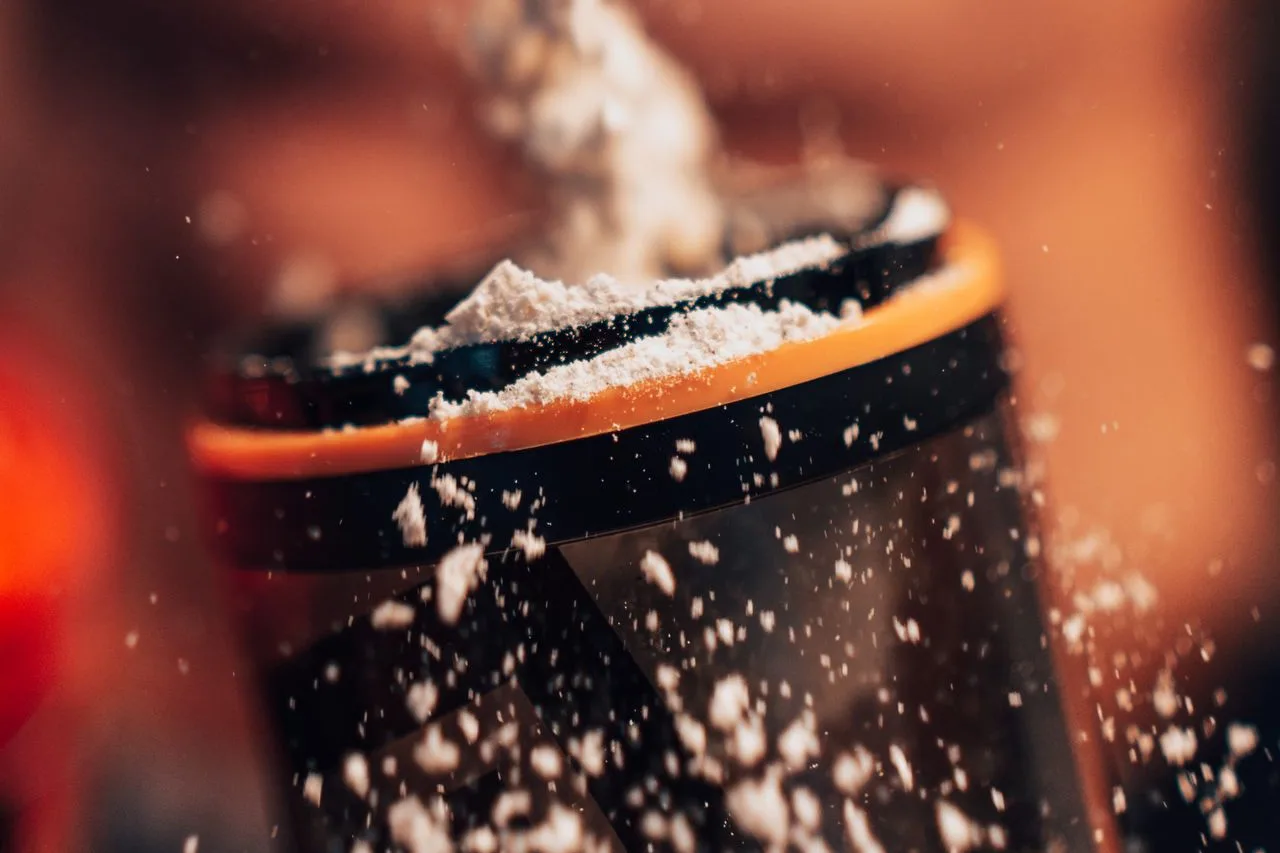
Creatine monohydrate is a tasteless powder that dissolves readily in liquid, so how you take it is mostly about convenience. The most popular options are:
- Plain water. The simplest approach. Stir 3 to 5 grams into a glass and drink it. It dissolves faster in warm or room-temperature water than in ice-cold water, and any grit left at the bottom is harmless, so top up and swirl again.
- Juice or a carbohydrate drink. A common choice because the small insulin response from carbs may help nudge creatine into muscle. The uptake benefit is modest, but it makes the powder easy to take and taste better.
- A protein or recovery shake. Convenient if you already drink one after riding, and it folds your creatine into a habit you already have.
- A smoothie, coffee, or tea. All fine. Creatine is stable in hot drinks over the time it takes to drink one, so your morning coffee works.
Timing barely matters once your stores are full. Consistency does. Stirring it into your post-ride drink or taking it with breakfast, including rest days, is the whole strategy. And remember the meta-analysis lesson: creatine works by making your training count for more, so pairing it with 2 to 3 strength sessions a week and enough protein (roughly 1.2 to 1.6 g per kg of body weight) is what unlocks most of the benefit.
So, should you take it?
Here is the quick read for everyday riders:
| Creatine probably helps you most if… | It is less of a priority if… |
|---|---|
| You are over 50 and want to hold onto strength and muscle | You are a pure climber chasing the lowest possible race weight |
| Your rides include sprints, punchy climbs, attacks, or group-ride surges | Your riding is almost entirely long, steady, flat efforts |
| You lift weights or do strength work alongside cycling | You have kidney disease or take kidney-related medication (ask your doctor first) |
| You are returning from injury and rebuilding lost muscle | You have had bad GI reactions to supplements and want to start very cautiously |
The honest verdict: for most everyday riders, creatine is worth it. If the table puts you in the left column, a sensible starting point is plain creatine monohydrate at 3 to 5 grams a day, taken consistently and paired with a couple of strength sessions a week. If you land in the right column, especially a weight-focused climber or anyone with kidney concerns, you can skip it without missing much. Either way, treat it as a small, reliable helper, not a shortcut around the training that actually makes you a stronger rider.
Frequently Asked Questions
- Can I skip the loading phase?
- Yes. Taking 3 to 5 grams a day reaches full muscle saturation in about 3 to 4 weeks, the same endpoint that loading reaches faster. For most recreational riders the daily approach is the easier choice, because it avoids the bloating and stomach upset that a high-dose loading phase (around 20 grams a day for 5 to 7 days) can cause. Loading only buys you speed, not a bigger long-term effect.
- How much weight does creatine add for a cyclist?
- The change is small, and it is not fat. Creatine pulls water into your muscle cells, so the scale typically rises 0.5 to 1.5 kg, mostly in the first week or two. Because cycling is non-weight-bearing, that water weight has far less impact on flat or rolling terrain than it would in a sport like running. The one real trade-off is sustained climbing, where power-to-weight is everything, so a gram-counting climber on a big mountain day may want to weigh the cost against the benefit.
- Is creatine safe for healthy kidneys?
- In healthy people, the evidence points to yes. Long-term studies show no adverse kidney or liver effects at recommended doses, and the only consistent side effect is mild stomach discomfort during high-dose loading. Much of the worry comes from confusing creatine, the supplement, with creatinine, a waste marker doctors measure to check kidney function. Taking creatine can nudge that marker up without your kidneys working any harder. The sensible caveat: if you have kidney disease or take medication that affects your kidneys, talk to your doctor before starting.
- When should I take creatine, and do I need it on rest days?
- Take it whenever you will remember, such as with breakfast or stirred into your post-ride drink. Once your muscles are saturated, timing barely matters, so consistency is what counts. Yes, take it on rest days too, because the goal is keeping your muscle stores topped up and a daily habit is what does that. Pairing it with two to three strength sessions a week and enough protein is what unlocks most of the benefit.
- Which type of creatine should I buy?
- Plain creatine monohydrate. It is the most researched form and works as well as pricier options like HCl, ethyl ester, or buffered blends. Look for a single-ingredient product that is third-party tested, such as NSF Certified for Sport or Informed Sport, so the label is accurate and screened for banned substances. Micronized powder dissolves more easily and may be gentler on the stomach, and Creapure on the label signals a high-purity source.