TL;DR:
Every rider knows the feeling of a winter wasted. You bought the trainer, signed up for the app, rode a few group rides and a race or two, and in March you were roughly where you were in November: a little fitter in some vague way, not any better at the thing that drops you in July. For road riders that is usually the long climb or the final sprint. For mountain bikers it is the string of punchy climbs that starts to hurt 40 minutes in. Whatever the weakness, “riding a lot on Zwift” does not fix it by itself. Specific work does.
- Winter on the trainer is the one time of year you control every variable: no wind, no traffic, no coasting. Use it to attack a specific weakness rather than riding “generally hard.”
- Build base with long steady rides at 60% to 75% of FTP, and lean on sweet spot (88% to 94%) if you ride fewer than 8 hours a week.
- Raise VO2 max with two proven formats: Norwegian 4x4-style long intervals, and 30-second-on, 15-second-off short intervals, which beat 4x5 minute efforts in a 10-week study of trained cyclists.
- Become a better climber with low-cadence torque intervals, over-unders at threshold, and full-length virtual climbs ridden in simulation mode, not ERG.
- Become a better sprinter with short neuromuscular efforts done fresh, in simulation mode, with full recovery; five weeks of 30-second all-out sprints raised power at the second ventilatory threshold by 11% in one 2026 study.
- Two hard sessions a week is the ceiling for most riders. Everything else is easy, and the easy days are where the adaptation happens.
Indoor training is unusually good at specific work. Outside, a 5-minute interval becomes 4 minutes and 20 seconds because of a stop sign. A low-cadence climb turns into a high-cadence descent. A sprint gets cut short by a car. On a trainer, the resistance does exactly what you tell it to, you never coast, and the data is clean enough to see whether you improved. We put together a guide to building the room itself, from a $200 fluid-trainer setup to a full smart bike; this article is about what to do once you are in it. Each section below targets one weakness with specific drills, the settings to run them in, and how to progress them across a winter.
Set up the week before you set up the workouts
Roughly 80% of your riding time should be easy enough to hold a conversation, and the remaining 20% should be hard. Well-trained endurance athletes who followed that split for 9 weeks in a 2014 Salzburg study raised VO2 peak by nearly 12% and peak power by 5%, more than groups that trained mostly at threshold, mostly at high intensity, or mostly at high volume. The trap indoors is that every ride drifts toward the middle because the virtual road always has a group to chase. Decide before you clip in which kind of ride it is.
Hard means two sessions a week, maybe three in a short block, never more. The drills below are interchangeable in those two slots. Base work fills the rest of the week.
Set your zones from a current FTP test, not last August’s number. A 20-minute test (95% of the average) or the ramp test built into most apps both work; the ramp test is less painful and good enough for setting zones. Retest every six weeks. Heart rate drifts upward indoors because you run hot, so power is the better guide for the hard work and perceived effort is a fine backup for the easy rides.
A word on cooling, because it changes the numbers. Without a strong fan your core temperature climbs, your heart rate rises 10 to 15 beats for the same power, and your 20-minute power can drop 5% to 10%. Two fans, one at your chest and one at your face, are not a luxury for interval work. They are part of the protocol.
Weakness 1: You fade after 90 minutes
The fix is base: long rides at low intensity that build mitochondria, capillaries, and the fat-burning machinery that lets you save carbohydrate for when the race gets hard. There is no shortcut, but there are smart ways to spend the time.
The drill: the steady long ride. Ride at 60% to 75% of FTP (Zone 2 for most riders) for as long as you can tolerate, starting at 90 minutes and adding 15 minutes a week until you reach 2.5 to 3 hours. Keep the power flat. The whole point is to avoid the surges that an outdoor group ride forces on you. Indoors, a 2-hour ride at a steady 200 watts builds more base than a 2-hour group ride that averages 200 watts with 50 spikes to 400.
How to run it. Use ERG mode. Pick a route with a long flat or rolling profile, or skip the route and ride a flat “free ride” workout where the trainer holds the number for you. Fuel it: 60 grams of carbohydrate an hour from the first hour, because indoors you sweat out more and cannot stop at a gas station. Pedal at your natural cadence, then spend 10 minutes of every hour at 10 rpm above it; the trainer is the easiest place on earth to rehearse a smoother, faster pedal stroke, and it transfers.
Making it tolerable. The reason most riders never build base indoors is boredom, not physiology. Group rides on Zwift or MyWhoosh at the Zone 2 pace band solve it if you have the discipline to let the group go when it surges. Rouvy’s real-road videos of long valley roads are the best long-ride scenery in the category. Many riders split the long ride into two sessions, morning and evening, on the same day; the research on whether this matches a single long ride is thin, but two 90-minute rides beat one 90-minute ride you skipped.

If you have less than 8 hours a week: sweet spot. Riding at 88% to 94% of FTP for 2x20 minutes, building to 3x20 and then 2x30, gives a time-crunched rider much of the aerobic stimulus of a long ride in a third of the time. It is not a full substitute, and it fatigues you more than Zone 2, so count a sweet spot session as one of your two hard days when it goes past 40 minutes of work. For a complete plan built around 4 to 6 hours a week, we have a guide to building cycling fitness on limited time.
Progression over 12 weeks. Weeks 1 to 4: one long ride of 90 to 120 minutes plus two sweet spot sessions. Weeks 5 to 8: long ride to 2.5 hours, one sweet spot session, one of the VO2 max sessions below. Weeks 9 to 12: hold the long ride, drop sweet spot, and run two of the specific sessions from whichever weakness you picked.
Weakness 2: Your ceiling is too low
VO2 max is the size of your engine. Threshold, the power you can hold for an hour, lives at some percentage of VO2 max, so when VO2 max goes up, everything below it has room to rise. It responds to a specific stimulus: time spent near maximal oxygen uptake, which in practice means time above roughly 90% of your maximum heart rate or at 106% to 120% of FTP. Two formats get you there, and the trainer is the ideal place for both because the effort never gets interrupted.
Drill A: the long-interval format. Four efforts of 4 to 8 minutes at the hardest pace you can hold evenly across all four, with recovery of half the work time between them. The classic is the Norwegian 4x4, four 4-minute efforts at 90% to 95% of max heart rate with 3 minutes easy; we wrote a full guide to the Norwegian 4x4. When Stephen Seiler’s group at the University of Agder compared 4x4, 4x8, and 4x16 minute intervals over 7 weeks in trained cyclists, the 4x8 group, riding at roughly 90% of max heart rate, made the biggest gains in peak power and VO2 max, bigger than the all-out 4x4 group. On the trainer, slightly longer and slightly less than all-out beats shorter and brutal.
Run this in ERG mode so the trainer forces the power and you cannot fade. Set the target at 106% to 112% of FTP for 8-minute efforts, 115% to 120% for 4-minute efforts. If you cannot finish the third interval within 5% of the first two, the target is too high; drop it 5 watts next session rather than quitting.
Drill B: the 30/15 format. Three sets of thirteen 30-second efforts at about 118% to 125% of FTP with 15 seconds easy between each, and 3 minutes easy between sets. That is 19.5 minutes of work in a 35-minute session. Bent Rønnestad and colleagues at Lillehammer compared this format against 4x5 minutes in trained cyclists over 10 weeks, with the same perceived effort in both groups. The short-interval group improved VO2 max by 8.7% against 2.6% for the long-interval group, raised power at 4 mmol lactate by 12% against 5%, and improved 40-minute time trial power by 12% against 4%. The explanation is that the 15-second rests are too short for oxygen uptake to fall, so you accumulate more total time near VO2 max than you can in longer efforts, at a lower perceived cost.
Run it in ERG mode. Zwift has a 30/15 workout under its “VO2 max” category and TrainerRoad has several. MyWhoosh does not have one built in, so we built it: download our 30/15 workout file and import it into your MyWhoosh account through the custom workout builder; the same file also loads into Zwift. Keep your cadence high, 95 rpm or above, so the trainer’s resistance changes do not stall you at the top of each effort. If your trainer is slow to ramp (common with wheel-on units), build your own version with 40-second efforts and 20-second rests; the ratio is what counts.
Which one, and how often. Alternate them. Run Drill A one hard day and Drill B the other for a 4-week block, then take an easy week with one short session. A second 4-week block in January and February is as much VO2 max work as most riders can absorb in a winter. Both drills work for mountain bikers and road riders equally; a cross-country race is a VO2 max event wearing a different helmet.
Weakness 3: You get dropped on climbs
Climbing comes down to sustained power per kilogram, and the winter trainer is where you build the numerator. We cover the physiology, including why weight loss alone rarely works, in our guide to becoming a better climber. These are the drills.

Drill A: torque intervals. Five to six efforts of 5 minutes at 85% to 95% of FTP, pedaling at 50 to 60 rpm, with 3 to 5 minutes easy between them. The low cadence raises the force per pedal stroke to something closer to what a 10% grade demands, and it recruits more of the larger fast-twitch fibers that your usual 90 rpm leaves idle. Austrian researchers in 2012 had trained cyclists perform 5-minute intervals at either 60 rpm uphill or 100 rpm on the flat for 4 weeks; the low-cadence group improved uphill time-trial power while the high-cadence group improved on the flat, a clean demonstration that specificity applies to cadence as well as duration.
Run this in simulation mode on a real climb, with the trainer difficulty set to 100%, or in ERG mode in a big gear. Stay seated. Keep your upper body still and push through the bottom of the stroke rather than stomping. If your knees complain, raise the cadence to 65 rpm and drop the power; this drill is about force, not pain. Riders with a history of knee issues should skip it in favor of Drill B.
Drill B: over-unders. Three sets of 10 to 12 minutes alternating 2 minutes at 95% of FTP with 1 minute at 105% to 110%, with 5 minutes easy between sets. The “over” portions flood your legs with lactate and the “under” portions teach you to clear it while still working hard, which is exactly what happens every time a climb steepens and then eases. Progress by lengthening the overs to 90 seconds, then by adding a fourth set. ERG mode is fine here; the point is the metabolic swing, not the terrain.
Drill C: the full climb. Once every 10 to 14 days, ride a complete virtual climb at the hardest even pace you can hold, in simulation mode. Alpe du Zwift takes most riders 45 to 75 minutes and has 21 numbered switchbacks that make pacing easy to judge; Rouvy’s library includes video of real climbs in the US and Europe if you prefer scenery that looks like the thing you are training for. Set trainer difficulty to at least 50% so the gradient changes force you to shift and change position the way a real climb does. The first ascent is your benchmark. Repeat it in week 6 and week 12. Mountain bikers can run the same session on shorter, steeper segments; a 20-minute pitch repeated twice mimics a long fire-road climb better than one hour-long alpine profile.
The off-bike piece. Heavy squats, deadlifts, and step-ups twice a week in winter raise the force you can produce at low cadence, and they are the cheapest watts available. Our guide to weight training for cyclists has the program; the short version is 3 to 5 sets of 4 to 6 reps, heavy, with the lifting session 6 or more hours away from the hard ride.
Weakness 4: You lose every sprint
Sprinting is neuromuscular first and aerobic second. The drills that build it look nothing like the ones above: they are short, rare, and done fresh. Doing them tired, at the end of a 2-hour ride, trains fatigue resistance but not peak power, and most riders already have plenty of the former.
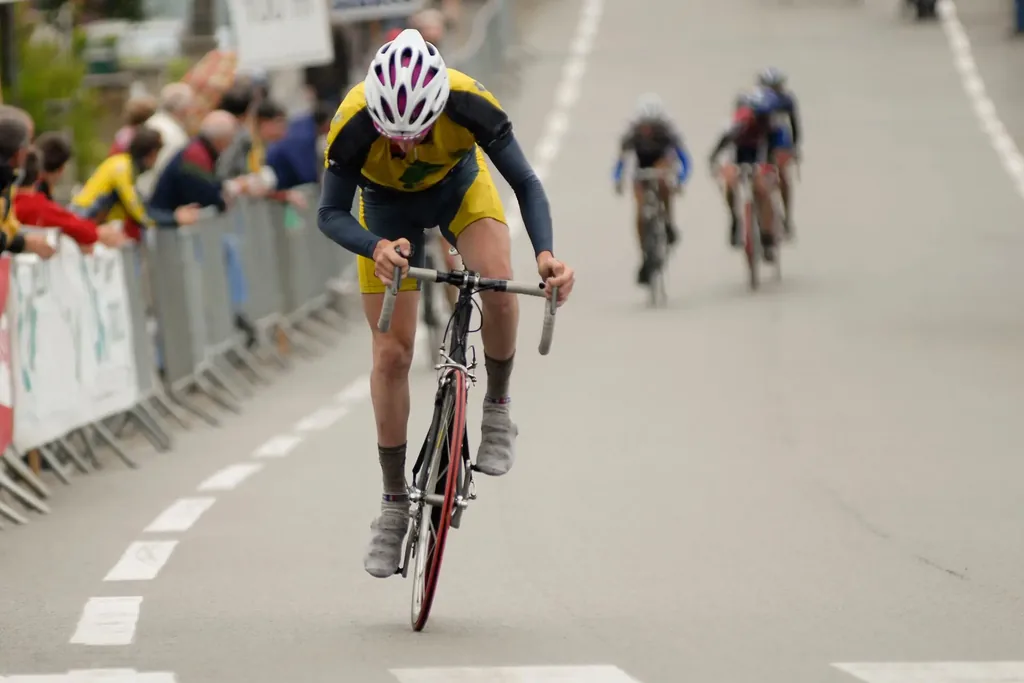
Drill A: standing-start sprints. From a near stop at 50 rpm in a big gear, sprint all-out for 10 to 12 seconds, then recover for a full 5 minutes. Six to eight of these. The low starting cadence forces maximal torque, and the short duration keeps you in the phosphocreatine system where peak power lives. Do these first in the session, after a 20-minute warm-up, never after intervals.
Drill B: high-cadence sprints. From a rolling 95 rpm, sprint for 8 to 10 seconds with the goal of hitting 130 rpm or more without bouncing in the saddle. Four to six of these with 4 minutes between. Where Drill A builds force, this builds leg speed, and a good sprinter needs both; the fastest riders peak at 120 to 130 rpm.
Drill C: 30-second all-out efforts. Four to six 30-second efforts at the hardest power you can produce, with 4 minutes of easy spinning between. A 2026 study from Brazilian and Canadian researchers had recreational riders perform exactly this, 4 to 6 Wingate-style sprints twice a week for 5 weeks, and found power at the respiratory compensation point rose 11% with no change in the control group. The researchers suggested the gains came from more efficient muscle activation rather than bigger muscles. This drill doubles as a VO2 max session, so count it as one of your two hard days.
How to run them. Switch to simulation mode, with trainer difficulty at 50% to 100%, so you can shift through gears as you accelerate; ERG mode fights a sprint and will stall you. Use a sprint segment in the app, or just a flat stretch. Sprinting out of the saddle on a rigid trainer is hard on the frame and the trainer and feels unnatural; a rocker plate fixes that, and if you do not have one, do Drills A and B seated and save the standing sprints for Drill C, where you can get up for the first 5 seconds then sit. Most direct-drive trainers handle 1,500 to 2,000 watts without complaint, but check the rating on a wheel-on unit, which can slip under a hard seated sprint. Tighten the roller before every sprint session.
Progression. Two sprint sessions a week in a 3-week block, then one a week to maintain. Track peak 5-second and 15-second power in your app; those numbers, not your FTP, are the sprint scorecard. We also have a guide to building explosive cycling power with more on the strength-training side.
For mountain bikers: repeatability. Trail riding rarely asks for one sprint. It asks for thirty 20-second surges over a two-hour race. The drill is 40 seconds on at 120% of FTP, 20 seconds off, repeated ten times, with 5 minutes easy, then repeated for a second and third set. It builds the ability to recover from a surge while still riding hard, which is the difference between staying on the wheel through the fifth punchy climb and watching it ride away. Run it in ERG mode.
ERG mode or simulation mode
ERG mode, where the trainer holds a target wattage regardless of cadence, is the right choice for anything with a fixed power target: base rides, sweet spot, over-unders, 30/15s, and long VO2 max intervals. It removes the temptation to fade and gives you clean data.
Simulation mode, where the trainer reproduces the gradient of the virtual road and you choose the gear, is the right choice for anything that needs to transfer to the road: sprints, full climbs, and torque intervals if you want the feel of a real hill. Set trainer difficulty to at least 50% for these; the default of 50% halves every gradient, so a 10% climb feels like 5%, which defeats the purpose of climbing practice. Racing in the app is always simulation mode, and it is a fine substitute for a VO2 max session once every week or two, as long as you do not let it become a third hard day.
One trap in ERG mode: the “spiral of death.” If your cadence drops during a hard interval, the trainer raises resistance to hold the power, which drops your cadence further until you grind to a stop. Keep cadence steady, and if you feel it going, shift to an easier gear or pause the workout rather than fighting it.
A sample winter
This is how the pieces fit for a rider with 7 to 8 hours a week who wants to climb better by spring. Swap the specific sessions in weeks 9 to 16 for the sprint or VO2 max drills if that is your weakness instead.
Weeks 1 to 4 (base). Tuesday: sweet spot 2x20. Thursday: sweet spot 3x15. Saturday: long Zone 2 ride, 90 minutes building to 2 hours. Sunday: 60 minutes easy, high cadence. Two lifting sessions.
Weeks 5 to 8 (base plus VO2 max). Tuesday: 30/15s, 3 sets. Thursday: 4x8 minutes. Saturday: long ride, 2 to 2.5 hours. Sunday: 60 minutes easy. Two lifting sessions. Week 8 is an easy week with one short session.
Weeks 9 to 12 (specific). Tuesday: torque intervals, 5x5 minutes. Thursday: over-unders, 3 sets. Saturday: long ride, 2.5 hours, with the full climb benchmark in week 12. Sunday: 60 minutes easy. One lifting session.
Weeks 13 to 16 (specific, sharpening). Tuesday: over-unders, 4 sets. Thursday: 4x8 at the top of the range, or a race. Saturday: long ride with the last 30 minutes at sweet spot. Sunday: easy. One lifting session. Week 16 is an easy week before the first outdoor rides.
Eight hard sessions in a block of four weeks is enough. If you find yourself adding a third one because the app makes it easy, read our piece on overtraining syndrome before you do.
Training recommendations in this article are general guidance and not a substitute for advice from a coach or physician. Policy terms, conditions, and exclusions apply to any insurance product mentioned; this article is not insurance or legal advice.
Frequently Asked Questions
- Can I do all of this without a smart trainer?
- Mostly. A fluid trainer with a heart rate monitor handles base rides, sweet spot, and long VO2 max intervals by heart rate and perceived effort. What you lose is ERG mode, which makes the 30/15s and over-unders much harder to execute precisely, and accurate power for tracking sprints. Virtual power from a speed sensor is close enough for pacing but too noisy to measure a 5-second peak.
- Why is my power lower indoors than outside?
- Heat, mostly. Without airflow your core temperature climbs and your heart rate rises for the same wattage, which costs most riders 5% to 10% of their 20-minute power. A fixed bike also removes the small side-to-side movement that lets you recruit your upper body outdoors. Two strong fans and a rocker plate close most of the gap. Set your FTP from an indoor test if you train indoors, rather than importing an outdoor number.
- How many hard sessions a week?
- Two. Three in a short block if you are experienced and recovering well. The easy rides are not filler; they are where the adaptations from the hard days get built.
- Should I do intervals in ERG or simulation mode?
- ERG for fixed-power work (base, sweet spot, over-unders, 30/15s, long VO2 max efforts). Simulation for anything that should feel like the road (sprints, full climbs, racing). Set trainer difficulty to at least 50% in simulation mode for climbing work.
- Do I still need to lift if I am doing torque intervals?
- Yes. Torque intervals train force at a cycling-specific cadence; heavy lifting raises the maximum force your legs can produce, which is the ceiling the torque intervals work under. Two sessions a week in winter, dropping to one as the riding gets harder.