TL;DR:
A gear ratio is chainring teeth divided by cog teeth. A ratio of 1.0 (such as 34 × 34) is the benchmark climbing gear; aim for 0.8 or lower for very steep or loaded riding.
- Range (highest ratio ÷ lowest) tells you what terrain a drivetrain covers; step size between cogs tells you how smoothly it covers it. Check both before buying.
- 2x drivetrains give tight steps for road riding, 1x gives simplicity and huge range for gravel and mountain, internal hubs and gearboxes trade some efficiency for near-zero maintenance.
- Crank length barely affects power but strongly affects comfort and fit. Shorter cranks spare your knees and hips, and slightly reduce leverage, so gear down one cog to compensate.
- Your drivetrain wears out every few thousand miles. Each replacement is a cheap chance to re-gear the bike for your terrain and fitness instead of copying the stock spec.
A practical guide to gear ratios, drivetrain designs, and crank length
If you have ever ground up a hill in a gear that felt like a leg press, or spun out on a descent wishing for one more click, you have already met the subject of this article. Every bicycle drivetrain solves the same problem: your legs produce their best power over a narrow band of pedaling speeds, while the road demands everything from crawling up a 15 percent grade to descending at 40 mph. Gears are the translator between the two. Understanding how they work, how the numbers are calculated, and how components like crank length fit into the picture will help you choose a bike, upgrade the one you have, and ride farther with less strain on your knees.
Here is the good news up front: unlike frame geometry or wheel size, gearing is not fixed at purchase. Your drivetrain is a consumable, and every time part of it wears out you get a fresh chance to tune the bike to the rider you actually are. We will come back to that, because it may be the most overlooked upgrade in cycling.
How Gear Ratios Are Calculated
The starting point is simple division. A gear ratio is the number of teeth on the front chainring divided by the number of teeth on the rear cog. Pedal a 50-tooth chainring with a 25-tooth cog and the ratio is 2.0, meaning the rear wheel turns twice for every full revolution of the cranks. A 34-tooth ring paired with a 34-tooth cog gives a ratio of 1.0, a full wheel turn per pedal stroke, which is widely considered the benchmark for a proper climbing gear on a road bike.
The ratio alone does not tell you how far the bike travels, because that also depends on wheel size. A 2.0 ratio moves a 29er mountain bike farther per pedal stroke than a 20-inch folding bike. Cyclists have developed three standard ways to express gearing that account for this:
- Gear inches multiply the ratio by the drive wheel diameter in inches. The number dates to the penny-farthing era, when it described the equivalent size of a direct-drive front wheel. It remains the most common comparison figure in the English-speaking world. A typical road bike spans roughly 27 gear inches in its lowest gear to about 120 in its highest.
- Development (meters) multiplies the ratio by the wheel circumference in meters, giving the actual distance traveled per crank revolution. Common in Europe and used to regulate junior racing gears.
- Gain ratio divides the wheel radius by the crank length, then multiplies by the gear ratio. Devised by the late bicycle mechanic and writer Sheldon Brown, it is the only measure that accounts for crank length, and it expresses true mechanical leverage: how far the bike travels for every unit of distance your foot travels around the pedal circle.
Here is a single gear, a 50-tooth chainring with a 14-tooth cog on a 700c wheel with a 28 mm tire, expressed all four ways:
| Measure | Formula | Value (50 × 14) | What it tells you |
|---|---|---|---|
| Gear ratio | chainring teeth ÷ cog teeth | 3.57 | Wheel revolutions per crank revolution |
| Gear inches | wheel diameter (in) × ratio | 95.3 in | Classic comparison number; higher = harder |
| Development | wheel circumference (m) × ratio | 7.61 m | Distance traveled per pedal revolution |
| Gain ratio | (wheel radius ÷ crank length) × ratio | 7.12 | Only measure that includes crank length (170 mm here) |
Table 1. Four ways to express the same gear. Wheel: 700c × 28 mm (678 mm diameter). All values in this article use this wheel size.
As rough rules of thumb: gears below 30 gear inches are for steep climbing (below 20 for loaded touring), 60 to 80 gear inches covers everyday cruising, and anything above 110 is for sprints and fast descents.
Gear Inches Reference Chart
The chart below covers the chainrings and cogs found on most modern road, gravel, and mountain drivetrains. Find your chainring in the left column and your cog across the top. To adjust for a different wheel: values scale directly with diameter. A 650b × 47 mm gravel wheel has almost exactly the same diameter, so the chart applies as-is; a 29er wheel with a 2.4-inch tire reads about 9 percent higher, and a classic 26-inch mountain wheel about 3 percent lower.
| Ring \ Cog | 10 | 11 | 13 | 15 | 17 | 21 | 25 | 30 | 36 | 44 | 52 |
|---|---|---|---|---|---|---|---|---|---|---|---|
| 30T | 80 | 73 | 62 | 53 | 47 | 38 | 32 | 27 | 22 | 18 | 15 |
| 34T | 91 | 83 | 70 | 61 | 53 | 43 | 36 | 30 | 25 | 21 | 17 |
| 36T | 96 | 87 | 74 | 64 | 57 | 46 | 38 | 32 | 27 | 22 | 18 |
| 40T | 107 | 97 | 82 | 71 | 63 | 51 | 43 | 36 | 30 | 24 | 21 |
| 42T | 112 | 102 | 86 | 75 | 66 | 53 | 45 | 37 | 31 | 25 | 22 |
| 46T | 123 | 112 | 94 | 82 | 72 | 58 | 49 | 41 | 34 | 28 | 24 |
| 50T | 133 | 121 | 103 | 89 | 79 | 64 | 53 | 44 | 37 | 30 | 26 |
| 52T | 139 | 126 | 107 | 93 | 82 | 66 | 56 | 46 | 39 | 32 | 27 |
Table 2. Gear inches for common chainring and cog combinations, 700c × 28 mm wheel. Values rounded to the nearest inch.
Drivetrain Designs
2x: The Road Standard
Two chainrings and a cassette of 10 to 13 cogs remain the dominant road design because the double ring multiplies the cassette's range while keeping the steps between gears small, usually one or two teeth. Small steps let you hold cadence within a few rpm at any speed. The main variants are named for chainring size: standard (53/39), mid-compact (52/36), compact (50/34), and subcompact (48/32 or 46/30). Over the past decade the industry has moved steadily toward smaller rings and wider cassettes. SRAM's AXS road groups took this furthest, pairing smaller rings such as 48/35 and 46/33 with cassettes that start at a 10-tooth cog, which preserves the top end while lowering everything else. The design's weaknesses are front shifting, which is slower and less reliable than rear shifting, and gear overlap, since several ring-and-cog combinations duplicate one another.
1x: Simplicity and Security
Single-chainring drivetrains dropped the front derailleur entirely and now rule mountain biking and much of gravel. A typical mountain setup pairs a 30 to 34-tooth ring with a 10-51 or 10-52 cassette, about 510 to 520 percent range, which is more than a compact road double. The benefits are real: nothing to cross-chain, fewer parts to adjust or break, better chain retention over rough ground, and less weight. The cost is step size. Spreading 12 cogs across that range forces jumps of 13 to 38 percent between some gears, where a road double's steps are mostly 7 to 10 percent. On a trail this rarely matters; in a fast paceline it can leave you stuck between a gear that is too easy and one that is too hard. Gravel-specific 1x systems such as SRAM's 13-speed XPLR (10-46, 460 percent) split the difference with tighter spacing.
3x: The Range King in Retirement
Triple cranksets (typically 48/36/26) once ruled touring bikes and entry-level hybrids, and they still offer the most total range of any derailleur system, well over 550 percent, with small steps. They persist on expedition touring bikes for good reason: a 26-tooth granny ring with a 34-tooth cog gives about 20 gear inches, low enough to climb a mountain pass with 40 pounds of luggage. Everywhere else the extra weight, redundancy, and fussy front shifting have retired them.
Internal Gear Hubs and Gearboxes
Not all gearing lives outside the frame. Internal gear hubs put a planetary gearset inside the rear hub: Shimano's 8-speed Alfine spans 307 percent and the 11-speed version 409 percent, while the benchmark Rohloff Speedhub packs 14 evenly spaced gears across 526 percent. Gearbox systems such as Pinion move the gears to the bottom bracket, offering up to 18 speeds and more than 600 percent range with the weight centered low on the frame. Both designs shift at a standstill, tolerate weather and neglect, and pair beautifully with clean, greaseless belt drives. The trade-offs are weight, price, and a few percent of drivetrain efficiency (a well-maintained derailleur drivetrain runs around 95 to 98 percent efficient; internal systems average roughly 90 to 95 percent). For commuters and world tourers, that trade is often worth making.
| Drivetrain | Range | Low–high (gear inches) | Best suited for |
|---|---|---|---|
| 2x road, compact (50/34, 11-34) | 455% | 27 – 121 | Road riding of all kinds; the modern default |
| 2x road, mid-compact (52/36, 11-30) | 394% | 32 – 126 | Fast group rides, racing, rolling terrain |
| 2x gravel, subcompact (48/32, 11-36) | 491% | 24 – 116 | Gravel, loaded riding, steep climbs |
| 1x gravel (40T, 10-44) | 440% | 24 – 107 | Gravel and adventure; simple and quiet |
| 1x mountain (32T, 10-52) | 520% | 16 – 85 | Mountain biking; huge low range |
| 3x touring (48/36/26, 11-34) | 571% | 20 – 116 | Loaded touring; widest range, some overlap |
| Internal hub, 8-speed (Alfine 8) | 307% | varies | Commuting; shift at a standstill, low upkeep |
| Internal hub, 14-speed (Rohloff) | 526% | varies | Touring and commuting; near-zero maintenance |
| Gearbox (Pinion, up to 18-speed) | 600%+ | varies | Expedition bikes; sealed, belt-drive friendly |
| Singlespeed / fixed | n/a (one gear) | one gear, often 65–70 | Flat urban riding; simplicity above all |
Table 3. Common drivetrain designs compared. Gear inches assume a 700c × 28 mm wheel; hub and gearbox figures vary with the chainring and sprocket fitted.
Range and Steps: The Two Numbers That Define a Cassette
Manufacturers describe gearing range as a percentage: the hardest ratio divided by the easiest. A 10-52 cassette has a 520 percent range because 52 divided by 10 is 5.2. For a full drivetrain, divide the highest ratio (big ring, smallest cog) by the lowest (small ring, biggest cog). A compact 50/34 with an 11-34 cassette works out to about 455 percent.
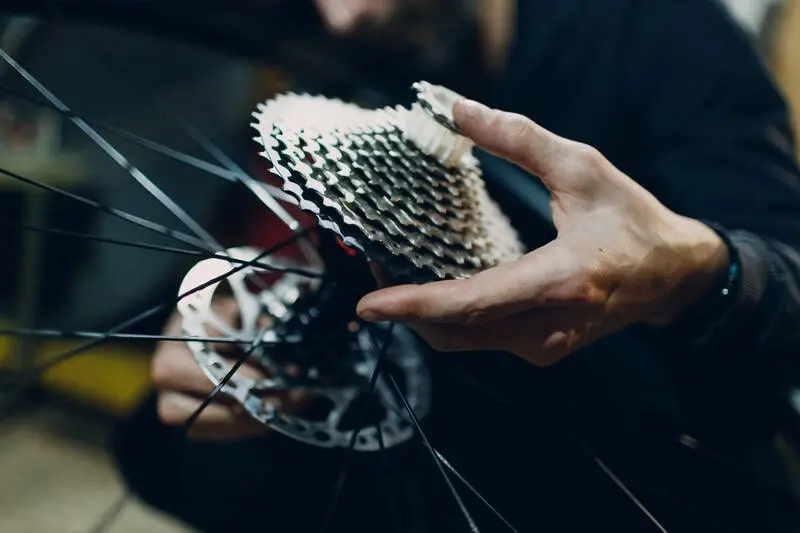
Range tells only half the story, and it is the half the marketing focuses on. The other half is step size, the percentage jump between adjacent cogs, because every shift forces a matching change in cadence or speed. A shift from a 15 to a 17-tooth cog is a 13 percent jump; at a steady 20 mph that means your cadence changes by about 11 rpm. Racers prize tight one-tooth steps in the middle of the cassette, while trail riders happily accept big jumps in exchange for range. When comparing bikes, look at both numbers.
| Cassette | Typical use | Range |
|---|---|---|
| 11-28 | road | 255% |
| 11-30 | road | 273% |
| 11-34 | road / endurance | 309% |
| 10-36 | road / gravel (SRAM AXS) | 360% |
| 10-44 | gravel 1x | 440% |
| 10-46 | gravel 1x (XPLR) | 460% |
| 10-51 | mountain (Shimano) | 510% |
| 10-52 | mountain (SRAM Eagle) | 520% |
Table 4. Common cassettes and their range.
Gearing, Cadence, and Speed
Your speed is fully determined by three things: the gear, the wheel size, and your cadence. The relationship is linear, so a speed table makes gearing tangible. Most riders are efficient between roughly 80 and 95 rpm; below about 60 rpm the pedal stroke turns into a series of strength efforts that load the knees.
| Gear | Gear inches | 60 rpm | 80 rpm | 90 rpm | 100 rpm |
|---|---|---|---|---|---|
| 34 × 34 | 27 | 4.8 | 6.4 | 7.1 | 7.9 |
| 34 × 28 | 32 | 5.8 | 7.7 | 8.7 | 9.6 |
| 34 × 21 | 43 | 7.7 | 10.3 | 11.6 | 12.9 |
| 50 × 17 | 79 | 14.0 | 18.7 | 21.0 | 23.4 |
| 50 × 13 | 103 | 18.3 | 24.4 | 27.5 | 30.5 |
| 50 × 11 | 121 | 21.7 | 28.9 | 32.5 | 36.1 |
Table 5. Speed in mph at various cadences, 700c × 28 mm wheel.
The table shows why low gears matter more than most buyers realize. In a 34 × 28, holding even 6 mph on a steep grade requires around 60 rpm. If the hill or the load slows you to 4 mph, cadence collapses to about 40 rpm and the ride becomes a leg press. This is why experienced riders push for a 1:1 ratio or lower on hilly terrain, and why loaded tourers aim for a bottom gear near 20 gear inches. Nobody regrets having a gear they rarely use; plenty of riders regret not having it. To run these numbers for your own bike, cadence, and wheel size, free tools such as the BikeCalc speed-at-cadence calculator or Sheldon Brown's gear calculator do all the arithmetic for you.
The Role of Crank Length
Cranks are levers, which makes them part of your gearing whether you think of them that way or not. A longer crank moves your foot through a bigger circle, giving more leverage over the same gear, which is exactly what the gain ratio captures. Swapping 175 mm cranks for 165 mm cranks makes every gear on the bike effectively about 6 percent harder in leverage terms, roughly the difference of one cog on the cassette.
For decades the assumption was that longer cranks meant more power, and plenty of riders still believe it. The research says otherwise. In the landmark 2001 study by Dr. Jim Martin at the University of Utah, trained cyclists sprinted on cranks from an absurd 120 mm to an equally absurd 220 mm. Peak power varied only about 4 percent across that entire span, and within the practical range the differences were negligible. Follow-up work on sustained aerobic cycling found the same: crank length, within reason, does not meaningfully change how much power you can produce.
What crank length does change is fit and comfort:
- Shorter cranks reduce how high your knee rises at the top of the stroke, opening the angle at the knee and hip. That relieves pressure on the front of the knee and helps riders with hip impingement or lower-back trouble.
- A more open hip angle lets road riders and triathletes lower their torso into a more aerodynamic position without choking off their pedal stroke.
- Shorter cranks improve pedal clearance through corners and over rocks.
- Because the pedal circle is smaller, your foot moves slower at any given cadence, so riders on shorter cranks naturally spin a few rpm higher at the same effort.
This is why the trend at the highest level of the sport has run decisively toward shorter cranks, with many professionals now on 160 to 165 mm, lengths once reserved for the smallest frames. Meanwhile most stock bikes still come with 170 to 175 mm cranks regardless of rider size, fitted more by tradition than by evidence.
| Crank length | Gain ratio in 34 × 28 | Cadence at equal pedal speed | Notes |
|---|---|---|---|
| 160 mm | 2.57 | 95 rpm | Increasingly common in pro racing and triathlon |
| 165 mm | 2.49 | 93 rpm | Typical on small frames; popular upgrade |
| 170 mm | 2.42 | 90 rpm | Common stock length on small/medium frames |
| 172.5 mm | 2.39 | 89 rpm | Common stock length on medium/large frames |
| 175 mm | 2.35 | 87 rpm | Common stock length on large frames |
Table 6. How crank length changes effective leverage and natural cadence. Gain ratio computed for a 34 × 28 climbing gear; cadence column shows the rpm that matches the foot speed of 170 mm cranks at 90 rpm.
If you switch to shorter cranks, remember the gearing consequence: your effective leverage drops slightly, so consider one step easier gearing, such as a 34-tooth cassette in place of a 32, to keep your climbing gear equivalent. And raise your saddle by roughly the amount you shortened the crank, since your leg extends farther at the bottom of the stroke.
Gearing for the Hills You Actually Ride
All of these numbers only matter in relation to your terrain, and terrain is something you can measure rather than guess. Free route-planning tools such as onthegomap.com, Ride with GPS, or Strava's route builder will show an elevation profile for any road: trace the climb that worries you and read off its gradient. Ten minutes of this turns a vague feeling of 'my area is kind of hilly' into a number you can shop with.
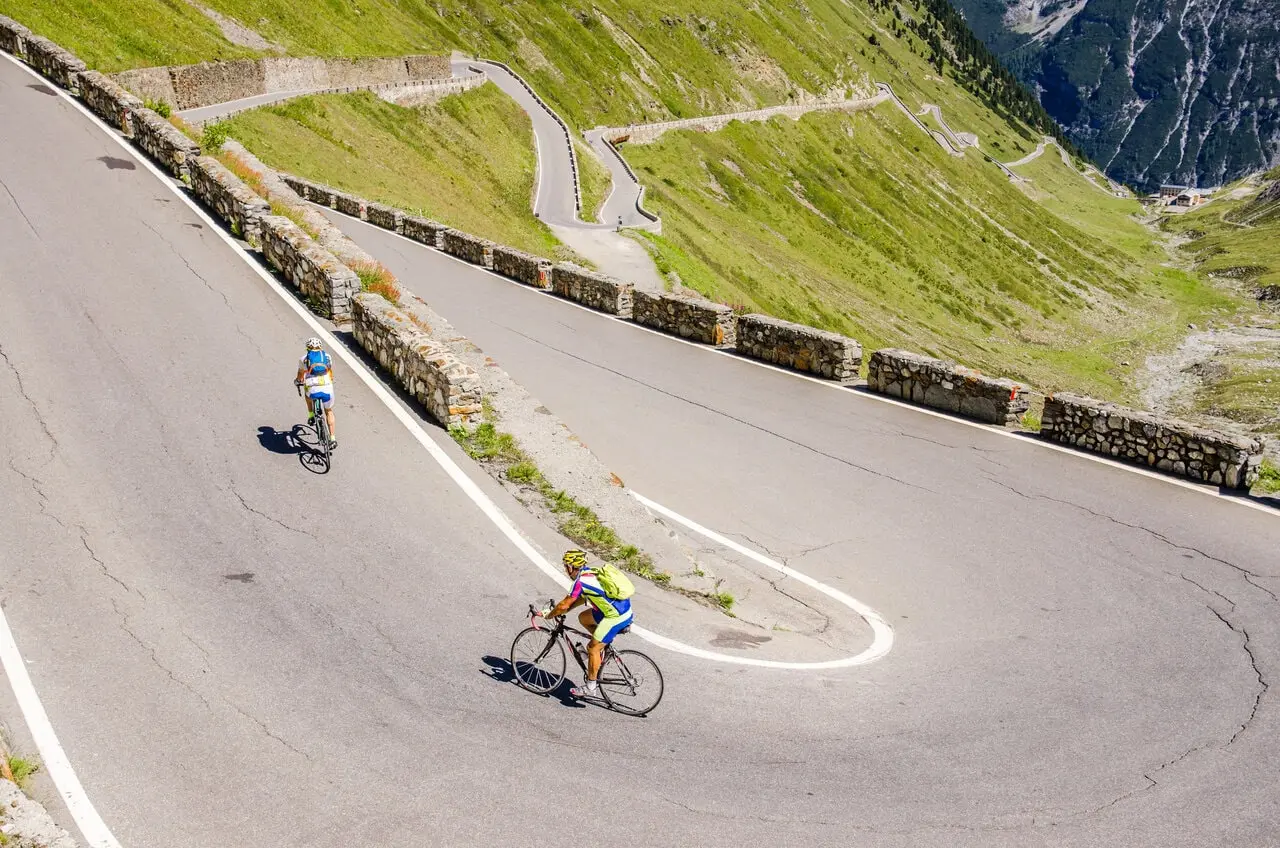
Once you know your steepest regular grades, match them to a lowest gear:
| Your terrain | Suggested lowest ratio | Gear inches | Notes |
|---|---|---|---|
| Mostly flat (0–3%) | 1.2 or higher | 32+ | Almost any stock gearing works; prioritize tight steps |
| Rolling (4–6%) | around 1.0 | about 27 | The classic 34 × 34 benchmark; comfortable for most riders |
| Steep (7–9%) | 0.8 – 0.9 | 21 – 24 | Sustained climbs at a healthy cadence |
| Very steep (10%+) or loaded | below 0.8 | under 21 | Long mountain grades, bikepacking, touring |
Table 7. Suggested lowest gear by terrain for a rider of average fitness on an unloaded bike. Heavier riders, heavier bikes, and longer climbs all push you one row down.
This same math is the fastest honest way to compare bikes when shopping, because two spec sheets that look completely different often are not. Take a bike with 50/34 rings and an 11-34 cassette against one with 46/33 rings and a 10-36 cassette. Divide the extremes: the first gives a 1.00 low and a 4.55 high, the second a 0.92 low and a 4.60 high. The second bike, despite its smaller chainrings, climbs easier and runs slightly taller at the top, which is exactly the trick that 10-tooth cogs make possible. Two divisions per bike, and marketing copy loses its power over you.
One friendly caution before you spend money chasing lower gears: fitness moves faster than you expect. A returning rider who needs a 0.9 ratio on a local hill in March may spin up the same hill comfortably in a much taller gear by June. If you are just starting out, ride what you have for a season before re-gearing, and there is no shame in walking a pitch while your legs catch up to your ambitions. The gears will still be there, and by then you will know exactly which ones you need.
The Most Overlooked Upgrade in Cycling
Here is the promise from the introduction. Drivetrains wear out by design: a chain stretches after roughly 2,000 to 3,000 miles, a cassette typically lasts through two or three chains, and chainrings go eventually too. Most riders treat this as a maintenance chore. They walk into the shop, hear that the cassette is worn, and replace it with the exact same one, never realizing they just passed up the cheapest transformation available to a bicycle.
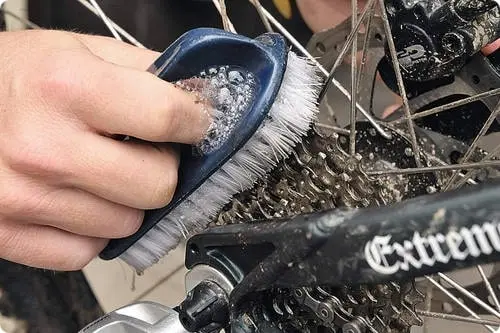
Because a cassette or chainring swap is not just a repair, it is a chance to re-gear the whole bike around your actual riding. The parts cost the same whether you replace like-for-like or choose differently, and the difference on the road is anything but subtle. Look back at Table 2 and consider what a few teeth actually buy:
- Struggling on climbs? Trading an 11-28 cassette for an 11-34 drops your lowest gear from 32 to 27 gear inches, an 18 percent reduction in effort at the same cadence. That is the difference between grinding at 55 rpm and spinning at 67 on the same hill, for the price of a cassette you needed to buy anyway.
- Never using your top gears? Many riders push around watts they never use. If your 50 × 11 sits untouched, subcompact rings shift your entire range toward the gears you actually live in, and front shifts get crisper because smaller rings shift better under load.
- On a 1x bike? The chainring is your single tuning knob, and a ring is one of the cheapest components on the bike. Going from a 42 to a 40-tooth ring makes every single gear 5 percent easier; going up does the reverse. Riders who move somewhere hillier, start bikepacking, or simply get faster can re-center their gearing in a ten-minute job.
Check Compatibility Before You Buy
A few compatibility notes are worth checking before you order parts, and any shop can confirm them in a minute. The big one is derailleur cage length. Rear derailleurs come with short, medium, or long cages, and the cage does two jobs: it limits the largest cog the derailleur can reach, and it takes up the chain slack created by the difference between your gears. A short-cage racing derailleur that handles an 11-28 beautifully simply cannot wrap enough chain for an 11-34, so the manufacturer's stated maximum cog and total capacity are worth respecting.
The good news is that a bigger cassette does not necessarily mean a whole new derailleur: on most modern derailleurs the cage is a replaceable part, and swapping in a longer one costs a fraction of a new unit. Beyond the cage, a bigger cassette usually wants a longer chain, and jumping between brands or speeds can require a different freehub body. None of these are obstacles so much as details.
The point of all this is to stop treating drivetrain replacement as a photocopy of what came off the bike. The manufacturer specced your gearing for a hypothetical average rider on hypothetical average terrain. Every couple of thousand miles, you get to spec it for you.
Putting It All Together
There is no best gearing, only gearing matched to terrain, load, and legs. Some practical guidance:
- Road riders in rolling terrain: a compact 50/34 with an 11-34 cassette covers about 455 percent, from a true 1:1 climbing gear to over 120 gear inches. This is the modern default for good reason.
- Riders in steep country, or anyone whose knees complain: go lower. A subcompact 48/32 or a mountain-range cassette buys you gears below 25 inches, and the small cost in top end is rarely missed.
- Gravel riders: choose 1x for simplicity and mud clearance if you ride steady tempo; choose 2x if you also do fast road miles and want tight steps.
- Commuters: an internal gear hub with a belt drive is the lowest-maintenance drivetrain ever fitted to a bicycle, and shifting while stopped at a light is a daily luxury.
- Tourers and bikepackers: plan around your lowest gear, aiming near 20 gear inches loaded. Range is your friend; ignore anyone who calls a granny gear a weakness.
- Everyone: if you constantly hunt between two gears, your steps are too big; if you run out of gears on climbs, your range is too small. The drivetrain should disappear beneath you.
Gearing rewards a little arithmetic. Ten minutes with a gear chart before your next cassette or chainring purchase will do more for your riding comfort than most upgrades costing ten times as much, and unlike carbon wheels, a well-chosen gear works on every single ride. The next time your chain checker says it is time, take it as an invitation: your bike is asking who you have become as a rider, and for once the right answer costs nothing extra.
Frequently Asked Questions
- What is a good gear ratio for climbing?
- A ratio of 1.0, where the chainring and the cog carry the same tooth count, is the widely used benchmark for a proper climbing gear on a road bike, and it handles rolling terrain of 4 to 6 percent at a healthy cadence. For sustained grades of 7 to 9 percent, aim for 0.8 to 0.9, and for double-digit gradients or a loaded bike, go below 0.8. One thing to watch: when you are between two options, gear lower, because an easy gear you rarely use costs you nothing while a missing one costs you cadence and knees.
- What do the numbers on a cassette like 11-34 mean?
- They are the tooth counts of the smallest and largest cogs, so 11-34 runs from an 11-tooth cog to a 34-tooth cog. The smallest cog sets your top speed and the largest sets your easiest climbing gear, which makes those two extremes matter far more than anything in between. Divide the large number by the small one to get the range: 34 divided by 11 is a 309 percent spread.
- How to choose between a 1x, 2x, and 3x drivetrain
- Match the design to the riding you actually do. A 2x setup, such as a compact 50/34, keeps steps between gears small, usually one or two teeth, which suits road riding where holding a precise cadence matters. A 1x setup drops the front derailleur for simplicity, better chain retention, and less weight, and a 30 to 34-tooth ring with a 10-52 cassette delivers about 520 percent range, which is why it rules mountain biking and much of gravel. A 3x crankset, typically 48/36/26, still offers the most total range of any derailleur system at well over 550 percent with small steps, and it persists on expedition touring bikes. The caveat worth knowing: 1x pays for its range with jumps of 13 to 38 percent between some gears, and both 2x and 3x carry slower front shifting and some gear overlap.
- How to pick a crank length that suits you
- Choose crank length for fit and comfort rather than for power. Shorter cranks reduce how high your knee rises at the top of the stroke, which opens the knee and hip angles, relieves pressure on the front of the knee, helps riders with hip impingement or lower-back trouble, and lets road riders drop into a lower position without choking off the pedal stroke. They also improve pedal clearance through corners. Research on maximal cycling power found peak power varied only about 4 percent across cranks from 120 mm to 220 mm, an intentionally absurd span, so the power question is largely settled. With one wrinkle: shorter cranks cut effective leverage by roughly 6 percent per 10 mm, so gear down about one cog and raise your saddle by the amount you shortened the crank.
- What to know about fitting a bigger cassette
- Most bikes can take a bigger cassette, and a modest jump such as 11-28 to 11-32 often works with the stock derailleur and a longer chain. Your rear derailleur has a stated maximum cog size and a total capacity it can wrap, so check that spec before ordering, and any shop can confirm it in a minute. The caveat worth knowing: larger jumps may need a longer derailleur cage, and swapping between brands or speeds can require a different freehub body. On most modern derailleurs the cage is a replaceable part that costs a fraction of a new unit, so a wider range is rarely the expensive upgrade it sounds like.