TL;DR:
- Mitochondria are the structures inside your muscle cells that burn fat, sugar and, late in a long ride, protein to power the pedals. A trained cyclist carries about twice as many of them in his legs as someone who does not ride.
- They set your threshold and your endurance. Your heart sets your VO2max. Most of the fitness an everyday rider can still gain lives in the muscle, and the muscle responds to hours.
- Once glycogen runs low, your mitochondria start burning amino acids pulled out of your own muscle. Protein covers about 4% of your energy on a fueled ride and about 10% on an empty one, and the difference is a chunk of why hour four hurts.
- Long steady rides add mitochondria. Hard intervals make the ones you have work better. The building continues for a day or two after a hard ride, and that is when food and sleep do their part.
- Stop riding and mitochondrial enzyme activity falls about 20% in three weeks and 40% in eight. High-dose vitamin C and E pills blunt the gains before you even get them.
Half of your fitness lives below the waist
Fitness feels like a heart-and-lungs thing. You train for a few months, your heart rate at 18 mph drops ten beats, and the improvement seems to come from the chest. About half of it does. The rest happens inside your leg muscles, in thousands of tiny structures called mitochondria, and that half explains why the last hour of a long ride turns to mud when you skip the food and why two weeks off the bike seems to cost a whole season.
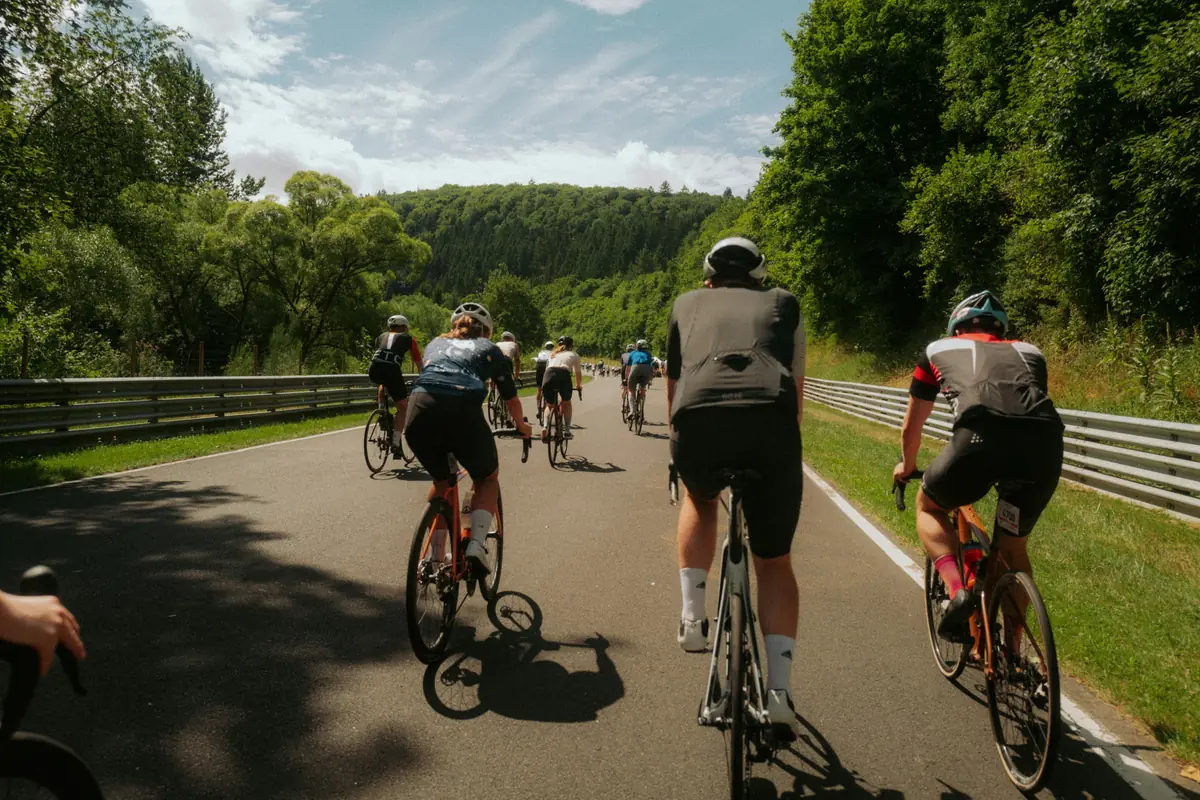
Picture the third hour of a long ride, the kind where nobody in the group is talking anymore. The legs have gone heavy in a way that is not soreness, and the speed is bleeding away a tenth of a mile per hour at a time. That is a fuel-supply problem, and your mitochondria are where it is being decided.
What a mitochondrion does
A mitochondrion is a bean-shaped structure far smaller than the muscle cell around it, and one fiber in a trained leg holds thousands. Their job is to take fuel, fat, carbohydrate or protein, combine it with oxygen in a loop of reactions called the Krebs cycle, and turn out ATP, the molecule a muscle spends every time it contracts. Oxygen accepts the electrons at the end of the chain, which is the entire reason you breathe harder when you ride harder. One glucose molecule burned this way yields around 30 ATP. The same glucose broken down without oxygen, out in the main body of the cell, yields two, and the leftover from that shortcut is lactate.
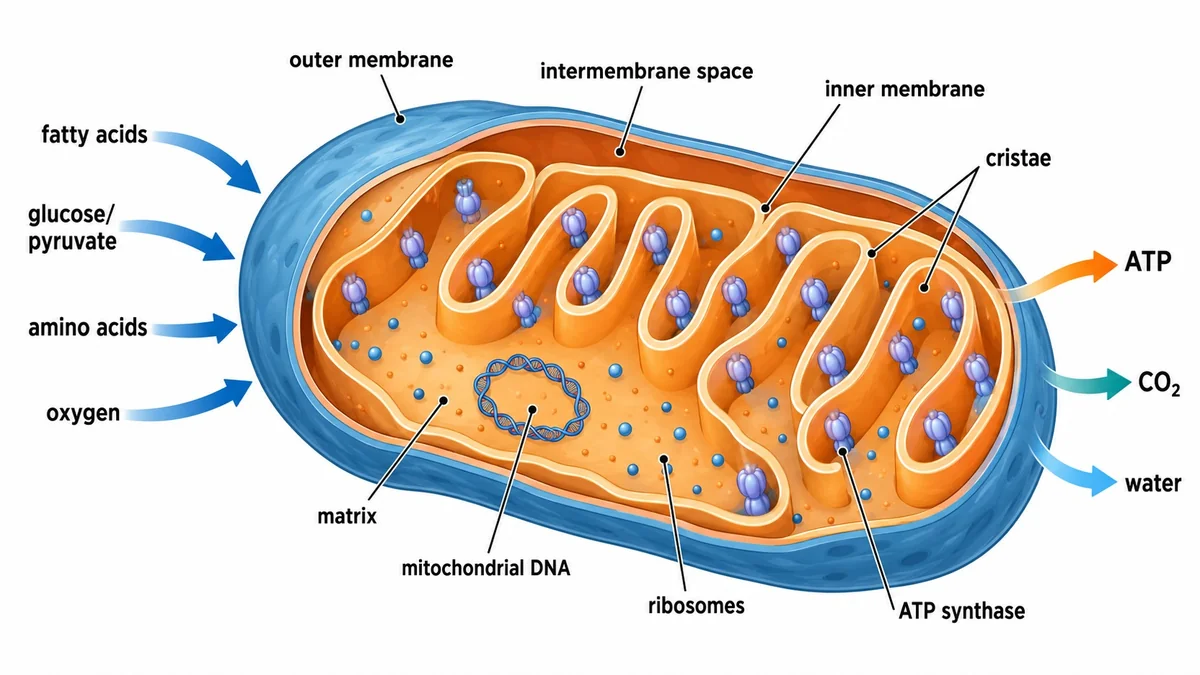
Lactate gets blamed for burning legs and next-day soreness, and it causes neither. When you push harder than your mitochondria can keep up with, the muscle makes ATP the fast, wasteful way, and lactate piles up along with the hydrogen ions that produce the burn. The lactate itself is fuel. It moves into neighboring slow-twitch fibers and gets burned by their mitochondria, a “lactate shuttle” that George Brooks at the University of California, Berkeley spent a career proving.
Why more of them makes you faster
In 1967, John Holloszy at Washington University in St. Louis found that 12 weeks of treadmill running doubled the mitochondrial enzyme content in rat muscle, the first proof that endurance training rebuilds a muscle from the inside. Hans Hoppeler’s group in Switzerland later measured roughly twice the mitochondrial density in elite endurance athletes as in untrained people, and six weeks of cycling raised mitochondrial volume in sedentary men by about 40%.
Fat can only be burned inside a mitochondrion, so the more of them you have, the more fat you oxidize per minute and the more glycogen you save for later. Asker Jeukendrup’s lab at the University of Birmingham found that fat burning peaks around 60% to 65% of VO2max in trained cyclists, and that well-trained riders burn far more fat at that pace than untrained ones do.
More mitochondria also mean more capacity to burn lactate, which is most of what moves your threshold, the pace you can hold for roughly an hour, and trained muscle pulls more oxygen out of every unit of blood, which is a large part of why your heart rate at 200 watts drops over a season.
What mitochondria do little for is VO2max, which is mostly set by how much blood your heart can pump. Two riders with identical VO2max can have very different thresholds, and the gap is in the mitochondria. For an everyday rider this is good news, because muscle is far easier to change than a heart, and it responds to hours.
How amino acids end up in the fire
In that third hour, your muscle glycogen is low. Fat alone cannot release energy fast enough to hold your pace, and the Krebs cycle needs a trickle of carbohydrate to keep turning, so the muscle reaches for amino acids. Three of them, the branched-chain amino acids leucine, isoleucine and valine, can be burned directly inside muscle mitochondria, and the enzyme behind it activates several times more strongly when you start a ride with glycogen already low. The amino acids come first from the muscle’s free pool and then from the breakdown of muscle protein itself. On a fueled ride, protein covers about 4% of your energy. Ride the same hour with glycogen depleted and it covers about 10%. Protein never becomes the main fuel, but on a long underfueled ride it becomes a meaningful one, paid for with your own muscle.
A second route runs through the liver. Muscle strips the nitrogen off amino acids to make alanine, and the liver turns the alanine back into glucose to hold your blood sugar up, which is a large part of why you do not black out when glycogen runs dry. The nitrogen comes off as ammonia, which rises through a long ride and has long been suspected of feeding the foggy, flat feeling of late-ride fatigue. The other cost shows up the next morning, when the muscle has to be rebuilt and the branched-chain amino acids you burned are the first thing in short supply.
All of this is why every coach tells you to eat on the bike. The 60 to 90 grams of carbohydrate an hour recommended on long rides keeps glycogen from running out, which is what flips the switch on burning your own muscle. We have a separate guide to how much sugar is reasonable for riders watching their blood sugar, and another on how much protein cyclists need to rebuild after long rides.
How a ride tells your body to build more
A hard ride is a stress, and the muscle answers by building the capacity to handle it better next time. Three signals carry the message: an energy sensor called AMPK that trips when a fiber burns ATP faster than it can make it, the calcium that floods the fiber with every contraction, and the reactive oxygen species that mitochondria leak while working hard. All three converge on a master switch, a protein called PGC-1 alpha, which turns on the genes for new mitochondrial parts and stays switched up for most of a day after a single hard ride.
Cycling raises the rate at which muscle makes mitochondrial protein, while lifting raises the rate at which it makes the contractile proteins that produce force, which is why a 400-pound squat does not make you an endurance rider. Our guide to weight training for cyclists covers why the gym still belongs in your week.
That building runs for 24 to 48 hours after a hard session, and mitochondria are made of protein. Thirty grams of protein after a ride is enough to max out the building of contractile muscle, but it takes about 45 grams to push the most amino acids into mitochondrial protein, and 45 grams of slow-digesting protein before bed keeps mitochondrial building going overnight. The electron chain is built around iron, so iron has to be in supply too, and a hard block run on poor sleep and thin food produces fatigue instead of fitness.
Those reactive oxygen species are also a trap for supplement takers. Taking 1,000 milligrams of vitamin C and a few hundred IU of vitamin E a day erases the rise in PGC-1 alpha that training produces, and riders who train on that dose for a few months build less mitochondrial protein than riders on a placebo. VO2max improves either way, so the pills do not cancel the training, but they dull the muscle’s response to it.
New mitochondria take a few weeks to show up and a couple of months to add up to a large change, and they are constantly torn down, with half-lives measured in days to weeks, so your aerobic engine is a population in constant turnover that training tilts toward building.
Volume builds more of them, intensity makes them better
The long-miles-versus-intervals argument comes down to a split. Training volume predicts how much mitochondrial mass you carry, and training intensity predicts how well each mitochondrion works. A few weeks of all-out sprint intervals raises the respiratory capacity of the mitochondria already there without adding any, while high-volume training adds mass without changing how each unit performs, and those high-volume gains disappear within about three weeks of cutting the volume back.

Long steady rides are how you add mitochondria, and there is no way around the hours. Hard, short intervals drive the signaling harder per minute and sharpen what you already have. Do only one and you leave gains on the table, and ride your long days too hard, the gray-zone tempo trap, and you get a weaker version of both signals. Our Dirty 30s workout covers the intensity side, and our winter trainer article covers the indoor hours.
Training with the tank low
Glycogen depletion is one of the strongest signals for building mitochondria, which raises the obvious question of whether training deliberately low amplifies the adaptation. It does. The cleanest demonstration used each of a rider’s own legs as its own experiment, worked separately on a one-leg exercise machine. One leg trained once a day. The other leg did two sessions back to back every other day, so its second session always started with the glycogen already burned off by the first, and that leg built more mitochondrial enzyme and lasted longer in a test to exhaustion than the leg trained the normal way. The “sleep low” version, hard intervals in the evening, no carbohydrate overnight, then an easy ride before breakfast, has produced a 3% improvement in a 10-kilometer run after three weeks. The protein requirement on those days rises to nearly 2 grams per kilogram of body weight, because the muscle is burning so much more of its own amino acids.
For most riders the sensible version is the easy one. Ride before breakfast now and then, keep it easy or moderate, and never do it two days in a row. Keep the hard sessions fueled, because hard efforts on empty produce lower power and leave you more open to catching whatever is going around.
Feeding the build
Put 35 to 45 grams of protein in the meal after a ride: a chicken breast on a big sandwich, a can of tuna over rice, or three eggs with a cup of Greek yogurt. On hard training days add a slow-digesting snack before bed, like a cup of cottage cheese, a glass of milk or a casein shake, to cover the hours when the building is still running.

Get your iron checked. A rider short on iron, which includes a surprising number of men who train hard, adapts poorly and cannot tell from the outside. Ferritin is the number to ask for, and our guide to the blood panel every cyclist should check walks through what to look at.
Skip the gram-scale antioxidant pills. Fruit, vegetables and a daily multivitamin are fine, but 1,000 milligrams of vitamin C with a vitamin E capsule around training is the dose that blunted mitochondrial building in the trials.
Restock carbohydrate after the ride as well as during it, or the next session becomes the low-glycogen kind whether you planned it or not. Oatmeal, rice or potatoes with dinner and a banana or two after a long day are as much a part of building the engine as the protein is.
How fast you lose them
In 1984, Edward Coyle at the University of Texas at Austin followed seven endurance athletes as they stopped training cold. Citrate synthase activity, the standard marker for mitochondrial content, fell about 20% in the first three weeks and about 40% by eight weeks, then leveled off at a point still roughly 50% above sedentary people. Capillary density barely moved. That curve is why two weeks of flu costs you a chunk of threshold while your heart is mostly intact, and why the first rides back feel fine for 20 minutes and then fall apart.
A modest amount of riding holds most of it. Cutting volume in half while keeping some intensity holds mitochondrial enzymes close to where they were for a few weeks, so two short hard rides a week through a busy stretch preserve most of the engine, and when you come back from being sick, rebuild the hours before the intervals. Our article on overtraining syndrome covers the opposite problem, the point where more riding stops building anything at all.
Mitochondria and aging
Mitochondrial function declines with age in people who do not exercise, and much of what gets called “getting old” in the legs tracks that decline. In 2018, Scott Trappe’s lab at Ball State University biopsied people in their 70s who had exercised for about 50 years and found mitochondrial enzyme activity and capillary density that matched active 25-year-olds. Their VO2max had declined, because the heart does age, but the engine inside the muscle had held.
A rider in his 50s or 60s gets the same prescription as a rider in his 30s with tighter margins. Keep the volume, keep some intensity, and eat more protein, since older muscle needs a bigger dose to get the same building response. Our piece on cycling and longevity covers the broader health case.
Frequently Asked Questions
- What do mitochondria do for a cyclist?
- They turn fat, carbohydrate and, on long rides, amino acids into ATP, the energy your muscles use to contract. More mitochondria mean more fat burned at a given pace, faster lactate clearance and a higher threshold. Trained cyclists carry about twice the mitochondrial density of untrained people in their leg muscles.
- Does cycling burn muscle?
- A little, on long rides. Once glycogen runs low the muscle burns branched-chain amino acids from its own protein, and protein’s share of energy rises from about 4% to about 10%. Eating 60 to 90 grams of carbohydrate per hour on long rides keeps glycogen up and keeps that from happening, and eating enough protein across the day replaces what was burned.
- What builds mitochondria fastest, Zone 2 or intervals?
- Both, for different reasons. Training volume builds mitochondrial mass and intensity improves how well each one works. Long steady rides are the only reliable way to add mitochondria, and hard intervals sharpen the ones you have. Riders who do only one leave gains behind.
- How long does it take to build more mitochondria?
- A few weeks of consistent training produces a measurable increase, and six weeks of cycling raised mitochondrial volume about 40% in previously sedentary men in one study. Larger changes take months, and because mitochondria are constantly replaced, the building has to continue.
- How fast do you lose mitochondria when you stop riding?
- Mitochondrial enzyme activity drops about 20% in three weeks and 40% in eight weeks of complete rest, then plateaus well above untrained levels. Keeping even two hard rides a week through a break preserves most of it.
- Should cyclists take antioxidant supplements?
- Not in large doses around training. Vitamin C at 1,000 milligrams plus vitamin E has been shown to blunt the mitochondrial adaptation to endurance training. Fruit and vegetables are fine.
- Does protein help build mitochondria?
- Yes. Mitochondria are made of protein, and 45 grams of protein after a ride or before bed has been shown to increase mitochondrial protein synthesis in cyclists. Aim for 35 to 45 grams in the meal after a ride and a protein-rich snack before sleep on hard training days.
Policy terms, coverage limits and availability vary by state. This article is for general information and is not insurance, medical or nutritional advice. Talk to a physician or registered dietitian before making major changes to your training or diet, especially if you have a medical condition.