TL;DR:
- A single gel carries 21 to 40 g of fast sugar, a 20 oz bottle of Gatorade carries 34 g, and the 90 to 120 g per hour the pros eat on Tour stages adds up to a pound of sugar in a long day. Most recreational riders copying that plan do not need it.
- Lean, high-volume endurance athletes are turning up with fasting glucose and HbA1c in the prediabetic range. Pro triathlete Lionel Sanders tested at 5.9% in late 2024 while eating up to 1,000 g of sugar a day. Sports physiologists and a sports-nutrition company founder in the UK say amateur cyclists are calling them with the same problem.
- The science is split. Working muscle pulls sugar out of the blood without insulin, former elite endurance athletes have a lower lifetime diabetes risk, and several dietitians argue the odd blood tests are training stress or underfueling. A high reading is a reason to test properly, not to panic, and not to ignore it.
- The one harm with no debate is your teeth: half of elite athletes studied had untreated decay, and the dentists blame the frequency of sugar hits, not the amount.
- Fuel to the ride. Easy rides under 90 minutes need water and maybe electrolytes. Longer or harder rides need 30 to 60 g of carbs an hour, which bananas, rice cakes, dates, potatoes and raisins deliver as well as gels in head-to-head trials. Save the 90 g per hour gel plan for race day.
How Cycling Fell in Love with Sugar
Twenty years ago a pro rider in a stage race took in about 53 g of carbohydrate an hour, according to a 2012 survey of more than 200 endurance athletes across Ironman, marathon and pro cycling events. A bottle of sports drink and a couple of bars covered it. Today the number at the Tour de France is 90 g an hour on a routine day and 120 g on the mountain stages, and some riders go beyond that. When Tadej Pogačar rode the 2025 queen stage to the Col de la Loze, his team’s published data showed about 460 g of carbohydrate during the five hours of racing, 1,200 g over the whole day, and 480 g in the hours after the finish. Visma-Lease a Bike packed 3,000 gels for the three weeks and told its riders to eat three things every hour. One team nutritionist admitted the job had flipped: “At some point, we had to shift from convincing riders to eat more to slowing them down a bit.”
That approach filtered down fast. Gel makers now sell 50 g and 90 g single-serve packets. Drink mixes come in “super high-carb” versions with 100 g per bottle. Coaching podcasts and group-ride conversations repeat 120 g an hour as the number to aim for, and riders on a Saturday coffee loop are drinking what a WorldTour sprinter drinks on a transition stage.
The problem is that your body is not a WorldTour sprinter’s body, and your ride is not a 110-mile stage. A 2025 review in Sports Medicine of the “100 g per hour fueling revolution” went looking for lab evidence that intakes above 90 g an hour improve performance and did not find it. One study found the optimum near 78 g an hour. Another gave riders 112 g an hour and saw no performance gain, only more reliance on glycogen. Even the team nutritionist feeding Jonas Vingegaard put it plainly to Velo: “Let’s not jump on the bandwagon of everybody trying 120 grams or 150 grams because we hear Tadej or Jonas are doing it. Even 90 grams per hour would be a huge improvement for most recreational riders.”
Two Numbers You Will See Throughout This Article
Most of the stories and studies below come down to two blood tests, so a quick primer before the bad news.
Fasting glucose is the amount of sugar in your blood after an overnight fast, measured in milligrams per deciliter (mg/dL). It is a snapshot of one morning. Under 100 mg/dL is normal, 100 to 125 mg/dL is prediabetes, and 126 mg/dL or higher on two tests is diabetes.
HbA1c (hemoglobin A1c, often just “A1c”) is the slower, more telling number. Glucose in your blood sticks to the hemoglobin in your red blood cells, and since those cells live about three months, the percentage of hemoglobin with sugar attached works as a rolling three-month average of your blood sugar. It cannot be gamed by eating clean the week before the test. Under 5.7% is normal, 5.7% to 6.4% is prediabetes, and 6.5% or higher is diabetes. Most of the time, a higher A1c reflects more hours each day spent with elevated glucose, which is exactly what a rider sipping sugar for four hours at a stretch is doing.
Prediabetes is the stage where your body is still clearing glucose but has to work harder to do it. The pancreas puts out more insulin to get the same job done, cells start responding to insulin less well, and the morning number creeps up. It is reversible, which is the good news, and it is silent, which is why the riders in the next section only found out from a blood draw.
What is in the Packet
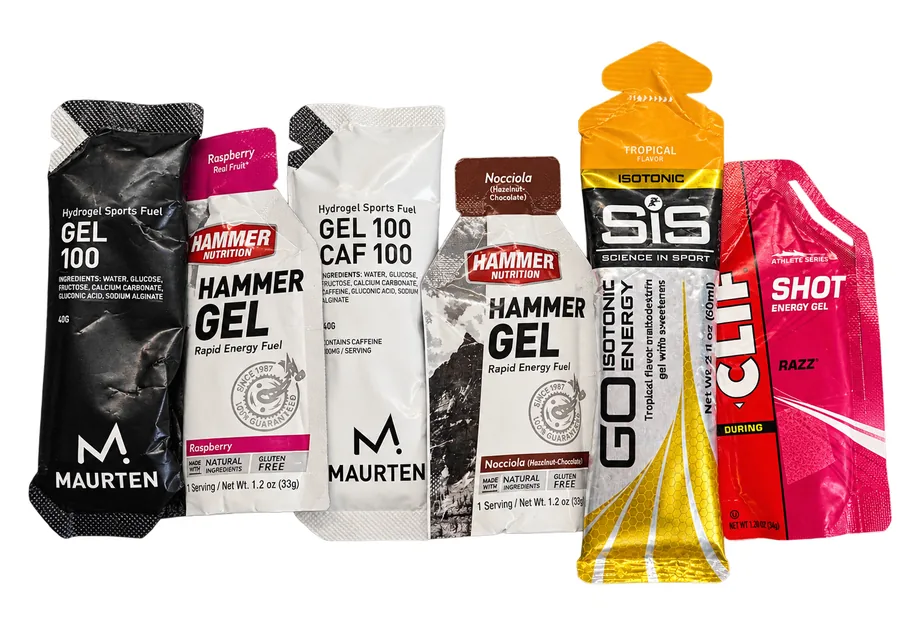
Sports nutrition labels are confusing on purpose. The nutrition panel lists “total carbohydrate” and “sugars” separately, and many gels show a big carb number with a small sugar number. That looks reassuring until you know that maltodextrin, the main ingredient in most gels and drink mixes, is a chain of glucose molecules that your gut breaks apart almost instantly. It raises blood glucose about as fast as table sugar but does not count as “sugar” on the label. A Science in Sport isotonic gel lists 22 g of carbohydrate and 0.6 g of sugar. Metabolically, it is 22 g of glucose.
What the common products deliver per serving, counting everything that ends up as glucose or fructose in your blood:
- GU Energy Gel: 21 to 23 g carbohydrate, maltodextrin and fructose.
- Maurten Gel 100: 25 g, all listed as sugar, glucose and fructose. The Gel 160 has 40 g.
- SiS Beta Fuel Gel: 40 g, maltodextrin and fructose.
- Precision Fuel PF 30: 30 g. The PF 90 packet holds 90 g, more than two cans of regular soda.
- Honey Stinger: 24 g, tapioca syrup and honey.
- Carbs Fuel 50: 50 g, maltodextrin, sucrose and fructose.
- Gatorade Thirst Quencher, 20 oz bottle: 36 g carbohydrate, 34 g of it sugar.
- Tailwind Endurance Fuel: 25 g per scoop, all dextrose and cane sugar. The recommended two-scoop bottle is 50 g.
- Skratch Sport Hydration: 19 to 20 g per scoop, cane sugar and dextrose.
- Skratch Super High-Carb: 100 g per serving from cluster dextrin, a glucose polymer that lists as 8 to 11 g of sugar.
Run the numbers for a typical “fueled” four-hour ride at 90 g an hour and you have eaten 360 g of sugar, about 13 oz, or the sugar in ten cans of Coke. That is a normal Sunday for a lot of riders who would never drink ten Cokes.
The Riders Whose Bloodwork Came Back Wrong
Lionel Sanders is one of the best long-course triathletes of the past decade, and in early 2025 he posted a video describing his November 2024 blood panel. His HbA1c came back at 5.9%, inside the prediabetic range. He wore a continuous glucose monitor for ten days and averaged about 123 mg/dL around the clock, well above the 70 to 99 mg/dL a healthy fasting reading sits in.
His diet was the fueling culture taken to its conclusion. He described himself as a sugar addict, estimated that some days he ate 1,000 g of sugar, and said that on long training days he took in 500 to 600 g of carbohydrate during the session and another 500 to 600 g afterward. He was getting up to urinate as many as eight times a night and had slept badly for years. “I don’t want to die young of diabetes,” he said, “and I’m headed down that pathway right now.”
He did not go low-carb. He started matching his carbohydrate intake to his power output, paired carbs with protein and fat, cooked more and bought less packaged food. Within two months his seven-day glucose average was in the low 100s, he was sleeping through the night, and he said he felt better in training.
Sami Inkinen has a similar story from a decade earlier. In 2012 he won his age group at the Ironman World Championship in 8 hours 24 minutes, and in the same season learned his fasting glucose was running 110 to 115 mg/dL. He was lean, he was fast, and by the clinical definition he was prediabetic and insulin resistant. He went on to co-found Virta Health, a company that treats type 2 diabetes with diet.
Tim Noakes, the South African sports scientist whose book Lore of Running shaped a generation of endurance training, developed type 2 diabetes in his late 50s after decades of marathons and ultras on the high-carbohydrate diet he had recommended to everyone else. He has a strong family history and does not blame gels alone, but his experience turned him into one of the loudest critics of sugar-fed endurance sport.
Those are the famous cases. The more telling ones are anonymous. In May 2026 BikeRadar reported that Tim Lawson, who founded Science in Sport and now runs the nutrition brand Secret Training, is being contacted by amateur riders who are not overweight, train as much as 15 hours a week, and have been told they are prediabetic. In the same article Dr. Garry Palmer, a sports physiologist who tests riders at his lab in England, described his own fasting glucose drifting to about 101 mg/dL after four months of reduced training while his carbohydrate habits stayed the same. His theory is that the trouble starts when the sugar intake stays high and the training volume drops: during a block of 15-hour weeks the muscle soaks up everything you eat, but in the off-season, or after an injury, or when work gets busy, the same breakfast and the same bottles produce sharp insulin responses with nowhere for the glucose to go. “I am convinced this is one of the main reasons why fit cyclists suffer from prediabetes,” he said.
Bob Seebohar, a sports dietitian who worked with the US Olympic team, wrote in 2026 that he is seeing more prediabetes among endurance, masters and recreational athletes, and that “an athlete can be lean, strong and highly trained while still developing early signs of impaired glucose regulation.”
What the Studies Show
A handful of small studies back up the anecdotes. None of them is large enough to settle the question.
Researchers in New Zealand in 2016 put glucose monitors on ten sub-elite runners and cyclists for six days of normal life and found three of them with fasting glucose in the prediabetic range. A 2023 study fed ten trained runners a month of high-carb eating and a month of low-carb eating at the same calories; three of the ten ran above 100 mg/dL on the high-carb month and none did on the low-carb month, though two of the authors are prominent low-carb advocates. A 2008 study of 119 professional and elite Italian road cyclists found their HbA1c ran higher than sedentary controls, 5.4% against 5.2%, and climbed with training load, even though both figures sit inside the normal range.
Swedish researchers added a twist in 2023: a three-hour ride at moderate intensity reduced an athlete’s glucose tolerance the following morning, while a short interval session did not. They call this adaptive, since the muscle is sparing glucose and burning fat as it recovers. It also means that if your doctor draws blood the morning after a long ride, the number may look worse than you are.
The Case for Calm
The researchers who built the fueling guidelines are not alarmed, and they have data of their own.
Working muscle takes up glucose through a pathway that does not need insulin, which is why sugar eaten during a hard ride is handled differently from sugar eaten on the couch. The long-term numbers lean the same way: a Finnish study of 392 former elite male athletes found the endurance athletes had a 61% lower risk of type 2 diabetes decades after retirement (though they competed before gels existed), and a 2022 study of 486 masters athletes found their average fasting glucose ran 14% below the general US population. Asker Jeukendrup, the Dutch researcher whose work produced the 60 and 90 g per hour guidelines, wrote in 2023 that “there is no evidence that sugar per se causes insulin resistance.” His advice is nevertheless the same as this article’s: use sports products when performance is on the line and eat normal food the rest of the time.
Nicola Guess, a dietitian and Oxford researcher who sees athletes with worrying bloodwork, reports that almost all of them have elevated glucose in the fasting state only. Their HbA1c sits at 5.6% to 6.0% and their fasting glucose at 99 to 108 mg/dL, but on a two-hour glucose tolerance test, the real diagnostic, they come back under 90 mg/dL. Her reading is that training stress and the post-ride fat-burning state push the morning number up without any disease behind it. Other dietitians argue the athlete with odd glucose labs is more often underfueled than overfueled.
Two things can be true. A fit rider with a fasting glucose of 103 mg/dL after a hard training block probably does not have a disease. A fit rider eating 400 g of sugar on every long ride, finishing with a recovery shake, snacking on gummies because they are “fuel,” and then cutting training in half for the winter is doing something no study has shown to be safe. The fueling culture does not distinguish between those two riders. Your bloodwork should.
The Harm Nobody Argues About: Your Teeth
The effect of on-bike sugar on your blood is still argued over. The effect on your teeth is not.
In 2019 researchers at University College London examined 352 Olympic and professional athletes across 11 sports, cycling included. Just under half had untreated tooth decay and one in three said their mouths were hurting their training or racing, even though 94% brushed twice a day. What they also did was use sports drinks (87%) and gels (70%). The mechanism is frequency: every sugar hit feeds acid-producing bacteria for 20 to 30 minutes, so a bottle sipped every ten minutes for four hours never gives enamel a break. Professor Ian Needleman, who led the study, told BikeRadar in 2026 that “the issue is the frequency, not the amount,” that honey carries the same risk as a lab-made gel, and that he has seen pro riders in their 20s and 30s needing extractions and root canals.
His advice costs nothing. Carry a second bottle of plain water and swish after every gel or sweet sip. Brush twice a day with fluoride toothpaste, spit and do not rinse, and ask your dentist for a high-fluoride prescription paste if you use gels often. Wait 30 to 60 minutes after a ride before brushing, since acid-softened enamel brushes away. And check your drink mix for citric acid, which erodes teeth faster than the sugar does.
Fuel to the Ride, Not to the Tour
The way out of this is not a new product. It is matching what you eat to what you are doing, which Jeukendrup laid out a decade ago and which the high-carb trend has buried.
Under an hour, any intensity. You need nothing but water. Your muscles and liver hold enough glycogen for this many times over. If you want the edge in a short race or a hard interval session, swish a carbohydrate drink in your mouth for five seconds and spit it out. Researchers at the University of Birmingham found in 2004 that cyclists who did this during a one-hour time trial went about 3% faster than those who rinsed with water, and a 2009 follow-up with brain imaging showed the mouth has carbohydrate sensors that light up reward and motor regions without a single calorie reaching your stomach.
One to two hours, steady. Your typical Zone 2 ride. You still need almost nothing. Jeukendrup’s guidance is “about 30 g an hour” for a performance-oriented effort in this window, and for an easy ride even that is optional. One banana or a small handful of dates covers it. If it is hot, add an electrolyte tablet to one bottle.
Two to three hours, or anything with hard efforts. Now you are into real fueling: 30 to 60 g an hour. Below 60 g an hour, the type of carbohydrate does not matter, which opens the door to food.
Over three hours, or racing. 60 to 90 g an hour, and above 60 g you need a mix of glucose and fructose because they use different transporters out of the gut. This is where gels and engineered drink mixes earn their keep. This is also the only situation where they do.
Trainers describe this as “fuel for the work required,” a framework from Liverpool John Moores University that treats carbohydrate as something you dose to the session rather than something you take all the time. Periodizing fuel this way has a performance case too. French researchers in 2016 had triathletes do their hard evening sessions fully fueled, go to bed without replacing the carbs, and ride easy the next morning on empty, three times a week for three weeks. The “sleep low” group improved a 10 km run by about 3% and cut body fat; the control group eating the same total carbs did not. The research on training low is mixed, with most studies showing improved cellular signaling but only about a third showing better performance, so treat it as a tool for a training block rather than a lifestyle. Not every ride is a race, and the rider who fuels every ride like one is the rider whose bloodwork comes back strange.
Real Food That Works as Well as Gels
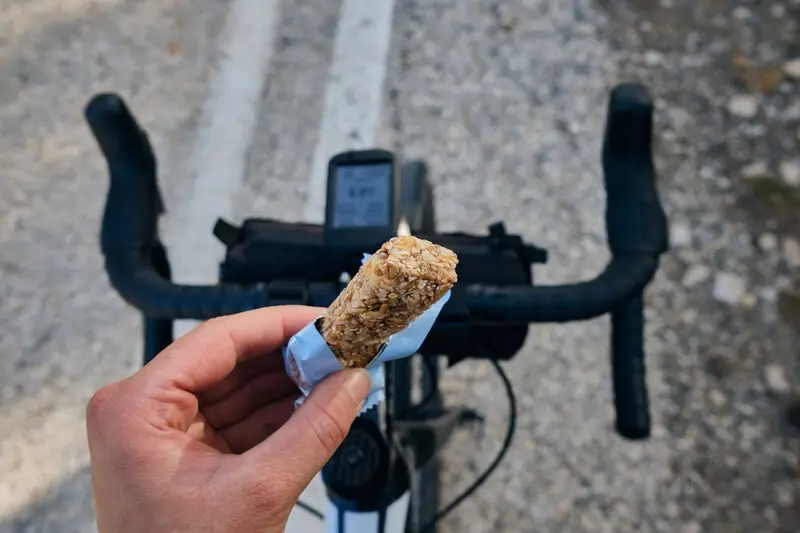
The trials comparing whole food to sports products keep ending the same way.
Bananas. Researchers at Appalachian State University had trained cyclists ride a 47-mile simulated road race twice, once drinking a cup of 6% sports drink every 15 minutes and once eating half a banana. Performance was identical. The banana riders also got potassium, fiber and B6, and the lead researcher described sports drinks as “essentially flavored sugar water.” The same lab repeated the experiment in 2018 with 20 cyclists and found bananas matched the sugar drink for endurance and reduced post-ride inflammation markers.
Potatoes. In 2019 University of Illinois researchers fed trained cyclists either a gel or an equal dose of baked russet potato puree every 15 minutes during two-hour rides, 60 g of carbohydrate an hour either way. Blood glucose, lactate, heart rate and performance were the same. The potato group reported more bloating, which the authors expected to fade with practice. Boiled baby potatoes with salt in a bag are a staple of the pro peloton for a reason.
Raisins. University of California, Davis researchers tested raisins against commercial sports chews in competitive runners during an 80-minute run followed by a 5 km time trial. The raisin group ran 20.6 minutes, the chew group 20.7, and the water group 21.6. The same lab had earlier found raisins equal to sports jelly beans in cycling.
Rice cakes. The sticky-rice cakes that Dr. Allen Lim made famous feeding the Garmin and RadioShack teams are the easiest real-food fuel to make at home: Calrose rice cooked a little wet, mixed hot with coconut milk, a little sugar, lemon and salt (or Parmesan, pepper and olive oil for the savory version), pressed into a baking pan and cut into squares. Wrap them in foil and they ride in a jersey pocket for hours. Each square carries roughly 30 g of carbohydrate with some salt and fat, which slows the sugar hit.
Dates. One Medjool date is about 18 g of carbohydrate, 16 g of it sugar, with 168 mg of potassium and fiber. Two dates are a gel.
Fig bars, PB&J, a boiled egg and salted potato. Not studied head to head, but the pro teams carry all of them, and a mini sandwich on white bread gives you carbs with fat and protein that keep glucose from spiking.
Homemade gels. Four tablespoons of maple syrup with a pinch of salt in a reusable flask is a 53 g gel for about 60 cents. Honey and molasses work the same way. Remember Needleman’s warning: natural sugar is still sugar to your teeth, so rinse.
The common thread is that food brings fiber, fat, protein, potassium and water along with the sugar, so the glucose arrives more slowly, and that you will eat fewer calories of real food than you will squeeze from packets, because real food has texture and fills you up. For anything up to 60 g an hour, the research says food is a straight swap. Above that, chewing becomes the limiting factor and gels have a legitimate job.
“Low Sugar” Products, and Which Ones Live Up to It
The supplement aisle has noticed the backlash and responded with products that promise steady energy without the spike. Some deliver and some are relabeled glucose.
Maltodextrin and cyclic dextrin mixes list as low sugar but are glucose chains. They are a reasonable fuel for a long ride and give you nothing in the way of a gentler glucose curve.
Hydrogel gels like Maurten are a gut-tolerance technology, not a low-glycemic one. Three studies since 2020 have looked, and none found a lower or smoother blood glucose response than the same sugars in a plain drink. Hydrogel does reduce stomach trouble at high intakes, and one trial found it caused a smaller acid drop on the teeth because it has no added acidulants.
Isomaltulose (Palatinose) is a slow-digesting sugar made from beet sugar. German researchers in 2016 found that 75 g taken before a 90-minute ride gave athletes more stable blood glucose and higher fat burning than maltodextrin, with a time trial result 2.7% better that fell short of statistical significance. It is still sugar on the label and to your teeth, but it is the one sweetener with evidence that it behaves differently in the blood.
UCAN (modified corn starch). Florida State researchers tested it against sugar in trained cyclists over a three-hour protocol and found it blunted the pre-exercise glucose rise and raised fat oxidation, with no performance difference and roughly double the nausea during sprints. The researchers’ summary: it behaves like any other low-glycemic carb, so save your money and eat oatmeal or a sweet potato.
Sugar-free electrolytes are the honest option for rides that do not need fuel. Nuun Sport has 1 g of sugar and 300 mg of sodium per tablet for about 75 cents; LMNT has none and 1,000 mg of sodium at about $1.50 a packet. Skratch Hydration and Precision Hydration’s PH 1500 are half-strength sports drinks, 15 to 19 g of sugar per serving, which is fine as long as you know that is what you are buying.
Sodium is where the sports drink argument has merit. Sweat sodium in a study of more than 500 athletes averaged about 1,000 mg per liter with a range from 290 to 2,400, so some riders lose a lot of salt. Nothing about that requires sugar. A salt tablet in a bottle of water does the same job.
Don’t Let the Habit Follow You Off the Bike
Palmer’s theory about prediabetic cyclists is that the sugar stays when the riding stops, and the pattern is easy to see in your own kitchen. The recovery shake after a 90-minute ride that did not deplete anything. The 400-calorie “recovery” pastry with the post-ride coffee. The gummies in the desk drawer because they are “sports nutrition.” The second breakfast on the Monday after a big weekend. Each is defensible on a 110-mile day and is dessert on a 25-mile one.
A few rules keep the fueling window where it belongs:
- A ride under 90 minutes at an easy pace does not need a recovery drink. Your next meal is the recovery.
- Rapid post-ride carbs make sense only when the next hard session is within about eight hours. Otherwise eat a normal dinner.
- Keep sports products in the garage, not the pantry. If they live with the bike, they get used on the bike.
- Sweetened coffee, sweetened yogurt and juice are sugar you did not count. For a rider taking 300 g on Saturday and another 300 g on Sunday, a week of them adds a third long ride’s sugar.
- Notice when training volume drops. The off-season, a busy month at work, an injury: those are exactly when Palmer sees the glucose numbers move, because the intake stays and the muscle demand goes away.
What to Check, and When to See a Doctor
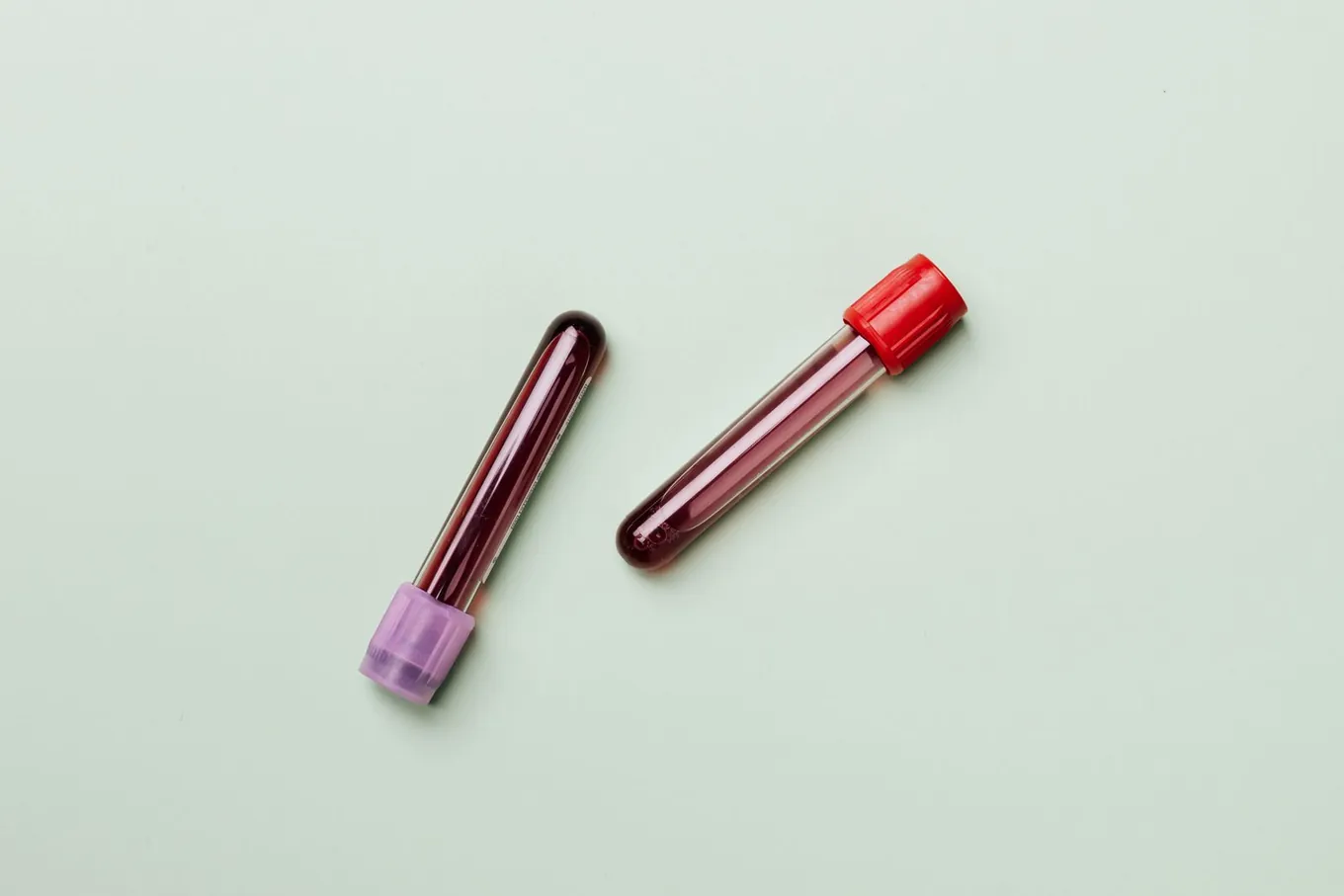
If you have followed the high-carb playbook for a few seasons, get a blood panel. The screening numbers from the CDC and the American Diabetes Association are:
- HbA1c: under 5.7% is normal, 5.7% to 6.4% is prediabetes, 6.5% and above is diabetes.
- Fasting glucose: 99 mg/dL or below is normal, 100 to 125 mg/dL is prediabetes, 126 mg/dL and above is diabetes.
- Two-hour oral glucose tolerance test: under 140 mg/dL is normal, 140 to 199 mg/dL is prediabetes, 200 mg/dL and above is diabetes.
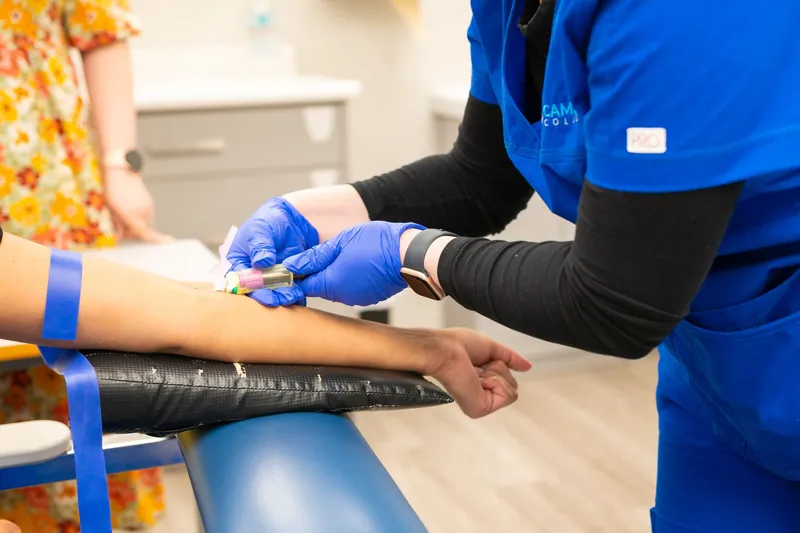
Draw blood on a rest day, not the morning after a long ride, since a three-hour ride measurably reduces glucose tolerance the next day. If your HbA1c or fasting glucose come back in the prediabetic range, ask for a two-hour glucose tolerance test and a fasting insulin before you conclude anything. That is the test that separates Guess’s “athlete with a high morning number and perfect glucose handling” from Sanders’s “athlete whose glucose is high all day.” Seebohar suggests endurance athletes get bloodwork twice a year, including fasting insulin, which rises years before glucose does. Our guide to the blood panel every cyclist should ask for walks through the full list.
Continuous glucose monitors are now sold over the counter in the US. Dexcom’s Stelo runs $89 a month for two 15-day sensors and Abbott’s Lingo starts at about $54 for a two-week sensor. Both are approved for adults not using insulin and neither is a diagnostic tool. Ten days of watching your glucose after breakfast, during a fueled ride and after your post-ride meal will teach you more about your own response than any article, including this one. Two warnings: glucose during exercise swings in ways that are normal for athletes and alarming to look at, and sports-science reviewers have flagged that monitors can push athletes toward anxiety and under-eating. Use one to learn, then take it off.
The tests in this article are routine care and your health plan pays for them. The crash is where the money goes: a broken collarbone on a fueled four-hour ride lands on a deductible that averages about $7,500 on a 2026 bronze marketplace plan, with copays and co-insurance on top. Medical gap coverage on a Velosurance bicycle policy reimburses those out-of-pocket costs after your health plan pays its share, and the core policy covers the bike itself after a crash, theft, or a bad day in transit. Both need to be in place before the accident, so sort it out before the long-ride season rather than after the first one. We explained why that gap keeps widening in The 2026 Policy Bonk.
Policy terms, conditions and coverage vary by state and by policy. This article is for general information only and is not insurance, medical or legal advice. Consult your physician about blood test results or dietary changes.
Frequently Asked Questions
- Do I need to give up gels?
- Keep them for the rides that earn them: over three hours, racing, or sessions with hard efforts where 60 g an hour or more makes a difference. On everything else, eat food or nothing.
- I ride 10 hours a week and my fasting glucose came back at 104. Should I worry?
- One reading on a morning after training is not a diagnosis. Repeat it on a rest day, ask for an HbA1c, a fasting insulin and ideally a two-hour glucose tolerance test, and look at your off-bike sugar. If everything else is normal, your doctor will likely treat it as an athlete’s morning number. If the glucose tolerance test is also elevated, you have an answer and a plan.
- Is honey or maple syrup better than a gel?
- For your blood, marginally, since they come with a little more fructose and minerals. For your teeth, no difference at all. For your wallet, a lot better.
- What about 120 g an hour? Should I train my gut to handle it?
- Train your gut for 120 g an hour only if you race for more than three hours and have already maxed out 90 g an hour. Lab studies show more of the extra carbohydrate gets burned at 120 g, but no additional sparing of your own glycogen and no proven performance gain. For recreational riders the ceiling is 90 g, and most will never need to go past 60.
- Do sports drinks hydrate better than water?
- For long hot rides, the sodium helps, and so does a sugar-free electrolyte tablet. For rides under an hour, water is all you need. The small amount of sugar in a 6% drink does speed water absorption from the gut slightly, which is one reason the pros use them, but at 34 g of sugar per bottle it is a trade you should make knowingly.
- Can a rider be lean and still insulin resistant?
- Yes. Two of the athletes in this article were lean and at their fastest when their bloodwork came back wrong. Low body fat lowers risk but does not cancel it, and muscle that is not working does not clear glucose the way muscle that is working does.
- Should I go low-carb or keto to fix this?
- Matching carbs to effort is the approach with the best evidence on both sides of the argument. The triathlete profiled above fixed his numbers without going low-carb: he matched his carbohydrate intake to his power output, paired carbs with protein and fat, and cooked more. One thing to watch: the small study that found fewer high readings on a low-carb month was co-authored by prominent low-carb advocates.