


 +
+ 
About Organic Transit
Rob Cotter founded Organic Transit in 2012 in a former furniture store in downtown Durham, North Carolina, after a career that ran from Porsche and BMW race cars to a 60 mph pedal-powered trike and a term as vice president of the International Human Powered Vehicle Association. Consulting on New York City’s bike share convinced him there was room for a vehicle between a bicycle and a car. A Kickstarter campaign in December 2012 came within reach of its $100,000 goal in ten days, and the ELF (Electric, Light, Fun) shipped the following year.
The ELF is an enclosed tadpole trike: two wheels in front, one behind, a Trylon composite body over an unpainted 6061 aircraft-aluminum frame, a 750W motor, and a 100W solar panel on the roof. Electric assist tops out at 20 mph, pedaling takes it to 30, and the vehicle weighs about 160 lb with a payload rating of 350 to 550 lb. Organic Transit built roughly 850 of them in Durham between 2013 and 2019 and says the fleet has covered more than 10 million miles.
Production stopped in 2019 when a bankruptcy sale handed the company to PetroSun, an energy company that never restarted the line. Cotter bought the rights back in 2024 and reopened Organic Transit in North Carolina. The ELF 3.0 is the result: a two-seat successor with full suspension, a 1 kWh battery with a 2 kWh option, a 200W solar roof, and a drivetrain that can be programmed as a Class 1, Class 2, or Class 3 e-bike. Reservations opened in 2026 at a target base price of $7,500.
Most popular Organic Transit models
Organic Transit’s catalog has always been one vehicle in a few configurations. The ELF Solo is the original single-seat velomobile, and the ELF 2FR adds a rear seat for a passenger or extra cargo and room for a second battery pack. Both sold from $8,895 to $9,795 depending on color, with a 750W motor, a 100W solar roof, 20 mph of electric assist, and a frame Organic Transit guaranteed for 10 years. The Tactical ELF, built for campus police and grounds crews, ran a 1,250W motor and 28 mph on the motor alone, which puts it outside the three e-bike classes and outside the policy.
The ELF 3.0 is the first new model since the restart: two seats with seat belts, full front and rear suspension, a 1 kWh battery that doubles to 2 kWh as an option, a 200W solar roof with a 400W upgrade, reverse gear, an immobilizer, and a tracker, at a target base price of $7,500 and a refundable $50 reservation. Organic Transit says the drivetrain can be set over the air to Class 1, Class 2, or Class 3 e-bike mode or to neighborhood electric vehicle mode. Only the e-bike configurations qualify: an ELF set up as a Class 1, Class 2, or Class 3 e-bike, with assist capped at 28 mph, is insured like any other recumbent trike at the value you declare, through our velomobile insurance.
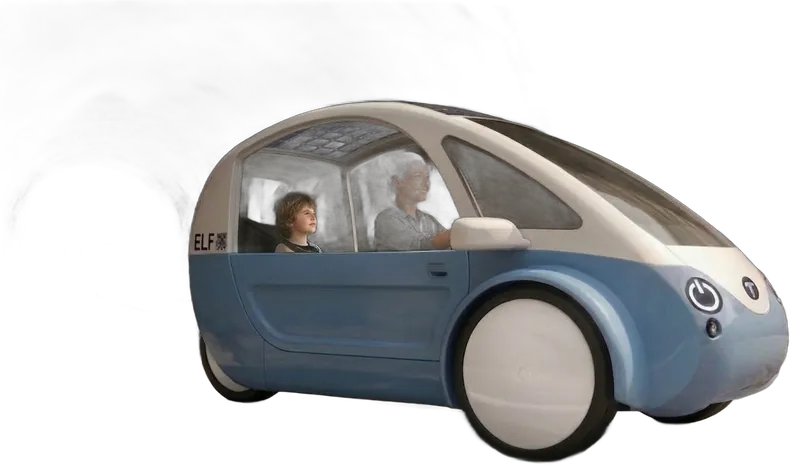
The 2026 relaunch model: two seats with seat belts, full suspension, a 1 kWh battery (2 kWh optional), a 200W solar roof, and a drivetrain programmable as a Class 1, 2, or 3 e-bike, reserved at a $7,500 target base price.
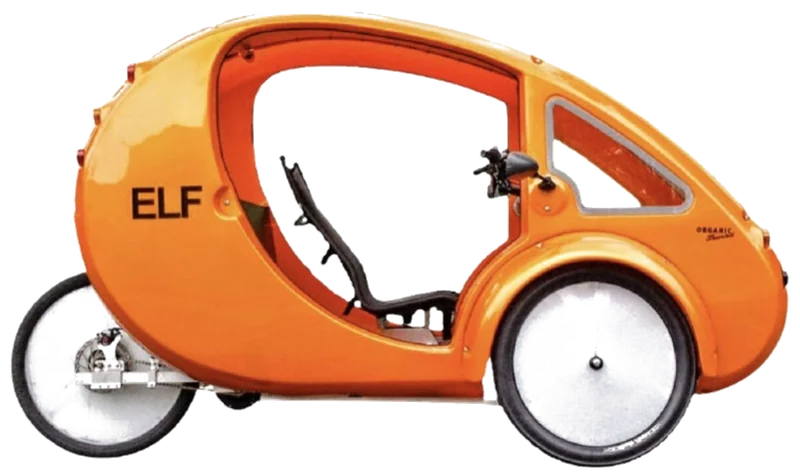
The original single-seat ELF: Trylon composite body on a 6061 aluminum frame, 750W motor, 100W solar roof, 20 mph electric assist and up to 30 mph pedaling, about 160 lb with a 350 lb payload.
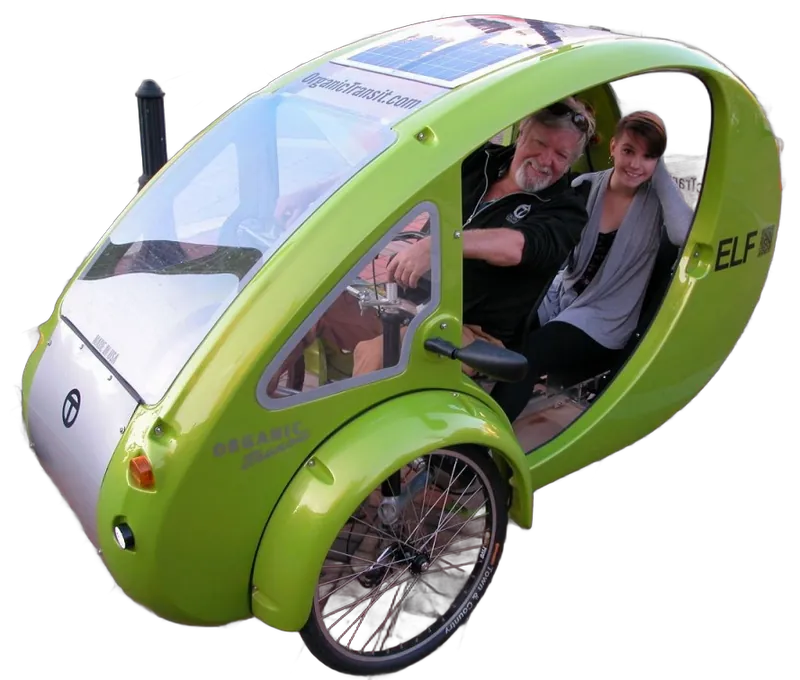
The Solo platform with a rear seat for a passenger or extra cargo, room for a second 16Ah battery pack, and the same 750W motor and 100W solar roof.
Organic Transit's Guarantee: What It Covers and Where It Stops
Organic Transit publishes two numbers for the legacy ELF, a 10-year guarantee on the frame and 12 months on the battery, and says the ELF 3.0 terms will follow. Five points decide what that is worth to you.
Ten years on the frame
The 6061 aircraft-aluminum frame and chassis comes with a 10-year guarantee. The published pages give no registration step, conditions, or exclusions for it.
Twelve months on the battery
Battery packs are tested for quality and guaranteed for 12 months. Organic Transit publishes no cycle count or capacity threshold, so a pack that fades after the first year is the owner's cost.
Repairs are meant for any bike mechanic
Organic Transit says most owners can maintain and make basic repairs with common hand tools, and that any competent bike mechanic can handle maintenance and repairs. Labor is not listed as a covered item.
Legacy parts go through a request form; ELF 3.0 terms are not out yet
Production paused during the change in ownership, and parts for legacy ELFs are handled through the Parts Requests page. The safety page says its guarantee information will be updated when the ELF 3.0 is finalized.
Nothing published covers crashes, theft, or a second owner
The guarantee pages say nothing about collision damage, theft, transit, or transfer to a new owner, and a defect guarantee never covers those losses. That gap is what a Velosurance policy is built for.
Summary of the Organic Transit Safety & Design and Legacy ELF FAQ pages, reviewed October 15, 2026. Applies to legacy ELF vehicles built in Durham from 2013 to 2019. Organic Transit says the published terms will be updated when the ELF 3.0 is finalized. The manufacturer decides every warranty claim, and its full published terms govern.
More Brands We Insure
Any brand of conventional or Class 1, 2, or 3 electric bike: theft, crash damage, and transit at stated value.



Why Velosurance is best for your Organic Transit
Velosurance is a stand-alone policy that covers theft and accidental damage and can be optioned to create a comprehensive umbrella of protection for your cycling lifestyle.
Protect your Organic Transit in under 2 minutes
Get a no-commitment price for any current Organic Transit model. Pay monthly, cancel anytime.
Get my free quote →