TL;DR:
Americans spent $5.4 billion on bicycles in 2020, up 64 percent in a year according to the retail tracker Circana, and a large share of those bikes were ridden for one summer and hung in a garage. Six years on they are flowing onto Facebook Marketplace, Craigslist, Pinkbike, and The Pro’s Closet at half of retail or less, which makes this the best used-bike market in memory and, for the same reason, the easiest one in which to buy somebody else’s problem. Used e-bikes, a category that barely existed five years ago, are now the fastest-growing part of that market, and they carry a problem that no ordinary bike does: a battery that may be worth a third of the asking price and quietly dying.
- Run the serial number before money changes hands. Bike Index and Project 529 are free, take five minutes, and a bike that turns out to be stolen can be seized from you with no refund from anyone.
- Inspect the bike like a mechanic, not a shopper. Frame and fork first, from the top and then flipped over, then bearings, wheels, tires, and drivetrain. Bring a flashlight, a chain checker, and a coin. A pre-purchase inspection at a shop, usually under $100, is the best money you’ll spend on a carbon bike.
- Assume the warranty is gone. Most manufacturers write the frame warranty to the original owner and require the original receipt. A few brands (Trek, Specialized, Giant with registration, Rad Power Bikes) extend something to a second owner, and the clock still runs from the first sale.
- On an e-bike, the battery is the deal. Get a dealer diagnostic showing charge cycles and remaining capacity, check the model for recalls, price a replacement battery before you negotiate, and do not buy a bike whose battery isn’t UL certified.
- Meet at a bank or police station parking lot, and leave with paperwork. A bill of sale with the serial number, notarized if the seller is willing, plus a payment record are what you’ll need to prove ownership, to register the bike, and to insure it for full value without the original receipt.
The good news is that a used bike is one of the most inspectable things you can buy second-hand. Almost everything that can go wrong is visible, audible, or measurable in a parking lot with a flashlight and ten minutes of attention. This guide walks through what to check, in the order that saves you the most time, and then covers the two subjects most guides skip: what happens to the warranty when a bike changes hands, and what is different about a used e-bike.
Before You Go: Price, Seller, and Serial Number
Most bad purchases are lost before the buyer ever sees the bike, so start with the listing.
Know what it should cost. Bicycle Blue Book’s value guide and The Pro’s Closet’s sold listings give you a floor and a ceiling for any common model. As a rough rule, a bike loses close to half its retail price in the first year and another 5 to 10 percent a year after that, so a clean two- or three-year-old bike sells for 40 to 50 percent of what it cost new, with bikes on outdated standards (rim brakes, 26-inch wheels, older axle spacing) going for less. A price far below the comps means one of three things: the seller doesn’t know what they have, the bike has a problem, or it isn’t theirs.
Read the listing like an investigator. Stock photos, a misspelled brand name, no frame size, no mention of components, and a seller who “just wants it gone” are the classic markers of a stolen bike being flipped. Legitimate sellers tend to know the bike’s history and are happy to talk about it. Ask how long they’ve owned it, where they bought it, what’s been replaced, and whether they have the original receipt or a serial number. A seller who won’t share the serial number before a meeting has already told you what you need to know.
Run the serial number. Every bike has one, usually stamped under the bottom bracket, and sometimes on the head tube, rear dropout, or seat tube. Search it on Bike Index and Project 529 Garage, the two largest theft registries in North America, and on the manufacturer’s registration lookup if they offer one. This step is not optional. Under U.S. law a thief cannot pass good title, so a stolen bike remains the property of its original owner no matter how many times it’s sold. If police identify it, they can seize it from you and return it, and your only recourse is a civil claim against a seller you met once in a parking lot. No insurance policy reimburses you for a purchase you never legally owned. A serial number that has been filed, painted over, or “lost” is a walk-away, not a discount.
The Inspection: Frame and Fork First
Everything on a bike can be replaced except the frame, so it gets the first and longest look. Meet in daylight, bring a small flashlight and a coin, and take the bike outdoors where you can see it from every angle.
Aluminum and steel frames. Sight down every tube from both ends looking for ripples, dents, or a paint finish that changes texture. Look at the underside of the down tube just behind the head tube, the top tube just behind the head tube, and the chainstays near the bottom bracket; these are where a front-end impact shows up first. Rust that’s cosmetic on a steel frame is fine; rust weeping from a weld, or a bubbling under paint, is not. On aluminum, check every weld for hairline cracks, particularly at the head tube and the seat tube junction.
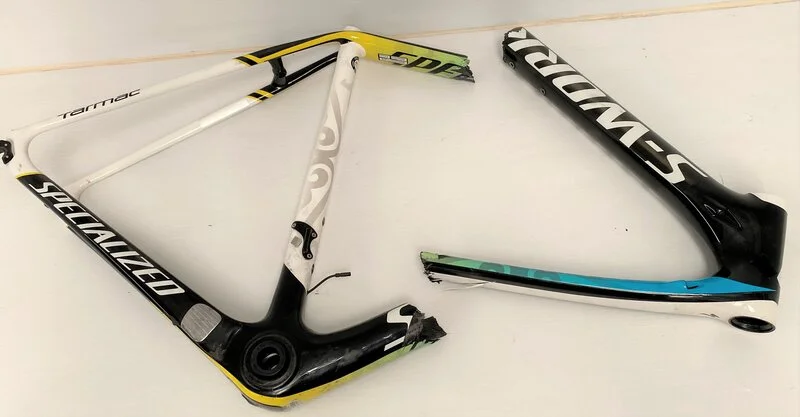
Carbon frames. Carbon does not dent, it cracks, and the cracks hide. The known trouble spots are the seatpost clamp slot (a small vertical crack that turns and runs horizontally), the inside faces of the seatstays, the fork crown around the brake mount, and the steerer tube where it meets the crown. Look for paint that has bubbled, spidered, or been touched up, and for any spot where the surface looks matte in a gloss finish. Press firmly along the tubes with your thumb; sound carbon is stiff and uniform, a damaged section flexes or feels soft. Then take out the coin and tap your way along every tube, an inch or so at a time. Healthy carbon gives a sharp, consistent click; a delaminated or cracked section sounds dull and flat, like tapping cardboard, and the change is obvious once you’ve heard it. Concentrate on the areas that take impacts, the down tube, the top tube behind the head tube, the chainstays, and around the dropouts, and tap both sides so you have a comparison. Then do the steerer test: stand over the bike, hold the front brake, and push down and forward on the bars. Any creak or rasp from the head tube, or visible movement between the fork and the frame, means walk away.
A carbon bike with any doubt at all should go to a shop before you pay for it. Most shops will do a pre-purchase inspection for the price of a basic tune-up, usually under $100, and some carbon repair specialists can ultrasound a suspect area. On a $3,000 frame, $100 to know what you’re buying is cheap.
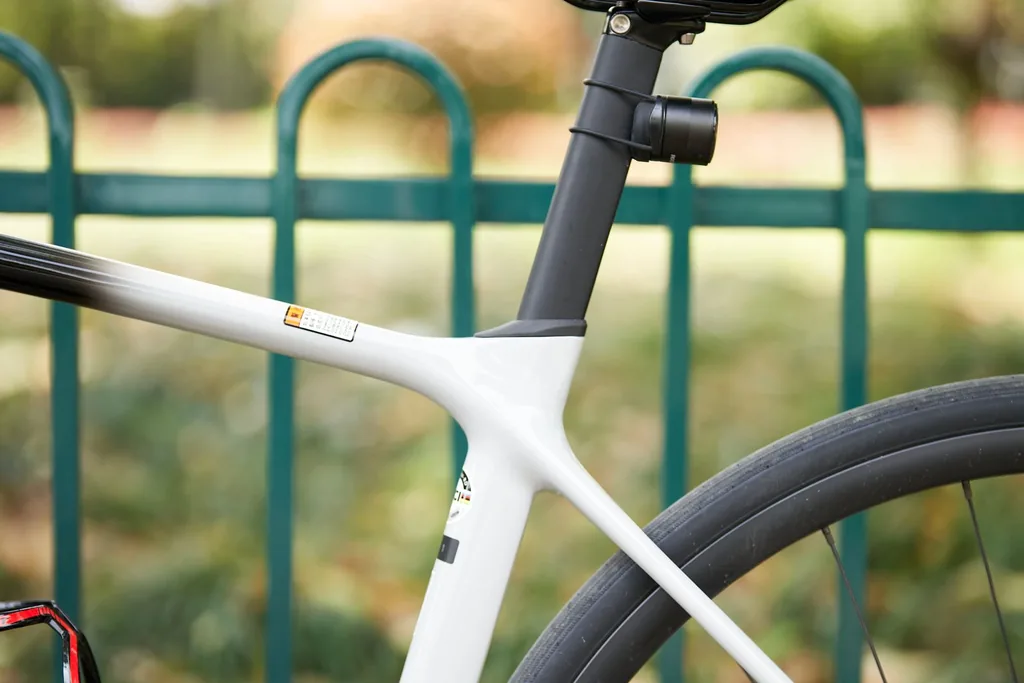
Flip it over. Once you’ve gone over the frame from above, turn the bike upside down and rest it on its saddle and bars. Most sellers never look at a bike from this angle, and neither do most buyers, which is why it’s where damage hides. The underside of the down tube takes rock strikes and tailgate-pad chafe, the bottom bracket shell takes the impact when a bike is dropped off a rack or cased on a jump, and the chainstays get hit by the chain. Run the flashlight and the coin along all of it. While the bike is upside down, spin each wheel: it’s the best position to sight the rims for wobble and hop, check spoke tension, look for cracks around the spoke nipples, and read the tire sidewalls.
Repaints and touch-ups. A repainted frame is hiding something until proven otherwise. Manufacturers do not repaint bikes, and owners rarely repaint one they haven’t crashed.
The touchdown points. Crashes leave evidence on the parts that hit the ground: scuffed hoods and lever tips, a scraped saddle edge, worn pedal ends, gashed crank arms, a scratched derailleur. One scuffed hood means the bike fell over; all of them on the same side mean it went down at speed, so go back over the frame on that side with the flashlight. Calibrate for the kind of bike. Mountain bikes live much harder lives and are designed to take a surprising amount of abuse, so rock rash on the cranks and pedal strikes are normal wear. On a mountain bike, look instead at the down tube and rear triangle, a derailleur bent in toward the spokes, and warped rotors.
The Inspection: Everything Else
With the frame cleared, the rest is about pricing the repair bill you’re about to inherit.
Wheels. Wheels are best checked with the bike still upside down from the frame inspection, where both spin freely and you can sight along the rim at eye level. Spin each wheel. It should run true, with no side-to-side wobble or up-and-down hop at the rim. Grab the wheel at the top and push it sideways; any play is a bearing or a loose axle. Squeeze pairs of spokes for even tension. On rim-brake bikes, run a fingernail across the brake track; a concave groove means the rim is nearing the end of its life. On carbon rims, any blistering or delamination on the brake track or spoke bed is a deal breaker.
Tires. Buyers skip these because they look like a consumable, and then find out a good tire runs $70 to $100 apiece, so a bike on two worn tires is a $150 to $200 line item before it leaves the driveway. Look for a squared-off center tread, cuts or cracks in the sidewall, exposed casing threads, and on tubeless setups, sealant weeping through the tread or a sidewall that’s gone soft and porous. Check the date code on the sidewall if there is one; rubber hardens with age, and a tire that’s been sitting for five years is done even if it still has tread.
Drivetrain. This is where the money goes on a neglected bike. Bring a chain checker (they cost about $10). A chain reading past 0.5 percent stretch on an 11 or 12-speed bike, or 0.75 percent on anything older, has worn the cassette and probably the chainrings with it. Look for shark-fin shaped teeth on the cassette and rings. A full drivetrain replacement on a modern road or mountain bike runs $200 to $500 in parts alone, so a bike that shifts badly in the parking lot needs more than the tune-up the seller will suggest. Price the parts and negotiate from there.
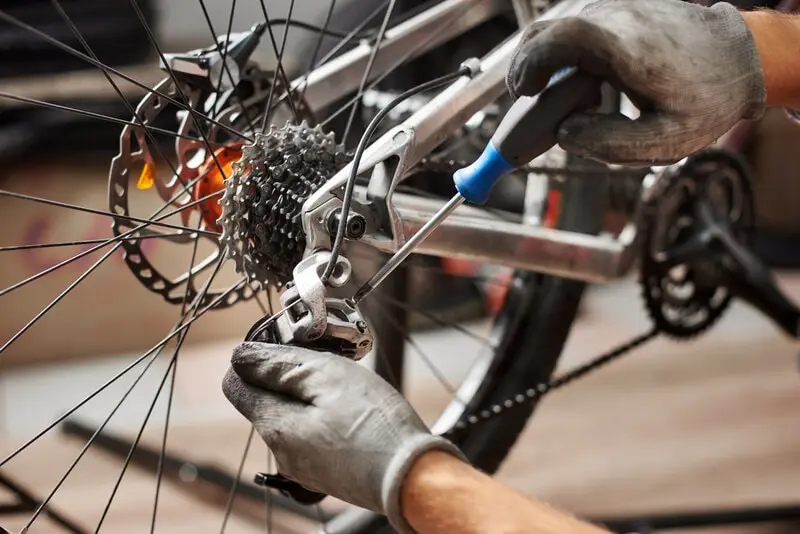
Bearings. Hold the front brake and rock the bike forward and back; a knock from the headset means it’s loose or worn. Pull the cranks side to side to feel for bottom bracket play, and spin them backward listening for grinding. On a full-suspension mountain bike, hold the front wheel and try to move the rear triangle sideways; play in the pivots means a bearing job that starts at $150 in labor. One more thing to check before you assume that job is even possible: bearing kits for many out-of-production frames, particularly full-suspension models from smaller brands or from big brands more than five or six years old, are notoriously hard to find. Search for the kit by model and year while you’re standing there. If nothing comes up but a forum thread of people asking the same question, price the bike as if the pivots can’t be rebuilt.
Suspension. On a mountain bike, cycle the fork and shock through their travel. They should move smoothly with no top-out clunk. Look at the stanchions for scratches or worn anodizing, and at the wiper seals for oil weeping. A fork or shock that’s due for service is $150 to $300 each; one with scored stanchions is a replacement. A parking-lot bounce won’t tell you much, so if there’s a park nearby, ride the bike down a flight of stairs. Suspension and linkages that haven’t been serviced announce themselves on stairs: a fork that tops out with a clunk, a shock that packs down and won’t recover, pivots that knock and creak. Some sellers will object. Don’t buy a mountain bike you weren’t allowed to ride like one.
Brakes. Hydraulic levers should feel firm, not spongy; mechanical cables should show no fraying or rust. On disc brakes, pads are cheap and rotors are not. With the bike upside down, shine the flashlight into the caliper to check pad thickness; worn pads are a $20 to $40 fix. Rotors wear thin, and the proper check is a micrometer against the brand’s published minimum thickness. Lacking one, drag a fingernail across the braking surface: if it catches on a lip, the rotor is shot, and a pair runs $60 to $120 plus labor.
Then ride it. Ten minutes minimum, on a route that includes a hill and a rough section. Shift through every gear under load. Stand and sprint to listen for creaks. Brake hard from speed to check for pulsing. Ride no-hands for a moment on a flat, safe stretch: a bike that pulls to one side may have a bent frame or fork, and that’s the one thing you can’t fix.
What you’re buying versus what’s advertised. Compare the components to the original spec (a quick search on the model year brings it up). Downgraded parts are common and honest sellers disclose them; undisclosed swaps to cheaper wheels or a lower-tier groupset are a reason to reprice or walk.
The Warranty: Assume It Left With the First Owner
Buyers routinely overvalue the warranty on a used bike, sellers routinely overstate it, and both are usually wrong in the same direction. The lifetime frame warranty that sold the first owner on the bike is, in most cases, not transferable. Manufacturers write their terms to “the original owner” or “the original retail purchaser,” require the original dated receipt, and say in plain language that coverage does not transfer. When the bike is sold, the warranty typically stays with the person who no longer owns it.
A few brands offer something to later owners, and the terms are narrow:
- Trek gives subsequent owners a three-year warranty on the frame and fork, running from the original retail purchase date and requiring proof of that original purchase. Wheels, suspension forks, and drivetrain are not included.
- Specialized extends a two-year warranty to any owner with proof of purchase, again from the original purchase date, compared with the lifetime frame warranty a registered original owner gets.
- Giant writes its warranty to the original owner only, not transferable unless the bike was registered on Giant’s site, and the e-bike battery is covered for one year or 600 charge cycles, whichever comes first.
- Canyon covers frames and forks for six years, and e-bike batteries for two years or 500 cycles, but only for the original owner. Nothing transfers.
- Rad Power Bikes extends its two-year warranty to a “valid transferee,” provided the bike was originally bought from Rad or an authorized retailer, and the battery portion is two years or 300 recharge cycles from the first sale. Any modification to an electrical component voids it.
- Santa Cruz, Yeti, Cannondale, Marin, Commencal and most boutique brands: original owner only. Several offer a crash-replacement discount to any owner, which is a discounted purchase, not coverage.
Two practical consequences follow. First, on any bike more than three years old, the transferable warranty is already zero, so stop pricing it in. Second, where a warranty does transfer, it still only covers defects in materials and workmanship. It never covered a crash, a theft, a fall off a hitch rack, or a battery that lost capacity from normal use. The events that end a bike’s life were never the warranty’s job, on a new bike or a used one, which is a large part of why used-bike owners insure the bike rather than chase the warranty.
If a transferable warranty matters to you, get the seller’s original receipt at the handoff. Without it, every brand on the list above will decline the claim.
E-Bikes: The Battery Is the Purchase
With a used e-bike you are buying a bicycle, which you inspect as above, plus a battery-and-motor system that can be worth more than the frame. The battery is the part that ages whether or not it’s ridden, and it is the part most sellers know least about.
Price the replacement before you negotiate. A replacement battery for a Bosch, Shimano, or Specialized system typically runs $600 to $1,000 and can go well past that for large-capacity packs; on a direct-to-consumer bike it may be cheaper but harder to source. That figure is your worst case, and a used e-bike priced without accounting for it is priced wrong.
Get the numbers, not the story. Every modern e-bike system logs total distance, charge cycles, and remaining capacity, and on newer bikes you can read some of it yourself. Bosch’s eBike Flow app shows charge cycles on Smart System bikes (roughly 2022 and later), the Specialized app reports battery health on its current motors, and Shimano’s E-Tube app and most direct-to-consumer brands’ apps show cycle counts and odometer. Ask the seller to open the app in front of you and screenshot the battery page. Two caveats: older systems, including pre-Smart System Bosch, show nothing in the app and need a dealer’s battery tester, and a cycle count alone is not the same as health. The full picture comes from a dealer diagnostic report, which a Bosch, Shimano, or Specialized dealer can pull in a few minutes and which lists manufacturing date, serial numbers, charge cycles, current capacity as a percentage, peak battery temperature, and the error log. Ask the seller to have it done, or make the sale conditional on a diagnostic at a shop of your choice. If the seller refuses, assume the report would have said what they don’t want you to read.
Cycle count tells you how much; it doesn’t tell you how. Two batteries with 300 cycles can be in very different shape, because lithium cells age according to how they were treated. A battery that was routinely run to empty, charged to 100 percent and left there for weeks, stored in an unheated garage through a northern winter, or left on the bike in the sun in July has lost capacity that never shows up in the cycle count. You can ask the seller how they charged and stored it, and the honest ones will tell you, but the answer is unverifiable. The only sure way to know what you’re buying is a dealer diagnostic that reads the battery’s actual capacity against its rated capacity.
Know what the numbers mean. Manufacturers guarantee their batteries to a threshold, not to full health: Bosch promises at least 60 percent of original capacity after 500 cycles or two years, Shimano 60 percent after 1,000 cycles, and most others land between. Certified pre-owned sellers such as Upway replace any battery below 80 percent. Use 80 percent as your line for a battery you don’t want to think about, and treat anything under 70 as a replacement cost you should subtract from the price. If there’s no diagnostic available, estimate cycles yourself: total miles on the odometer divided by realistic miles per charge (25 to 35 for most commuters) gives you a rough count.
Check the physical battery. Look for cracks in the casing, corrosion on the contacts, and any swelling or deformation. Confirm the battery locks and unlocks cleanly, that both keys are present, and that the original charger comes with the bike. A missing charger or key is the single most common tell for a stolen e-bike.
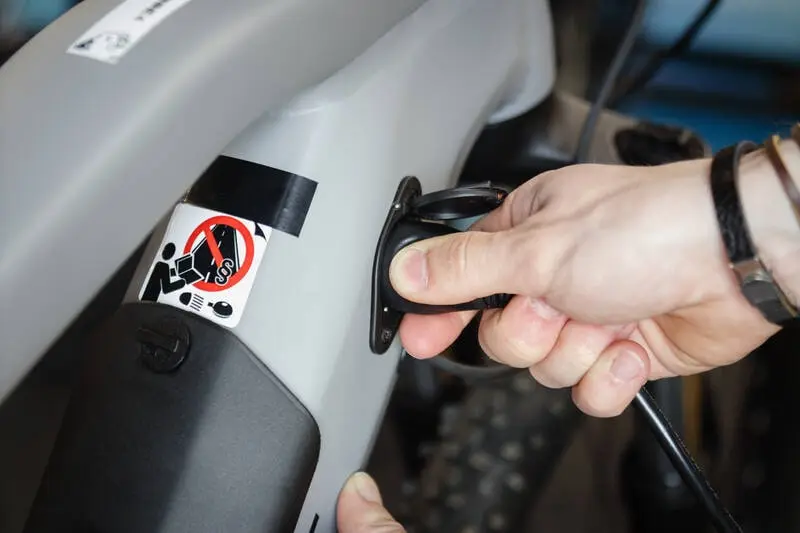
Look for the certification mark. Since 2023, New York City has required e-bikes sold there to be certified to UL 2849 (the whole electrical system) and batteries to UL 2271, and other jurisdictions and insurers have followed the standard. The mark is usually on a label on the battery, the motor, or the frame near the down tube. An uncertified battery on a name-brand bike (Bosch, Shimano, Yamaha, Specialized, Trek) is essentially unheard of; on a no-name direct import it is the norm, and it is the reason those bikes make the news. If you can’t find the mark, assume it isn’t there, and don’t buy the bike. Uncertified batteries are the ones behind the apartment fires that pushed New York City to pass Local Law 39 in 2023, which bans the sale of e-bikes and batteries without third-party certification, and building managers in New York and other cities have been writing the same requirement into their house rules since. No discount is worth storing one in your home.
Check for recalls. Search the make and model on the Consumer Product Safety Commission’s recall database at cpsc.gov, and search the news for the brand plus “recall” or “safety warning.” Then read past the headline, because a recall is only useful if the manufacturer honors it. In November 2025 the CPSC warned owners of nine Rad Power models to stop using two battery models after 31 fires; Rad disputed the finding and declined to recall or refund. In March 2026 the CPSC told owners of the Ridstar Q20 to stop riding and dispose of the battery as hazardous waste after 11 fires, and the manufacturer refused to cooperate with a recall at all. A bike under a safety warning that its maker won’t act on has no fix and no path to one, at any price. Walk away.
Check for tampering. Derestriction kits and tuning dongles that remove the 20 or 28 mph assist cutoff are common on used e-mountain bikes. They void every manufacturer’s warranty, they can move the bike out of the Class 1-3 system your state recognizes (and out of what a bicycle insurance policy covers), and modern motor firmware logs the evidence even after the device is removed. Ask directly, look for a small inline module near the speed sensor or rear wheel magnet, and on the test ride watch the display: assist that continues past 20 mph on a Class 1 or 2 bike is your answer.
Test the whole system. Ride in every assist mode. Power should come on smoothly and cut cleanly when you stop pedaling. Listen for grinding or clicking from the motor under load on a hill, and note any error codes on the display. Confirm firmware is current at the diagnostic; some brands lock older firmware out of the app.
The e-bike warranty clock runs faster. Battery and motor warranties are short, usually two years or a cycle count from the first sale, so a two-year-old used e-bike often has zero battery warranty left on the day you buy it, even from the brands that transfer. The battery is exactly the part you’d want covered, and it’s the one you won’t be.
The Handoff: Leave With Paper
Pick the meeting place yourself, and pick one with a camera. A bank parking lot or a police station lot is ideal: well lit, busy, recorded, and the kind of place a seller with a stolen bike would rather not go. Police departments from Fremont, California to Dallas and Richardson, Texas now mark out a “safe exchange zone” in their lots, under 24-hour cameras, for exactly this kind of sale; search your city’s name plus “safe exchange zone” to find the nearest one. Bring a friend and the printed listing so you can compare it to what shows up. Then, before any money moves, get the paperwork that will matter for years.

A bill of sale. One page: seller’s name and contact, your name, date, price, make, model, year, color, and the serial number, signed by both. It is your proof of ownership if the bike is ever questioned, and it’s what lets you register the bike in your own name and insure it. Velosurance has a free fillable bicycle bill of sale you can print or complete on a phone at the handoff.
Get it notarized if you can. For the most complete protection, have the bill of sale notarized. A notary checks the seller’s government ID and records the signing, which turns a piece of paper into a document that names a verified person as the seller. If the bike ever turns out to be stolen, that record is what points police and a court to the right party, and it does something useful before that too: a seller who knows the bike isn’t theirs will find a reason not to show up. Most banks offer notary service free to their customers, so schedule the handoff in your bank’s parking lot, make an appointment with the branch if yours requires one, and walk inside together to sign. If the seller is willing, it’s ten minutes.
A payment record. Pay by Venmo, Zelle, PayPal, or bank transfer rather than cash so there’s a dated record of the transaction and who received it. That record doubles as proof of purchase.
Whatever the seller has. The original receipt (for any warranty that transfers), service records, spare keys, the charger, the tubeless valves, the thru-axle tool. Ask for all of it.
Photograph everything the same day. The bike from both sides, the serial number, the drivetrain, the components, the battery label. These establish the bike’s condition and build on day one.
Then, that evening, do three things. Register the serial number in your name on Bike Index and Project 529 (it’s free, and the previous owner’s registration, if any, should be transferred to you). Register the bike with the manufacturer, which is the only way any second-owner warranty benefit comes to life. And insure it.
Insuring a Bike You Didn’t Buy New
This is the part that surprises people. Buyers assume a used bike is harder to insure than a new one, that they’ll need the original receipt, or that a claim will be paid at some depreciated fraction of what they paid. None of that is true of a proper bicycle policy.
A used bike, whether you bought it last week or bought it new nine years ago, is insured for what it would cost to replace as it’s built today: the frame plus every component currently on it. For a bike you bought second-hand, that starts at the price you paid or a value you can support with comparable listings, and there is no depreciation for age. A five-year-old bike insured for $4,000 that’s stolen from a locked garage pays $4,000 less the deductible, not what a homeowners adjuster thinks a five-year-old bike is worth. Proof of purchase can be your bill of sale or your payment record; the original retail receipt is not required. When you upgrade a part, the insured value adjusts to match.
The other thing worth understanding before you buy is where coverage stops, because it points right back to the inspection. Insurance covers what happens after the policy starts. A carbon crack from the previous owner’s crash, a battery that has faded to 55 percent, or a fatigued steerer that lets go on your third ride is not a new loss and no policy covers it. The pre-purchase inspection does two jobs at once: it protects the purchase, and it documents the bike’s condition on the day your coverage begins.
Everything a warranty was never going to cover on a used bike, theft at home or away, crash damage, damage in transit, being hit by a car, is covered from the policy’s effective date, along with the liability and medical coverage that matter more on an e-bike. The full detail, including how used e-bike batteries are covered and what a homeowners policy does and doesn’t do for a used bike, is on our used and second-hand bike insurance page.
Frequently Asked Questions
- How do I check if a used bike is stolen?
- Get the serial number from the seller before you meet (it’s usually stamped under the bottom bracket) and search it on Bike Index and Project 529 Garage. Then look at the listing and the seller: stock photos, no serial number, a price far under market, a missing charger or keys on an e-bike, and a seller who knows nothing about the bike’s history are the usual tells. A stolen bike can be seized from you without compensation, and no insurance policy covers a purchase you never legally owned.
- Does the manufacturer’s warranty transfer when I buy a used bike?
- Usually not. Most brands limit the warranty to the original owner and require the original receipt. Trek gives second owners three years on the frame and fork from the original purchase date, Specialized two years, Giant transfers only if the bike was registered, and Rad Power Bikes covers a transferee for two years from the first sale. Canyon, Santa Cruz, Yeti, Cannondale, and most boutique brands transfer nothing. Even when a warranty transfers, it covers manufacturing defects only, never theft or crash damage.
- How can I check an e-bike battery’s health before buying?
- On newer systems, the brand’s app (Bosch eBike Flow on Smart System bikes, the Specialized app, Shimano E-Tube) shows charge cycles and sometimes a health percentage; ask the seller to open it in front of you. Cycle count alone doesn’t capture how the battery was charged and stored, so the reliable answer is a dealer diagnostic that reports actual capacity against rated capacity. Treat 80 percent as the line for a battery you won’t have to think about, and subtract a replacement ($600 to $1,000 or more) from the price for anything well below it.
- Should I buy a used e-bike whose battery isn’t UL certified?
- No. Look for the UL 2849 or UL 2271 mark on the battery, motor, or frame label. Name-brand systems carry it; many low-cost direct imports don’t, and those are the batteries behind the fires that have led cities and building managers to ban uncertified e-bikes indoors. Also check the model against the CPSC recall database and walk away from any bike under a safety warning the manufacturer won’t honor.
- How do I check a carbon frame for cracks?
- Under bright light, look for bubbled, spidered, or touched-up paint and any matte patch in a gloss finish, especially at the seatpost clamp, the seatstays, the fork crown, and the head tube. Tap along every tube with a coin: sound carbon clicks sharply, damaged carbon sounds dull. Press with your thumb for soft spots, flip the bike over to check the underside of the down tube and the bottom bracket area, and do the steerer test by holding the front brake and pushing down on the bars. If anything is in doubt, pay a shop to inspect it before you buy.
- What should be on a bill of sale for a bike?
- Seller’s name and contact, buyer’s name, date, price, make, model, year, color, and the serial number, signed by both. Have it notarized if the seller is willing (most banks do it free for customers), and pay by Venmo, Zelle, PayPal, or bank transfer so there’s a dated record. Together these prove ownership, let you register the bike, and stand in for a retail receipt when you insure it.
- Can I insure a used bike without the original receipt?
- Yes. A bicycle policy insures the bike for what it would cost to replace as it’s built, with no depreciation for age, and accepts a bill of sale or payment record as proof of purchase. Coverage begins on the policy’s effective date, so damage that predates it, including a hidden crack or a faded battery from the previous owner, isn’t covered, which is one more reason to inspect before you pay. Details are on the used bike insurance page.
Policy terms, available coverages, and state laws vary and change; this article is general information, not insurance or legal advice. Manufacturer warranty terms are as of September 2026 and change without notice; check the manufacturer’s current policy before relying on it.