TL;DR:
- The federal cap on what a health plan can make you pay in a year rises to $12,000 for an individual in 2027, up from $10,600, and employers expect their steepest cost increase since 2003. Make sure you elect Medical Payments coverage on your bike policy, because that is what covers the deductible and out-of-pocket costs your health plan leaves you with after a crash.
- About one in five cyclists killed on US roads in 2024 died in a hit-and-run, one in three drivers is uninsured or underinsured, and cyclist deaths in crashes with cars are up 73% since 2010. Uninsured Motorist coverage is the one option every road rider and bike commuter should carry, and not every bike policy offers it.
- New Jersey became the first state to require liability insurance for throttle e-bikes, and co-op and condo boards now ask for proof of insurance before an e-bike is stored on the premises. Most states still treat an e-bike as a bicycle.
- Bikes cost more to replace in 2027 because new tariffs took effect in July 2026. Insure the bike for the value that matches today's replacement price, so you can afford to replace it in case of a total loss.
- A homeowners claim for a stolen bike raises your premium by roughly 25%, and most home policies now treat an e-bike as a motor vehicle. Keep bike claims on a bike policy.
This guide updates last year's guide to bike insurance with what changed in 2026.
First, health plans cover less of an injury. The federal limit on what a plan can make you pay out of pocket rises to $12,000 for 2027, the enhanced marketplace subsidies expired, and employers are raising deductibles. Second, liability insurance for e-bikes became a requirement in some places: New Jersey is the first state to require it by law, and apartment buildings, co-op boards and universities set their own rules on storage, batteries and proof of insurance. Even city-owned sidewalks are not immune. Third, bikes became more expensive to replace after new tariffs took effect in 2026.
Your health plan covers less of a crash in 2027

Nearly every health plan, including your employer's, caps what you pay in a year for in-network care at a figure the federal government sets. For 2027 the cap is $12,000 for an individual, up from $10,600, the largest one-year increase on record. The hospital treats you first and bills you afterward, and in 2027 those bills can add up to $12,000 that you pay out of pocket before the plan covers the rest. An ambulance, imaging and surgery can reach that in a day.
If you buy your own coverage on the marketplace, Congress let the enhanced premium tax credits expire at the end of 2025, and the average marketplace deductible rose 37% in a year, according to KFF, the health policy research group, as people moved to cheaper bronze plans. Premiums for 2027 are up another 13%.
Large employers expect costs to rise 8.2% in 2027, the biggest jump since 2003, according to Mercer, and most plan to pass part of it on through higher deductibles. The usual tool is a high-deductible plan with a health savings account, which you fund from your paycheck over the year, so a crash in March arrives when the account holds two months of contributions and the full deductible is due.
Most serious cycling crashes end with an ambulance ride, because a rider with a broken collarbone or a concussion does not drive to the ER, and the ambulance is the bill your health plan pays least of. The federal No Surprises Act, which stops hospitals and doctors from billing you for the difference between their charge and what your insurer pays, does not cover ground ambulances, and most ambulance companies are out of network, so they can bill you for the gap. If the ambulance charges $3,000 and your plan allows $1,000, you owe the $2,000 difference, and the $1,000 the plan allowed comes out of your deductible.
Medical Payments coverage is the answer, and it is an option on some bike policies. Where offered, it pays the deductible, the coinsurance and the ambulance bill up to the limit you choose, regardless of fault, whether you crashed alone on a trail or were hit in a bike lane. Look for a policy that offers a limit closest to your health plan's annual out-of-pocket deductible. We go through the health changes in more detail in the cyclist's health coverage guide.
Drivers cause the most expensive crashes, and many cannot pay

Drivers injured 52,887 cyclists in 2024, according to NHTSA, and the number has risen every year since 2020. Cyclist deaths rose again in 2025 while total traffic deaths fell.
About one in five cyclists killed in 2024 died in a hit-and-run, 230 riders, according to NHTSA, and the AAA Foundation for Traffic Safety reports hit-and-runs at a record high.
The Insurance Research Council's latest study found that one in three drivers on US roads is uninsured or carries limits too low to cover a serious injury, a share that has grown ten points since 2017. Even in states that raised their minimums for 2026, the law requires as little as $30,000 to $50,000 per person.
Uninsured Motorist coverage pays your medical bills, lost wages and rehabilitation when the driver has no insurance, not enough, or drove off, and Medical Payments coverage pays the deductible and ambulance bill while the claim against the driver is argued. Uninsured Motorist coverage is rare on bike policies, so if you ride on roads, make it the first thing you check for. If a policy does not list it, there is no substitute anywhere else in your insurance. We covered how auto and bike policies interact in does auto insurance cover bicycle accidents.
New Jersey now requires e-bike liability insurance
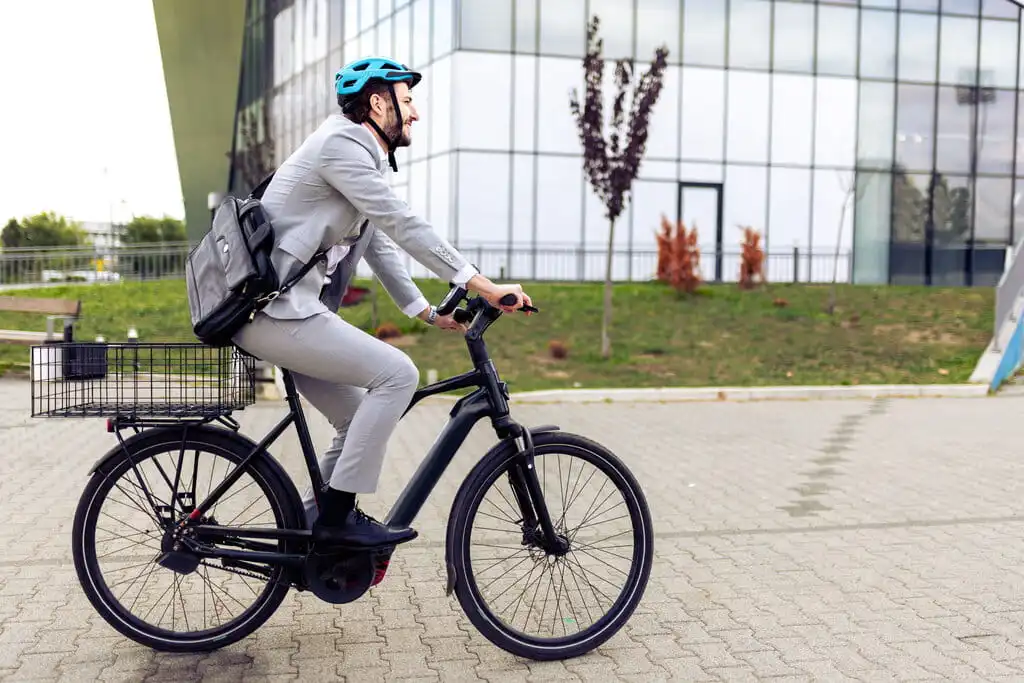
New Jersey's e-bike law took full effect on July 19, 2026. Any e-bike with a throttle, or with pedal assist above 20 mph, now needs a license, registration and liability insurance. The required minimums are $15,000 of bodily injury coverage per person, $30,000 per accident and $5,000 of property damage, and a homeowners or auto policy does not satisfy the requirement. To register the e-bike, the Motor Vehicle Commission asks for an insurance ID card showing those limits, which very few bike insurers can issue. No other state requires insurance for a Class 1, 2 or 3 e-bike, and the 2026 laws in Illinois and California keep those classes as bicycles. Our New Jersey e-bike law guide covers the paperwork, and we keep a state-by-state e-bike regulations update.
Your liability when you ride away from home
Liability coverage pays when you are at fault: a pedestrian you hit in a crosswalk, a rider you bring down in a group, a car you scrape. Their medical bills, lost wages and property damage become your debt, and you are the one who gets sued. If the rider is under 18, that usually means the parents. In New York City alone, e-bikes and e-scooters injured 329 pedestrians in 2022 and 328 in 2023, according to the city comptroller.
Most riders assume their homeowners or renters policy covers this, and for a conventional bicycle it usually does, but not an e-bike. Since the 2022 revision of the standard homeowners forms, an e-bike is defined as a motor vehicle, which the liability section excludes away from the insured premises. A personal umbrella follows the same exclusion. Very few bike insurance policies offer liability coverage, and among those that do the limits vary widely, so confirm that the policy offers it and what the limit is. We explain the homeowners e-bike exclusion and how a bike policy satisfies umbrella requirements separately.
Buildings, co-ops and campuses write their own rules

The New York City Fire Department counted 401 lithium battery fires and 6 deaths through late October 2026, up from 292 fires and 1 death in all of 2025.
Co-op and condo boards work from a familiar menu: register the e-bike with management, show the receipt and the battery's UL certificate, show proof of insurance, charge only in the bike room or not at all, and sign an acknowledgment that breaking the rules is a lease violation.
Boards rarely publish a required liability limit. When a building asks for proof of insurance, it wants a policy that pays if your e-bike injures someone or damages property in the building. In practice, $300,000 satisfies most managing agents and $500,000 nearly all of them, and most umbrella carriers require the same amounts of underlying coverage before they pay anything.
On June 24, 2026 the Consumer Product Safety Commission (CPSC) proposed a mandatory standard that would make UL 2849 and UL 2271 certification a legal requirement for every e-bike and battery sold in the United States, and San Francisco banned the sale of uncertified batteries the same month. If the battery has no UL mark, your building can refuse it, your insurer can refuse it, and the CPSC may soon make it unsellable, so there is little reason to buy an e-bike without a certified battery in 2027, whatever the price.
The bike itself costs more to replace

New tariffs on imported bikes and parts took effect on July 24, 2026, at 10% to 12.5% depending on country of origin, added to the existing 25% tariff on Chinese goods. The bike you bought in 2024 costs more to replace in 2027 than you paid, so insure it for today's replacement price. Under an actual cash value policy, a three-year-old $4,000 e-bike pays about $2,900 before the deductible, while an agreed value policy pays the full insured amount.
The best academic estimate puts US bike thefts at about 2.4 million a year, valued at $1.44 billion, and the largest survey of theft victims found that only about 15% got their bike back, nearly all of them riders who had the serial number on record. Without a serial number, recovery drops to about 5%.
Theft coverage is where bike policies differ most. On some it is not included by default and must be elected separately, and many policies rate e-bikes separately from conventional bikes, with e-bike theft coverage priced significantly higher. Before comparing premiums, confirm that theft is included and ask for the e-bike rate.
Leave your homeowners policy out of it
The average US homeowners premium ended 2025 at $2,948, up 12% in a year, and a single theft claim raises it about 25% on average, according to Insure.com's 2026 rate analysis. The payout is depreciated and reduced by a deductible that is often $2,500 or more.
Some bike policies are not primary. A secondary policy requires you to file with your homeowners insurer first and only pays what the home policy did not, so a stolen bike still lands on your home insurance record and raises that premium. To keep bike and home insurance separate, make sure the bike policy you buy is primary coverage, meaning it pays first and the homeowners insurer is not involved. Beyond that, check that the policy pays an agreed value with no depreciation, covers theft away from home at any hour, covers crash and transit damage from any accidental cause, and covers the bike when a friend rides it.
What to carry in 2027
Every rider needs the same base: theft and crash damage coverage on the bike itself. On some policies those are separate elections, so confirm both are included. The optional coverages should be selected by how and where you ride.
Commuter. Add liability at $100,000 or more, Medical Payments sized to your health insurance's annual out-of-pocket deductible, and Uninsured Motorist coverage, since commuting puts you in traffic daily. If you leave the bike outside unattended, read the lock requirements and any limit on how long it can be left unattended, because some policies set very strict limits.
Urban dweller. If you keep an e-bike in an apartment building or a co-op, ask the building manager in writing what liability limit the building requires, then buy that limit or the next tier higher. Keep the declarations page with the battery's UL certificate, since the building will ask for both.
E-bike owner. Confirm the policy covers e-bikes and at what rate, that the battery is covered as part of the bike, and that liability is available, since the weight and speed expose you to liability. In New Jersey, the policy also has to produce the Motor Vehicle Commission's insurance card.
Recreational rider. If you ride paths and quiet roads, agreed value theft and crash damage coverage is most of what you need, plus Medical Payments sized to your health insurance's annual out-of-pocket deductible.
Road rider. Uninsured Motorist coverage first, then Medical Payments sized to your health insurance's annual out-of-pocket deductible.
Mountain biker. Medical Payments first, since most trail crashes involve nobody else.
Racer. Make sure the policy offers racing coverage and that you elected it, because most bike policies exclude damage during competitive events unless competitive use is declared. Claim any discount for USA Cycling, USA Triathlon or IMBA membership.
Parent of a teen rider. Confirm the policy covers your child riding the bike, that liability applies to any permitted rider and not only the owner, and that Medical Payments pay for whoever is on the bike. If the teen injures someone, the claim comes to you.
Family. Families share bikes, so make sure the policy includes permissive use, which extends coverage to anyone riding the bike with the primary insured's permission.
Multi-bike household. Insure every bike on one policy and ask for the multi-bike discount, with each bike at its own agreed value.
Traveler. Check how the policy treats transit and where coverage ends. Some policies cover you only in the United States, others include Canada by default, and coverage beyond that requires a worldwide add-on, so confirm the policy offers one and add it before leaving.
Whatever kind of rider you are, read the policy document before buying and check the list of exclusions.
Where all of this is in one policy
Every coverage described above is on the Velosurance bicycle and e-bike insurance policy: agreed value with no depreciation, primary coverage that never touches your homeowners insurance, theft away from home at any hour with any lock, crash and transit damage from any accidental cause, coverage when someone else rides your bike, and optional Medical Payments, liability, Uninsured Motorist, racing and worldwide coverage. Class 1, 2 and 3 e-bikes are covered the same way as any other bicycle.
Frequently Asked Questions
- Do I need e-bike insurance by law in 2027?
- Only in New Jersey, and only for e-bikes with a throttle or assist above 20 mph. Every other state treats Class 1, 2 and 3 e-bikes as bicycles with no insurance requirement. Outside New Jersey the requirement, where there is one, comes from your building, your university or your homeowners association.
- How much liability coverage does an apartment building or co-op want?
- Most boards do not publish a number. Managers tend to accept the limits umbrella insurers require as underlying coverage, which is $300,000 for most policies and $500,000 for some. Ask the managing agent in writing, and expect to show the battery's UL 2849 or UL 2271 certificate alongside the policy.
- Why does the 2027 out-of-pocket maximum change what bike coverage I buy?
- The federal cap on in-network spending is $12,000 for an individual in 2027, up from $10,600, and it applies to employer plans as well as marketplace plans. Medical Payments coverage on a bike policy pays the deductible and coinsurance that sit under that cap, regardless of fault, up to the limit the policy offers. Pick a policy that offers a limit matching your deductible plus an ambulance bill.
- Will my homeowners or renters policy cover my e-bike?
- Usually not for liability, and often not for theft away from home. The standard homeowners forms were revised in 2022 to define an e-bike as a motor vehicle, so the liability section excludes it once you leave the property, and a personal umbrella follows the same exclusion. Property coverage, where it exists, is depreciated and subject to the home deductible.
- What does bike insurance cost in 2027?
- Most specialty policies run 3% to 8% of the bike's agreed value per year for theft and damage, so a $3,000 bike costs roughly $150 to $200 and a $6,000 bike $300 to $400. Liability, Medical Payments and Uninsured Motorist coverage add tens to a few hundred dollars a year each. Tariffs raised bike values in 2026, so re-check the insured value at renewal.
Policy terms, conditions and exclusions vary. This article is for general information only and is not insurance or legal advice. Check your policy documents and local laws for the details that apply to you.