TL;DR:
- Most two-wheel trailers attach with a small steel hitch plate that sits on the left end of your rear axle. Quick-release axles take it as is. Thru-axles and the nutted axles found on hub-motor e-bikes usually need an adapter or a replacement axle, so identify your axle before you shop.
- Buy for the trip you make every week. A Costco run wants a 100 lb two-wheel flatbed or tub. A daycare run wants a child trailer built to ASTM F1975 with a five-point harness. A walk-in grocery stop wants a folding seatpost trailer that doubles as a hand cart.
- Never put a child in a cargo trailer. Burley’s Flatbed manual says it in capital letters: do not carry passengers or pets. Children ride in child trailers, wearing helmets, starting at about 12 months.
- Load heavy items low and over the trailer’s axle, keep some weight on the hitch (Burley specifies more than 2 lbs and no more than 20 lbs), and hold your speed to 15 MPH on straight roads and 5 MPH in turns.
- An e-bike makes a loaded trailer easy to pull and no easier to stop. Expect 20% to 50% less range, brake early, and read your e-bike’s manual for a towing limit before you hitch up.
The cheapest way to retire your car from errand duty
A good electric cargo bike costs $2,000 to $8,000 and needs its own parking spot. A trailer costs $150 to $600, hooks to the bike you already own in about ten seconds, and hangs on a garage wall afterward. For one or two big hauls a week, it is the smarter purchase.
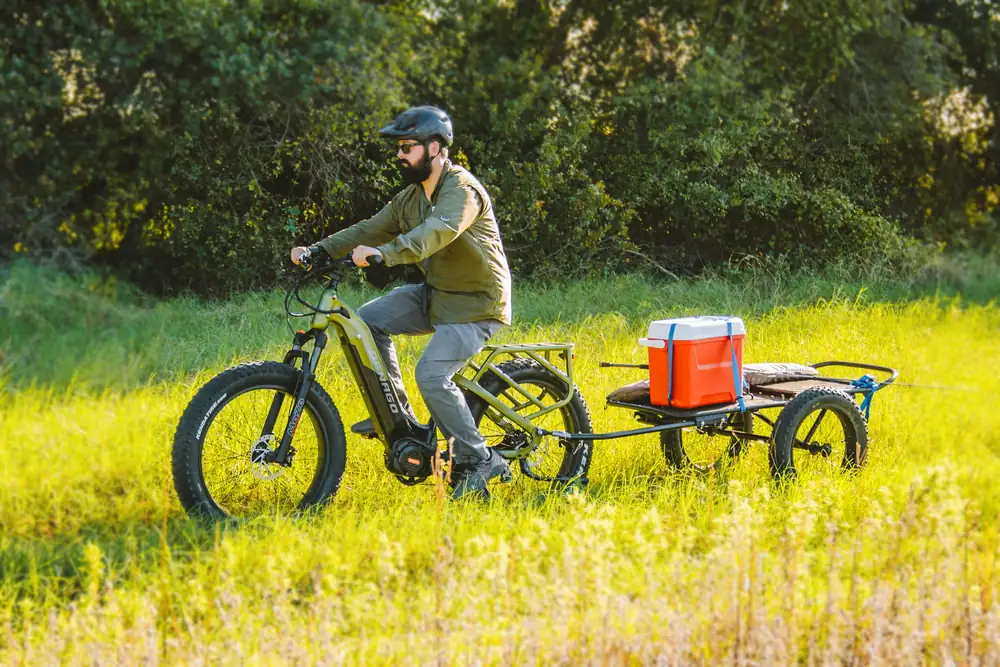
Burley of Eugene, Oregon, a trailer builder since the 1970s, sells five cargo models. Thule, Wike, Surly, Bikes At Work, Aosom, Schwinn and Retrospec compete at $150 to almost $1,200. E-bikes grew the category by taking the suffering out of pulling 100 lbs uphill.
Picture a Saturday at a warehouse store. A rider straps a case of water, a 40 lb bag of dog food and a box of diapers into an aluminum trailer and pedals past SUVs waiting for a space. The bike handles as it did on the way over, because the trailer’s wheels carry the weight.
How a trailer attaches to your bike
Axle-mount hitches
Two-wheel trailers from Burley, Thule, Wike, Aosom, Schwinn and most others use a small steel or forged aluminum plate clamped under the nut on the left end of the rear axle. It weighs a few ounces and stays on the bike. The tow bar locks in with a pin, backed up by a nylon strap around the chainstay. A flexible joint lets the bike lean, or fall, while the trailer stays upright.
Quick-release axle. Remove the skewer’s acorn nut, slide the hitch on, rethread and close the lever. Five minutes, no tools. If fewer than four or five full turns of thread engage, buy a longer skewer.
Nutted (bolt-on) axle. Found on most hub-motor e-bikes, single-speeds and internally geared hubs. The hitch goes under the left hex nut. Motor axles are often fatter, commonly M12 or M14, with an anti-rotation washer the hitch must not replace or disturb, and sometimes a motor cable in the way. A threaded hitch adapter in the matching size gives the hitch a flat seat.
Thru-axle. Standard on current mountain, gravel and disc road bikes, it threads into the frame. With nowhere for a plate, you swap in a replacement axle with a threaded stud, from Burley, Thule or The Robert Axle Project of Bend, Oregon, which covers nearly every frame and trailer brand, including Croozer, Hamax, Schwinn and Aosom. You need the diameter (almost always 12 mm), length and thread pitch, often printed on the axle, or look them up by bike model in Robert Axle’s Axle Finder.
Where a hooded dropout or disc caliper crowds the hitch, a quick-release hitch adapter spaces it outward.
Seatpost hitches
The Burley Travoy clamps a quick-release bracket around seatposts from 25 mm to 35 mm. The single-wheel Tout Terrain Mule and handmade Frances Farfarer mount the same way. Any axle works, and the trailer follows the rear wheel through tight turns. But the load pushes from saddle height, so capacities are lower, carbon and dropper posts are out, and a rack or child seat can block the arm.
Chainstay and yoke hitches
The heaviest-duty trailers skip the axle nut. Iowa’s Bikes At Work bolts a clamp around the left chainstay. Surly’s yoke grabs both ends of the rear axle. The single-wheel Burley Coho XC’s yoke, adjustable from 126 mm to 197 mm, drops onto ball-ended fittings on a dedicated axle. All three sell the hitch or axle separately. The Coho axle guide matches the part to your bike, including frames with SRAM’s Universal Derailleur Hanger.
The hardware, with prices
| Part | What it fits | Price |
|---|---|---|
| Burley Steel Hitch | Quick-release and nutted axles | $24.99 |
| Burley Hitch Adapter | M12, M14, 3/8 x 26 geared hubs; hooded dropouts | $24.95 |
| Burley Thru Axle | Thru-axle frames | $64.95 |
| Thule thru axles and internal hub hitch adapter | Maxle, Shimano, Syntace; geared hubs | $74.95; $39.95 |
| Robert Axle Project trailer axles | Thru-axle frames | $58 to $62 |
| Coho XC axles: 5 mm skewer, nutted adapter, thru-axle | Coho XC only | $64.95; $29.95; from $50.99 |
| Surly trailer hitch | Bill and Ted; hubs 120 mm to 145 mm | $325 |
| Bikes At Work chainstay hitch | A-series trailers | $80 |
| Tout Terrain Mule hitch | 27.2, 30.9 or 31.6 mm seatposts | Sold separately |
Burley’s hitch and adapter guide shows what each axle needs. Two adults sharing a trailer should each have a hitch.
One wheel or two
Two wheels suit almost every errand. The trailer stands on its own for loading, carries 100 lbs or more, and barely changes how the bike feels, because it carries its own weight. The penalties are width, usually 24 to 32 inches, and tipping if a wheel climbs a curb at speed.
A single-wheel trailer tracks behind the rear tire and leans with the bike, so it threads singletrack and traffic gaps, which suits bikepackers and tourists. But half the load rests on the bike’s rear axle, and a badly packed one wags the bike at speed. Most are rated for 70 to 85 lbs. The BOB Yak, which defined the type for more than 25 years, was discontinued in 2022. The Coho XC, with a coil-spring shock and kickstand, is its closest replacement.
What to look for
Capacity you can believe. The Aosom Wanderer claims 110 lbs to Burley’s 100. It is sturdy for the money, but it rattles when empty and its axle can rotate forward under load. On budget trailers the plastic wheels, thin skewers and stamped hitches fail before the frame. For weekly loads near the limit, pick a brand that sells replacement parts.
Trailer weight. It ranges from 14.5 lbs (Burley Flatbed) to 34.6 lbs (Aosom Elite II), a full grocery bag of difference for your legs, brakes and motor.
Wheel size. Sixteen-inch wheels are the norm and handle cracked pavement. The Wike’s 20-inch wheels are smoother on gravel. The Travoy’s 12.5-inch wheels suit sidewalks and bike lanes and cannot handle curbs.
Bed shape. An open flatbed takes lumber, a cooler or a boxed bookshelf, and the Burley Flatbed’s open ends let long items overhang. Straps are not included. A covered tub keeps loose groceries in and rain mostly out.
Storage. The Travoy folds to 21 x 18 x 8 inches and has a storage bag. The Flatbed and Nomad fold flat with push-button wheels. A 64-inch Bikes At Work trailer does neither.
Width. Measure your narrowest gate, bollard gap or doorway. Surly’s Bill and Ted fit a 30-inch door.
Match the trailer to the trip
Prices and ratings are in the table below.
The Costco run
Bulk shopping is heavy and boxy: a 40 lb case of water, a 40 lb bag of dog food, a flat of canned tomatoes, a rotisserie chicken. You will reach 100 lbs sooner than you expect, so keep a tally.
The Burley Flatbed is the lightest trailer here rated for 100 lbs and suits boxes that do not fit a tub. For loose items, the Burley Nomad has fabric sides and a weather-resistant cover, and the Aosom Wanderer does the same for half the price with more rattle. The Wike Heavy Duty Flatbed adds headroom.
Bring two cam straps, a cargo net, an insulated bag, and a lock long enough for the trailer frame. Water and dog food go over the axle, paper towels on top.
The daycare run
Children go in a child trailer, with a roll cage, a five-point harness and a design tested to ASTM F1975, the standard for harness strength, rollover and crush resistance. Burley and pediatric safety groups say to wait until a child is about 12 months old, sits upright unsupported, and can hold up their head in a helmet, worn on every ride.
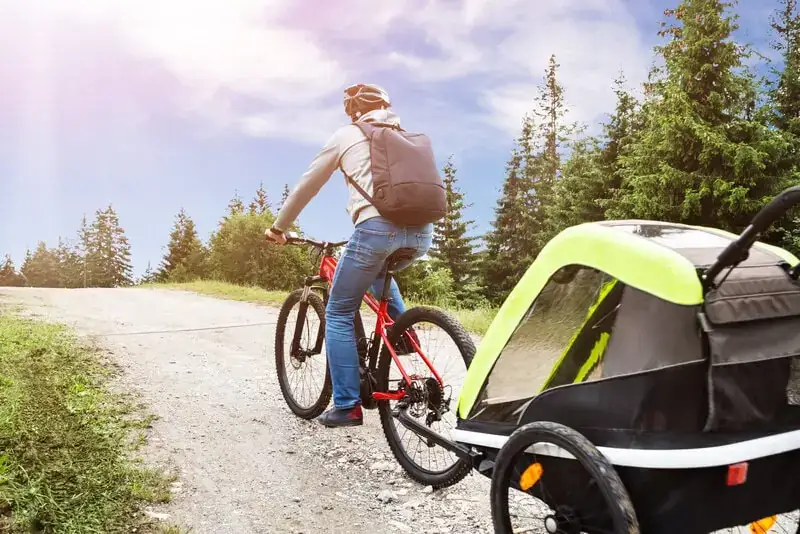
The Burley Bee is the value pick: 20 lbs, bike-only, with a large cargo area behind the seat for the daycare bag. The Burley D’Lite X adds suspension, a reclining seat, stroller and jogger kits, and seats that fold flat for cargo. The Thule Chariot Cross 2 is the most weatherproof, with less storage, and the Coaster XT is Thule’s entry-level two-seater. Burley rates its doubles at 100 lbs, recommends no more than 40 lbs per child, and caps child height at 41.25 inches, which many kids reach between four and five.
Ask where the trailer can spend the day. Many daycares will park a folded trailer in the stroller area, and a stroller wheel lets you walk the child to the door. A second Steel Hitch on the other parent’s bike lets the trailer go home with whoever does pickup.
The grocery stop and the commute
For two or three bags on the way home, the Burley Travoy weighs under 11 lbs, stands upright like a golf cart, unclips with one hand and rolls into the store as a hand cart, so it never gets locked outside. Its 60 lb rating splits into 40 lbs on the lower shelf and 20 lbs on the upper. Lift it over curbs.
The hardware store and the small business
Concrete, 8-foot lumber, a farmers market stall or a mobile repair shop need a heavy flatbed. Surly’s Ted (32 x 24 inch bed) and longer Bill are TIG-welded chromoly on 16-inch Maxxis Hookworm tires. Both were sold out on Surly’s site in September 2026, so call a dealer. The aluminum Bikes At Work 64A, 38 lbs empty, has a 64 x 19.25 inch bed that holds four to eight 18-gallon totes and loads up to 8 feet long.
All three are rated for 300 lbs, which outweighs rider and bike combined and will push the rear wheel around in a panic stop. Professionals use low gears, disc brakes and flat routes, at jogging speed.
The brands at a glance
| Trailer | Type | Capacity | Price (Sept. 2026) |
|---|---|---|---|
| Retrospec Rover Hauler | Tub | 80 lbs | $149.99 |
| Schwinn Day Tripper | Tub | 50 lbs | $150 |
| Aosom Wanderer | Tub | 110 lbs | $190 |
| Burley Travoy | Seatpost, folds | 60 lbs | $319.95 |
| Burley Flatbed | Flatbed | 100 lbs | $319.95 |
| Burley Nomad | Covered tub | 100 lbs | $369.95 |
| Wike Heavy Duty Flatbed | Flatbed | 125 lbs | About $400 |
| Carry Freedom Y-Frame Small | Flatbed | 99 lbs | €459 |
| Burley Coho XC | Single-wheel | 70 lbs | $519.95 plus axle |
| Tout Terrain Mule | Single-wheel, seatpost | 84 lbs | $825 plus hitch |
| Burley Hopper | Trailer and wagon | 100 lbs | $599.95 |
| Surly Ted / Bill | Steel flatbed | 300 lbs | $710 / $815 plus hitch |
| Bikes At Work 64A | Aluminum flatbed | 300 lbs | $1,175 plus hitch |
| Thule Courier | Kids, cargo or dog | 100 lbs | $799.95 |
| Burley Bee | Child, bike-only | 100 lbs | From $379.95 |
| Thule Coaster XT | Child, two seats | 2 kids | $499.95 |
| Burley D’Lite X | Child, multisport | 100 lbs | From $999.95 |
| Thule Chariot Cross 2 | Child, multisport | 2 kids | $1,499.95 |
| Burley Tail Wagon | Dog | 75 lbs | $419.95 |
| Burley Bark Ranger | Dog | 75 lbs; 100 lbs XL | From $649.95 |
Prices are list or from recent reviews and will change.
Towing with an e-bike
Range drops 20% to 50%, by Burley’s estimate, depending on load, hills, wind and assist level. Charge before a long errand.
A Class 3 e-bike will pull a loaded trailer at 28 MPH, but trailer makers rate their products for 15 MPH on straight roads and about 5 MPH in turns, because a two-wheel trailer can lift a wheel in a fast corner and a heavy one lengthens stopping distance. Use low assist and brake early with both brakes. Hydraulic discs are strongly preferred.
Read your e-bike’s manual. Some brands publish a maximum trailer weight, some approve only certain child trailers, and a few prohibit towing. Ignoring the manual can get a frame or motor warranty claim denied.
Loading and riding
Weigh your cargo the first few times. Heavy items go low, over or slightly ahead of the trailer’s axle. Weight behind the axle lifts the tow bar, unloads your rear tire and causes sway. Too much forward presses on the hitch. Burley’s Flatbed manual asks for more than 2 lbs and no more than 20 lbs at the hitch end of the loaded tow bar, which you can check on a bathroom scale.
Strap everything. A load that shifts in a corner starts most trailer crashes. Inflate tires to the sidewall pressure, since soft tires under load drag like an anchor.
The trailer is wider than your handlebars and cuts corners tighter than your rear wheel, so swing wide around curbs and posts and leave room when merging back after a parked car. Practice once in an empty parking lot, including a hard stop.
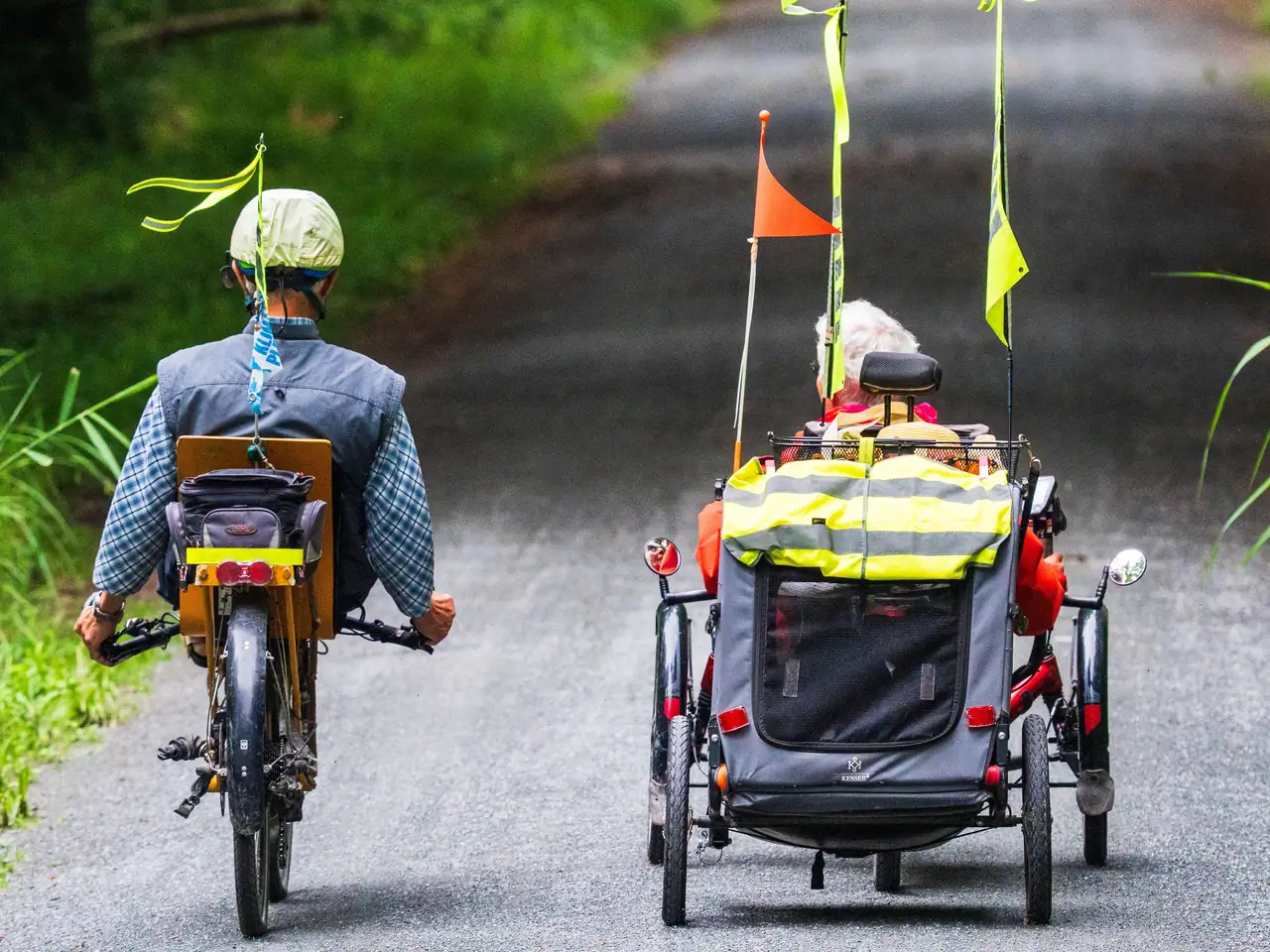
Before every ride: hitch pin clipped, safety strap around the chainstay, wheels locked in, flag up, light on.
Insurance
A rider pulling 100 lbs who clips a pedestrian or a parked car does more damage than a rider alone. Homeowners and renters policies may cover bicycle liability, but many exclude or restrict e-bikes, and their deductibles often exceed a trailer’s price. A stand-alone bicycle policy can add Liability and Medical Payments coverage to theft and crash damage protection for the bike. When you get a quote, say you tow a trailer, and ask how it, its cargo and any passengers are treated. On Velosurance’s cargo bike insurance policies, for example, Medical Payments applies to the rider’s injuries and not a passenger’s, so your child’s medical costs would fall to your family health plan.
Frequently Asked Questions
- Will a trailer fit my bike?
- Almost certainly, with the right hardware. Quick-release bikes accept an axle-mount hitch as is. Thru-axle bikes need a replacement axle from the trailer maker or The Robert Axle Project. Hub-motor e-bikes and internally geared hubs need a nutted axle adapter in the correct size. Full carbon road frames are the exception: check with the frame maker before clamping anything to a carbon dropout, and never use a seatpost trailer on a carbon post.
- Can my kid ride in a cargo trailer for a short trip?
- No. Cargo trailers have no harness, roll cage or side protection, and their manuals prohibit passengers. Use a child trailer tested to ASTM F1975.
- Can one trailer carry kids and cargo?
- Yes. The Thule Courier carries two kids up to 49 lbs each, converts to a flat cargo floor with tie-down points, and takes a $159.95 dog kit. It weighs 38.4 lbs and costs more than a Bee and a Flatbed together, so it makes sense mainly when storage space is tight. The Burley Hopper (115 liters) converts to a push wagon, but Burley permits kids only in wagon mode with a seat insert, never behind a bike.
- Can I tow my dog?
- Not in an open cargo trailer. Burley’s Tail Wagon and Bark Ranger and Thule’s Courier with the dog kit have enclosed cabins, leash tie-ins and low entry points. Leave a margin above your dog’s weight, and do slow laps of the block before riding in traffic.
- How do I keep a trailer from being stolen?
- The quick detach that makes a trailer useful makes it easy to steal. Run a cable or chain through the trailer frame and a wheel whenever the bike is locked, take the Travoy inside with you, and store the trailer indoors at home. Keep the receipt and photograph the serial number or frame markings.
- Which trailer works for touring or bikepacking?
- Pavement tourists who dislike panniers do well with the Burley Nomad, which leaves the bike unloaded for day rides from camp. The Carry Freedom Y-Frame Small, sold direct from Europe, is a lighter flatbed alternative. For dirt, the suspended single-wheel Coho XC is the default, and the seatpost-mounted Tout Terrain Mule is the premium choice for tight tracking behind a hardtail.
- How much can I tow?
- The lowest of three numbers: the trailer’s rating, any towing limit in your bike’s manual, and what your brakes can stop on the steepest hill of your route. For most riders on most bikes, 100 lbs is a sensible ceiling.
- Is a trailer better than a rear rack and panniers?
- For loads under 40 lbs or so, panniers are simpler. Above that, a rack puts the weight high on the frame and the bike gets hard to handle, while a trailer carries it on its own wheels. Trailers also handle bulky items that no pannier fits.
- Is a trailer better than a cargo bike?
- If you haul daily, carry two kids, or want one vehicle that is always ready, a cargo bike is better. If you haul weekly, already own a bike you like, or lack the space and budget for a second large bike, a trailer does most of the same work for a fraction of the price.
- Do I need lights or a flag by law?
- Most state bicycle lighting laws require a rear reflector or light visible from behind at night, and a trailer blocks the one on your bike. Put a red light and rear-corner reflectors on the trailer. Burley’s manual says never to ride at night without lighting on the trailer itself. A flag is rarely required by statute. Use one anyway, because a low trailer sits below a driver’s sightline over a hood.
- How fast can I go?
- Trailer manufacturers rate their products for 15 MPH on straight, smooth roads and 5 MPH in turns. That applies on an e-bike too.
Policy terms, available coverages, and state laws vary and change; this article is general information, not insurance or legal advice. Prices, specifications and product availability are as of September 2026 and change without notice; check the manufacturer’s current manual and fit guide before buying or towing.