


What Can Go Wrong Between the Driveway and the Campsite
8.1 million American households own an RV, by the Go RVing 2025 Owner Demographic Profile, and a large share of them travel with bikes hanging off the back. Those bikes spend the trip in the open: on a hitch rack at a truck stop, leaning on the picnic table overnight, bouncing behind the rig on a washboard road. The RV policy was written for the RV, the home policy stays home, and neither was written for a $4,000 e-bike on a rack 900 miles from the garage. Velosurance covers the bikes themselves, wherever the trip goes in the USA and Canada.
Theft on the Road
Taken from the rack at a rest stop, from the campsite overnight, or out of a locked RV. Covered under the policy's locking conditions, with the RV's own rack counting as an immovable object.
Damage on the Rack
Rear-ended at a light, a strap that lets go on the interstate, a bollard clipped while backing in at the fuel island. Transit damage is part of the core policy, not an add-on.
What Your RV and Home Policies Leave Out
RV personal effects limits, the homeowners off-premises cap, the e-bike motor exclusion, and the full-timer with no home policy at all. A standalone bike policy fills every one of those gaps.
The Short Answer: The Bikes are Covered Wherever the RV Goes
One policy follows the bikes from the driveway to the campsite and back, in the USA and Canada, with no per-trip declarations.
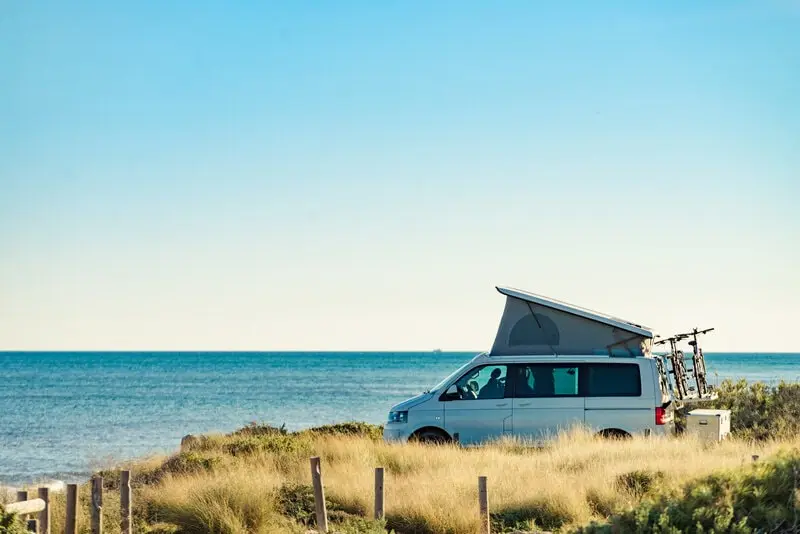
The median RV owner is 49 years old, by the Go RVing 2025 Owner Demographic Profile, and the bikes on the rack are increasingly e-bikes bought for exactly this: getting around the campground, the beach town, and the rail trail without unhooking the rig. Those bikes are the most portable valuables on the trip, and they live outside. A Velosurance policy insures each one at the value you declare, with no depreciation, and covers it anywhere in the USA and Canada, in transit and in use. Every bike on the rack can sit on one policy, with a 10% multi-bike discount on the bicycle coverage premium for the second bike and 15% for three or more.
The policy is all-risk. Anything not specifically excluded is covered: theft (subject to the policy's locking conditions), crash and accidental damage, and loss or damage in transit by car, airline, or courier. Physical damage claims are subject to the deductible you choose. Class 1, Class 2, and Class 3 e-bikes are covered on the same terms as pedal bikes.
It is standalone and primary. Velosurance pays first and never asks your RV policy, your auto policy, or your homeowners policy to contribute. A theft at a campground in Utah stays on the bike policy and off every other record you carry. The broader picture for cyclists who travel, by air as well as by road, is on our bicycle travel insurance page.
Theft at the Campground, the Rest Stop, and the Truck Stop
Thieves work the places where bikes sit unattended on a rack for twenty minutes. Lock to the RV and the policy responds.
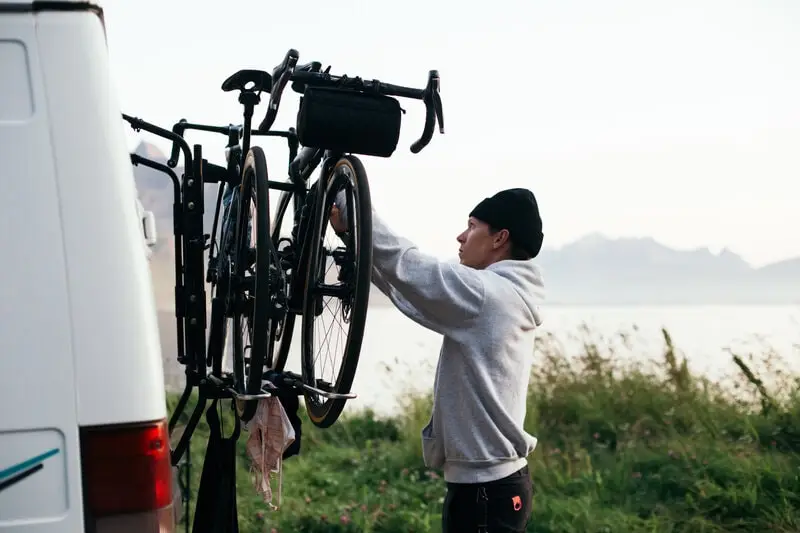
The rack on the RV counts as an immovable object. Away from home, the policy covers theft when the bike was locked to an immovable object with an appropriate security device, a key or combination lock. A properly fixed vehicle bike rack is an immovable object under the policy, so a bike locked through the frame to the RV's hitch or ladder rack meets the condition at a rest stop, a fuel stop, or a campsite. A bike sitting unlocked on the rack while you pay for diesel does not.
Inside a locked RV. A bike stolen from inside a locked RV is covered when the police report shows evidence of forcible entry: a pried door, a broken window, a cut hasp on the storage bay. Lock the bike to something solid inside anyway. Several tools open an RV door without leaving a mark, and a defeated lock on the bike is evidence on its own. The same logic applies to a locked tow vehicle, and it is spelled out in our locked-car FAQ.
Overnight at the site. A campground is a public place with a steady turnover of strangers, and a bike leaning against the picnic table is a bike left unlocked. Lock the bikes to the rack or to the RV frame every night, run the lock through the frame rather than a wheel, and keep the lock heavy: a hardened chain or a U-lock, not the cable that came with the rack. How thieves pick a target, and how to stay off the list, is in securing your bikes at the campsite.
File the police report where the theft happened, the same day. Every theft claim needs one, and it needs to record the time, the place, and how the bike was secured. The county sheriff or the nearest police department takes it; a campground office does not. Photograph the cut lock and the empty rack before you touch anything.
Damage on the Rack: Transit Is Core Coverage
A bike on the back of a 30-foot rig takes every hit the rig takes, and a few of its own.
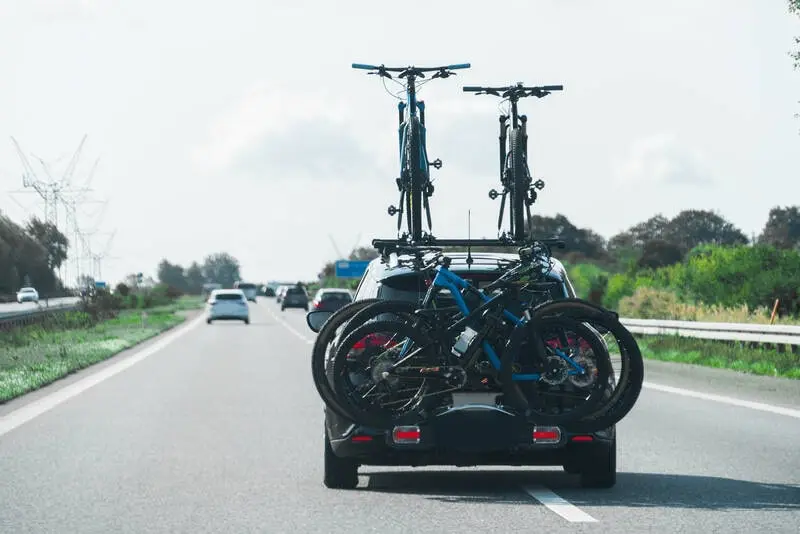
Rear-ended at the light. The bikes on the hitch rack are the first thing the other driver's bumper reaches. Velosurance pays for the damage as a covered transit loss at stated value, minus your deductible, without waiting for the other driver's insurer to agree on what a three-year-old gravel bike was worth. Fault does not change the claim.
The strap that let go. A bike that drops off the rack at 65 mph, a wheel that works loose on a washboard road, a rack that swings open on a steep campground driveway: all of it is accidental damage, and all of it is covered. An under-tightened strap is your mistake, and it is still an accident under the policy.
Fuel islands, parking lots, and the back-in. A rack hanging past the bumper of a 30-foot rig is the first thing to meet a bollard at the fuel island, a parked car in a tight truck-stop lot, or the post at the edge of the site when you back in. A bollard that folds a wheel or a bumper that bends a derailleur is covered the same way as a crash on the trail. Cosmetic damage that does not affect the bike's function is excluded, so a scratched top tube is on you and a bent wheel is on the policy.
The RV policy stops at the RV. Collision coverage on the motorhome repairs the motorhome. The bikes on the rack are personal effects, and whether they are covered at all depends on an optional coverage with its own limit. Transit coverage on a Velosurance policy applies whether the bikes ride on a hitch rack, a ladder rack, a roof rack on the tow vehicle, or inside the trailer. Picking a rack that holds up is covered in how to choose a hitch bike rack.
E-bikes on the RV: Weight, Racks, and Coverage
An e-bike is the heaviest, most valuable, and most stealable thing traveling outside the RV.
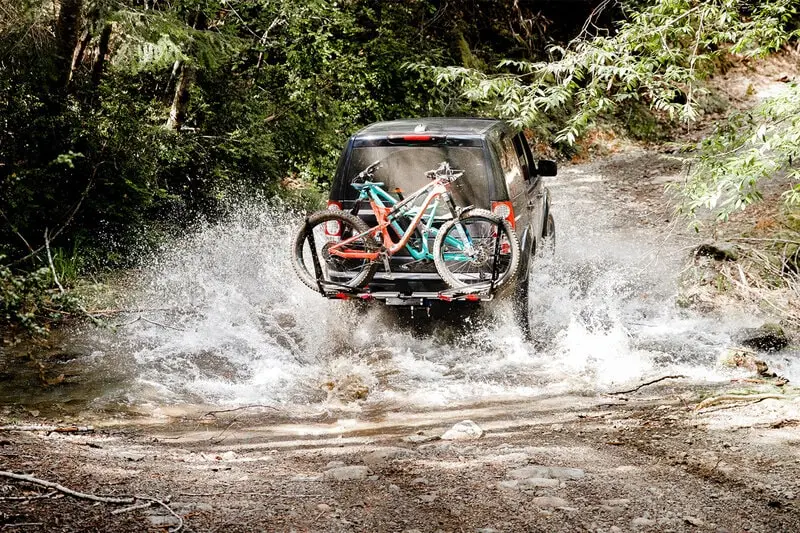
Weight first. Many e-bikes weigh 50 to 70 pounds, and fat-tire models more. RV-rated racks from Swagman, Thule, and Hollywood list 60 to 80 pounds per bike; the lightweight bumper racks sold for pedal bikes list 30. A standard 4-inch travel-trailer bumper is not built to carry a loaded rack at all, and a rack that passes a trailer's side-to-side sway for a season can crack a weld. Check the rack's rating against the bike with its battery in, and the bumper's rating with the manufacturer before you mount anything to it.
Battery out, bike covered. Pull the battery before loading: it drops 6 to 8 pounds off the rack, keeps the most expensive component out of the weather, and leaves a thief a bike that will not move under power. The battery is part of the bike's stated value on the policy, so a stolen e-bike pays as a whole, battery included, as long as the battery was declared in the insured value.
Same policy, same terms. Velosurance insures Class 1, Class 2, and Class 3 e-bikes, with a maximum assisted speed of 28 mph, under the same policy as a conventional bike. Theft on the rack follows the same locking conditions, and transit damage is covered the same way. High-power electric dirt bikes in the Sur-Ron and Talaria class are outside the policy. The details are on our e-bike insurance page.
What Your RV and Home Policies Leave Out
Three policies, and none of them written for the bikes on the rack.
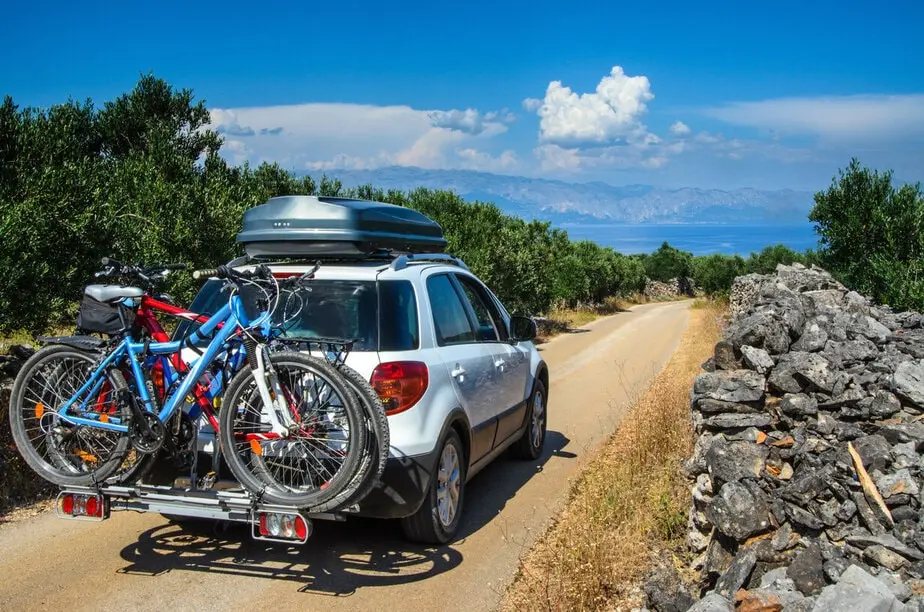
The RV policy. An RV policy insures the vehicle. Belongings fall under personal effects coverage, which is optional on many policies, included at a modest amount on some, and paid at actual cash value with per-item caps on others. Whether a bike on an exterior rack counts as "inside the RV" is a question for your carrier, and the answer varies. Full-timer policies add personal liability and medical payments for people who live aboard, but they do not turn into bike coverage.
The auto policy. The tow vehicle's auto policy covers the tow vehicle. Bikes on its roof or hitch rack are not covered by comprehensive or collision, and a thief who takes them from the rack has not stolen the car.
The homeowners policy. Where it covers bikes at all, a homeowners policy caps property away from home at roughly 10% of the contents limit, pays depreciated value after a deductible that often runs $500 to $2,000, and puts the claim on your home insurance record. Most forms exclude e-bikes outright as motor vehicles. And the full-timer who sold the house has no homeowners policy to fall back on. The side-by-side is on Velosurance vs. homeowners insurance.
The bike policy. A Velosurance policy is written for the bike, not the vehicle it rides on or the house it lives in. Theft, crash, and transit damage are in the core policy. Liability, medical gap, uninsured motorist, racing, and worldwide coverage are optional additions, each elected before the accident, not after. Liability limits run from $25,000 to $500,000, chosen per bike. Every bike in the family can sit on one policy, each at its own stated value, with a 10% multi-bike discount on the bicycle coverage premium for a second bike and 15% for three or more.
What the Claim Pays From the Road
A claim filed from a campsite in Utah runs the same as one filed from your kitchen table, and the trip does not have to end.
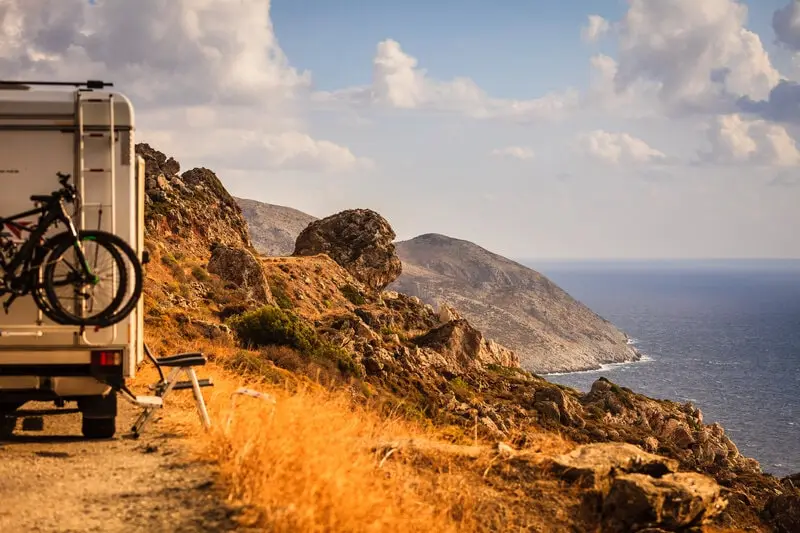
Stated value, no depreciation. A total loss pays the value you insured the bike for, minus the deductible you chose, at any age. A five-year-old $5,000 bike insured for $5,000 pays $4,800 after a $200 deductible. Repairs are paid the same way, up to the insured value, and the deductible applies to physical damage claims.
How a claim runs. File from wherever you are. A claims manager contacts you within two business days, and most claims are paid in under 14 business days. You will need the police report for a theft, photos of the damage or the scene, and your purchase receipt, so photograph both sides of every bike and its serial number before the trip and keep the receipts on your phone. The steps are on our claims page.
The replacement bought on the road. A newly acquired bike is covered when we are notified within 30 days of the purchase, and until then it carries the broadest coverage already on the policy. Buy the replacement in the next town, add it from the client portal, and ride on. After a total loss on a multi-bike policy, the lost bike comes off and coverage continues for the rest.
Riding Far From Home: Liability, Medical Gap, and Uninsured Motorist
The campground loop is the safe part. The grocery run and the ride into town are where the optional coverages earn their keep.
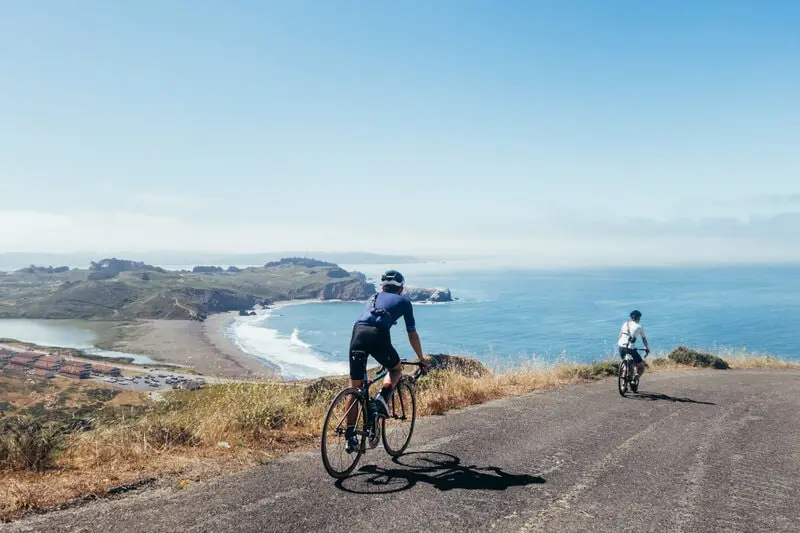
Liability on the ride into town. The bikes come off the rack for the grocery run, the ride to the beach, and the afternoon in the nearest town, on streets you have never ridden, among drivers who are not expecting you. A collision with a pedestrian on Main Street or a rail trail is a lawsuit in a county you will never visit again. Liability coverage pays for injury or damage to others, includes the cost of defending a covered lawsuit, and pays covered settlements or judgments up to the limit you chose, from $25,000 to $500,000. Being sued does not require being at fault. Your spouse and anyone else riding the bike with your permission is an insured.
Medical gap, 900 miles from your doctor. A crash on the trip means an emergency room you did not pick. Medical gap reimburses the out-of-pocket medical costs your health plan leaves behind, deductible, copays, and co-insurance, after the plan pays its share, and pays first up to the selected limit if you have no health insurance. It covers the operator of the bike, not a passenger.
Uninsured motorist on the road into town. When the driver who hits you cannot pay, uninsured motorist coverage picks up losses beyond medical bills, such as lost wages. It requires physical contact between the bike and the vehicle, and a hit-and-run must be reported to the police within 24 hours. The two-lane between the campground and town is where uninsured drivers and long ambulance rides overlap, which is why RV travelers tend to carry it.
Elect them before the trip. Liability, medical gap, and uninsured motorist each have to be on the policy before the accident, not before the lawsuit. They apply anywhere in the USA and Canada once elected, with no per-trip step. Which combination makes sense for the way you ride is on our e-bike liability insurance page.
Canada Is Included, Mexico Is an Add-on
The snowbird route north is inside the policy's territory. The one south needs the worldwide extension before you cross.
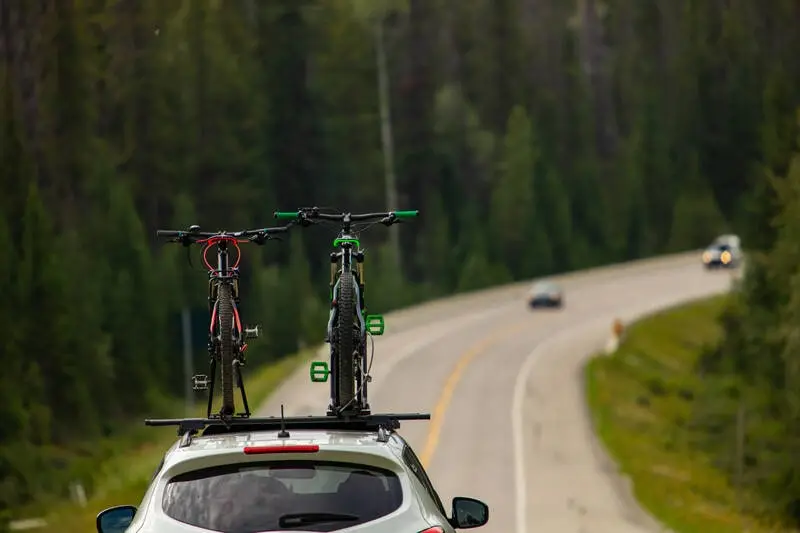
Canada is inside the policy's territory. The policy covers the insured bikes anywhere in the USA and Canada, in transit and in use, with every optional coverage you carry applying the same way on both sides of the border. The drive to Banff, the Icefields Parkway, the Cabot Trail: no declaration, no extra step. Details are in do you provide coverage in Canada.
Mexico and beyond, with the worldwide extension. Baja and the Sonoran coast are outside the policy's territory until you add worldwide coverage, which extends physical damage and theft protection for the bikes to any country. It is an add-on to an active policy, bought once from the client portal before you leave, and it covers the bikes on the same terms abroad. One thing to watch: liability, medical gap, and uninsured motorist stop at the Canadian and Mexican borders, so line up travel insurance for yourself before an international leg. The extension is explained on our international bicycle insurance page.
Every state, no paperwork. Coverage follows the bikes through all 50 states with nothing to update when you cross a line, and it does not lapse because the RV has been on the road for six months. The policy is written for USA residents, wherever the rig happens to be parked.
We cover all types of bikes
Whether you ride the tarmac or shred the gnar, dodge pedestrians, or cruise the beach, you're a member of a special club of people who appreciate the world in a primal way – on two wheels. To keep you rolling, we address the specific risks associated with your discipline.
Road bikes
Light and aerodynamic, equipped with skinny tires and optimized for long days in the saddle.
E-bikes
Electrically-assisted Class 1, 2, and 3 e-bikes with maximum assisted speed of up to 28 mph.
Commuter bikes
Simple, reliable bikes designed specifically for urban environments.
Mountain bikes
Rugged, resilient, and incredibly fun. Equipped with suspension and designed to offroad, tackle technical terrain and jumps.
Gravel bikes
Drop bar bikes capable of going on both pavement and unprepared terrain, even mild singletrack.
Triathlon bikes
Exceptionally aerodynamic and lightweight, these speed machines are designed with one goal in mind: go fast.
Trikes
Three-wheeled bicycles are known for additional stability and versatility.
Recumbent bikes
Two and three wheeled bikes with a leisurely leaning back seating position.
Cargo bikes
The SUVs of the two-wheeled world, these bikes are designed to carry heavy loads, including groceries and passengers.
Coverages and Features
Velosurance offers must-have protection such as accidental damage, theft, or loss in transit. Each policy can be customized by adding additional coverages such as liability protection, uninsured motorist, and medical payments.
Bicycles are very easy to steal and equally difficult to recover, and even a hefty U-lock doesn’t guarantee your bike is still there when you return. Velosurance provides peace of mind if it is stolen or damaged in the process.
Bike theft insurance →Our policy will pay to replace your ride if it is accidentally damaged and beyond repair, including damage that occurs while being carried on or in your vehicle. If it can be repaired, we will pay all the costs associated with the bike's repair, including tax, labor, and shipping, minus the deductible. Cosmetic damage that does not affect safety is excluded.
Bicycle crash insurance →Our policy optional coverage purchase will protect and defend you from your personal liability (injury, sickness, death, or damage to property, including fire damage) that you are found legally liable for. Coverage limits offered: $25,000, $50,000, $100,000, $300,000 or $500,000 per occurrence.
E-bike liability insurance →If you’re hurt and require medical attention, our optional medical gap will take care of your medical bills, up to the selected limit. The payments are paid directly to you to supplement the deductible of your personal health insurance policy.
Medical gap insurance →Depreciation is a hidden deductible that increases every year and is applied if the bicycle is stolen or totaled. No one is ever happy with an Actual Cash Value insurance settlement: the bike is first devalued, and then a deductible is applied, resulting in a reimbursement that is far less than the cost of a replacement. We reimburse without depreciation, for the cost of a replacement that is of like, kind, and quality similar to your totaled bike.
One of the scariest things that can happen to a cyclist is getting hit by a car. This coverage will pay for medical expenses, physical therapy, mental health services, lost wages, and other expenses that arise from a bicycle-car accident.
Uninsured motorist insurance →We cover all electrically assisted Class 1, 2, and 3 bikes with a maximum assisted speed of 28 mph. All protections available for conventional bicycles also apply to electric ones.
E-bike insurance →Bikes often get damaged in transit by personal vehicles, airlines, or courier services. Filing a claim with the airlines and courier services is a notoriously difficult process with a questionable outcome. We cover the insured bicycle for loss or damage while it's on its way to or from your destination by air or road. Even if it falls off a vehicle rack or is hit in a rear-end accident, it is covered, no arguments.
Bicycle travel coverage →If you go down in a crash, we cover your ride as well as your apparel, such as helmet, shoes, glasses, or riding kit that are torn up, and pay up to $500 per accident and $1,000 per term. Spare parts that are not installed, such as a spare wheelset, are also covered up to $500 per loss and $1,000 per year.
Our policy does not piggypack on any coverage you may already have, such as homeowners policies. Filing a claim won’t impact your rates with other carriers. With home insurance premiums rising each year in the U.S., it’s wise to reserve that policy for major incidents, because no matter how valuable your bike is, it’s still a lot cheaper than a kitchen fire or a flooded basement.
We cover the insured bike at all times, anywhere in the USA and Canada, and can be extended worldwide on request. There are no exclusions on the time of day or limitations on how long it can be stored away from home. 24/7/365 means every minute of every day, no matter where or when.
In the heat of a race, the focus on speed often outweighs concerns for safety, leaving little margin for error. If you go down in a crash, this optional coverage takes care of repairs or replacement. If you use your bike in a competitive environment, this is a no-brainer because it offers protection in the highest-risk category.
Bicycle racing insurance →If your travels take you beyond the USA and Canada, for a small additional premium, this option extends the physical loss and damage protection, including loss or damage caused by an airline, to any country in the world.
International coverage →You can lend it to anyone you choose, and it will be covered. The bike and the person riding it are covered as if it were you riding it‚ this includes theft and crash damage as well as any purchased optional coverages.
We do not dictate what type or brand of lock must be used to protect your ride from theft – you are welcome to use any lock that you trust. The best security is provided by metal locks combined with a high-quality chain. Securing your ride to a solid and immovable object, such as a bike rack, with a high-quality lock will send the thief onto the one secured with a more vulnerable lock.
Why Velosurance is a Better Policy for the Bikes on Your RV
RV and auto policies insure the vehicle and leave the bikes to an optional personal effects limit, if at all. Homeowners policies cap property away from home, depreciate it, and routinely exclude anything with a motor. A standalone bike policy insures each bike at stated value anywhere in the USA and Canada, on the rack and off it.
| Policy Coverage |  | Homeowner/Renters Policy |
|---|---|---|
| Insured at Full Value | Yes | Possibly |
| Crash Damage | Yes | No |
| Theft Coverage | Yes | Limited |
| Theft by Force | Yes | No |
| Theft of Accessories | Yes | Limited |
| Theft Away From Home | Yes | Possibly |
| Uninsured Motorist | Yes | No |
| Personal Liability | Yes | Possibly |
| Permissive Use Policy | Yes | No |
| Replacement Rental | Yes | No |
| Event Fee Return | Yes | No |
| Cycling Apparel Coverage | Yes | No |
| Medical Payments | Yes | Possibly |
| Racing Coverage | Yes | No |
| E-bikes | Yes | No |
| Coverage in-transit | Yes | No |
| USAC, USAT and IMBA Member Discount | Yes | No |
| FREE INSTANT QUOTE |
Not all insurance policies provide the same level of protection, and many people only discover gaps in their coverage after filing a claim. We’ve done the hard work of reviewing the fine print. To see how plans compare, check out our insurance comparison.
Client satisfaction is our #1 goal, and we strive to deliver the best experience every time. Here's what our clients say about Velosurance:


Velosurance really stepped up and put me at ease. The claim was fast and easy. I am insuring all my bikes now.

Check out Velosurance reviews to see what people are saying about us.
Frequently Asked Questions
- Is my bike covered if it is stolen from the rack on my RV?
- Yes, when it was locked to the rack with a key or combination lock. A properly fixed vehicle bike rack is an immovable object under the policy, so a bike locked through the frame to the RV's hitch or ladder rack meets the theft condition at a rest stop, a fuel stop, or a campsite. File a police report where the theft happened, the same day. A bike left unlocked on the rack does not meet the condition.
- Is a bike stolen from inside my locked RV covered?
- Yes, when the police report shows evidence of forcible entry into the RV: a pried door, a broken window, or a cut hasp on a storage bay. Lock the bike to something solid inside as well, since some tools open an RV door without leaving a mark, and a defeated bike lock is evidence on its own. Theft by someone the bike was entrusted to is not covered.
- Does the policy cover damage to a bike on the rack while the RV is moving?
- Yes. Loss or damage in transit by car is part of the core policy, so a bike that is rear-ended on the hitch rack, drops off at highway speed, or folds a wheel on a bollard while you back in is covered as accidental damage, at stated value minus your deductible. Fault does not affect the claim, and an under-tightened strap is still an accident. Cosmetic damage that does not affect function is excluded.
- Does my RV insurance cover the bikes I carry?
- Check the personal effects section of your RV policy before you count on it. Personal effects coverage is optional on many RV policies, included at a modest amount on some, and often paid at actual cash value with per-item caps, and whether a bike on an exterior rack qualifies varies by carrier. A Velosurance policy insures each bike at stated value with no depreciation and pays first, with no RV or home policy behind it.
- Can I carry Class 1, Class 2, and Class 3 e-bikes on the RV and insure them?
- Yes. Class 1 (pedal assist to 20 mph), Class 2 (throttle to 20 mph), and Class 3 (pedal assist to 28 mph) e-bikes are insured under the same policy and on the same terms as a conventional bike, including theft on the rack and transit damage. Use a rack rated for the weight of the e-bike with its battery in, and remove the battery before loading. High-power electric dirt bikes are not covered.
- Am I covered on an RV trip to Canada or Mexico?
- Canada is inside the policy's territory: the policy applies anywhere in the USA and Canada, in transit and in use, with every optional coverage applying the same way. Mexico needs the optional worldwide coverage, an add-on to an active policy bought before you cross that extends physical damage and theft coverage for the bike to any country. One thing to watch: liability, medical gap, and uninsured motorist apply only in the USA and Canada.
- Will the policy pay for a rental bike so I can finish the trip?
- Yes. When a covered loss happens more than 50 miles from home during a trip, event, or race, the policy reimburses a rental bike up to $250 per occurrence, with no deductible. Spare parts and cycling apparel lost with the bike are covered at actual cash value up to $500 per occurrence and $1,000 per policy term. A replacement bike bought on the road is covered when we are notified within 30 days of the purchase.
- Which optional coverages make sense for an RV traveler?
- Liability and medical gap are the two to start with, and uninsured motorist is worth adding for the ride into town on roads you do not know. Liability covers injury or damage to others, with the cost of defending a covered lawsuit, up to a limit of $25,000 to $500,000. Medical gap reimburses your out-of-pocket medical costs after your health plan pays, and uninsured motorist covers losses beyond medical bills when the at-fault driver cannot pay. For any of them to apply, it must be elected before the accident.
- Is my spouse covered when riding my insured bike at the campground?
- Yes. Anyone riding the bike with your permission is an insured under the policy, so your spouse, your kids, and the neighbor at the next site who borrows it for the afternoon are covered for physical damage, and for liability when that coverage is on the policy. The caveat worth knowing: theft by someone the bike was entrusted to is not covered, so lend the bike, not the lock.
- Does a Velosurance claim affect my RV or homeowners insurance?
- A Velosurance claim stays on the bicycle policy. The policy is standalone and primary, so it pays first, never asks your RV, auto, or homeowners insurer to contribute, and never lands on their claims history. Most claims are paid in under 14 business days, and a claims manager contacts you within two business days of filing, wherever the RV is parked.
Insure the Bikes Before the Next Trip
The rack, the campsite, and the road between are where bikes go missing. Insure them today, from $9 a month, at the value you paid, covered anywhere in the USA and Canada.