
TL;DR:
- Washington is a fault state with pure comparative fault under RCW 4.22.005: your share of the blame cuts your recovery by that percentage and never bars it.
- Minimum auto liability limits are $25,000 per person, $50,000 per accident, and $10,000 for property damage, and no increase has been enacted.
- Personal injury protection of at least $10,000 for medical bills is on every auto policy unless rejected in writing, and it covers a pedestrian, meaning anyone not occupying a motor vehicle, struck by the insured car.
- You have three years to sue for injuries or bike damage; a claim against the state or a local government needs the standard tort claim form and a 60-day wait before suit.
- A hit-and-run claim does not require contact, but a no-contact crash needs independent evidence and a report to law enforcement within 72 hours.
Who Pays After a Crash in Washington
Washington is a fault state. The driver who caused the crash pays, through the liability insurance that RCW 46.30.020 requires for every registered motor vehicle. No injury threshold stands between you and a claim.
The required limits are low. RCW 46.29.090 sets them at $25,000 for one person's injuries, $50,000 for everyone hurt in the crash, and $10,000 for property damage. The section was last amended in 1980 and no increase has been enacted. Shoulder surgery with rehab costs $15,000 to $40,000, so one operation can exhaust a minimum policy. Your bike and gear come out of the $10,000 property limit.
Under RCW 48.22.085, every auto insurer must offer personal injury protection, and the Office of the Insurance Commissioner says the coverage is added unless the policyholder rejects it in writing. RCW 48.22.095 sets the minimum at $10,000 for medical and hospital bills, $2,000 for funeral costs, $10,000 for lost income at up to $200 a week, and $5,000 for household services. It pays no matter who was at fault.
The definitions in RCW 48.22.005 decide who gets it. An insured includes "a pedestrian accidentally struck by the insured automobile," and a pedestrian is any natural person not occupying a motor vehicle. A rider on a pedal bike fits that wording, so the PIP on the car that hit you can pay your first medical bills even if you own no car.
Your own auto policy is a second source: the same definition covers the named insured and resident relatives without requiring that they be inside a car. Confirm it with your insurer in writing. Medical benefits cover expenses incurred within three years of the crash.
Fault and How It Reduces a Claim
Washington uses pure comparative fault. Under RCW 4.22.005, your contributory fault reduces your damages proportionately "but does not bar recovery." A rider found 30% at fault for a $100,000 loss collects $70,000.
One exception can erase a claim. RCW 5.40.060 gives the defense a complete bar when the injured person was under the influence of alcohol or drugs, that condition was a proximate cause of the injury, and the person was more than 50% at fault.
Under RCW 5.40.050, breaking a statute is not negligence in itself; a jury may treat it as evidence of negligence. Driving under the influence is the exception and counts as negligence per se.
RCW 46.61.755 gives a rider on the roadway the rights and duties of a driver, and a rider on a sidewalk or in a crosswalk those of a pedestrian. The rules an insurer will check:
- Lane position. RCW 46.61.770 requires a rider slower than traffic to keep as near to the right side of the right through lane "as is safe," with exceptions for turns, passing, and hazards such as parked cars and surface defects. Two abreast is the limit.
- Stop signs. RCW 46.61.190 lets a cyclist treat a stop sign as a yield sign, except at railroad crossings and for a school bus stop signal.
- Lights. RCW 46.61.780 requires a white front lamp visible from 500 feet and a red rear reflector during the hours of darkness.
Helmets are an open question. Washington has no statewide helmet law, and the bicycle statutes in RCW 46.61.750 through 46.61.790 are silent on whether riding without one can be used to reduce your damages.
Hit-and-Run and Uninsured Drivers
RCW 48.22.030 requires every Washington auto liability policy to include underinsured motorist coverage unless the named insured or a spouse rejected it in writing. The statute names three targets: underinsured vehicles, hit-and-run vehicles, and phantom vehicles. The coverage must match your own liability limits unless you rejected part of it.
The phantom vehicle rule is what sets Washington apart for cyclists. A phantom vehicle is one that causes injury with no physical contact, the car that forces you into the curb and keeps going. The claim is allowed on two conditions: the facts must be corroborated by competent evidence other than your own testimony or that of anyone else with a claim from the crash, and the crash must be reported to law enforcement within 72 hours.
The statute treats a vehicle as underinsured when its liability limits are less than the damages you are entitled to recover. The comparison is with your loss, not your own limit, so the coverage can apply against a driver carrying the legal minimum.
Property damage under this coverage means damage to the insured car unless the policy specifically says otherwise, so do not expect it to pay for a bike.
The statute protects "persons insured" under the policy without requiring that you be in a car, but the policy form decides who is insured. Confirm with your insurer that the coverage follows you onto a bike.
Two things to check in a bike insurance policy: whether it offers uninsured motorist coverage of its own, and whether crash damage is covered no matter who hit you.
Dooring and Passing Laws
RCW 46.61.620 is the dooring statute. No person may open a motor vehicle door on the side adjacent to moving traffic "unless and until it is reasonably safe to do so," or leave a door open on that side longer than necessary to load or unload passengers.
Passing is governed by RCW 46.61.110, rewritten in 2019 and amended again in 2023 and 2025. What the driver must do depends on the road:
- Two or more lanes in your direction. The driver must move completely into a lane to the left before passing.
- One lane with room. The driver must slow to a safe speed relative to yours and pass at a safe distance, "where practicable of at least three feet."
- One lane without room. The driver must move completely into the oncoming lane when it is safe to do so.
A driver who violates the rule pays an additional fine equal to the base penalty. The 2025 amendment exempts streets a city has designated as shared streets under RCW 46.61.197.
Washington also penalizes negligent driving that injures a rider. Under RCW 46.61.526, a driver whose negligence causes substantial or great bodily harm to a vulnerable user of a public way, a term that includes people on bicycles and electric-assisted bicycles, faces a $5,000 penalty and a 90-day license suspension. Since January 1, 2025, RCW 46.61.5259 makes negligent driving that kills a vulnerable user a gross misdemeanor carrying up to 364 days in jail.
None of these penalties pays you, but a citation under either statute is evidence of negligence in the civil claim under RCW 5.40.050.
E-bikes
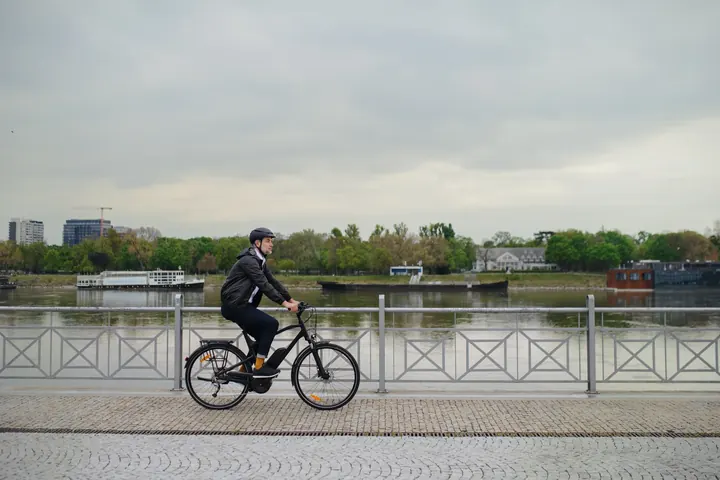
RCW 46.04.169 defines an electric-assisted bicycle as a bike with two or three wheels, a saddle, fully operative pedals, and a motor of no more than 750 watts. Class 1 assists only while you pedal and stops at 20 mph. Class 2 can run on the motor alone and stops assisting at 20 mph. Class 3 assists only while you pedal, stops at 28 mph, and must have a speedometer.
The definition narrowed in 2026. Senate Bill 6110, in force since June 11, 2026, says an electric-assisted bicycle does not include a vehicle capable of exceeding 20 mph on its motor alone, or one designed or sold to be easily reconfigured out of the class limits. The Legislature noted that many of those machines already meet the definition of a motorcycle or a moped.
Inside the definition, you are treated as a cyclist. RCW 46.37.690 applies the same provisions to an e-bike rider as to a bicycle rider, RCW 46.20.500 requires no driver's license, and RCW 46.16A.080 exempts e-bikes from registration. The mandatory insurance law reaches only vehicles subject to registration. Riders under 16 may not operate a Class 3.
One question has no clear answer in the statutes: whether a rider on an e-bike counts as a "pedestrian" for PIP, since that term turns on not occupying a motor vehicle. Get the insurer's position in writing. In a bike insurance policy, check that your e-bike's class is covered and that the label showing class, top assisted speed, and wattage matches the bike.
Deadlines

Washington gives you three years to sue. The deadlines that cost claims are the short ones at the start.
- At the scene
Driver Must Stop and Share Insurance
RCW 46.52.020 requires the driver to stop, give a name, address, insurance company, policy number, and plate number, and render aid. Leaving an injury crash is a class C felony.
- 72 hours
Report a No-Contact Hit-and-Run
A phantom vehicle claim under RCW 48.22.030 requires a report to the appropriate law enforcement agency within 72 hours of the crash, plus evidence beyond your own testimony.
- Four days
Written Collision Report
When no officer files a report, RCW 46.52.030 gives the driver of a vehicle in a crash with an injury or at least $1,000 in property damage four days to file a written report with the city police, county sheriff, or State Patrol.
- 60 days
Waiting Period on a Government Claim
A claim against the state goes to the Office of Risk Management at the Department of Enterprise Services on the standard tort claim form, under RCW 4.92.100. A claim against a county, city, or transit agency goes to the agent that entity has appointed, under RCW 4.96.020. Either way you cannot file suit until 60 calendar days after the claim is presented. The three-year clock is paused during those 60 days.
- Three years
Injury and Bike Damage Lawsuit
RCW 4.16.080 gives you three years to sue for personal injury and the same three years for damage to the bike and gear. A government claim has no shorter deadline of its own: it must be presented within that same period.
For a rider under 18, RCW 4.16.190 does not count the time before the 18th birthday. Both tort claim statutes say substantial compliance with the form is enough.
For a dispute over the bike alone, small claims court hears cases up to $10,000 brought by an individual under RCW 12.40.010.
Evidence to Preserve
Collect evidence with the statutes above in mind.
- The driver's details. RCW 46.52.020 requires name, address, insurance company, policy number, and plate number. The policy number is what opens a PIP claim.
- Independent proof of a no-contact crash: witness names and phone numbers, camera footage, a ride recording. A phantom vehicle claim cannot rest on your word alone.
- The road layout: how many lanes ran in your direction, lane width, the bike lane or shoulder, and where the driver was when passing. The passing statute sets a different duty for each.
- Your front lamp and rear reflector, photographed on the bike, if the crash happened after dark.
- The e-bike label showing class, top assisted speed, and wattage.
- Both declarations pages, yours and the driver's if you can get it, showing whether PIP and underinsured motorist coverage were rejected.
- A dated copy of any tort claim form and proof of how and when it was delivered.
Coverage for Washington Riders
Washington's rules leave four gaps: a driver carrying $25,000 for your injuries and $10,000 for your bike, a driver who is never found, PIP that either side may have rejected in writing, and a fault rule that lets the driver's insurer shift blame to you. The Velosurance policy offers the coverages discussed above.
Uninsured Motorist covers losses beyond medical bills, such as lost wages, when the at-fault driver cannot pay.
Medical Payments covers the deductible and out-of-pocket costs your health plan leaves, whether or not a $10,000 PIP benefit is available. Choose a limit close to your plan's out-of-pocket deductible.
Liability answers the other side of pure comparative fault. If you are blamed for a share of a crash, it covers injury to other people and damage to their property, including the cost of defending a covered lawsuit, with limits from $25,000 to $500,000.
Crash damage to the bike is part of the policy itself, and it counts where the driver's property limit is $10,000. The bike is insured at stated value with no depreciation, subject to the deductible, whoever caused the crash. Class 1, Class 2, and Class 3 e-bikes are covered like conventional bikes.
For any of these coverages to apply, it must be on the policy before the crash. Get a quote and add them before your next ride.
Bicycle Accident Attorneys in Washington
Velosurance legal partners who represent injured cyclists in Washington.

Frequently Asked Questions
- How does fault affect a bicycle accident claim in Washington?
- You can recover damages in Washington even when you share the blame, because the state uses pure comparative fault. Your recovery drops by your percentage of fault: a rider 30% at fault for a $100,000 loss collects $70,000. The caveat worth knowing: a rider who was under the influence, whose condition was a proximate cause, and who was more than 50% at fault can be barred completely.
- How long do you have to file a bicycle accident lawsuit in Washington?
- You have three years to file suit in Washington for injuries and for damage to your bike and gear. One thing to watch: a claim against the state, a county, or a city must first be presented on the standard tort claim form, and you must wait 60 calendar days after presenting it before you can sue.
- How does personal injury protection help a cyclist hit by a car in Washington?
- Personal injury protection on the car that hit you can pay your first medical bills regardless of fault, because Washington's definition of an insured includes a pedestrian accidentally struck by the insured automobile, and a pedestrian is any person not occupying a motor vehicle. The minimum is $10,000 for medical and hospital bills. One thing to watch: the coverage exists only if the policyholder did not reject it in writing.
- What makes a hit-and-run claim work for a Washington cyclist when the car never touched you?
- Underinsured motorist coverage on a Washington auto policy can pay for a no-contact crash, which the statute calls a phantom vehicle claim. Report the crash to law enforcement within 72 hours and collect evidence beyond your own account, such as a witness or camera footage. With one wrinkle: whether the coverage follows you onto a bike depends on the policy form, so confirm it with your insurer.
- How are Class 1, Class 2, and Class 3 e-bikes treated after a crash in Washington?
- Washington treats Class 1, Class 2, and Class 3 e-bikes as bicycles, so the same pure comparative fault rule and three-year deadline apply. Class 1 is pedal assist to 20 mph, Class 2 can run on the motor alone and stops assisting at 20 mph, and Class 3 is pedal assist to 28 mph with a speedometer for riders 16 and older. The caveat worth knowing: since June 11, 2026, a vehicle that can exceed 20 mph on its motor alone is not an electric-assisted bicycle.
Sources
- RCW 4.22.005 and 4.22.070 (comparative fault, several and joint liability)
- RCW 5.40.050 and 5.40.060 (statutory violations as evidence of negligence, intoxication defense)
- RCW 4.16.080 and 4.16.190 (three-year limitation period, tolling for minors)
- RCW 4.92.100 and 4.92.110 (tort claims against the state)
- RCW 4.96.020 (tort claims against local governmental entities)
- RCW 12.40.010 (small claims limit)
- RCW 46.29.090 and 46.30.020 (minimum liability limits, mandatory liability insurance)
- RCW 48.22.005, 48.22.085, 48.22.090, 48.22.095, and 48.22.100 (personal injury protection)
- RCW 48.22.030 (underinsured, hit-and-run, and phantom vehicle coverage)
- RCW 46.52.020 and 46.52.030 (duties after a crash, accident reports)
- WAC 446-85-010 (accident-reporting threshold)
- RCW 46.61.110 (overtaking and passing, vulnerable users)
- RCW 46.61.526 and 46.61.5259 (negligent driving with a vulnerable user victim)
- RCW 46.61.190 and 46.61.197 (stop signs, shared streets)
- RCW 46.61.620 (opening and closing vehicle doors)
- RCW 46.61.755, 46.61.770, and 46.61.780 (bicycle rights and duties, lane position, lamps)
- RCW 46.04.169, 46.04.071, and 46.04.320 (electric-assisted bicycle, bicycle, and motor vehicle definitions)
- RCW 46.20.500, 46.16A.080, and 46.37.690 (e-bike licensing, registration, and label)
- Engrossed Substitute Senate Bill 6110, chapter 159, Laws of 2026 (electric-assisted bicycle definition)
- Washington Office of the Insurance Commissioner, Personal injury protection (PIP)
- Washington Office of the Insurance Commissioner, What to do if you're hit by an uninsured or underinsured driver
- Washington Department of Enterprise Services, Office of Risk Management, File a Tort Claim
- Washington State Department of Transportation, Bicyclist laws and safety
- King County Board of Health Code (Title 9, Bicycle Helmets, repealed)
This guide is general information about Washington law as of the review date above. It is not legal or insurance advice, and it does not create an attorney-client relationship. Laws change and every crash turns on its own facts: talk to a licensed Washington attorney about your situation.