
TL;DR:
- Utah is a no-fault state: the insurer of the car that hit you pays at least $3,000 of your medical bills regardless of fault, even if you own no car.
- Pain and suffering requires a listed injury. A bone fracture qualifies on its own, and so do medical expenses over $3,000.
- Fault is compared under Utah Code section 78B-5-818. You recover only if the driver's share exceeds yours, so a rider found 50% at fault recovers nothing.
- Deadlines: one year for a notice of claim against a government body, two years for wrongful death, four years to sue for injuries or damage to the bike.
- Drivers on policies issued or renewed since January 1, 2025 carry at least $30,000 per person for injuries and $25,000 for property damage. Uninsured motorist coverage pays nothing for the bike.
Who Pays After a Crash in Utah
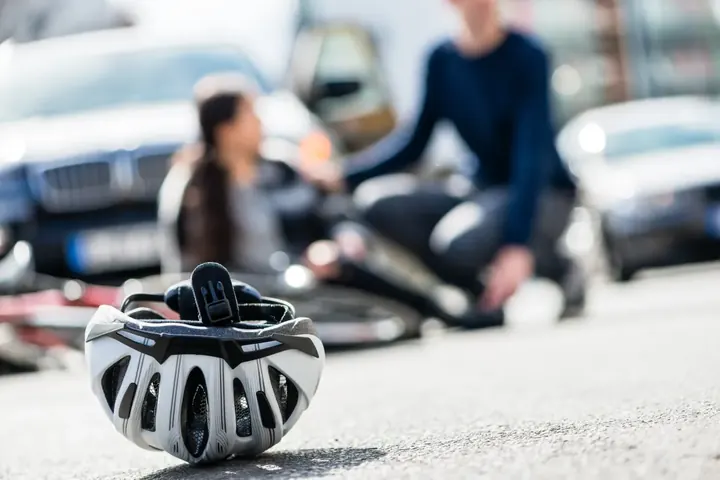
Utah is a no-fault state, and the first $3,000 of a cyclist's medical bills has an unusual source: the car. Utah Code section 31A-22-308 extends personal injury protection, known as PIP, to a pedestrian injured in an accident in Utah involving the insured vehicle. Section 31A-22-301 defines a pedestrian as any natural person not occupying a motor vehicle. On a bike, that is you.
The benefits are set in section 31A-22-307, and they are small. PIP pays at least $3,000 per person for medical expenses, with no deductible. It replaces lost income at the lesser of $250 a week or 85% of gross income for up to 52 weeks. After that, your health plan takes over.
The order of insurers is in section 31A-22-309: the policy on the vehicle in use during the accident is primary. If you or a relative in your household has a Utah auto policy, that policy's PIP also covers you in an accident involving any motor vehicle.
The rest comes from a claim against the driver. Section 31A-22-304 sets the minimum liability limits for policies issued or renewed on or after January 1, 2025: $30,000 per person and $65,000 per accident for injuries, and $25,000 for property damage. The minimums for policies issued or renewed before that date were $25,000, $65,000, and $15,000. PIP pays nothing for the bike, so the frame and wheels are a claim against that property damage limit.
Suing for pain and suffering has a threshold. Under section 31A-22-309, a person who has or is required to have PIP coverage may claim general damages only after death, dismemberment, permanent disability or impairment based on objective findings, permanent disfigurement, a bone fracture, or medical expenses over $3,000. A broken collarbone clears it. So does any hospital bill above $3,000. Whether a rider with no auto policy is bound by the threshold at all is a question to put to a Utah attorney.
Fault and How It Reduces a Claim
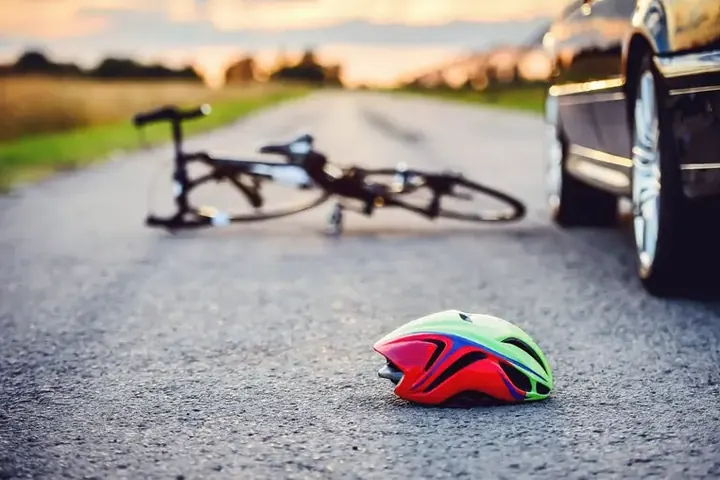
Utah compares fault, and the comparison has a cliff. Section 78B-5-818 lets you recover only from defendants whose combined fault exceeds your own. At 49% your award is reduced by 49%. At 50% you recover nothing.
Section 78B-5-820 adds a second limit: each defendant pays only its own percentage of the damages. If a jury splits fault between two drivers, neither covers the other's share.
What you did on the bike feeds that percentage. Section 41-6a-1102 gives a cyclist all the rights and duties of any other vehicle operator. Section 41-6a-1105 requires riding as near as practicable to the right-hand edge of the roadway when moving slower than traffic, with exceptions for passing, preparing for a left turn, avoiding hazards and parked cars, and a lane too narrow to share side by side.
One rule works in your favor. Since 2021, section 41-6a-1105 has let a cyclist approaching a stop sign roll through without stopping, after slowing to a reasonable speed and yielding to pedestrians, traffic in the intersection, and oncoming traffic that poses an immediate hazard. A rolling stop done that way is legal, not a violation to hold against you. The rule does not apply at an active railroad crossing.
Helmets are handled in section 41-6a-1505, the protective headgear statute. Failure to wear one is not comparative negligence and may not be introduced as evidence on negligence, injuries, or mitigation of damages. That statute covers motorcycles, e-bikes, and scooters. It does not name conventional bicycles, so treat the question as open for a rider on an unassisted bike.
Hit-and-Run and Uninsured Drivers
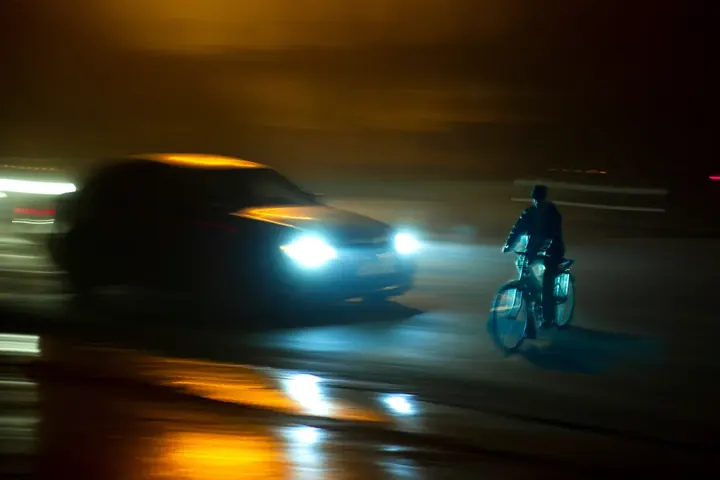
Uninsured motorist coverage is built into Utah auto policies. Section 31A-22-302 requires it in every policy unless the named insured rejects it in writing, and section 31A-22-305 sets the limit equal to the policy's liability limits unless the insured signs a form choosing less. It cannot be sold below the minimum injury limits, now $30,000 per person and $65,000 per accident.
The coverage follows people, not cars. Covered persons include the named insured and relatives living in the household, and the statute provides for a covered person "injured as a pedestrian." If the owner waived the coverage, there is nothing to claim.
Utah does not demand physical contact in a hit-and-run. Section 31A-22-305 counts an unidentified vehicle that left the scene as uninsured. If it never touched you, you must prove it existed by clear and convincing evidence consisting of more than your own testimony. A witness, a camera, or paint on the bike can decide the claim.
An uninsured motorist claim is also exempt from the PIP lawsuit threshold. You have four years from the loss to start an action on the policy.
Underinsured motorist coverage, in section 31A-22-305.3, applies when the driver's limits run out. It has a floor of $10,000 per person and $20,000 per accident, and it is added on top of the driver's liability coverage, not set off against it. Limits on several vehicles are not stacked.
Both coverages pay for bodily injury only. When the driver is gone, a bike insurance policy's crash coverage is the only source for the bike. Two things to check in a bike insurance policy: whether it offers uninsured motorist coverage of its own, and whether crash damage is covered no matter who hit you.
Dooring and Passing Laws
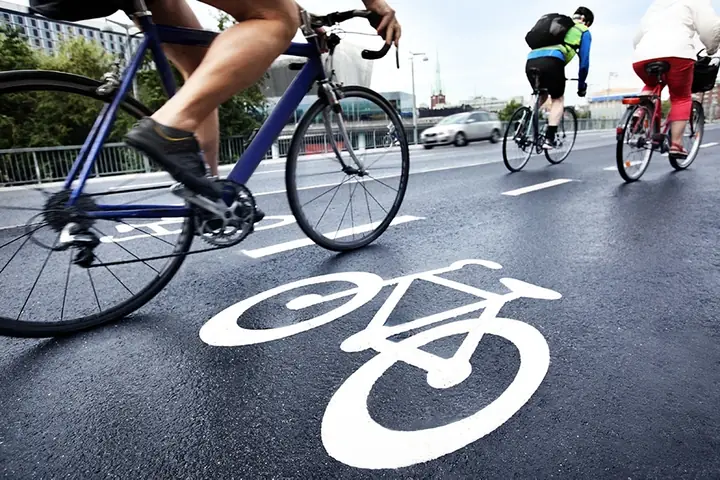
Section 41-6a-1704 is the dooring statute. A person may not open the door of a motor vehicle on a side available to moving traffic unless it can be done safely and without interfering with other traffic, and may not leave it open on that side longer than it takes to load or unload passengers. "A person" includes a passenger.
Section 41-6a-706.5 is the three-foot law, and its wording is narrower than its reputation. A driver may not knowingly, intentionally, or recklessly operate a motor vehicle within three feet of a vulnerable user of a highway. Cyclists and e-bike riders are on the list. A violation is an infraction, and a class C misdemeanor when it causes bodily injury.
The same section bars a driver from forcing a vulnerable user off the roadway. A citation under either statute is evidence worth having.
E-bikes
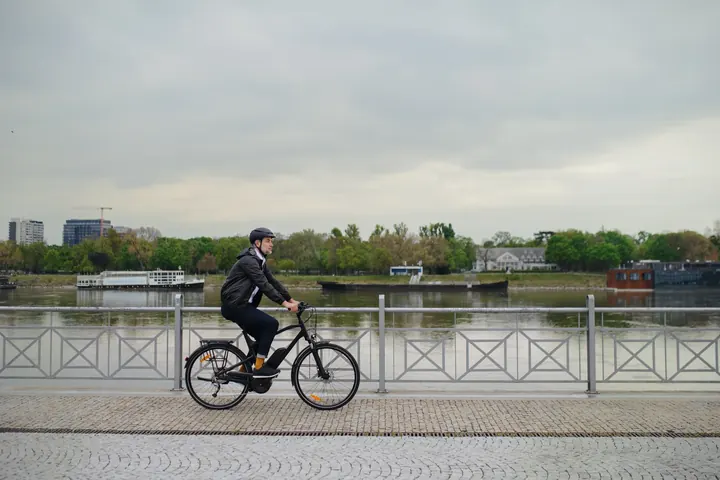
Utah calls it an electric assisted bicycle, and section 41-6a-102 defines it tightly: a motor of not more than 750 watts, fully operable pedals, and cranks installed at original manufacture. Class 1 assists only while you pedal and stops at 20 mph. Class 2 can run on the motor alone and stops at 20 mph. Class 3 assists only while you pedal, stops at 28 mph, and carries a speedometer.
The same section excludes an electric assisted bicycle from the definition of a motor vehicle, and section 41-12a-301 exempts it from the insurance requirement. Section 41-6a-1115.5 applies the bicycle rules to it. It bars riders under 16 from Class 3, and a rewritten version with new age rules takes effect May 5, 2027.
A 2026 law, House Bill 381, tightened the rest as of May 6, 2026. Section 41-6a-1505 used to require a helmet for riders under 21 on a Class 3 e-bike only. It now covers anyone under 21 riding any e-bike on a highway, with an exception written for a Class 1 e-bike or a scooter rented from a business.
The definition has a hard edge. Anything able to reach 20 mph or more on motor power alone, or rated above 750 watts, is not an electric assisted bicycle. An e-bike modified beyond the manufacturer's settings becomes a "high power electric device." Sellers of such machines must warn buyers that "your insurance policies may not provide coverage."
For a conforming e-bike, the text favors the rider: not occupying a motor vehicle, you fit the insurance code's definition of a pedestrian for PIP and uninsured motorist claims. No appellate decision read for this guide confirms it. In a bike insurance policy, check that your e-bike's class and top assisted speed are covered.
Deadlines

Utah gives an injured cyclist four years to sue a driver and one year to put a government body on notice. The clocks below are listed shortest first.
- Immediately
Police Notice of an Injury Crash
The driver must notify the nearest law enforcement agency by the quickest means available under section 41-6a-401.7.
- 10 days
Accident Report on Request
The Department of Public Safety may require a vehicle operator to file a report within 10 days of its request after a crash with an injury, a death, or $2,500 or more in property damage.
- 30 days
PIP Payment Due
PIP benefits are overdue 30 days after the insurer receives reasonable proof of the expense, and unpaid amounts earn interest at 1.5% a month under section 31A-22-309.
- One year
Notice of Claim Against a Government Body
A claim against the state, a county, a city or town, a school district, a special district, or a government employee is barred unless a written notice of claim is filed within one year after the claim arises, under section 63G-7-402. Section 63G-7-401 names the office: the attorney general for the state, the county clerk, the city or town clerk. You may not sue until 60 days after filing.
- Two years
Lawsuit Against a Government Body
The lawsuit must start within two years after the claim arises under section 63G-7-403, a rule in effect since July 1, 2025.
- Two years
Wrongful Death Lawsuit
Under section 78B-2-304.
- Four years
Injury and Property Damage Lawsuit
Under section 78B-2-307. Damage to a bike in a crash with a motor vehicle is named in section 78B-2-305 as a four-year claim.
Insurance contract claims run on their own four-year clocks. A lawsuit against an insurer for PIP benefits or uninsured motorist benefits must start within four years after the inception of the loss, under sections 31A-22-307 and 31A-22-305. Policies set their own notice conditions, so report the claim to every insurer promptly.
Evidence to Preserve
Utah claims turn on percentages and proof.
- The driver's insurer and policy number. The driver must give them at the scene. That insurer owes your first $3,000 in PIP medical benefits.
- The police report number and any citation under section 41-6a-706.5 or 41-6a-1704.
- Itemized medical bills and imaging. A fracture or more than $3,000 in medical expenses opens the claim for pain and suffering.
- Independent proof of a hit-and-run vehicle: witness contacts, doorbell or dash camera video, paint transfer. Your word alone is not enough when there was no contact.
- Evidence of your own riding: lane position, lights, your speed at a stop sign. Every point of fault assigned to you counts toward the 50% bar.
- Every auto policy in your household, with its declarations page. It shows whether uninsured motorist coverage was kept or rejected.
- For an e-bike: the class label, motor wattage, and top assisted speed. Utah law requires a label on the bike showing all three.
- The damaged bike, unrepaired, with receipts. That claim runs against the driver's property damage limit, which may be as low as $25,000.
Coverage for Utah Riders
Utah's system leaves specific gaps for a cyclist: a $3,000 PIP benefit, a driver who may carry only $30,000 per person, uninsured motorist coverage that an auto policyholder can waive in writing, and a fault rule that pays nothing at 50%. The Velosurance policy offers the coverages discussed above.
Uninsured Motorist covers losses beyond medical bills, such as lost wages, when the at-fault driver cannot pay. It does not depend on an auto policy in your household.
Medical Payments covers the deductible and out-of-pocket costs your health plan leaves once the $3,000 in PIP is spent. Choose a limit close to your plan's out-of-pocket deductible.
Liability covers the claims made against you. Section 41-6a-1106 prohibits riding negligently so as to collide with a pedestrian or another cyclist. The coverage pays covered settlements or judgments and the cost of defending a covered lawsuit, with limits from $25,000 to $500,000.
Crash damage to the bike, the loss PIP ignores, is part of the policy itself. The bike is insured at stated value with no depreciation, subject to the deductible, regardless of fault. Class 1, Class 2, and Class 3 e-bikes are covered like conventional bikes.
For any of these coverages to apply, it must be on the policy before the crash. Get a quote and have them in place before you need them.
Bicycle Accident Attorneys in Utah
Velosurance legal partners who represent injured cyclists in Utah.

Frequently Asked Questions
- Who pays medical bills for a cyclist hit by a car in Utah?
- The insurer of the car that hit you pays first, under Utah personal injury protection, with at least $3,000 in medical benefits regardless of fault and no deductible. Your health plan takes over after that. One thing to watch: PIP pays nothing for the bike, which is a claim against the driver's property damage coverage.
- When can a Utah cyclist sue for pain and suffering?
- You can claim pain and suffering once your injury meets the Utah threshold, and a bone fracture qualifies on its own. Medical expenses over $3,000, permanent disfigurement, and permanent disability or impairment also qualify. With one wrinkle: the threshold does not apply to an uninsured motorist claim.
- How does shared fault affect a bicycle accident claim in Utah?
- You recover as long as the driver's share of fault is greater than yours, with the award reduced by your percentage. A rider found 49% at fault keeps 51% of the damages. The caveat worth knowing: at 50% you recover nothing, so evidence of your lane position and how you handled a stop sign carries real weight.
- How long do you have to file a bicycle accident claim in Utah?
- You have four years to sue for injuries and for damage to your bike in Utah. One thing to watch: a claim against the state, a county, a city, or a school district needs a written notice of claim within one year, and a wrongful death lawsuit must be filed within two years.
- How are Class 1, Class 2, and Class 3 e-bikes defined in Utah?
- Utah defines three classes of electric assisted bicycle, each with a motor of not more than 750 watts and fully operable pedals. Class 1 assists only while you pedal and stops at 20 mph, Class 2 can run on the motor alone and stops at 20 mph, and Class 3 assists only while you pedal and stops at 28 mph. The caveat worth knowing: a machine that can reach 20 mph or more on motor power alone falls outside the definition.
Sources
- Utah Code section 31A-22-301 (definitions, including pedestrian and motor vehicle)
- Utah Code section 31A-22-302 (required components of motor vehicle insurance policies)
- Utah Code section 31A-22-304 (motor vehicle liability policy minimum limits)
- Utah Code section 31A-22-305 (uninsured motorist coverage)
- Utah Code section 31A-22-305.3 (underinsured motorist coverage)
- Utah Code sections 31A-22-306, 31A-22-307, 31A-22-308 (personal injury protection benefits and persons covered)
- Utah Code section 31A-22-309 (limitations, exclusions, and conditions to personal injury protection)
- Utah Code sections 78B-5-817 to 78B-5-820 (comparative negligence and allocation of fault)
- Utah Code sections 78B-2-304, 78B-2-305, 78B-2-307 (two-year, three-year, and four-year limitation periods)
- Utah Code sections 63G-7-401, 63G-7-402, 63G-7-403 (Governmental Immunity Act notice of claim and time to sue)
- Utah Code section 41-6a-102 (Traffic Code definitions, including electric assisted bicycle classes)
- Utah Code sections 41-6a-401, 41-6a-401.3, 41-6a-401.7, 41-6a-402 (duties after an accident and accident reports)
- Utah Code section 41-6a-706.5 (operating a motor vehicle near a vulnerable user of a highway)
- Utah Code sections 41-6a-1102, 41-6a-1105, 41-6a-1106 (bicycle rights, roadway position, stop signs, negligent collision)
- Utah Code section 41-6a-1115.5 (electric assisted bicycles: restrictions), current version and version effective May 5, 2027
- Utah Code section 41-6a-1505 (protective headgear), as amended by Chapter 334, 2026 General Session
- Utah H.B. 381, Electric Mobility Device Amendments, 2026 General Session (enrolled copy; Laws of Utah 2026, Chapter 334)
- Utah Code section 41-6a-1704 (vehicle door: prohibited opening)
- Utah Code section 41-12a-301 (owner's or operator's security requirement and exceptions)
This guide is general information about Utah law as of the review date above. It is not legal or insurance advice, and it does not create an attorney-client relationship. Laws change and every crash turns on its own facts: talk to a licensed Utah attorney about your situation.