
TL;DR:
- South Dakota is an at-fault state with a slight negligence rule: you recover only if your own negligence was slight compared with the driver's, reduced in proportion to it.
- Minimum auto liability limits are $25,000 per person, $50,000 per accident, and $25,000 for property damage under SDCL 32-35-70.
- You have three years to sue for injuries and six years for bike damage, but only 180 days to give written notice of a claim against a public entity.
- Every South Dakota auto policy must carry uninsured and underinsured motorist coverage for bodily injury; limits cannot be stacked, and a hit-and-run claim needs no physical contact.
- Drivers must leave three feet when passing a bicycle at posted limits of 35 mph or less and six feet above that. Only Class 3 e-bike riders under 18 and passengers must wear a helmet.
Who Pays After a Crash in South Dakota
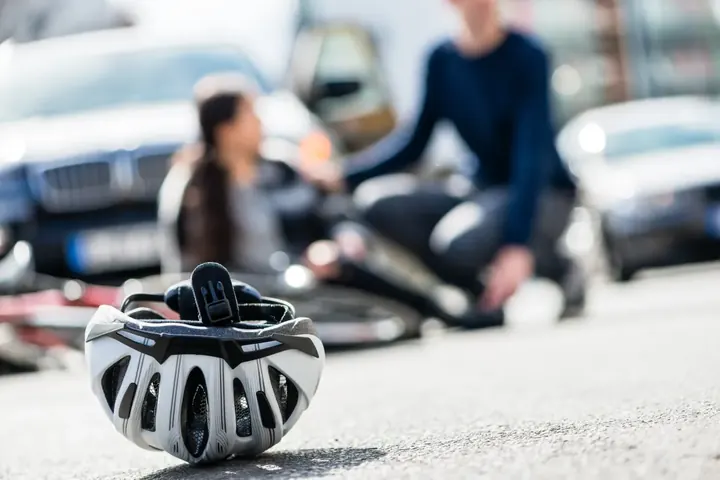
South Dakota is an at-fault state. The driver who caused the crash owes you for your losses, and SDCL 32-35-70 sets what that driver's policy must carry: $25,000 for one person's injuries, $50,000 for everyone hurt in the accident, and $25,000 for property damage.
There is no personal injury protection system here and no injury threshold to clear before you bring a claim. Your bike and gear are paid from the driver's $25,000 property limit, your injuries from the bodily injury limit.
The first-party benefit South Dakota does provide is optional. SDCL 58-23-7 bars an insurer from taking an application for an automobile liability policy unless it makes three supplemental coverages available, and section 58-23-8 sets their floors: medical expenses of at least $2,000 per injured person incurred within two years of the accident, plus small disability and accidental death benefits. The buyer can decline all three.
Those coverages pay when the named insured is hurt in the car or "through being struck by a motor vehicle while a pedestrian." Section 58-23-6 extends the pedestrian wording to members of the household. The statute does not say whether a person riding a bicycle counts as a pedestrian, so ask your auto insurer in writing whether medical payments coverage follows you onto a bike.
If nobody in your household owns a car, none of this exists for you. Your sources are the driver's liability coverage, your health plan, and whatever you carry on the bike itself.
Fault and How It Reduces a Claim

South Dakota's fault rule is strict, and it shapes every bike claim in the state. SDCL 20-9-2 says your own negligence does not bar recovery "when the contributory negligence of the plaintiff was slight in comparison with the negligence of the defendant." In that case your damages are reduced in proportion to your negligence. If your negligence was more than slight, you recover nothing.
The statute draws no percentage line. It goes further and directs that the question of whether your negligence was slight be decided without a special jury question that discloses a percentage of your fault. You cannot plan around a number.
The material comes from the traffic code. SDCL 32-14-1 defines a vehicle to include bicycles and electric bicycles, so the rules of the road bind you as they bind a driver. The provisions most likely to be raised:
- Lane position. SDCL 32-20B-5 requires a rider slower than traffic to keep as close as practicable to the right-hand curb or edge. You may move left to pass, to prepare for a left turn, or to avoid hazards, parked cars, and substandard width lanes, defined as lanes too narrow for a bicycle and a vehicle to travel safely side by side.
- Signals. Section 32-20B-6 requires a continuous turn signal for the last 100 feet before a turn. It also bars passing on the right a vehicle that is signaling a right turn.
- Lights. Section 32-17-25 requires a lighted front lamp visible from at least 300 feet and a rear reflector or lamp, yellow or red, visible from 200 feet.
- Sidewalks and crosswalks. Under section 32-20B-2 you have a pedestrian's rights there, but you must stop before entering a crosswalk or highway from a sidewalk.
Helmets are an open question. South Dakota has no bicycle helmet law for conventional bikes, and no statute or state Supreme Court decision was found saying whether riding without one can be used against you.
Hit-and-Run and Uninsured Drivers

South Dakota makes both halves of this coverage compulsory. SDCL 58-11-9 bars any auto liability policy from being issued in the state without uninsured motorist coverage, and the statute names "hit-and-run motor vehicles" alongside uninsured ones. Section 58-11-9.4 requires underinsured motorist coverage as well. Each must equal the policy's own bodily injury limits, so at least $25,000 per person and $50,000 per accident.
The statute protects "persons insured thereunder" who are legally entitled to recover from the driver, and does not say you must be inside a car. Who counts as an insured away from the vehicle is set by the policy form. Confirm with your insurer that it applies on a bicycle.
For a driver who flees, state case law favors you. In Clark v. Regent Insurance Co., a 1978 decision, the South Dakota Supreme Court refused to enforce a policy clause requiring physical contact with the hit-and-run vehicle, reasoning that section 58-11-9 contains no such condition. A car that forces you off the road without touching you can still support a claim. The burden of proving that an unidentified driver caused the crash is yours, so witnesses and video carry the claim.
The statute sets no deadline for reporting a hit-and-run, which leaves the deadline to your policy. Call police from the scene. A police investigation is your best record that a second vehicle existed.
Three limits to know. Both coverages pay for bodily injury only, so neither one replaces a wrecked bike. Underinsured coverage under section 58-11-9.5 pays your limit less what the driver's liability insurer paid: against a driver carrying the $25,000 minimum, a $25,000 underinsured limit adds nothing. And sections 58-11-9.7 through 58-11-9.9 forbid stacking, so the limits on two household cars cannot be added together.
Dooring and Passing Laws
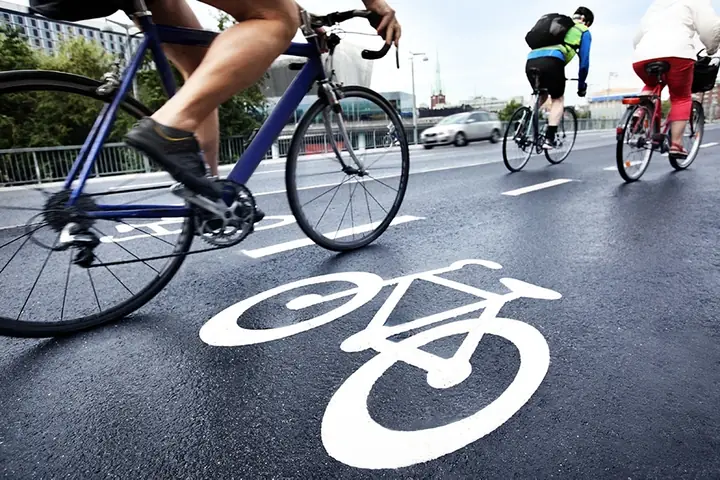
South Dakota puts its passing rule in feet. SDCL 32-26-26.1, enacted in 2015, requires a driver overtaking a bicycle to leave at least three feet between the right side of the vehicle, "including any mirror or other projection," and the left side of the bike where the posted limit is 35 mph or less. Where the posted limit is higher, the gap is six feet.
The statute removes the usual excuse. A driver may partially cross the centerline, or the line between two lanes going the same way, to give you the room, provided it can be done safely. A violation is a Class 2 misdemeanor. A citation under this section supports your case that the negligence was the driver's.
Dooring is covered by SDCL 32-30-2.5. No person may open a vehicle door on the side available to moving traffic "unless and until it is reasonably safe to do so" and it can be done without interfering with other traffic. The rule applies to passengers as well as drivers, and a violation is a petty offense.
E-bikes
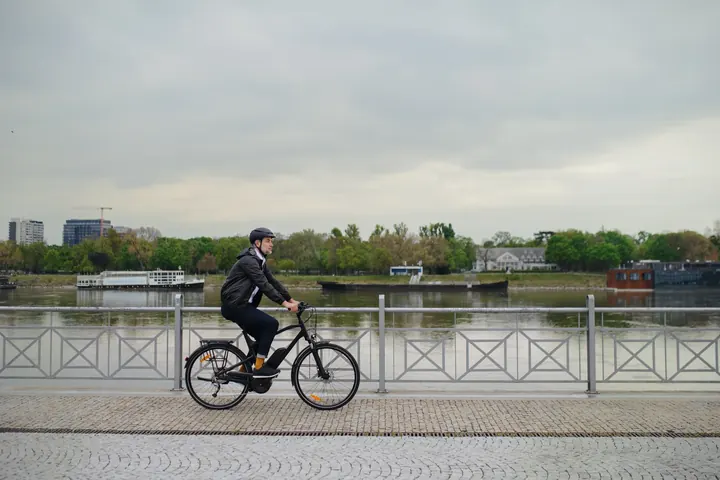
SDCL 32-20B-9 defines an electric bicycle as a bicycle or tricycle with a seat, operable pedals, and an electric motor of 750 watts or less. Class 1 assists only while you pedal and stops assisting at 20 mph. Class 2 can propel the bike without pedaling and stops at 20 mph. Class 3 assists only while you pedal and stops at 28 mph.
Class 3 carries extra rules. The operator must be at least 16 under section 32-20B-13, the bike needs a working speedometer under section 32-20B-15, and section 32-20B-14 requires a helmet for an operator under 18 and for any passenger of any age. It is the only bicycle helmet rule in state law.
One recent change: a 2025 law amended SDCL 41-17-27 to let Class 1 e-bikes onto the George S. Mickelson Trail, where motorized vehicles are otherwise banned.
An e-bike is not a motor vehicle in South Dakota. Both the traffic code definition in section 32-14-1 and the financial responsibility law in section 32-35-1 exclude it, so there is no compulsory insurance, and in a crash you stand where any cyclist stands: the same slight negligence rule, the same three-year deadline.
Section 32-20B-10 requires a permanent label showing class, top assisted speed, and motor wattage. Photograph it. A motor over 750 watts falls outside the definition, and the other side's insurer will ask.
Whether the uninsured motorist or medical payments coverage on an auto policy applies to you on an e-bike is not answered by any statute, Division of Insurance guidance, or appellate decision found for this guide. Get your insurer's position in writing. In a bike insurance policy, check that your e-bike's class is covered.
Deadlines

South Dakota gives you three years to sue for injuries, but a claim against a public entity can be lost in 180 days.
- At the scene
Police Notice and Driver Details
SDCL 32-34-7 requires the driver of a motor vehicle to notify the nearest law enforcement officer immediately, by the quickest means, of any accident with bodily injury. Do not rely on the driver: make the call yourself.
- 180 days
Written Notice to a Public Entity
A claim against the state, a county, a city, a school district, or their employees needs written notice of the time, place, and cause of the injury within 180 days under SDCL 3-21-2. Section 3-21-3 names who receives it: the attorney general and the commissioner of human resources and administration for the state, the county auditor for a county, the mayor or city finance officer for a municipality, the superintendent for a school district.
- Three years
Injury Lawsuit
SDCL 15-2-14 gives you three years from the day the claim accrues to sue for personal injury. A wrongful death action runs three years from the death under section 21-5-3.
- Six years
Bike Damage Lawsuit
Damage to the bike and gear falls under SDCL 15-2-13, which allows six years for an action for injuring goods or chattels. Small claims court hears disputes up to $12,000 under section 15-39-45.1.
The 180-day notice does not buy time: section 3-21-2 says nothing in the notice chapter tolls or extends the limitation period. Send it in writing, to the right officer, and keep proof of delivery.
Notice is also not the last hurdle. Under SDCL 21-32A-1 and 21-32A-3, a public entity other than the state is immune from damages except to the extent it participates in a risk sharing pool or has bought liability insurance, and section 3-22-17 allows suits against the state only for claims its coverage document covers.
Evidence to Preserve
Under the slight negligence rule, evidence in South Dakota has one job: showing that your share of the blame was small and the driver's was large.
- The posted speed limit where you were passed, photographed. It decides whether the driver owed you three feet or six.
- The investigating officer's report. Under SDCL 32-34-10 it goes to the Department of Public Safety within three days after the investigation is complete, and section 32-34-13 says reports are not confidential.
- The driver's details. SDCL 32-34-3 requires a driver in an injury crash to give you a name, address, the owner's name and address, and the license number.
- Witness names and video for a driver who fled. With no contact required, proof that the other vehicle existed is the whole claim.
- Your auto policy's declarations page, showing the uninsured and underinsured limits and whether medical payments coverage was bought.
- The damaged bike, unrepaired, with receipts for the bike and gear.
Coverage for South Dakota Riders

South Dakota law leaves a rider exposed in four places: a driver carrying the $25,000 minimum, auto uninsured motorist coverage that pays for injuries only and is absent in a household without a car, medical costs your health plan leaves you, and a fault rule that bars a claim once your negligence is more than slight. The Velosurance policy offers the coverages discussed above.
Uninsured Motorist covers losses beyond medical bills, such as lost wages, when the at-fault driver cannot pay.
Medical Payments covers the deductible and out-of-pocket costs your health plan leaves, regardless of the driver's insurance. Choose a limit close to your plan's out-of-pocket deductible.
Liability is the coverage for the day the slight negligence rule runs against you. If you are held responsible for a crash, it covers injury to other people and damage to their property, including the cost of defending a covered lawsuit, with limits from $25,000 to $500,000.
Crash damage to the bike is part of the policy itself: stated value with no depreciation, subject to the deductible, whoever was at fault. Class 1, Class 2, and Class 3 e-bikes are covered like conventional bikes.
For any of these coverages to apply, it must be on the policy before the crash. Get a quote before the next ride, not after it.
Frequently Asked Questions
- How does the slight negligence rule work in a South Dakota bicycle accident claim?
- You recover damages in South Dakota when your own negligence was slight compared with the driver's, and the award is reduced in proportion to it. The caveat worth knowing: negligence that is more than slight bars the claim entirely, and the statute sets no percentage line, so evidence of lawful riding decides the outcome.
- How long do you have to file a bicycle accident claim in South Dakota?
- You have three years to sue for personal injury in South Dakota and six years for damage to your bike. One thing to watch: a claim against a public entity needs written notice within 180 days of the injury, and that notice period does not extend the time to sue.
- What makes a hit-and-run claim work for a cyclist in South Dakota?
- Uninsured motorist coverage, which every South Dakota auto policy must include, also covers hit-and-run vehicles, and state case law does not require physical contact with the car that fled. Call police from the scene and gather witnesses, because proving an unidentified driver caused the crash is your burden. With one wrinkle: whether the coverage follows you onto a bike depends on the policy form.
- How much room must a South Dakota driver leave when passing a bicycle?
- A South Dakota driver must leave at least three feet where the posted limit is 35 mph or less and at least six feet where it is higher, measured from the vehicle's mirror or other projection. The driver may partially cross the centerline to do it when safe, and a violation is a Class 2 misdemeanor.
- How are Class 1, Class 2, and Class 3 e-bikes treated after a crash in South Dakota?
- South Dakota treats Class 1, Class 2, and Class 3 e-bikes as bicycles and not motor vehicles, so the same slight negligence rule and three-year deadline apply. Class 1 is pedal assist to 20 mph, Class 2 can run without pedaling to 20 mph, and Class 3 is pedal assist to 28 mph for operators 16 and older. The caveat worth knowing: a motor over 750 watts puts the bike outside the definition.
Sources
- SDCL 20-9-2 (comparative negligence, slight negligence rule)
- SDCL 15-8-15.1 (liability of a party allocated less than 50% of total fault)
- SDCL 32-35-70 and 32-35-113 (minimum liability limits, maintenance of financial responsibility)
- SDCL 32-35-1 (financial responsibility definitions; electric bicycle excluded from motor vehicle)
- SDCL 58-11-9 (uninsured motorist and hit-and-run coverage)
- SDCL 58-11-9.4 and 58-11-9.5 (underinsured motorist coverage and its limits)
- SDCL 58-11-9.7, 58-11-9.8, 58-11-9.9 (adding coverage limits together prohibited)
- SDCL 58-23-6, 58-23-7, 58-23-8 (supplemental automobile coverages: medical, disability, accidental death)
- Clark v. Regent Insurance Co., 270 N.W.2d 26 (S.D. 1978) (physical contact clause)
- SDCL 15-2-14 and 15-2-13 (three-year and six-year limitation periods)
- SDCL 21-5-3 (wrongful death limitation)
- SDCL 3-21-1 through 3-21-3 (notice of claims against public entities)
- SDCL 21-32A-1 through 21-32A-3 and 3-22-17 (sovereign immunity and its waiver)
- SDCL 15-39-45.1 (small claims limit)
- SDCL 32-14-1 (traffic code definitions: vehicle, motor vehicle, electric bicycle)
- SDCL chapter 32-20B (bicycle regulation and electric bicycles), sections 32-20B-2 through 32-20B-6 and 32-20B-9 through 32-20B-15
- SDCL 32-17-25 (bicycle lamps)
- SDCL 32-26-26.1 (overtaking a bicycle, minimum separation)
- SDCL 32-30-2.5 (opening doors on the traffic side)
- SDCL 32-34-3, 32-34-7, 32-34-10, 32-34-13 (duties and reports after an accident)
- SDCL 41-17-27 (Mickelson Trail; Class I electric bicycles permitted, SL 2025 ch. 178)
- South Dakota Division of Insurance, auto insurance guidance
This guide is general information about South Dakota law as of the review date above. It is not legal or insurance advice, and it does not create an attorney-client relationship. Laws change and every crash turns on its own facts: talk to a licensed South Dakota attorney about your situation.