
TL;DR:
- Rhode Island is a fault state with pure comparative negligence: your share of the blame cuts your recovery by that percentage and never bars it.
- Minimum auto liability limits are $25,000 per person, $50,000 per crash, and $25,000 for property damage, or a $75,000 combined single limit.
- You have three years to sue for injuries, but a crash caused by a defect in a city or town road needs written notice to the council within 60 days.
- A hit-and-run uninsured motorist claim does not require physical contact with the car, under a 1981 Rhode Island Supreme Court decision.
- Riding without a helmet cannot be used against you in a civil trial, and opening a car door into a bike lane violates section 31-21-14.
Who Pays After a Crash in Rhode Island
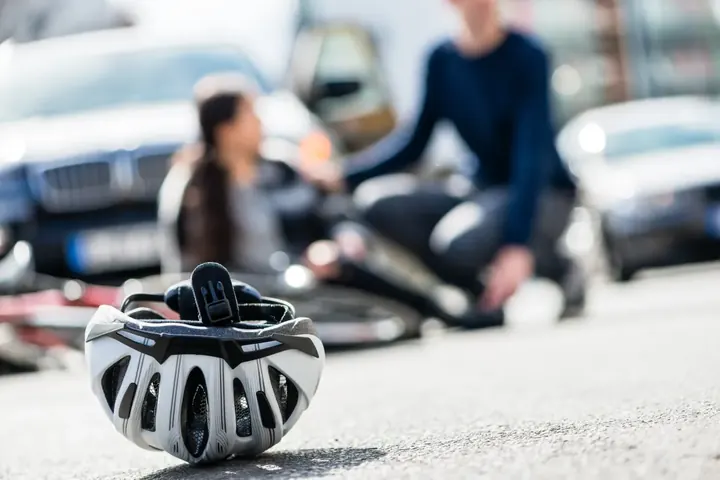
Rhode Island is a fault state. The driver who caused the crash pays, through the liability coverage that the Motor Vehicle Reparations Act, chapter 31-47 of the General Laws, requires for every registered vehicle. There is no personal injury protection and no injury threshold: any loss, from a bent wheel to a fractured hip, can be claimed against the person responsible.
Section 31-47-2 sets the minimums at $25,000 for one person's injuries, $50,000 when two or more people are hurt, and $25,000 for property damage. Shoulder surgery with rehab costs $15,000 to $40,000, so one operation can use up a minimum-limits policy before lost income or pain and suffering enter the claim.
Your bike and gear are paid from the property damage limit. Your medical bills are paid from the bodily injury limit, usually in one settlement at the end of treatment. Until then your health plan pays, and you carry its deductible and copays.
Under section 27-7-2.5, every auto liability policy must include medical payments coverage of at least $2,500 per person and $5,000 in total, paid regardless of fault, unless the named insured rejected it in writing. Whether yours follows you onto a bicycle depends on the policy wording, so ask your auto insurer in writing.
If nobody in your household insures a car, that leaves the driver's liability coverage, your health plan, and whatever you carry on the bike itself.
A case that reaches judgment grows: section 9-21-10 adds interest at 12% a year from the date the claim arose.
Fault and How It Reduces a Claim

Section 9-20-4 states the rule in one sentence: your own lack of due care "shall not bar a recovery," but your damages are reduced in proportion to your negligence. There is no cutoff at 50% or anywhere else. A rider found 30% at fault for a $100,000 loss collects $70,000. A rider found 80% at fault still collects $20,000.
So the percentage is the fight. Section 31-19-3 gives a person on a bicycle or an electric bicycle every right and every duty of a driver under chapters 12 through 27 of Title 31, and an insurer will read chapter 19 looking for a rule you broke:
- Lane position. Section 31-19-6 requires riding as near to the right side of the roadway as practicable, with due care when passing a standing vehicle, unless signs or pavement markings direct otherwise.
- Lights and reflectors. Section 31-19-10 requires a white front lamp visible from 500 feet at night, a red rear reflector visible from 600 feet, and reflective pedals.
One argument is closed to the insurer. Section 31-19-2.1 requires helmets for riders 15 and younger and adds that failure to wear one is not contributory or comparative negligence and is not admissible as evidence in the trial of any civil action. The e-bike helmet statute, section 31-19.7-3, repeats those words.
Under the vulnerable road user law, section 31-15-20, a driver who fails to use due care and injures a bicyclist "acting in compliance with chapter 19" is fined $200. The fine is $500 with a three-month license suspension for a serious bodily injury, and $1,000 with a one-year suspension for a death.
Hit-and-Run and Uninsured Drivers

Section 27-7-2.1 requires every auto liability policy on a vehicle registered or garaged in Rhode Island to carry uninsured motorist coverage equal to its bodily injury liability limits. The named insured can choose a lower limit in writing, but not below $25,000 per person and $50,000 per crash. One exception: a buyer of minimum liability limits can reduce the coverage to zero after signing an advisory notice approved by the Department of Business Regulation. Check your declarations page, and ask your insurer in writing whether the coverage applies while you ride a bicycle: the statute protects "persons insured under the policy" and leaves that definition to the policy.
The same coverage reaches an underinsured driver, one whose liability coverage is less than the damages you are entitled to recover. Rhode Island also lets you stack: if you paid two or more uninsured motorist premiums on one policy, or on several policies with the same company, you can collect up to the combined limits whatever the policy says.
In Pin Pin H. Su v. Kemper Insurance Companies in 1981, the Rhode Island Supreme Court held that a policy clause requiring physical contact with the unidentified vehicle is void. A rider forced off the road by a car that never touched them can still claim, but must prove by a fair preponderance of the evidence that an unidentified driver's negligence caused the crash.
Section 27-7-2.1 sets no reporting deadline of its own, so read your policy for one and call police from the scene. Under section 31-26-3.3, a driver who hits a cyclist must stop, give aid, and notify police immediately.
None of this pays for the bike. The statute defines its property damage coverage as damage to the insured vehicle and property inside it, and a 2026 amendment taking effect April 1, 2027 keeps that definition.
Two things to check in a bike insurance policy: whether it offers uninsured motorist coverage of its own, and whether crash damage is covered no matter who hit you.
Dooring and Passing Laws

Section 31-21-14 is the dooring statute, and it names cyclists. No person may open a motor vehicle door on a roadway available to moving traffic until it is reasonably safe and can be done without interfering with other traffic, "including pedestrians and bicycles on sidewalks, shoulders, or bicycle lanes." It says "person," not "driver," so a rideshare passenger is covered. The fine under section 31-41.1-4 is $100.
Passing is governed by section 31-15-18, known as Frank's Law. Rhode Island does not use a number of feet. A driver may pass a bicycle only on the left at a "safe distance," defined as enough room to avoid contact if the rider were to fall into the driver's lane. The driver may cross the center line to do it when the way is clear. The fine is $100.
Bicycle lanes are protected by section 31-15-17. A motor vehicle may enter one only to turn, to enter or leave the roadway or a parking lane, or on official duty. The fine is $100.
E-bikes

Rhode Island adopted three e-bike classes on July 1, 2024, in chapter 31-19.7. Class 1 assists only while you pedal and stops at 20 mph. Class 2 has a throttle-actuated motor that stops assisting at 20 mph. Class 3 assists only while you pedal and stops at 28 mph.
Section 31-1-3 defines an electric bicycle as a two-wheel vehicle moved by human power, an electric motor, or both, with a motor rated at no more than two S.A.E. horsepower and a top speed of no more than 28 mph. The same section excludes it from the definition of "motor vehicle," and section 31-19-3 gives its rider the rights and duties of any other vehicle driver. In a crash you are treated as a cyclist: the same fault rule and the same deadlines.
Three rules are specific to e-bikes. Section 31-19.7-3 requires a helmet for every operator and passenger under 21. Section 31-19.7-2 allows Class 1 e-bikes on state bicycle trails and paths. And section 31-19-12 bars e-bikes from sidewalks and crosswalks in the town of New Shoreham, on Block Island.
A machine that exceeds 28 mph or two horsepower is not an electric bicycle under section 31-1-3 and loses the exclusion from the motor vehicle definition.
One question has no clear answer in the Rhode Island authority reviewed for this guide: whether an auto policy's uninsured motorist or medical payments coverage follows you onto an e-bike. Get your auto insurer's position in writing. In a bike insurance policy, check that your e-bike's class is covered.
Deadlines

Rhode Island gives an injured rider three years to sue. The deadline riders miss is the 60 days allowed for a claim over a city or town road.
- Immediately
Driver's Notice to Police
Under section 31-26-3.3, a driver in a crash with a cyclist must stop and notify local or state police by the quickest means available.
- 21 days
Driver's DMV Crash Report
The driver must send a written report to the Division of Motor Vehicles within 21 days of any crash involving an injury, a death, or more than $1,000 in damage to one person's property, under section 31-26-6.
- 40 days
City or Town's Time to Pay
Under section 45-15-5, any claim against a city or town goes to its council first. You may sue if it is not paid within 40 days.
- 60 days
Notice of a City or Town Road Defect
If a pothole, broken grate, or other defect in a city or town road or bridge caused the crash, section 45-15-9 requires notice of the time, place, and cause within 60 days. Section 45-15-10 requires it in writing, signed, and presented to the council. Recovery for personal injuries in these cases is capped at $100,000 by section 45-15-12.
- Three years
Injury or Wrongful Death Lawsuit
Section 9-1-14 gives you three years to file an injury lawsuit. A wrongful death action must be filed within three years of the death under section 10-7-2.
- Three years
Lawsuit Against the State, a City, or a Town
Section 9-1-25 requires any tort lawsuit against the state, a city, or a town to be filed within three years, for injuries and for bike damage alike. Chapter 9-31 caps damages at $100,000 unless the entity was performing a proprietary function, and sets no separate notice period for claims against the state.
- Ten years
Bike and Gear Damage Lawsuit
A lawsuit against a private party for damage to the bike and gear falls under the ten-year general limit in section 9-1-13.
For a child, section 9-1-19 delays the start of the limitation periods in chapter 9-1 until age 18. Do not assume that pause reaches the 60-day notice to a city or town, which sits in a different chapter.
Evidence to Preserve
Collect evidence with the Rhode Island statutes above in mind.
- The police report number, from the city or town department or the Rhode Island State Police.
- The driver's name, address, registration, and license, which section 31-26-3.3 entitles you to ask for, plus a photo of the insurance card.
- Witnesses and video from your own camera, nearby businesses, doorbells, and RIPTA buses. In a hit-and-run without contact, they prove the other vehicle existed. Ask the same day.
- The scene: lane markings, the parked car's door position, and sight lines. For a pothole or broken grate, photograph the defect with something for scale and note the exact street address for the 60-day notice.
- Your bike as it was: front lamp, rear and pedal reflectors, and for an e-bike the class label. Do not repair or discard the bike until the claim is settled.
- Medical bills and receipts for the bike and gear.
- Proof of delivery for a notice to a city or town council: a stamped copy from the clerk or a certified mail receipt.
Coverage for Rhode Island Riders

Rhode Island leaves specific gaps: a driver with $25,000 of coverage, an auto policy whose uninsured motorist limit was reduced to zero, medical payments of $2,500, and a bike that no auto coverage pays for. The Velosurance policy offers the coverages discussed above.
Uninsured Motorist covers losses beyond medical bills, such as lost wages, when the at-fault driver cannot pay.
Medical Payments covers the deductible and out-of-pocket costs your health plan leaves, whatever the driver's insurance does. Choose a limit close to your plan's out-of-pocket deductible.
Liability answers the other side of section 9-20-4. Pure comparative negligence works in both directions: a driver or pedestrian can claim against you for your share of a crash. It pays for injury to other people and damage to their property, including the cost of defending a covered lawsuit, with limits from $25,000 to $500,000.
Crash damage to the bike is part of the policy itself. The bike is insured at stated value with no depreciation, subject to the deductible, whoever caused the crash. Class 1, Class 2, and Class 3 e-bikes are covered like conventional bikes.
For any of these coverages to apply, it must be on the policy before the crash. Get a quote and add them before your next ride.
Frequently Asked Questions
- How does fault affect a bicycle accident claim in Rhode Island?
- You can recover damages in Rhode Island even when you share the blame, because section 9-20-4 uses pure comparative negligence with no percentage cutoff. Your recovery drops by your share of fault: a rider 30% at fault for a $100,000 loss collects $70,000. One thing to watch: an insurer will look for a chapter 19 rule you broke, such as lane position or lights, to raise that percentage.
- How long do you have to file a bicycle accident claim in Rhode Island?
- You have three years to file an injury lawsuit in Rhode Island, and ten years to sue a private party for damage to your bike and gear. One thing to watch: a crash caused by a defect in a city or town road needs written notice to the council within 60 days, and any lawsuit against the state, a city, or a town must be filed within three years.
- What does the at-fault driver's insurance pay after a bike crash in Rhode Island?
- The at-fault driver's liability policy pays for your injuries from its bodily injury limit and for your bike and gear from its property damage limit. Rhode Island's minimums are $25,000 per person, $50,000 per crash, and $25,000 for property damage. The caveat worth knowing: shoulder surgery with rehab costs $15,000 to $40,000, so one operation can use up a minimum-limits policy.
- How does uninsured motorist coverage work for a Rhode Island cyclist in a hit-and-run?
- A hit-and-run claim under Rhode Island uninsured motorist coverage can succeed even when the car never touched you, because the state Supreme Court voided policy clauses that require physical contact. You must prove the unidentified driver's negligence, so gather witnesses and video the same day. With one wrinkle: ask your auto insurer in writing whether the coverage applies on a bicycle, and it does not pay for the bike.
- How are Class 1, Class 2, and Class 3 e-bikes treated after a crash in Rhode Island?
- Rhode Island treats Class 1, Class 2, and Class 3 e-bikes as vehicles outside the motor vehicle definition, so the same fault rule and filing deadlines apply as on a bicycle. Class 1 is pedal assist to 20 mph, Class 2 has a throttle and stops assisting at 20 mph, and Class 3 is pedal assist to 28 mph. The caveat worth knowing: a machine that exceeds 28 mph or two horsepower is not an electric bicycle under section 31-1-3.
Sources
- R.I. Gen. Laws section 9-20-4 (comparative negligence)
- R.I. Gen. Laws section 31-47-2 (Motor Vehicle Reparations Act definitions, minimum liability limits)
- R.I. Gen. Laws section 27-7-2.1 (uninsured and underinsured motorist coverage)
- 2026 H 7520 Substitute A (P.L. 2026, chs. 388 and 389; underinsured motorist property damage, effective April 1, 2027)
- R.I. Gen. Laws section 27-7-2.5 (medical payments coverage)
- Pin Pin H. Su v. Kemper Insurance Cos., 431 A.2d 416 (R.I. 1981) (physical contact clause void)
- R.I. Gen. Laws section 9-21-10 (interest in civil actions)
- R.I. Gen. Laws sections 9-1-13, 9-1-14, 9-1-19, and 9-1-25 (filing deadlines, minors, suits against the state and municipalities)
- R.I. Gen. Laws section 10-7-2 (wrongful death actions)
- R.I. Gen. Laws sections 9-31-1, 9-31-2, and 9-31-3 (governmental tort liability and damage limits)
- R.I. Gen. Laws sections 45-15-5, 45-15-8, 45-15-9, 45-15-10, and 45-15-12 (claims against cities and towns, highway defect notice)
- R.I. Gen. Laws sections 31-19-3, 31-19-6, 31-19-7, 31-19-10, 31-19-11, and 31-19-12 (bicycle rights, duties, equipment, sidewalks)
- R.I. Gen. Laws section 31-19-2.1 (bicycle helmets, age 15 and younger)
- R.I. Gen. Laws sections 31-19.7-1, 31-19.7-2, and 31-19.7-3 (electric bicycle classes, state property, helmets under 21)
- R.I. Gen. Laws section 31-1-3 (definitions: electric motorized bicycle, motor vehicle)
- R.I. Gen. Laws section 31-15-18 (Frank's Law, unsafe passing of a bicycle)
- R.I. Gen. Laws section 31-15-20 (unsafe passing of a vulnerable road user)
- R.I. Gen. Laws sections 31-15-17 and 31-27-19 (motor vehicles in bicycle lanes)
- R.I. Gen. Laws section 31-21-14 (opening vehicle doors)
- R.I. Gen. Laws section 31-41.1-4 (schedule of traffic fines)
- R.I. Gen. Laws sections 31-26-3.3 and 31-26-6 (duty to stop after a crash with a bicycle, written crash report)
This guide is general information about Rhode Island law as of the review date above. It is not legal or insurance advice, and it does not create an attorney-client relationship. Laws change and every crash turns on its own facts: talk to a licensed Rhode Island attorney about your situation.