
TL;DR:
- Oregon is a fault state with a 51% bar under ORS 31.600: at 50% at fault you recover half, at 51% you recover nothing.
- Every Oregon auto policy carries PIP that pays up to $15,000 of medical bills, within two years, for a rider struck by the insured car, regardless of fault.
- Drivers must carry $25,000 per person, $50,000 per accident, and $20,000 for property, and uninsured motorist coverage is mandatory on every auto policy.
- You have two years to sue for injuries and six for bike damage, but only 180 days to give notice of a claim against a public body.
- Riding without a helmet cannot be used to reduce your damages under ORS 814.489, and a hit-and-run must be reported within 72 hours.
Who Pays After a Crash in Oregon
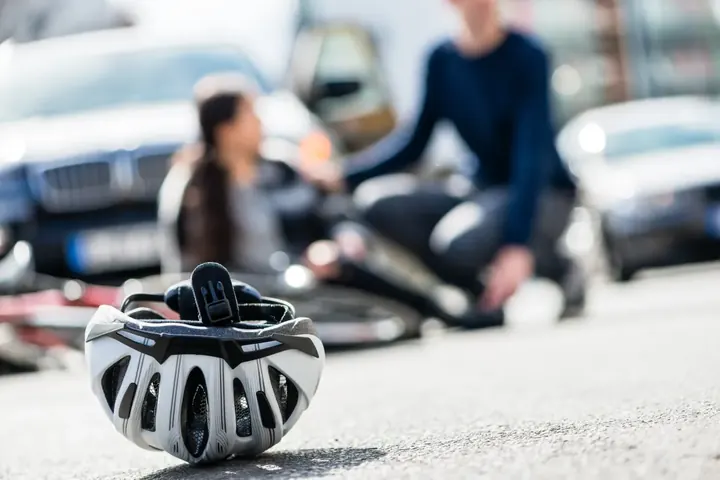
Oregon is a fault state: the driver who caused the crash is liable for your losses. But the first bills do not wait for that argument to end. ORS 742.520 requires every private passenger auto policy to carry personal injury protection, and it extends those benefits to "pedestrians struck by the insured motor vehicle." ORS 742.518 defines a pedestrian as a person not occupying a self-propelled vehicle, a definition that fits a rider on a conventional bicycle.
Under ORS 742.524, PIP pays reasonable and necessary medical expenses incurred within two years of the injury, up to $15,000. If you are disabled for at least 14 days, it pays 70% of lost income, capped at $3,000 a month for up to 52 weeks. Fault plays no part.
If you or a relative you live with insures a car, ORS 742.526 makes that policy's PIP primary when you are hit as a pedestrian. If you rely on the striking driver's PIP, it is excess over your other benefits, so your health plan pays first.
The liability claim comes next. ORS 806.070 sets the minimums at $25,000 for one person's injuries, $50,000 for everyone hurt in the accident, and $20,000 for property damage, and neither the 2025 nor the 2026 session changed them. Collarbone surgery alone costs $11,000 to $17,000, so one operation can exhaust PIP.
Oregon has no injury threshold, and taking PIP does not close the door on suing. Your bike and gear are paid from the driver's $20,000 property limit, never from PIP.
Fault and How It Reduces a Claim

ORS 31.600 lets you recover as long as your fault is "not greater than the combined fault" of the people you are claiming against, and reduces the award by your percentage. A rider found 50% at fault for a $100,000 loss collects $50,000. At 51%, the same rider collects nothing.
The comparison is against the other side as a group, including anyone you have already settled with. Under ORS 31.610 each defendant then owes only its own share.
ORS 814.400 gives a cyclist the rights and duties of a driver, and an insurer will go through the bicycle statutes looking for one you broke:
- Lane position. ORS 814.430 requires a rider slower than traffic to keep as close as practicable to the right edge. The exceptions cover passing, left turns, hazards, and a lane too narrow for a bike and a vehicle to travel safely side by side.
- Bike lanes. ORS 814.420 requires you to use an adjacent bike lane or path, but only where the road authority has found it suitable after a public hearing.
- Stop signs. Under ORS 814.414 and 814.416, a cyclist may roll through a stop sign or a flashing red signal after slowing to a safe speed and yielding.
- Lights. ORS 815.280 requires a white light visible from 500 feet ahead and a red reflector or light visible from 600 feet behind in limited visibility.
One argument is off the table. ORS 814.489 says evidence that a rider wore no helmet is not admissible to reduce damages or to serve as a defense when someone else was at fault in whole or in part.
Hit-and-Run and Uninsured Drivers

Uninsured motorist coverage is mandatory in Oregon. ORS 742.502 requires it on every motor vehicle liability policy, at the same limits as the policy's bodily injury coverage unless the named insured chose lower limits in writing, and never below $25,000 per person and $50,000 per accident. It cannot be rejected outright.
It follows you onto a bike. The policy terms in ORS 742.504 cover the named insured, a spouse, and resident relatives, and define a hit-and-run vehicle as one that makes physical contact "with the insured or with a vehicle the insured is occupying."
Two conditions apply when the driver cannot be identified. The crash must be reported within 72 hours to a police officer or to the Oregon Department of Transportation. A statement under oath must reach your insurer within 30 days after that report.
Oregon also covers the car that never touches you. ORS 742.504 calls it a phantom vehicle and applies the same 72-hour and 30-day terms, with one addition: the facts must be corroborated by competent evidence other than your own testimony.
Underinsured coverage is built in. Under ORS 742.502 it applies when the at-fault driver's liability insurance is less than your damages and pays the difference up to your own uninsured motorist limit.
Uninsured motorist coverage pays for bodily injury only. The property version in ORS 742.510 is optional and written for damage to the insured's vehicle. Two things to check in a bike insurance policy: whether it offers uninsured motorist coverage of its own, and whether crash damage is covered no matter who hit you.
Dooring and Passing Laws
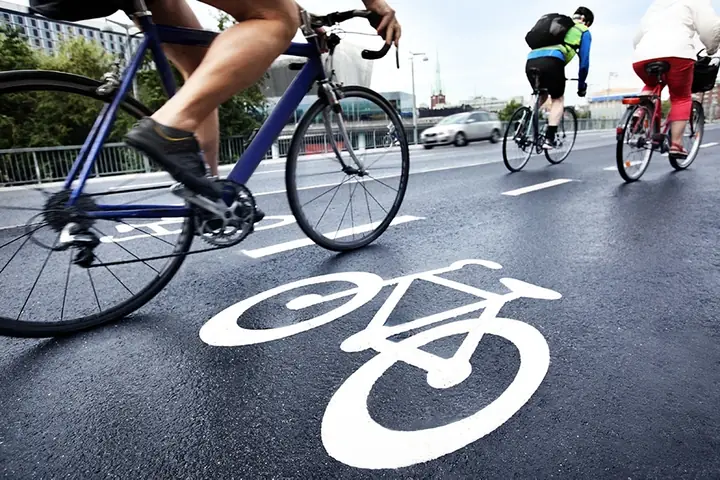
ORS 811.490 is Oregon's dooring statute. A person may not open any door of a vehicle until it is reasonably safe and can be done without interfering with traffic "or with pedestrians and bicycles on sidewalks or shoulders." Leaving a traffic-side door open longer than it takes to load or unload passengers is the same offense, a Class D traffic violation.
The passing rule, ORS 811.065, has no number of feet in it. A driver must pass to the left at a safe distance, defined as enough room to prevent contact if you were to fall into the driver's lane.
The exceptions are wide. The fall-over distance does not apply when the driver is traveling at 35 mph or less, or is in a lane separate from and adjacent to a designated bike lane. Passing a rider in a no-passing zone is prima facie evidence of the offense when the rider is injured. The section has stood unchanged since 2007.
Two more statutes belong in a claim file. ORS 811.050 makes it a Class B violation for a driver to fail to yield to a rider in a bike lane. And when careless driving under ORS 811.135 contributes to the serious injury or death of a vulnerable user, a category ORS 801.608 says includes a person on a bicycle, the court must order a traffic safety course and 100 to 200 hours of community service.
E-bikes
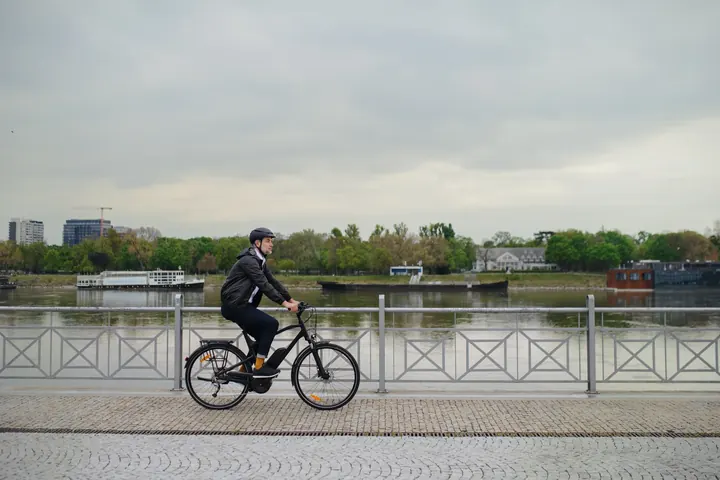
Oregon adopted the three-class system through HB 4103, in effect since January 1, 2025. Under ORS 801.258, Class 1 assists only while you pedal and stops at 20 mph. Class 2 can be propelled by the motor without pedaling and stops assisting at 20 mph. Class 3 assists only while you pedal, stops at 28 mph, and must have a speedometer.
ORS 814.405 treats an e-bike as a bicycle, not a motor vehicle, for purposes of the Vehicle Code. No driver license is needed, but ORS 807.020 sets a minimum age: 16 for every class today. HB 4007, passed in 2026, lowers that to 14 for Class 1 starting January 1, 2027 and leaves Class 2 and Class 3 at 16.
One restriction is specific to e-bikes: ORS 814.410 makes riding one on a sidewalk a traffic violation.
Insurance is less settled. PIP reaches a rider through the word "pedestrian," which the statute defines as a person not occupying a self-propelled vehicle. Whether a rider on a motor-assisted bike still fits is an open question, so do not assume the driver's PIP will pay. Ask the insurer in writing. In a bike insurance policy, check that your e-bike's class is covered and that the motor has not been modified beyond it.
Deadlines

Oregon's deadlines run from 72 hours to six years, and the one that ends the most claims is the 180-day notice to a public body.
- 72 hours
Report a Hit-and-Run
A crash with a driver who cannot be identified must be reported within 72 hours to a police officer or the Oregon Department of Transportation to keep an uninsured motorist claim alive under ORS 742.504.
- 72 hours
Driver's DMV Collision Report
ORS 811.725 gives the driver 72 hours to file an Oregon Traffic Collision and Insurance Report with the DMV after any collision involving an injury.
- 30 days
Sworn Statement to Your Insurer
In a hit-and-run or phantom vehicle claim, a statement under oath is due to your own insurer within 30 days after the 72-hour report.
- 180 days
Notice of Claim Against a Public Body
A claim against the state, a city, or a county falls under the Oregon Tort Claims Act. ORS 30.275 requires notice of claim within 180 days of the injury, or within one year for a wrongful death. A period of up to 90 days when the injured person cannot give notice because of the injury or minority is not counted. The lawsuit itself must be filed within two years.
- Two years
Injury Lawsuit and Uninsured Motorist Claim
ORS 12.110 gives you two years to file an injury lawsuit. The same two years applies to an uninsured motorist claim under ORS 742.504: within two years of the accident you must settle with your insurer, start arbitration, or file suit.
- Three years
Wrongful Death Lawsuit
ORS 30.020 allows three years from the time the injury causing the death is discovered or reasonably should have been, and never more than three years after the death.
- Six years
Bike and Gear Damage Lawsuit
ORS 12.080 gives you six years to sue for damage to personal property. Small claims court hears disputes up to $10,000 under ORS 46.405.
For a rider under 18, ORS 12.160 pauses the two-year clock, but for no more than five years and no later than one year after the 18th birthday. That pause does not reach a public body: ORS 30.275 sets its own two-year limit, and ORS 30.271 and 30.272 cap what the state or a local public body pays on an injury claim, at amounts adjusted each year.
Evidence to Preserve
With a 51% bar, evidence in Oregon has one job: keeping your percentage at 50 or below.
- The driver's details. ORS 811.705 requires a driver in an injury collision to give you a name, address, registration number, insurance carrier, and policy number. The policy number is how you open the PIP claim.
- Proof of the 72-hour report if the driver fled: the agency, the officer's name, the report number, and the time you called.
- An independent witness or video for any crash without contact. A phantom vehicle claim fails without corroboration beyond your own account.
- The driver's speed and the lane layout. The fall-over passing distance applies only above 35 mph and outside a lane next to a bike lane.
- Medical bills dated within two years of the crash, the window for PIP medical benefits, and pay records if you missed 14 days or more of work.
- Dated copies of any tort claim notice and proof of mailing or delivery.
- The damaged bike, unrepaired, with receipts for the bike and gear.
Coverage for Oregon Riders

Oregon law still leaves predictable gaps: PIP that stops at $15,000 and sits behind your health plan, a driver carrying the $25,000 minimum, a 51% bar that can turn the claim against you, and a bike that neither PIP nor uninsured motorist coverage pays for. The Velosurance policy offers the coverages discussed above.
Uninsured Motorist covers losses beyond medical bills, such as lost wages, when the at-fault driver cannot pay. It is the fallback for a rider in a household with no auto policy, where Oregon's mandatory auto coverage does not exist.
Medical Payments covers the deductible and out-of-pocket costs your health plan leaves, whatever the driver's insurance does. Choose a limit close to your plan's out-of-pocket deductible.
Liability is for the day the percentages run the other way. If you are held responsible for a crash, it covers injury to other people and damage to their property, including the cost of defending a covered lawsuit, with limits from $25,000 to $500,000.
Crash damage to the bike is part of the policy itself. The bike is insured at stated value with no depreciation, subject to the deductible, whoever caused the crash. Class 1, Class 2, and Class 3 e-bikes are covered like conventional bikes.
For any of these coverages to apply, it must be on the policy before the crash. Get a quote and add them before your next ride.
Bicycle Accident Attorneys in Oregon
Velosurance legal partners who represent injured cyclists in Oregon.
-

Portland Bicycle Accident Attorney Michael A. Colbach
434 NW 19th Avenue
Portland, OR 97209
Frequently Asked Questions
- How does the 51% rule work in an Oregon bicycle accident claim?
- You recover damages in Oregon as long as your fault is not greater than the combined fault of the people you are claiming against, and the award is reduced by your percentage. A rider 50% at fault for a $100,000 loss collects $50,000. The caveat worth knowing: at 51% the recovery is zero, so the evidence that sets your percentage decides the claim.
- How does personal injury protection help an Oregon cyclist hit by a car?
- Personal injury protection on the car that struck you pays reasonable and necessary medical expenses incurred within two years, up to $15,000, without regard to fault. It also pays 70% of lost income, up to $3,000 a month for up to 52 weeks, once you are disabled for 14 days. One thing to watch: the striking driver's PIP is excess over your other benefits, so your health plan pays first.
- How long do you have to file a bicycle accident claim in Oregon?
- You have two years to file an injury lawsuit in Oregon and six years to sue for damage to your bike and gear. One thing to watch: a claim against a public body needs a notice of claim within 180 days of the crash, and the lawsuit itself must be filed within two years.
- What makes a hit-and-run claim work for a cyclist in Oregon?
- Uninsured motorist coverage on an Oregon auto policy pays for your injuries when the driver cannot be identified, and it is mandatory on every policy. Report the crash to police or the Oregon Department of Transportation within 72 hours and send your insurer a statement under oath within 30 days after that. With one wrinkle: a car that never touched you counts only when evidence other than your own testimony corroborates the facts.
- How are Class 1, Class 2, and Class 3 e-bikes treated after a crash in Oregon?
- Oregon treats Class 1, Class 2, and Class 3 e-bikes as bicycles, so the same 51% rule and filing deadlines apply. Class 1 is pedal assist to 20 mph, Class 2 can be propelled by the motor without pedaling and stops assisting at 20 mph, and Class 3 is pedal assist to 28 mph with a speedometer. The caveat worth knowing: whether a driver's PIP covers a rider on a motor-assisted bike is an open question, so ask the insurer in writing.
Sources
- ORS 31.600 and 31.610 (comparative negligence, several liability)
- ORS 12.080, 12.110, and 12.160 (limitation periods, minors)
- ORS 30.020 and 30.260 to 30.300 (wrongful death; Oregon Tort Claims Act, including 30.271, 30.272, and 30.275)
- ORS 46.405 (small claims jurisdiction)
- ORS 742.502, 742.504, and 742.510 (uninsured and underinsured motorist coverage)
- ORS 742.518 to 742.544 (personal injury protection)
- ORS 801.258 and 801.608 (electric assisted bicycle classes, vulnerable user of a public way)
- ORS 806.010 and 806.070 (financial responsibility, minimum limits)
- ORS 807.020 (operating an electric assisted bicycle without driving privileges)
- ORS 811.050, 811.065, 811.135, and 811.490 (bike lane yield, unsafe passing, careless driving, vehicle doors)
- ORS 811.705, 811.720, 811.725, 811.745, and 811.748 (driver duties and collision reports)
- ORS 814.400 to 814.489 (bicycles: rights and duties, sidewalks, stop signs, bike lanes, lane position, helmets)
- ORS 815.280 (bicycle equipment and lighting)
- Oregon HB 4103 (2024), enrolled (three e-bike classes)
- Oregon HB 4007 (2026), enrolled; Oregon Laws 2026, chapter 101 (e-bike ages, helmets, impostor vehicles; operative January 1, 2027)
- Oregon Laws 2026, table of ORS sections amended, repealed, or added to
- Oregon DMV, collision reporting (Oregon Traffic Collision and Insurance Report)
- Oregon DMV, insurance requirements
This guide is general information about Oregon law as of the review date above. It is not legal or insurance advice, and it does not create an attorney-client relationship. Laws change and every crash turns on its own facts: talk to a licensed Oregon attorney about your situation.