
TL;DR:
- Oklahoma is an at-fault state with a 51% bar: at 50% responsible you recover half, and once your negligence is greater than the driver's you recover nothing.
- Minimum auto liability limits are $25,000 per person, $50,000 per accident, and $25,000 for property damage.
- You have two years to sue for injuries or bike damage, and one year to give written notice of a claim against the state or a political subdivision.
- Uninsured motorist coverage comes with every Oklahoma auto policy unless rejected in writing, pays for bodily injury only, and needs no physical contact in a hit-and-run.
- Drivers must leave three feet when passing a bicycle under 47 O.S. 11-1208, and Oklahoma has no statewide bicycle helmet law.
Who Pays After a Crash in Oklahoma
Oklahoma is an at-fault state. The driver who caused the crash pays for your losses, and the Compulsory Insurance Law in Title 47 requires that driver to carry at least $25,000 for one person's injuries, $50,000 for everyone hurt in the accident, and $25,000 for property damage. Your bike and gear come out of the $25,000 property limit.
There is no personal injury protection here and no injury threshold to clear before you bring a claim. The Oklahoma Insurance Department lists medical payments coverage as an optional add-on to an auto policy that pays regardless of fault. If your household has it, ask the insurer in writing whether it applies when you are hit on a bike.
One Oklahoma rule sounds alarming and does not touch you. Under 47 O.S. 7-116, a claimant who was driving without the required insurance cannot collect for pain and suffering. The statute exempts anyone who "was not in any motor vehicle involved in the accident," which describes a cyclist exactly.
Two newer rules shrink what a claim is worth. Under 12 O.S. 3009.1, the medical bills a jury sees are the amounts actually paid, not the amounts billed. And for injuries on or after September 1, 2025, 23 O.S. 61.3 caps pain and suffering at $500,000. The cap lifts for a permanent and severe physical injury or a reckless or grossly negligent driver. Economic losses such as wages and medical costs are never capped.
Fault and How It Reduces a Claim
Oklahoma's comparative negligence statute, 23 O.S. 13, lets you recover unless your negligence is "of greater degree" than the negligence of the person who hurt you. In practice the line sits at 51%. Section 14 then reduces the award in proportion to your share. A rider found 50% responsible for a $100,000 loss collects $50,000. At 51%, the same rider collects nothing.
The arguments over your percentage come from Title 47. Section 11-1202 gives a cyclist on the roadway all the rights and duties of a driver. The rules most likely to be raised:
- Lane position. Section 11-1205 requires a rider slower than traffic to keep as close as is safe to the right edge. The exceptions cover passing, left turns, surface hazards, parked cars, and any time the edge is unsafe. Two abreast is legal within a single lane if it does not impede traffic.
- Stop signs and red lights. Since November 1, 2021, section 11-202.1 lets a person on a bicycle slow and roll through a stop sign when there is no immediate hazard, and proceed through a red light after a complete stop.
- Lights. From a half hour after sunset, sections 12-702 and 12-703 require a white front lamp and a red rear lamp, each visible from 1,000 feet, on any street posted above 25 mph. A red rear reflector is required everywhere.
Liability in Oklahoma is several only. Under 23 O.S. 15, each defendant pays the share of damages allocated to it and no more, so a second at-fault driver with no assets leaves a hole in your recovery.
Oklahoma has no bicycle helmet statute, and the statutes do not say whether riding without one can be used against you. Treat the question as open.
Hit-and-Run and Uninsured Drivers
Every Oklahoma auto liability policy must include uninsured motorist coverage unless a named insured rejected it in writing, under 36 O.S. 3636. The minimum is $25,000 per person and $50,000 per occurrence, and you can buy up to your own liability limits.
The coverage form the statute prescribes says it protects "you and family members who live with you while riding in any vehicle or while a pedestrian," unless the policy provides otherwise. Whether a person on a bicycle is covered is left to the policy wording, so get your insurer's answer in writing and check that the coverage was never rejected.
Oklahoma is generous to riders in two ways. First, a hit-and-run claim does not require physical contact. In Biggs v. State Farm, the Oklahoma Supreme Court refused to enforce a policy clause demanding contact with the fleeing vehicle. A driver who forces you off the road without touching you can still trigger the coverage, though the burden of proving that driver caused the crash is yours.
Second, the statute treats a driver as uninsured whenever their liability limits are less than your claim, whatever limits you carry. What that driver's insurer pays is not credited against your own coverage. When your losses exceed a driver's $25,000 minimum, your own $25,000 sits on top.
The limits are real too. Policies issued or renewed after November 1, 2014 cannot be stacked unless the insurer expressly allows it. And the coverage pays for bodily injury only: the Insurance Department says it does not pay for property damaged by a hit-and-run or uninsured driver. Your bike is not covered by it.
The statute sets no deadline for reporting a hit-and-run, which leaves the deadline to your policy. Call police from the scene. Two things to check in a bike insurance policy: whether it offers uninsured motorist coverage of its own, and whether crash damage to the bike is covered no matter who hit you.
Dooring and Passing Laws
Oklahoma's dooring statute is 47 O.S. 11-1105. No person may open the door of a motor vehicle on the side available to moving traffic "unless and until it is reasonably safe to do so," or leave that door open longer than necessary to load or unload passengers.
The passing law, 47 O.S. 11-1208, is specific. On a road with one lane in your direction, a driver may not pass at less than three feet, measured between any part of the vehicle and any part of the bicycle or its rider. On a road with more than one lane in your direction, the driver must move to the lane to the immediate left when it is available and reasonably safe.
The penalties rise with the harm. A first violation is a misdemeanor with a fine of up to $100. A violation that injures someone carries up to three months in county jail and a $1,000 fine. Great bodily injury raises that to six months and $3,000, and a death to one year and $5,000.
E-bikes
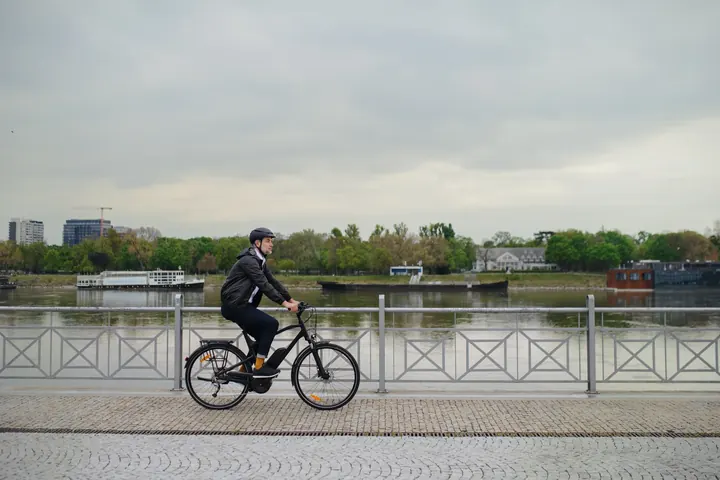
Oklahoma calls them electric-assisted bicycles. Under 47 O.S. 1-104, one has two or three wheels, fully operative pedals, and a motor of not more than 750 watts. Class 1 assists only while you pedal and stops assisting at 20 mph. Class 2 has a motor that can propel the bike on its own and gives no assistance at 20 mph. Class 3 assists only while you pedal, stops at 28 mph, and must have a speedometer.
Section 11-1209 sets the minimum age for operating a Class 3 at 16 and requires a permanent label showing the class, top assisted speed, and motor wattage. The same section says an electric-assisted bicycle is not subject to Oklahoma's financial responsibility, vehicle insurance, driver license, registration, or title laws. Section 1-134 removes it from the definition of a motor vehicle. In a crash you stand where any cyclist stands.
There is one trap. The stop sign and red light rule in section 11-202.1 defines "bicycle" by pointing to the human-powered definition alone. Do not count on it if you rolled a stop sign on an e-bike.
A machine over 750 watts falls outside the definition. Photograph the label.
No Oklahoma statute or Insurance Department publication says whether an auto policy's uninsured motorist or medical payments coverage applies to you on an e-bike. Ask your insurer in writing. In a bike insurance policy, check that your e-bike's class is covered.
Deadlines
Oklahoma gives you two years to sue a driver, but a claim against the state, a city, a county, or a school district is forever barred without written notice in the first year.
- At the scene
Notify Police Immediately
Under 47 O.S. 10-107, the driver in a crash that injures anyone must notify the local police, the county sheriff, or the Highway Patrol immediately, by the quickest means of communication. The investigating agency has 30 days to send its collision report to the Department of Public Safety, and a party to the crash can request a copy as soon as it is available.
- One year
Notice to the State or a Political Subdivision
A claim involving a city bus, a county truck, or a state vehicle falls under the Governmental Tort Claims Act, and section 156 of Title 51 requires a written claim within one year of the loss, stating the date, time, place, circumstances, and the amount demanded. A claim against the state goes to the Office of the Risk Management Administrator; a claim against a city, county, or school district goes to the clerk of its governing body. Miss the year and the claim is forever barred. Under section 157, a claim not approved within 90 days is deemed denied, and you then have 180 days to file suit.
- Two years
Injury and Bike Damage Lawsuit
12 O.S. 95 gives you two years to sue for personal injury and the same two years for damage to the bike. A wrongful death action under 12 O.S. 1053 must also be commenced within two years.
Recovery against a government body is capped. Senate Bill 1168 raised the caps on November 1, 2025 to $250,000 per claimant, $375,000 against the state or a city or county of 150,000 or more people, and $75,000 for property. A second 2025 act amended the same section using the earlier figures of $125,000, $175,000, and $25,000, and the Legislature publishes both versions, so confirm which one governs your claim.
Since November 1, 2026, House Bill 4143 has raised the property damage threshold for a written collision report from $300 to $3,000. A crash with an injury is still reportable.
Evidence to Preserve
With a 51% bar and several-only liability, evidence in Oklahoma has two jobs: keeping your percentage down and pinning the rest on a defendant who can pay.
- The collision report number and the agency that took it.
- The driver's security verification form. Section 10-104 requires a driver in an injury crash to show it to the person struck on request, along with a driver license.
- Passing distance. Video, witness names, and photos of where the car and bike came to rest help prove the three-foot rule was broken.
- Witnesses to a driver who fled. With no contact required, proof that the other vehicle existed is the whole hit-and-run claim.
- The e-bike label showing class, top assisted speed, and wattage.
- Your auto policy's declarations page and the uninsured motorist selection form, showing the coverage was not rejected.
- The damaged bike, unrepaired, with receipts for the bike and gear.
Coverage for Oklahoma Riders
Oklahoma law leaves a rider exposed in four places: a driver carrying the $25,000 minimum, uninsured motorist coverage that someone rejected in writing or that never pays for a bike, medical costs your health plan passes on to you, and a 51% bar that can turn a claim into a bill. The Velosurance policy offers the coverages discussed above.
Uninsured Motorist covers losses beyond medical bills, such as lost wages, when the at-fault driver cannot pay.
Medical Payments covers the deductible and out-of-pocket costs your health plan leaves, regardless of the driver's insurance. Oklahoma has no personal injury protection to do that job. Choose a limit close to your plan's out-of-pocket deductible.
Liability is the coverage for the day the percentages run against you. If you are held responsible for a crash, it covers injury to other people and damage to their property, including the cost of defending a covered lawsuit, with limits from $25,000 to $500,000.
Crash damage to the bike is part of the policy itself: stated value with no depreciation, subject to the deductible, whoever was at fault. Class 1, Class 2, and Class 3 e-bikes are covered like conventional bikes.
For any of these coverages to apply, it must be on the policy before the crash. Get a quote before the next ride, not after it.
Frequently Asked Questions
- How does the 51% rule work in an Oklahoma bicycle accident claim?
- You recover damages in Oklahoma as long as your negligence is not greater than the driver's, and the award is reduced in proportion to your share. A rider 50% responsible for a $100,000 loss collects $50,000. The caveat worth knowing: at 51% the recovery is zero, so the evidence that sets your percentage decides the claim.
- How long do you have to file a bicycle accident claim in Oklahoma?
- You have two years to file suit in Oklahoma for injuries and for damage to your bike. One thing to watch: a claim against the state, a city, a county, or a school district needs written notice within one year of the loss, and the lawsuit must follow within 180 days after the claim is denied.
- What makes a hit-and-run claim work for a cyclist in Oklahoma?
- Uninsured motorist coverage on an Oklahoma auto policy can pay when the driver flees, and it applies even when the vehicle never touched you. Call police from the scene and collect witness names, because the burden of proving the other driver caused the crash is yours. With one wrinkle: the coverage pays for bodily injury only, and whether it follows you onto a bicycle depends on the policy wording.
- How much room must a driver leave when passing a bicycle in Oklahoma?
- Oklahoma drivers must leave at least three feet between any part of the vehicle and any part of the bicycle or its rider on a road with one lane in that direction. With more than one lane, the driver must move to the lane to the immediate left when it is available and reasonably safe. A violation that causes an injury is a misdemeanor.
- How are Class 1, Class 2, and Class 3 e-bikes treated after a crash in Oklahoma?
- Oklahoma treats Class 1, Class 2, and Class 3 electric-assisted bicycles as bicycles, so the same 51% rule and two-year deadline apply. Class 1 is pedal assist that stops at 20 mph, Class 2 has a motor that can propel the bike on its own up to 20 mph, and Class 3 is pedal assist that stops at 28 mph for riders 16 and older. The caveat worth knowing: a motor over 750 watts puts the bike outside the definition.
Sources
- Oklahoma Statutes Title 23, sections 13, 14, 15 (comparative negligence, several liability)
- Oklahoma Statutes Title 23, section 61.3 (noneconomic damages, SB 453, effective September 1, 2025)
- Oklahoma Statutes Title 12, sections 95 and 1053 (limitations, wrongful death)
- Oklahoma Statutes Title 12, section 3009.1 (medical bill evidence)
- Oklahoma Statutes Title 51, sections 154, 156, 157 (Governmental Tort Claims Act)
- Oklahoma Statutes Title 36, section 3636 (uninsured motorist coverage)
- Oklahoma Statutes Title 47, sections 7-103, 7-116, 7-601 (minimum liability limits, Compulsory Insurance Law)
- Oklahoma Statutes Title 47, sections 1-104 and 1-134 (bicycle, electric-assisted bicycle, motor vehicle definitions)
- Oklahoma Statutes Title 47, sections 11-1202, 11-1205, 11-1208, 11-1209 (bicycles, passing, electric-assisted bicycles)
- Oklahoma Statutes Title 47, section 11-202.1 (bicycles at stop signs and signals, HB 1770, effective November 1, 2021)
- Oklahoma Statutes Title 47, section 11-1105 (opening and closing vehicle doors)
- Oklahoma Statutes Title 47, sections 12-201, 12-702, 12-703, 12-704 (bicycle lamps and reflector)
- Oklahoma Statutes Title 47, sections 10-102, 10-104, 10-107, 10-108 (duties and reports after an accident)
- Enrolled House Bill 4143 (2026), amending 47 O.S. 10-108 and 40-102, effective November 1, 2026
- Biggs v. State Farm Mutual Automobile Insurance Co., 569 P.2d 430 (Okla. 1977)
- Oklahoma Insurance Department, consumer resource guide (2025)
- Oklahoma Insurance Department, 2026 Statute and Rule Changes
- Oklahoma Legislature, Oklahoma Statutes complete titles (12, 23, 36, 47, 51)
This guide is general information about Oklahoma law as of the review date above. It is not legal or insurance advice, and it does not create an attorney-client relationship. Laws change and every crash turns on its own facts: talk to a licensed Oklahoma attorney about your situation.