
TL;DR:
- Ohio is an at-fault state with a 51% bar: at 50% at fault you recover half, at 51% you recover nothing.
- Minimum auto liability limits are $25,000 for one person, $50,000 for two or more, and $25,000 for property. A pending bill to raise them has not become law.
- You have two years to sue for injuries or bike damage, and the same two years against a city, a county, or the state.
- Uninsured motorist coverage is optional on an Ohio auto policy. A hit-and-run claim needs independent corroborative evidence, not physical contact.
- Drivers must give a bicycle or e-bike three feet or more when passing, and section 4511.70 bans opening a door into traffic.
Who Pays After a Crash in Ohio
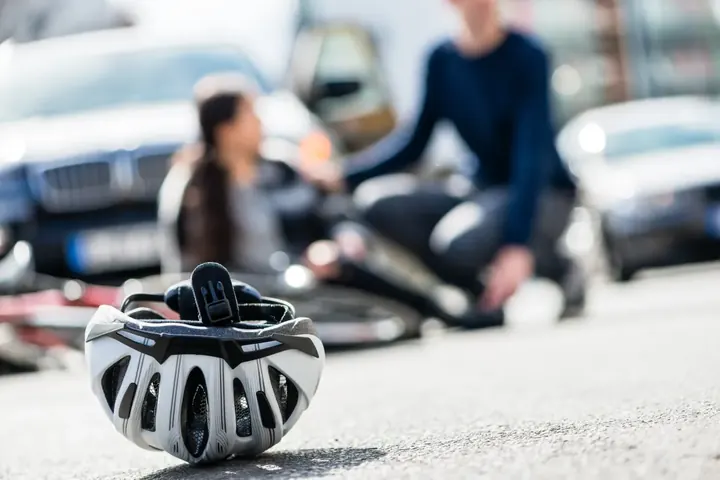
Ohio is an at-fault state. The driver who caused the crash pays for your losses, and Revised Code section 4509.101 bars anyone from driving without proof of financial responsibility. Sections 4509.01 and 4509.51 set that proof at $25,000 for one person's injuries, $50,000 when two or more people are hurt, and $25,000 for property damage.
Those numbers may move. House Bill 596, introduced in the 136th General Assembly, would raise the injury limits to $50,000 and $100,000 and require uninsured motorist coverage on every auto policy. It has not become law, and the codified sections still read 25/50/25.
There is no injury threshold to clear before you can claim, and no personal injury protection system: the only coverage Ohio compels on a car is liability. Medical payments coverage on an auto policy exists only where the policyholder bought it, and whether it pays for a crash on a bike depends on the policy wording. If you own no car, that leaves the driver's liability limits, your health plan, and whatever you carry on the bike.
Ohio also caps part of the claim. Under section 2315.18, economic loss such as medical bills and wages has no ceiling, but pain and suffering is limited to the greater of $250,000 or three times your economic loss, up to $350,000 per plaintiff and $500,000 per occurrence. The cap lifts for permanent and substantial physical deformity, loss of use of a limb, or loss of a bodily organ system.
Fault and How It Reduces a Claim

The line in Ohio sits at 51%. Section 2315.33 lets you recover as long as your fault is "not greater than" the combined fault of everyone else, and reduces the award by your percentage. A rider found 50% at fault for a $100,000 loss collects $50,000. At 51%, section 2315.35 directs the court to enter judgment for the defendants.
The percentages are argued from the traffic code, which section 4511.52 applies to bicycles and e-bikes on any highway or bike path. The rules most likely to be raised:
- Lane position. Section 4511.55 says to ride as near the right side as practicable, then adds that you need not ride at the edge when it is unreasonable or unsafe, including when the lane is too narrow for a bike and an overtaking vehicle to travel side by side. Two abreast in a single lane is legal.
- Lights. From sunset to sunrise, section 4511.56 requires a white front lamp visible from 500 feet, a red rear reflector, and a red rear lamp visible from 500 feet. The lamp can double as the reflector.
- Dead signals. Under section 4511.132, when a signal fails to detect your bike you may stop, yield, and proceed with ordinary care.
Section 2307.22 adds a twist once the driver passes 50%. A defendant more than 50% at fault owes all of your economic loss, including shares assigned to others. Pain and suffering is always split by percentage.
Helmets are an open question. Section 4511.53 says a motorcycle helmet violation "shall not be used in the trial of any civil action." The code has no matching sentence for bicycles, which have no statewide helmet rule, or for Class 3 e-bikes, which do.
Hit-and-Run and Uninsured Drivers

Section 3937.18 says an Ohio auto policy "may, but is not required to" include uninsured or underinsured motorist coverage. It sets no minimum limit either. Read your declarations page before you assume you have it.
If you do, the statute has no physical contact requirement. A driver who cannot be identified counts as uninsured when "independent corroborative evidence" shows that driver's negligence caused your injury. Your own testimony is not enough unless additional evidence supports it. A witness, a camera, or paint from the car is what turns a phantom-vehicle story into a claim, even when the car never touched you.
Three limits are written into the statute:
- Underinsured coverage is not excess. It is reduced by what the at-fault side's policies make available. Against a driver carrying $25,000, a $25,000 underinsured limit adds nothing.
- Stacking can be barred. Policies may preclude combining limits across vehicles, policies, and household members.
- The clock can be three years. A policy may require a claim or suit within three years of the crash.
Who counts as an insured away from the car is set by the policy form, so ask your insurer in writing whether the coverage follows you onto a bike.
For the bike itself, auto coverage is a dead end. Section 3937.181 limits uninsured motorist property damage to the motor vehicle identified in the policy, struck by a driver who has been identified. In a bike insurance policy, check whether it offers uninsured motorist coverage of its own and whether crash damage is covered no matter who hit you.
Dooring and Passing Laws
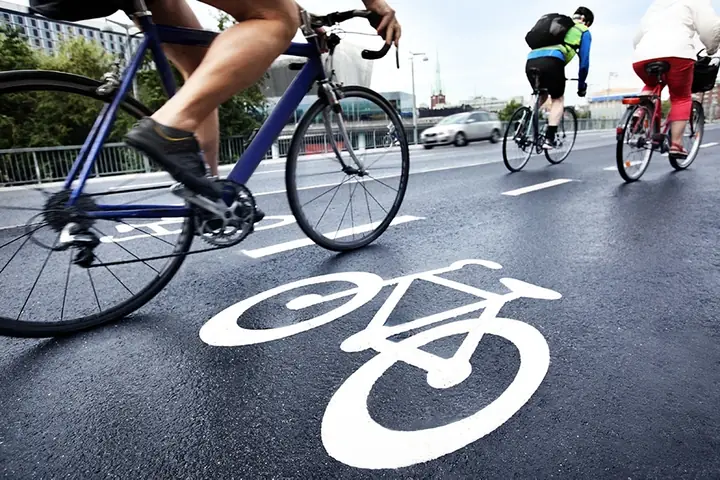
Ohio puts a number on passing. Section 4511.27 requires a driver to pass on the left at a safe distance and states that when a motor vehicle overtakes a bicycle or electric bicycle, "three feet or greater is considered a safe passing distance." A mirror clip is hard to square with that sentence, and a ride camera that shows the gap is the best proof you can bring.
Dooring is covered by section 4511.70. No person may open a vehicle door on the side available to moving traffic "unless and until it is reasonably safe to do so," or leave it open longer than needed to load or unload passengers. The rule binds passengers as well as drivers, and a violation is a minor misdemeanor.
Local rules sit on top of the state code. Section 4511.07 lets cities regulate bicycles so long as the rule is not fundamentally inconsistent with the state's rules of the road, and section 4511.711 forbids any local authority from requiring you to ride on the sidewalk.
E-bikes

Section 4511.01 defines three classes of electric bicycle, all with fully operable pedals and a motor of less than 750 watts. Class 1 assists only while you pedal and stops at 20 mph. Class 2 can run without pedaling and stops at 20 mph. Class 3 assists only while you pedal and stops at 28 mph.
The same section counts an e-bike as a bicycle and excludes it from the definition of motor vehicle, as does the financial responsibility law in section 4509.01. No compulsory insurance applies. After a crash you stand where any cyclist stands.
Class 3 carries extra rules under section 4511.522. The operator must be at least 16, and both operator and passenger must wear a helmet that meets Consumer Product Safety Commission or ASTM standards. Whether riding a Class 3 without one can be used against you in a civil claim is unsettled.
Two details give the other side's insurer something to work with. Every e-bike must carry a label showing its class, top assisted speed, and wattage, and anyone who changes the top speed must change the label to match. And section 4511.711 allows an e-bike on a sidewalk only with the motor not engaged. Photograph the label.
Whether an auto policy's uninsured motorist or medical payments coverage applies to you on an e-bike has no answer in the Ohio statutes read for this guide. Get your insurer's position in writing. In a bike insurance policy, check that your e-bike's class is covered.
Deadlines

Ohio runs on a two-year clock for nearly everything, including claims against government. The shorter dates are the ones that protect your evidence.
- At the scene
Driver Details and a Police Report
Section 4549.02 requires the driver to stop and give a name, address, and registration number to anyone injured and to the officer. Under section 5502.11, the investigating agency forwards its report to the Director of Public Safety within five days when there is an injury or more than $1,000 in property damage.
- Six months
Report an Uninsured Driver
Section 4509.06 lets anyone involved in a crash send the Registrar of Motor Vehicles a written report, within six months, alleging the driver was uninsured. The Registrar then requires that driver to produce proof of coverage within 30 days.
- Two years
Injury and Bike Damage Lawsuit
Section 2305.10 gives you two years from the day of the injury to sue for bodily injury and the same two years for damage to the bike. A wrongful death action must start within two years of the death under section 2125.02. For a rider under 18, section 2305.16 starts the two years at the 18th birthday.
- Two years
Claims Against a City, County, or the State
Section 2744.04 gives you two years to sue a political subdivision, such as a city, county, township, or school district. A claim against the state goes to the Court of Claims, also within two years under section 2743.16, and when the loss is one the state insures you must first ask its Office of Risk Management to settle. Neither section sets a separate, shorter notice-of-claim step, but confirm that with a lawyer before relying on the full two years.
- Three years, if the policy says so
Uninsured Motorist Claim
Section 3937.18 allows an auto policy to require that an uninsured or underinsured motorist claim or suit be brought within three years of the crash.
Suing a local government changes the arithmetic. Under section 2744.05, damages that are not actual loss, pain and suffering above all, are capped at $250,000 per person, punitive damages are barred, and insurance benefits you received are deducted from the award. Section 2744.02 makes a subdivision liable for an employee's negligent driving and for failing to keep public roads in repair, with a full defense for police, fire, and ambulance crews on emergency calls short of willful or wanton misconduct.
Evidence to Preserve
With a 51% bar, evidence in Ohio has one job above all: holding your percentage down.
- The crash report number from the officer. Reports are searchable on the Ohio Department of Public Safety's crash retrieval site.
- Independent proof of a driver who fled: witness names and phone numbers, doorbell and dash camera footage, paint transfer, broken trim. Section 3937.18 will not accept your word alone.
- Passing distance. Camera footage or a witness who saw the gap, measured against three feet.
- Your lights, photographed on the bike, if the crash happened between sunset and sunrise.
- The e-bike label showing class, top assisted speed, and wattage.
- The driver's name, address, and registration number, which section 4549.02 requires a driver to give you at the scene.
- Your auto policy's declarations page, showing whether uninsured motorist coverage was ever purchased.
- Medical bills and wage records. Economic loss sets the ceiling for pain and suffering under section 2315.18.
- The damaged bike, unrepaired, with receipts for the bike and gear.
Coverage for Ohio Riders

Ohio law leaves a rider exposed in four places: a driver carrying the $25,000 minimum, an auto policy that was never required to include uninsured motorist coverage, a fault rule that pays nothing at 51%, and auto property coverage that stops at the car. The Velosurance policy offers the coverages discussed above.
Uninsured Motorist covers losses beyond medical bills, such as lost wages, when the at-fault driver cannot pay.
Medical Payments covers the deductible and out-of-pocket costs your health plan leaves, regardless of the driver's insurance. Choose a limit close to your plan's out-of-pocket deductible.
Liability is the coverage for the day the percentages run against you. If you are held responsible for a crash, it covers injury to other people and damage to their property, including the cost of defending a covered lawsuit, with limits from $25,000 to $500,000.
Crash damage to the bike is part of the policy itself: stated value with no depreciation, subject to the deductible, whoever was at fault. Class 1, Class 2, and Class 3 e-bikes are covered like conventional bikes.
For any of these optional coverages to apply, it must be on the policy before the crash. Get a quote before the next ride, not after it.
Frequently Asked Questions
- How does the 51% rule work in an Ohio bicycle accident claim?
- You recover damages in Ohio as long as your fault is not greater than the combined fault of everyone else, and the award is reduced by your percentage. A rider 50% at fault for a $100,000 loss collects $50,000. The caveat worth knowing: at 51% the court enters judgment for the defendants, so the evidence that sets your percentage decides the claim.
- How long do you have to file a bicycle accident lawsuit in Ohio?
- You have two years in Ohio to file suit for injuries and for damage to your bike, and a wrongful death claim runs two years from the death. A claim against a city or county carries the same two years, and a claim against the state goes to the Court of Claims within two years. One thing to watch: an auto policy may require an uninsured motorist claim within three years of the crash.
- What makes a hit-and-run claim work for a cyclist in Ohio?
- Uninsured motorist coverage on an Ohio auto policy can pay when the driver is never identified, and the statute does not require physical contact. Collect independent corroborative evidence such as witnesses, camera footage, or paint transfer, because your own testimony is not enough without it. One thing to watch: the coverage is optional in Ohio, so confirm your policy includes it and that it follows you onto a bike.
- How does Ohio's three-foot passing law help a cyclist's claim?
- Ohio law states that three feet or greater is a safe distance when a motor vehicle passes a bicycle or electric bicycle, which gives you a fixed number to measure the driver against. Camera footage or a witness who saw the gap is the strongest proof. With one wrinkle: the other side will look at your lane position and lights too, and each percentage of fault assigned to you reduces the award.
- How are Class 1, Class 2, and Class 3 e-bikes treated after a crash in Ohio?
- Ohio treats Class 1, Class 2, and Class 3 e-bikes as bicycles, so the same 51% rule and two-year deadline apply and no compulsory insurance law reaches them. Class 1 assists only while you pedal to 20 mph, Class 2 can run without pedaling to 20 mph, and Class 3 assists only while you pedal to 28 mph. The caveat worth knowing: Class 3 requires a helmet and an operator at least 16 years old, and every class needs a motor of less than 750 watts.
Sources
- Ohio Revised Code sections 2315.33, 2315.34, 2315.35 (contributory fault and its effect on recovery)
- Ohio Revised Code section 2307.22 (joint and several tort liability)
- Ohio Revised Code section 2315.18 (limits on noneconomic damages)
- Ohio Revised Code sections 2305.10 and 2305.16 (two-year limitation, tolling for minority)
- Ohio Revised Code section 2125.02 (wrongful death)
- Ohio Revised Code section 3109.01 (age of majority)
- Ohio Revised Code sections 2744.02, 2744.04, 2744.05 (political subdivision tort liability)
- Ohio Revised Code sections 2743.02 and 2743.16 (Court of Claims)
- Ohio Revised Code sections 4509.01, 4509.06, 4509.101, 4509.51 (financial responsibility)
- Ohio Revised Code sections 3937.18 and 3937.181 (uninsured and underinsured motorist coverage)
- Ohio Revised Code section 4511.01 (definitions, including electric bicycle classes)
- Ohio Revised Code sections 4511.52, 4511.522, 4511.53, 4511.55, 4511.56 (bicycles and electric bicycles)
- Ohio Revised Code sections 4511.07, 4511.132, 4511.27, 4511.70, 4511.711 (local regulation, signals, passing, vehicle doors, sidewalks)
- Ohio Revised Code sections 4549.02 and 5502.11 (duties after a collision, police crash reports)
- House Bill 596, 136th General Assembly, as introduced (uninsured motorist coverage and minimum limits)
- Ohio Bureau of Motor Vehicles, Mandatory Insurance
- Ohio Department of Public Safety, Crash Retrieval
This guide is general information about Ohio law as of the review date above. It is not legal or insurance advice, and it does not create an attorney-client relationship. Laws change and every crash turns on its own facts: talk to a licensed Ohio attorney about your situation.