
TL;DR:
- North Dakota is a no-fault state: the insurer of the car that hit you pays up to $30,000 in medical bills and lost income regardless of fault, even if you own no car.
- Pain and suffering requires a serious injury, which includes medical expenses over $2,500 or a disability lasting beyond 60 days.
- The fault bar sits at 50%: at 49% responsible you recover 51% of your loss, and at 50% you recover nothing.
- You have six years to sue a driver, but a claim against the state needs written notice within 180 days, or one year for a serious injury.
- Uninsured and underinsured motorist coverage are mandatory at $25,000 and $50,000, drivers must pass a bicycle with at least three feet, and none of the injury coverages pays for the bike.
Who Pays After a Crash in North Dakota
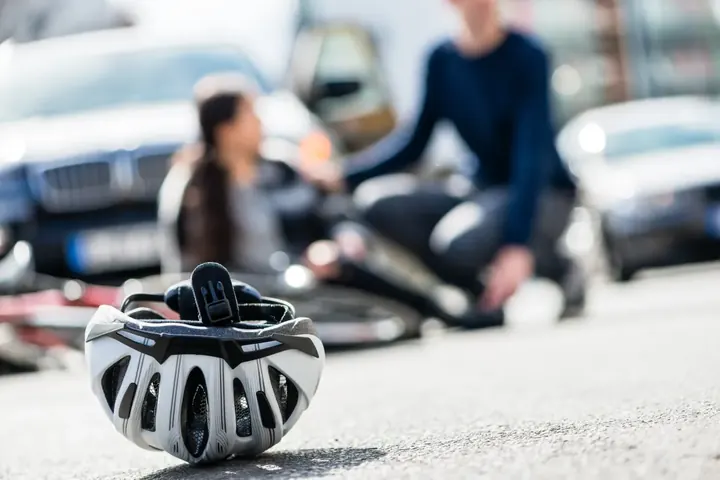
North Dakota is a no-fault state, and its no-fault law treats a cyclist as a pedestrian. Chapter 26.1-41 of the Century Code defines a pedestrian as any individual not occupying a vehicle designed to be driven by power other than muscular power. A rider on a conventional bicycle fits. Section 26.1-41-06 then requires a vehicle's insurer to pay basic no-fault benefits to any pedestrian the vehicle strikes in the state, without regard to fault. You do not need to own a car.
Basic no-fault benefits are capped at $30,000 per person. They cover medical and rehabilitation expenses, 85% of lost income, replacement services up to $15 a day, and up to $3,500 in funeral expenses. The weak point is the income benefit: section 26.1-41-01 caps it at $150 a week.
Section 26.1-41-13 sets the order of insurers. The insurer of the car that struck you pays first. If that car carried no insurance, the claim moves to your own auto policy or the policy of a relative in your household, which covers the owner and relatives struck as pedestrians. With no policy anywhere, section 26.1-41-18 creates an assigned claims plan run by the state's no-fault insurers. Ask the North Dakota Insurance Department whether it accepts your claim before you count on it.
No-fault limits what you can claim from the driver. Under section 26.1-41-08, an insured driver owes nothing for pain and suffering unless you have a serious injury: death, dismemberment, serious and permanent disfigurement, disability beyond 60 days, or medical expenses over $2,500. The driver also owes nothing for economic loss that no-fault has already paid.
No-fault pays nothing for the bike. Damage to the bike and gear is a claim against the driver's liability coverage. Section 39-16.1-11 sets the minimums at $25,000 for one person's injuries, $50,000 for everyone hurt in the crash, and $25,000 for property.
Fault and How It Reduces a Claim

Section 32-03.2-02 is titled "Modified comparative fault," and the line sits at 50%. You recover unless your fault is as great as the combined fault of everyone else who contributed to the injury. Below that line, the award shrinks by your percentage. A rider 49% at fault for a $100,000 loss collects $51,000. At 50%, the same rider collects nothing.
One exception helps with the bike. Under section 32-03.2-02.1, property damage of up to $5,000 from a motor vehicle accident with two people at fault is not reduced at all when the other person is more than 50% to blame. The text does not mention bicycles, so confirm with an attorney that it reaches a bike struck by a car.
Section 39-10.1-02 gives a cyclist the rights and duties of a driver. The rules most likely to be raised against you:
- Lane position. Section 39-10.1-05 requires riding as near to the right side of the roadway as practicable, and no more than two abreast.
- Stop signs. Since 2021, section 39-10.1-05.1 lets you slow, yield, and proceed without stopping at a stop sign on a roadway with two or fewer lanes. A full stop is still required at a roadway with three or more lanes. The catch: a collision in the intersection after you pass a stop sign without stopping, or a steady red light, is prima facie evidence that you failed to yield.
- Lights. Section 39-10.1-07 requires a white front lamp visible from 500 feet at night and a red rear reflector.
Helmets can cost you money even though no law requires one on a conventional bike. In Halvorson v. Voeller, a 1983 motorcycle case, the North Dakota Supreme Court held that failure to wear a helmet is admissible to reduce damages when a qualified expert testifies a helmet would have lessened the injuries. The defendant carries the burden. No decision applying the rule to a bicycle turned up, but expect an insurer to argue it.
Hit-and-Run and Uninsured Drivers

North Dakota makes both halves of this coverage mandatory. Section 26.1-40-15.2 requires every auto liability policy to include uninsured motorist coverage at $25,000 per person and $50,000 per accident, and section 26.1-40-15.3 requires underinsured motorist coverage at the same limits. The statute contains no option to reject either one.
The text contemplates an insured who is not in a car: the hit-and-run rule speaks of contact "with the insured, or with a motor vehicle occupied by the insured." Who counts as an insured is set by the policy, so confirm with your insurer that the coverage follows you onto a bike.
For a driver who is never identified, section 26.1-40-15.1 offers two routes. Either the vehicle made actual physical contact with you, or the crash is "independently verified by a disinterested witness." A car that forces you off the road without touching you can still support a claim if a stranger saw it. Contact with the bike alone is not contact with the insured under the wording, so get witness names.
Section 26.1-40-15.6 adds conditions. The coverage does not apply if you failed to report the crash to law enforcement as soon as practicable. It pays for pain and suffering only where the no-fault serious injury test would have allowed it.
Underinsured coverage applies only when the driver's limit is lower than yours. Against a driver carrying the $25,000 minimum, a policy with the same $25,000 limit adds nothing. Limits are never stacked: section 26.1-40-15.4 caps recovery at the highest single limit.
All of it covers bodily injury only, never the bike. Two things to check in a bike insurance policy: whether it offers uninsured motorist coverage of its own, and whether crash damage is covered no matter who hit you.
Dooring and Passing Laws
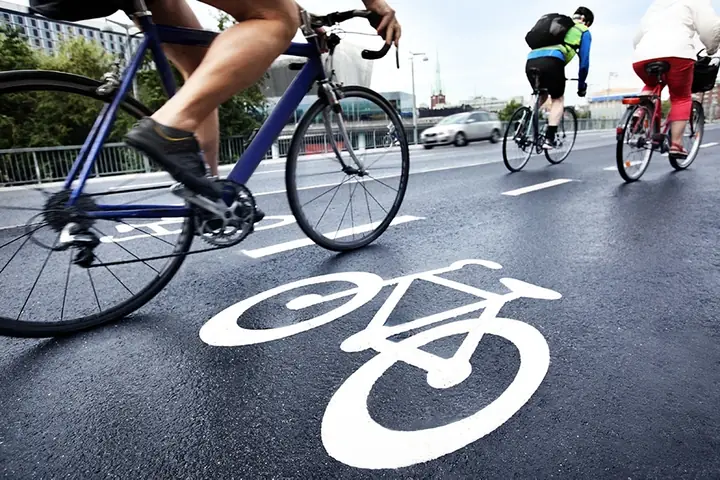
North Dakota put a number on passing in 2021. Section 39-10-11.1 requires the driver of a vehicle overtaking a bicycle on a roadway to leave a safe distance and to hold it until safely clear, and it defines safe distance as "no less than three feet." Because the Century Code's definition of bicycle includes an electric bicycle, the rule protects e-bike riders too.
Section 39-10-54.1 is the dooring statute. No person may open the door of a motor vehicle on the side available to moving traffic unless and until it is reasonably safe and can be done without interfering with other traffic. Nor may anyone leave a door open on that side longer than necessary to load or unload passengers. "No person" covers the passenger as well as the driver.
E-bikes
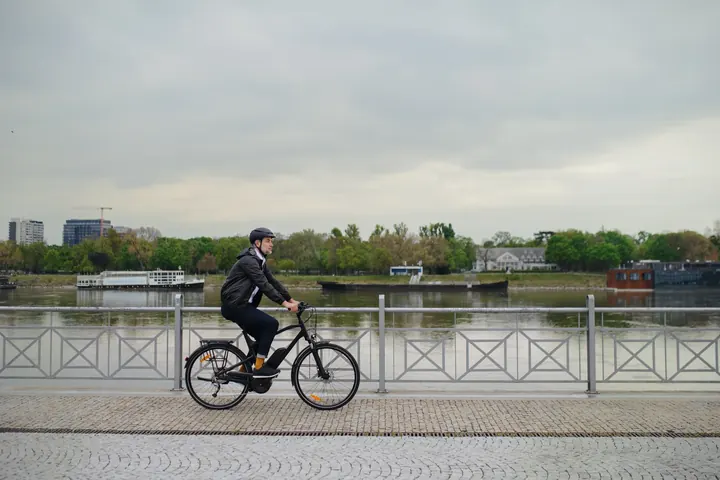
Section 39-01-01 defines an electric bicycle as a bicycle with fully operable pedals, a saddle or seat, and an electric motor of 750 or fewer watts. Class 1 assists only while you pedal and stops at 20 mph. Class 2 can run without pedaling and stops at 20 mph. Class 3 assists only while you pedal and stops at 28 mph.
The same section folds an electric bicycle into the definition of bicycle and excludes it from the definitions of motor vehicle, motorcycle, and motorized bicycle. The financial responsibility chapter excludes it as well, so no compulsory liability insurance attaches to it.
Section 39-10.1-09 adds the equipment rules. Every e-bike needs a permanent label showing its class, top assisted speed, and motor wattage. A Class 3 needs a working speedometer, and a rider under 18 must wear a helmet on one.
Here is the unsettled part. No-fault benefits reach a cyclist through the definition of pedestrian, and that definition excludes anyone occupying a vehicle "designed to be driven or drawn by power other than muscular power." The no-fault chapter does not mention e-bikes, and no North Dakota Supreme Court decision or Insurance Department guidance on the point turned up. If an e-bike rider is not a pedestrian, the striking car's $30,000 may not be available.
Get the insurer's position in writing early. In a bike insurance policy, check that your e-bike's class is covered and that the motor matches its label.
Deadlines

North Dakota gives you six years to sue a driver, which makes the shorter clocks easy to miss. The first one that can end a claim runs 180 days.
- At the scene
Notify Law Enforcement
Section 39-08-09 requires the driver in a crash with an injury, a death, or at least $4,000 in apparent property damage to give immediate notice to city police, or outside a city to the county sheriff or the Highway Patrol. Make your own report too.
- 180 days
Medical Billing Under No-Fault
Under section 26.1-41-09, neither you nor the no-fault insurer has to pay for services billed more than 180 days after the date of treatment.
- 180 days, or one year
Notice of a Claim Against the State
A claim against the state or a state employee (a Department of Transportation truck, a university vehicle) requires written notice to the director of the Office of Management and Budget under section 32-12.2-04. The notice is due within 180 days after the injury is discovered and must state the time, place, and circumstances, the names of any state employees involved, and the amount demanded. For a serious injury, as the no-fault law defines it, the period is one year.
- Two years
Wrongful Death Lawsuit
Section 28-01-18 gives two years, measured from the death.
- Three years
Lawsuit Against a Government Body
Section 28-01-22.1 sets three years for an action against the state. Section 32-12.1-10 sets the same three years for a city, county, school district, or other political subdivision, and that chapter adds no separate notice-of-claim step.
- Six years
Injury and Bike Damage Lawsuit
Section 28-01-16 gives six years to sue for personal injury and the same six years for damage to the bike.
Recovery from a government body is capped. Sections 32-12.1-03 and 32-12.2-02 limit liability to $500,000 per person and $2 million per occurrence, with no punitive damages. The cap rose in yearly steps and reached those figures on July 1, 2026, so ask which figure applies to an earlier crash.
Evidence to Preserve
In North Dakota the file has two jobs: prove a serious injury, and keep your share of fault under 50%.
- The plate number and insurer of the car that hit you. Section 39-08-06 requires the driver to give a name, address, registration number, and insurance carrier. That insurer is where the no-fault claim goes.
- Every medical bill, totaled. Crossing $2,500 in medical expenses opens the claim for pain and suffering.
- Records of time off work and activities you could not do, dated, to document a disability beyond 60 days.
- Names and phone numbers of witnesses who do not know you. A disinterested witness can carry a hit-and-run claim with no contact.
- The intersection layout: the number of lanes on the road you crossed and whether you stopped. Both decide how the stop-sign rule is applied.
- Your helmet, kept as it was after the crash.
- The e-bike label showing class, top assisted speed, and wattage.
- Every auto policy in your household. One may supply no-fault, uninsured, or underinsured motorist coverage.
- The damaged bike, unrepaired, with receipts. That claim sits outside no-fault.
Coverage for North Dakota Riders

North Dakota's system leaves a rider exposed in specific places: no-fault income benefits capped at $150 a week, drivers carrying $25,000 in injury coverage, a 50% bar that can erase a claim, and no coverage at all for the bike under no-fault or uninsured motorist insurance. The Velosurance policy offers the coverages discussed above.
Uninsured Motorist covers losses beyond medical bills, such as lost wages, when the at-fault driver cannot pay.
Medical Payments covers the deductible and out-of-pocket costs your health plan leaves. Choose a limit close to your plan's out-of-pocket deductible.
Liability is for the day the percentages run against you. If you roll a stop sign and injure someone or damage their property, it pays covered settlements or judgments and the cost of defending a covered lawsuit, with limits from $25,000 to $500,000.
Crash damage to the bike is part of the policy itself. The bike is insured at stated value with no depreciation, subject to the deductible, whoever was at fault. Class 1, Class 2, and Class 3 e-bikes are covered like conventional bikes.
For any of these coverages to apply, it must be on the policy before the crash. Get a quote before the riding season starts, not after the first close pass.
Frequently Asked Questions
- Who pays medical bills for a cyclist hit by a car in North Dakota?
- The insurer of the car that hit you pays, under North Dakota no-fault, up to $30,000 in medical bills and lost income regardless of fault, even if you own no car. A rider on a conventional bicycle counts as a pedestrian under the no-fault law. One thing to watch: the lost income benefit is capped at $150 a week, and no-fault pays nothing for the bike.
- How does the 50% rule work in a North Dakota bicycle accident claim?
- You recover damages in North Dakota as long as your fault is less than the combined fault of everyone else, and the award is reduced by your share. A rider 49% at fault for a $100,000 loss collects $51,000. The caveat worth knowing: at 50% the recovery is zero, and a collision after passing a stop sign without stopping is prima facie evidence that you failed to yield.
- What makes a hit-and-run claim work for a cyclist in North Dakota?
- Uninsured motorist coverage is mandatory on North Dakota auto policies and can pay when the driver is never identified, provided the vehicle made physical contact with you or a disinterested witness verifies the crash. Report it to law enforcement as soon as practicable and collect witness names at the scene. With one wrinkle: whether the coverage follows you onto a bike depends on your policy's definition of an insured.
- How long do you have to file a bicycle accident claim in North Dakota?
- You have six years to sue a driver in North Dakota for injuries and for damage to your bike. One thing to watch: a claim against the state needs written notice within 180 days, or one year for a serious injury, and a wrongful death lawsuit must be filed within two years of the death.
- How are Class 1, Class 2, and Class 3 e-bikes treated after a crash in North Dakota?
- North Dakota defines Class 1, Class 2, and Class 3 e-bikes as bicycles, so the same 50% fault rule, six-year deadline, and three-foot passing law apply. Class 1 is pedal assist to 20 mph, Class 2 can run without pedaling to 20 mph, and Class 3 is pedal assist to 28 mph, with a helmet required for riders under 18. The caveat worth knowing: whether an e-bike rider qualifies for no-fault benefits as a pedestrian is unsettled.
Sources
- North Dakota Century Code chapter 26.1-41 (auto accident reparations: basic no-fault benefits, serious injury, priority of insurers, assigned claims plan)
- North Dakota Century Code sections 26.1-40-15.1 through 26.1-40-15.7 (uninsured and underinsured motorist coverage)
- North Dakota Century Code sections 32-03.2-02 and 32-03.2-02.1 (modified comparative fault, automobile accident property damage)
- North Dakota Century Code section 39-16.1-11 (minimum liability limits)
- North Dakota Century Code section 39-16-01 (financial responsibility definitions)
- North Dakota Century Code sections 28-01-16, 28-01-18, 28-01-22.1, 28-01-25 (limitation periods)
- North Dakota Century Code chapter 32-12.2 (claims against the state), sections 32-12.2-02 and 32-12.2-04
- North Dakota Century Code chapter 32-12.1 (liability of political subdivisions), sections 32-12.1-03 and 32-12.1-10
- North Dakota Century Code chapter 39-10.1 (bicycles and electric bicycles)
- North Dakota Century Code sections 39-10-11.1 and 39-10-54.1 (passing a bicycle, vehicle doors)
- North Dakota Century Code section 39-01-01 (definitions: bicycle, electric bicycle, motor vehicle)
- North Dakota Century Code sections 39-08-06 and 39-08-09 (duties and notice after an accident)
- Halvorson v. Voeller, 336 N.W.2d 118 (N.D. 1983) (helmet evidence)
- North Dakota Legislative Assembly, 2025 House Bill 1142 (liability caps for the state and political subdivisions)
- North Dakota Legislative Assembly, 2021 House Bill 1290 (passing a bicycle) and House Bill 1252 (yielding and stopping on a bicycle)
- North Dakota Insurance Department, auto insurance (required coverages)
This guide is general information about North Dakota law as of the review date above. It is not legal or insurance advice, and it does not create an attorney-client relationship. Laws change and every crash turns on its own facts: talk to a licensed North Dakota attorney about your situation.