
TL;DR:
- North Carolina is a fault state with contributory negligence: a rider whose own negligence helped cause the crash recovers nothing unless the driver had the last clear chance to avoid it.
- Minimum auto liability limits are $50,000 per person, $100,000 per crash, and $50,000 for property on policies issued or renewed since July 1, 2025.
- You have three years to sue for injuries or bike damage and two years for wrongful death; claims against a state agency go to the Industrial Commission within three years.
- Uninsured and underinsured motorist coverage are mandatory on auto policies; a hit-and-run claim needs a report within 24 hours or as soon as practicable, and courts require physical contact.
- Drivers must pass at least two feet to the left, or four feet when passing a bicycle in a no-passing zone; North Carolina has no dooring statute.
Who Pays After a Crash in North Carolina
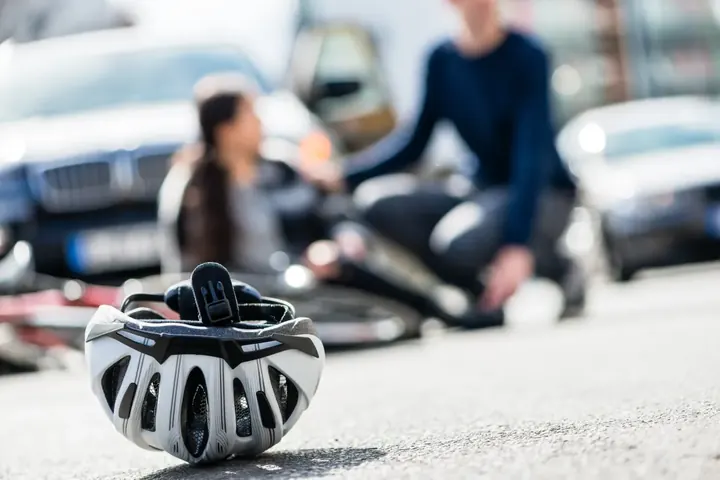
North Carolina is a fault state. The driver who caused the crash pays, through the liability policy that General Statutes section 20-309 makes a condition of registering a motor vehicle. There is no personal injury protection here and no threshold to clear before you can bring a claim.
For any auto policy issued or renewed on or after July 1, 2025, section 20-279.21 sets the minimums at $50,000 for one person's injuries, $100,000 for everyone hurt in the crash, and $50,000 for property damage. The old figures were $30,000, $60,000, and $25,000.
Shoulder surgery with rehab costs $15,000 to $40,000, so a minimum-limits policy covers one operation and leaves little for lost income and pain and suffering.
Your bike is paid from the property damage limit and your medical bills from the bodily injury limit, usually in one settlement at the end of treatment. Until then your health plan pays, and you carry its deductible and copays.
Medical payments coverage is not among the coverages section 20-279.21 requires. The Department of Insurance describes it as covering you or a family member while occupying an automobile, "or as a pedestrian when struck by a motor vehicle." Whether a cyclist counts as a pedestrian depends on the policy wording. Ask your insurer in writing.
If nobody in your household insures a car, you have no auto policy to fall back on: only the driver's liability coverage, your health plan, and whatever you carry on the bike itself.
Fault and How It Reduces a Claim

North Carolina still uses contributory negligence. Damages are not divided by percentage. In Clodfelter v. Carroll, the state Supreme Court described a plaintiff's contributory negligence as the kind of fault that will "defeat recovery." If your own negligence helped cause the crash, the driver's insurer owes you nothing.
Two things soften that. Under General Statutes section 1-139, the side asserting contributory negligence has the burden of proving it. And the last clear chance doctrine can restore a claim: in Lewis v. Brumbles, the Court of Appeals in 1986 sent a 15-year-old cyclist's case to a jury even though he had swung across the center line without looking back, because the driver may have had the time and the means to avoid him.
Expect the insurer to search Chapter 20 for a rule you broke. Section 20-4.01(49) makes a bicycle a vehicle and gives its rider the duties of a driver. The usual candidates:
- Lane position. Section 20-146(b) requires a vehicle moving below the speed limit to use the right-hand lane or keep as close as practicable to the right edge, except when passing or preparing for a left turn.
- Stop signs and signals. Section 20-158 requires a stop from every vehicle, bicycles included.
- Lights. Section 20-129(e) requires, at night, a front lamp visible from 300 feet and either a red rear lamp visible from 300 feet or bright clothing visible from the same distance.
Helmets are settled for children and open for adults. Section 20-171.9 says no negligence may be assessed on account of a violation of the under-16 helmet law. No statute speaks to an adult riding without one.
House Bill 969, filed in 2025, would have the legislature study abolishing the rule. It has sat in a House committee since April 14, 2025.
Hit-and-Run and Uninsured Drivers

Section 20-279.21 requires every auto liability policy in North Carolina to include uninsured motorist coverage. It protects the named insured, a spouse, and relatives in the same household "while in a motor vehicle or otherwise." Those last two words carry the coverage onto a bicycle.
The limits match the policy's bodily injury limits unless the policyholder chose otherwise, and they cannot fall below $50,000 per person and $100,000 per crash. Since July 1, 2025, every policy issued or renewed must also include underinsured motorist coverage at the same limits, and it pays on top of the at-fault driver's insurance with no offset. If the driver carries $50,000, your losses come to $120,000, and your own policy carries $50,000, both policies pay in full.
Two cars on one policy do not double the limit. Two separate policies can be combined, taking the highest limit from each.
A hit-and-run claim has conditions written into the statute. Report the crash within 24 hours, or as soon as practicable, to a police officer or the Commissioner of Motor Vehicles. Give your insurer notice within a reasonable time, with the time, date, and place. You cannot sue the insurer until 60 days after that notice.
The statute speaks of injury from a "collision between motor vehicles," and in Moore v. Nationwide the Court of Appeals confirmed in 2008 that the courts require physical contact with the hit-and-run vehicle. In Petteway v. South Carolina Insurance Co., a driver forced off the highway by a car that never touched his own recovered nothing. How that phrase applies to a rider on a bicycle is a question to put to a North Carolina attorney before you rely on the coverage.
In a bike insurance policy, check whether it offers uninsured motorist coverage of its own and covers crash damage no matter who hit you.
Dooring and Passing Laws
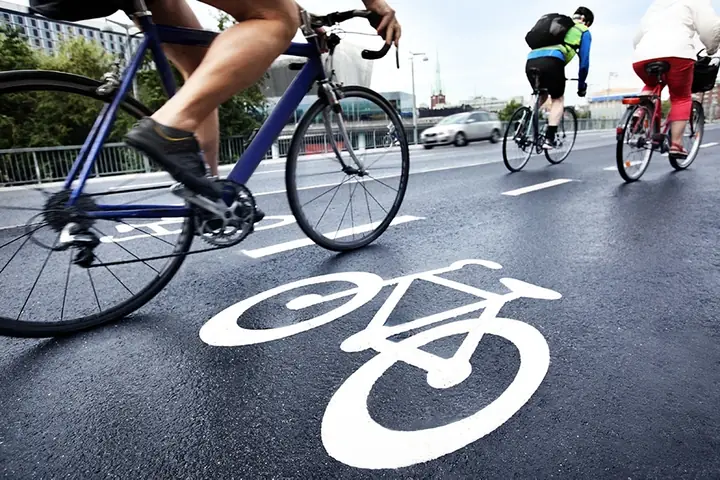
North Carolina has no dooring statute. Chapter 20 contains no rule against opening a car door into traffic, so a dooring claim rests on ordinary negligence. The insurer will answer with your speed, your lights, and how close you rode to the parked cars.
Passing is covered twice. Section 20-149(a) requires a driver overtaking another vehicle, a bicycle included, to pass at least two feet to the left and not move back until safely clear. Section 20-150(e) lets a driver pass a bicycle in a marked no-passing zone only by leaving at least four feet or moving completely into the left lane, and never when the rider is turning left or signaling a left turn.
Section 20-154 adds penalties aimed at drivers who cut riders off. A driver who starts, stops, or turns without first seeing that it is safe, and forces a bicycle to change lanes or leave the travel lane, faces a fine of at least $200. If a crash injures the rider or damages the bike, the minimum is $500. If the damage exceeds $5,000 or the injury is serious, it is $750, and the judge may suspend the driver's license for up to 30 days.
E-bikes
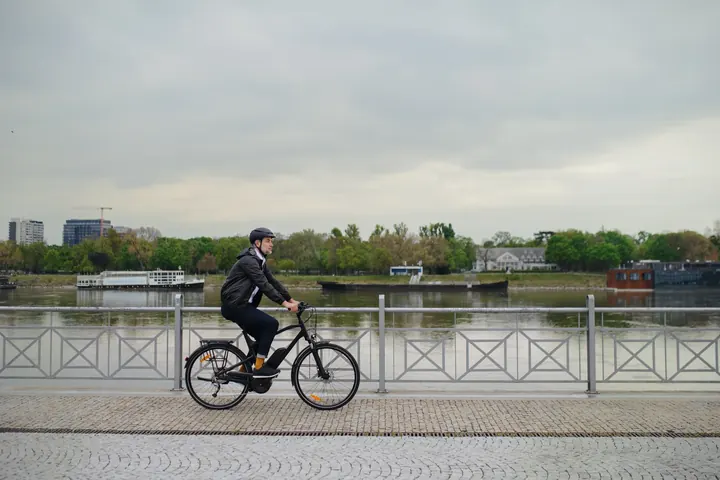
North Carolina's e-bike law changes on December 1, 2026. Until then, section 20-4.01(7a) recognizes one kind of electric assisted bicycle: operable pedals, a motor of no more than 750 watts, and a top speed of 20 mph on motor power alone.
Session Law 2026-46, signed July 7, 2026, replaces that with three classes. Class 1 assists only while you pedal and stops at 20 mph. Class 2 can move without pedaling and stops assisting at 20 mph. Class 3 assists only while you pedal and stops at 28 mph.
The same law adds section 20-171.3, which permits all three classes on roadways, bike lanes, and multiuse paths, and requires a helmet for anyone under 18 on a Class 3. Cities and counties may restrict classes and set speed limits on multiuse paths and sidewalks, and may require helmets for riders under 18 on Class 1 and Class 2.
Under section 20-4.01, an electric assisted bicycle is a vehicle but not a motor vehicle. The registration and insurance requirements of section 20-309 attach to motor vehicles, so they do not reach it. In a crash you are treated as a cyclist: the same contributory negligence rule, the same deadlines. A machine with a motor over 750 watts falls outside the definition.
One question stays open: whether an auto policy's uninsured motorist or medical payments coverage follows you onto an e-bike. Get your auto insurer's position in writing. In a bike insurance policy, check that your e-bike's class is covered.
Deadlines

North Carolina's clocks run from 24 hours to three years. The state has no short notice-of-claim deadline for public entities, which makes the 24-hour hit-and-run report the one riders miss.
- Right away
Notice to Law Enforcement
Under section 20-166.1, the driver of any vehicle in a crash involving a motor vehicle that causes an injury, or $1,000 or more in property damage, must notify the police, the State Highway Patrol, or the sheriff immediately. Chapter 20 counts a bicycle as a vehicle.
- 24 hours
Report a Hit-and-Run to Police
A hit-and-run must be reported within 24 hours, or as soon as practicable, to keep an uninsured motorist claim alive under section 20-279.21.
- Two years
Wrongful Death Lawsuit
Section 1-53 gives a family two years from the date of death to file a wrongful death lawsuit.
- Three years
Injury Lawsuit
Section 1-52 gives you three years to file a lawsuit for personal injury.
- Three years
Bike and Gear Damage Lawsuit
The same section gives you three years to sue for damage to the bike and gear. Small claims court hears cases up to $10,000 under section 7A-210, which covers most bike-only losses.
- Three years
Claim Against a Public Entity
If a state agency is involved, such as a Department of Transportation truck, the Tort Claims Act sends the claim to the Industrial Commission. Section 143-299 bars it unless filed within three years, section 143-299.2 caps payment at $1,000,000 per person, and section 143-291 allows an award only when the claimant was free of contributory negligence. Cities and counties are sued in court. Section 1-539.16 forbids local acts from requiring notice of a claim, but under sections 160A-485 and 153A-435 a city or county waives governmental immunity only to the extent of its insurance.
For a child, section 1-17 treats being under 18 as a disability, and the three-year clock for the child's own injury claim does not start until the 18th birthday.
Evidence to Preserve
In a contributory negligence state, evidence does two jobs: it proves what the driver did, and that you did nothing wrong.
- The crash report. Under section 20-166.1, the investigating officer (city police, the State Highway Patrol, or the sheriff) must write a report within 24 hours. Order a copy from the Division of Motor Vehicles with form TR-67A. Session Law 2026-46 lets the Division send an unredacted report electronically to a person directly involved.
- Proof of when you reported, if the driver fled.
- The scene: lane width, center line and no-passing markings, signs, and where you were in the lane. The markings decide whether the driver owed you two feet or four.
- Your bike and clothing as they were: front lamp, rear lamp or bright clothing, and for an e-bike the motor's wattage label. Do not repair the bike until the claim is settled.
- Video from your own camera, nearby businesses, and doorbells. Ask the same day.
- Medical records and bills from the first visit onward, and receipts for the bike and gear.
Coverage for North Carolina Riders

A driver may carry only $50,000 of coverage. A driver who flees leaves you with a claim that turns on physical contact and a 24-hour report. And under contributory negligence, one mistake of your own can leave you with nothing from the driver's insurer. The Velosurance policy offers the coverages discussed above.
Uninsured Motorist covers losses beyond medical bills, such as lost wages, when the at-fault driver cannot pay.
Medical Payments covers the deductible and out-of-pocket costs your health plan leaves, whatever the driver's insurance does. Choose a limit close to your plan's out-of-pocket deductible.
Liability answers the claim against you. If you injure a pedestrian or damage a car, it covers injury to other people and damage to their property, including the cost of defending a covered lawsuit, with limits from $25,000 to $500,000.
Crash damage to the bike is part of the policy itself, and in a contributory negligence state it carries the most weight. The bike is insured at stated value with no depreciation, subject to the deductible, whoever caused the crash. Class 1, Class 2, and Class 3 e-bikes are covered like conventional bikes.
For any of these coverages to apply, it must be on the policy before the crash. Get a quote and add them before your next ride.
Frequently Asked Questions
- How does fault affect a bicycle accident claim in North Carolina?
- You recover your damages from the at-fault driver when the crash was the driver's doing alone, because North Carolina does not divide damages by percentage. The caveat worth knowing: under contributory negligence, a rider whose own negligence helped cause the crash recovers nothing unless the driver had the last clear chance to avoid it. The side raising that defense has the burden of proving it.
- How long do you have to file a bicycle accident claim in North Carolina?
- You have three years to file a lawsuit for injuries and three years for damage to your bike and gear. A wrongful death claim has two years from the date of death. One thing to watch: a claim against a state agency is filed with the Industrial Commission, not in court, within the same three years.
- What does the at-fault driver's insurance pay after a bike crash in North Carolina?
- The at-fault driver's liability policy pays for your injuries from its bodily injury limit and for your bike and gear from its property damage limit. On policies issued or renewed since July 1, 2025, the minimums are $50,000 per person, $100,000 per crash, and $50,000 for property. The caveat worth knowing: shoulder surgery with rehab costs $15,000 to $40,000, so a minimum policy leaves little for lost income.
- How does uninsured motorist coverage work for a North Carolina cyclist in a hit-and-run?
- Uninsured motorist coverage on a North Carolina auto policy protects the policyholder and resident relatives on or off a motor vehicle, and it is mandatory on every policy. Report the crash to police within 24 hours or as soon as practicable, and notify your insurer within a reasonable time. With one wrinkle: the courts require physical contact with the fleeing vehicle.
- How are Class 1, Class 2, and Class 3 e-bikes treated after a crash in North Carolina?
- From December 1, 2026, North Carolina recognizes Class 1, Class 2, and Class 3 e-bikes as electric assisted bicycles, so the same contributory negligence rule and filing deadlines apply as on a bicycle. Class 1 is pedal assist that stops at 20 mph, Class 2 can move without pedaling and stops assisting at 20 mph, and Class 3 is pedal assist that stops at 28 mph, with a helmet for riders under 18. The caveat worth knowing: a motor over 750 watts puts the machine outside the definition.
Sources
- Clodfelter v. Carroll, 261 N.C. 630 (1964) (contributory negligence and last clear chance)
- Lewis v. Brumbles, 83 N.C. App. 90 (1986) (last clear chance applied to a cyclist)
- North Carolina General Statutes section 1-139 (burden of proof of contributory negligence)
- North Carolina General Statutes section 20-279.21 (minimum liability limits, uninsured and underinsured motorist coverage)
- Session Law 2023-133, section 12, and Session Law 2024-29, section 8 (limits and underinsured motorist changes effective July 1, 2025)
- North Carolina General Statutes section 20-309 (financial responsibility required for registration)
- Moore v. Nationwide Mutual Insurance Co., 191 N.C. App. 106 (2008) (physical contact in hit-and-run claims)
- Petteway v. South Carolina Insurance Co., 93 N.C. App. 776 (1989) (no collision, no uninsured motorist recovery)
- North Carolina General Statutes section 20-4.01 (definitions: electric assisted bicycle, motor vehicle, vehicle, reportable crash)
- Session Law 2026-46, sections 4 and 19 (crash reports; three e-bike classes effective December 1, 2026)
- North Carolina General Statutes sections 20-129, 20-146, 20-154, and 20-158 (lights, lane position, signals, stop signs)
- North Carolina General Statutes sections 20-149 and 20-150 (overtaking and passing)
- North Carolina General Statutes sections 20-166 and 20-166.1 (duty to stop; crash reports)
- North Carolina General Statutes sections 20-171.6 to 20-171.9 (Child Bicycle Safety Act)
- North Carolina General Statutes sections 1-52, 1-53, and 1-17 (filing deadlines, minors)
- North Carolina General Statutes section 7A-210 (small claims limit)
- North Carolina General Statutes sections 143-291, 143-299, and 143-299.2 (State Tort Claims Act)
- North Carolina General Statutes sections 1-539.16, 160A-485, and 153A-435 (claims against cities and counties)
- House Bill 969 (2025-2026 Session), study of abolishing contributory negligence
- North Carolina Department of Insurance, Basic and Miscellaneous Auto Coverages
- North Carolina Division of Motor Vehicles, crash reports (form TR-67A)
This guide is general information about North Carolina law as of the review date above. It is not legal or insurance advice, and it does not create an attorney-client relationship. Laws change and every crash turns on its own facts: talk to a licensed North Carolina attorney about your situation.