
TL;DR:
- New York is a no-fault state: the insurer of the car that hit you pays up to $50,000 in medical bills and lost earnings regardless of fault, even if you own no car.
- The fault rule changed in 2026. In motor vehicle injury lawsuits started on or after May 26, 2026, a claimant more at fault than the driver recovers nothing.
- Pain and suffering requires a serious injury. A fracture qualifies on its own; the old 90-out-of-180-days category was deleted in 2026.
- Deadlines are short: 30 days for a no-fault claim, 90 days for a notice of claim against a municipality, three years to sue.
- No-fault and uninsured motorist coverage pay nothing for the bike. That claim goes against the driver, whose minimum property damage limit is $10,000.
Who Pays After a Crash in New York
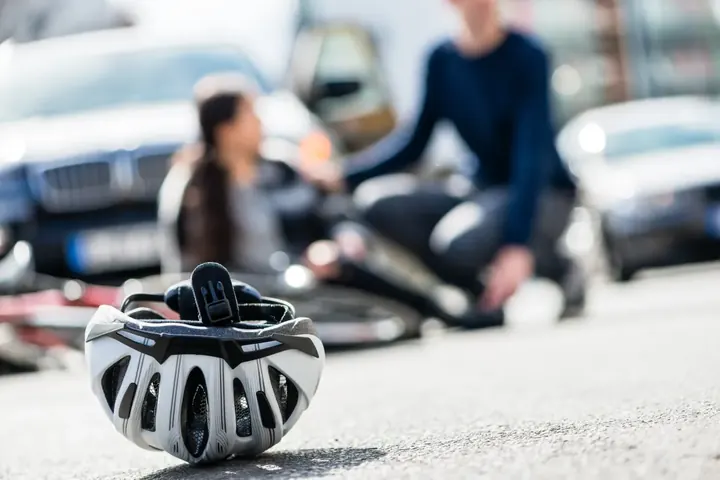
New York is a no-fault state, and for a cyclist that is mostly good news. Insurance Law section 5103 requires a vehicle's insurer to pay first-party benefits to people the vehicle injures, other than occupants of another motor vehicle or a motorcycle. A cyclist is neither. The insurer of the car that hit you pays your basic economic loss whether or not the driver was at fault and whether or not you own a car. The state Insurance Department applied the rule to a bicyclist in a 2005 opinion.
Basic economic loss is capped at $50,000 per person under section 5102. It covers all necessary medical expenses, lost earnings up to $2,000 a month for up to three years, and other reasonable expenses up to $25 a day for up to one year. The earnings benefit is reduced by 20%.
The order of insurers is fixed. You file first with the insurer of the vehicle that struck you. If that vehicle is unknown or uninsured, you file with the auto insurer of a relative in your household. If there is no auto policy in the household, you file with the Motor Vehicle Accident Indemnification Corporation, known as MVAIC.
The catch is the calendar. Written notice of a no-fault claim is due within 30 days of the crash. Medical bills must be submitted within 45 days of treatment and lost earnings claims within 90 days.
No-fault pays nothing for the bike. Damage to the bike and gear is a separate claim against the driver, whose property damage coverage may be as low as $10,000. Vehicle and Traffic Law section 311 sets the liability minimums at $25,000 per person and $50,000 per crash for injury, $50,000 and $100,000 for death, and $10,000 for property.
A lawsuit against the driver is limited by section 5104. You can sue for economic loss beyond the $50,000 that no-fault covers. You can sue for pain and suffering only if you have a serious injury.
Section 5102 lists what counts: death, dismemberment, significant disfigurement, a fracture, and several categories of permanent or significant loss or limitation of use. A fracture qualifies on its own, so a broken collarbone or wrist clears the threshold. An injury that kept you from your usual activities for 90 of the first 180 days used to qualify too. That category was deleted for lawsuits started on or after May 26, 2026.
Fault and How It Reduces a Claim

New York rewrote its fault rule in 2026, and riders who learned the old one need to unlearn it. For decades the state applied pure comparative fault to everything: your share of the blame reduced your recovery and never eliminated it.
Chapter 58 of the Laws of 2026 added subdivision (b) to CPLR section 1411. In a personal injury action subject to Article 51 of the Insurance Law, the no-fault article, a claimant recovers nothing if their culpable conduct is greater than the defendant's, or greater than the defendants' combined. The statute names no percentage. A rider equally at fault with the driver still recovers half. A rider more at fault recovers nothing.
The change applies to actions commenced on or after May 26, 2026. The filing date controls, not the crash date, so a 2024 crash sued today falls under the new rule.
Three limits on the change are in the text. Subdivision (a), the pure comparative rule, still governs property damage, so a rider mostly at fault can still recover a share of the bike's value. It still governs wrongful death. And no-fault benefits are paid regardless of fault: a rider barred from suing keeps the $50,000.
How courts will apply subdivision (b) to a cyclist's lawsuit against a driver has not been settled in a published decision. The wording points toward it applying, because a cyclist's injury claim against a driver runs through the no-fault article. Treat the question as open and put it to a New York attorney before you file.
On the road, the duties run both ways. Vehicle and Traffic Law section 1146 requires every driver to exercise due care to avoid colliding with any bicyclist, and a driver who injures a cyclist while failing to do so commits a traffic infraction with a fine of up to $500. Section 1234 requires a cyclist to use a usable bike lane or, without one, to ride near the right-hand curb or on a usable shoulder, except when preparing for a left turn or avoiding unsafe conditions. No more than two abreast.
Helmets get rare statutory protection. Under section 1238, a failure to comply with the helmet law cannot bar a claim or reduce the damages. That protection is written for the riders the law requires to wear one: children under 14 and anyone on a Class 3 e-bike. For an adult on a conventional bike, the statute is silent.
Hit-and-Run and Uninsured Drivers

Uninsured motorist coverage is mandatory in New York. Insurance Law section 3420 puts it in every auto liability policy at $25,000 per person and $50,000 per crash for injury, with $50,000 and $100,000 for death. It applies when the driver has no insurance, when the driver flees and is never identified, and when the driver's insurer disclaims.
The coverage follows the person, not the car. In a 2004 opinion, the state Insurance Department found that a man hit by a hit-and-run driver while riding a bicycle was an insured under his own policy's uninsured motorist coverage and under the supplementary coverage on his brother's policy in the same household.
Supplementary coverage, called SUM, is the part that applies when the driver has insurance but too little. It is optional, available up to your own bodily injury limits, with a ceiling of $250,000 per person and $500,000 per crash. On new policies it defaults to your liability limits unless you waive it in writing. Limits are never stacked: with two policies in play, the most you collect is the highest single limit.
A hit-and-run claim has conditions. The fleeing vehicle must have made physical contact with you. The crash must be reported to police within 24 hours or as soon as reasonably possible. Your insurer needs a statement under oath, and written notice as soon as practicable.
With no auto policy anywhere in your household, the claim goes to MVAIC, and its deadlines are in section 5208. File the notice of claim within 180 days if the vehicle was uninsured. In a hit-and-run you have 90 days, and the police report within 24 hours is a condition there too.
All of this covers bodily injury only. Neither uninsured motorist coverage nor MVAIC pays for the bike. When the driver is gone, a bike insurance policy's crash coverage is the only source for the bike.
Two things to check in a bike insurance policy: whether it offers uninsured motorist coverage of its own, and whether crash damage is covered no matter who hit you.
Dooring and Passing Laws
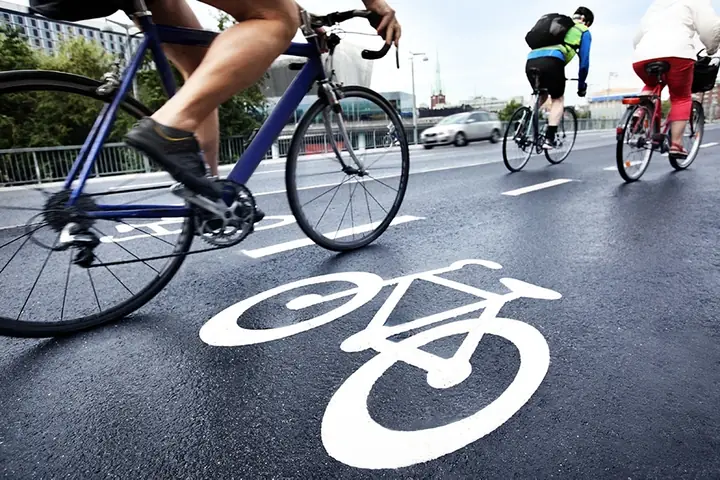
Vehicle and Traffic Law section 1214 is the dooring statute. No person may open the door of a motor vehicle on the side available to moving traffic until it is reasonably safe to do so and can be done without interfering with other traffic. Nor may anyone leave a door open on that side longer than necessary to load or unload passengers. "No person" includes the passenger stepping out of a taxi or rideshare.
The passing law is brief. Section 1122-a requires a driver overtaking a bicycle to pass to the left "at a safe distance until safely clear." The statute gives no number of feet. What a safe distance was becomes a question of evidence: speed, lane width, and how much room the driver had.
E-bikes
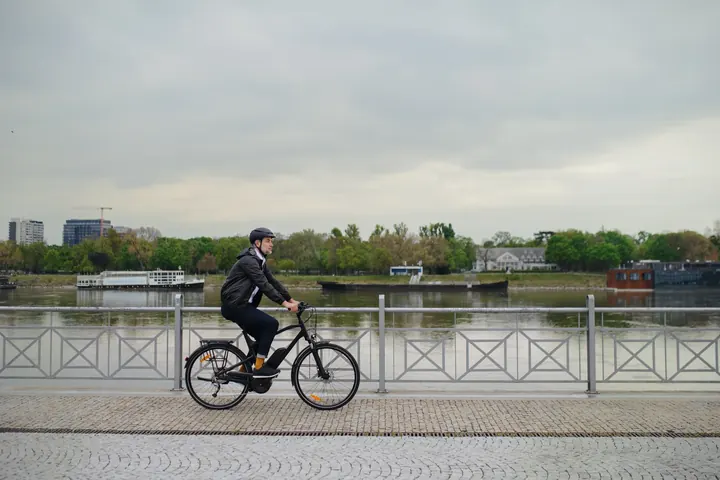
New York's e-bike classes do not match the labels on most bikes sold in the state. Vehicle and Traffic Law section 102-c defines a bicycle with electric assist as a bike no wider than 36 inches with operable pedals and a motor under 750 watts. Class 1 is pedal assist that stops at 20 mph. Class 2 has a throttle and stops assisting at 20 mph. Class 3 is throttle-capable, stops assisting at 25 mph, and is legal only in a city with a population of one million or more, which means New York City.
An e-bike sold as a 28 mph model fits none of the three classes.
Section 1242 sets the operating rules. Riders must be at least 16. E-bikes are limited to roads with a posted speed limit of 30 mph or less unless local rules say otherwise, and they stay off sidewalks unless a local law allows it. Class 3 riders must wear a helmet at any age. In New York City, a Department of Transportation rule has capped e-bike speed at 15 mph since October 24, 2025, unless a different limit is posted.
Section 125 excludes a bicycle with electric assist from the definition of a motor vehicle. An e-bike that fits a class needs no registration and no liability insurance.
What that means for an injured e-bike rider is not settled. The text of the no-fault law favors treating an e-bike rider like any other cyclist, entitled to benefits from the car that hit them. No Department of Financial Services opinion or appellate decision says so directly, and a machine outside the three classes loses the exclusion altogether. In a bike insurance policy, check that your e-bike's class and top assisted speed are covered.
Deadlines

New York stacks short deadlines in front of a long one. Miss an early one and the three-year statute of limitations will not help.
- 24 hours
Report a Hit-and-Run to Police
Both uninsured motorist coverage and MVAIC make it a condition.
- 10 days
Driver's DMV Crash Report
A driver in a crash with an injury, a death, or more than $1,000 in property damage must file a report with the DMV under Vehicle and Traffic Law section 605.
- 30 days
No-Fault Claim Notice
Written notice of your no-fault claim. Medical bills follow within 45 days of each treatment, lost earnings claims within 90 days.
- 90 days
Notice of Claim Against a Government Body
A claim against a city, county, town, village, or school district requires a notice of claim within 90 days under General Municipal Law section 50-e, and the lawsuit must be started within one year and 90 days under section 50-i. A claim against the State goes to the Court of Claims: file the claim, or a notice of intention to file one, within 90 days. The notice of intention extends the filing deadline to two years.
- 90 or 180 days
MVAIC Filing
90 days after a hit-and-run, 180 days when the vehicle was uninsured.
- Two years
Wrongful Death Lawsuit
Measured from the death.
- Three years
Injury and Property Damage Lawsuit
Under CPLR section 214.
Evidence to Preserve
New York claims are won on paper filed on time. Build the file from day one.
- The plate number and insurer of the car that hit you. That insurer is where your no-fault claim goes.
- A dated copy of your no-fault notice and proof of when it was sent.
- The police report number, and the time you reported if the driver fled.
- Imaging and records that document a fracture or another listed serious injury. They decide whether you can claim pain and suffering.
- Evidence of who was at fault: video, witness contacts, the bike lane or shoulder you were riding in, the position of an open door. Under the 2026 rule the comparison between you and the driver can decide everything.
- Every auto policy in your household, including relatives' policies. One of them may supply uninsured motorist or SUM coverage.
- For an e-bike: the class label, motor wattage, and speed data, especially in New York City where the limit is 15 mph.
- The damaged bike, unrepaired, with receipts. That claim sits outside no-fault.
Coverage for New York Riders

No-fault does a lot for a New York cyclist, and it stops in specific places: nothing for the bike, earnings capped at $2,000 a month, no pain and suffering below the serious injury threshold, and a fault rule that can now close the courthouse door. The Velosurance policy offers the coverages discussed above.
Uninsured Motorist covers losses beyond medical bills, such as lost wages, when the at-fault driver cannot pay.
Medical Payments covers the deductible and out-of-pocket costs your health plan leaves. Choose a limit close to your plan's out-of-pocket deductible.
Liability covers the claims made against you. If you injure a pedestrian or damage someone's property while riding, it pays covered settlements or judgments and the cost of defending a covered lawsuit, with limits from $25,000 to $500,000.
Crash damage to the bike, the loss no-fault ignores, is part of the policy itself. The bike is insured at stated value with no depreciation, subject to the deductible, regardless of fault. Class 1, Class 2, and Class 3 e-bikes are covered like conventional bikes.
For any of these coverages to apply, it must be on the policy before the crash. Get a quote and have them in place before you need them.
Bicycle Accident Attorneys in New York
Velosurance legal partners who represent injured cyclists in New York.
-

-

Daniel Flanzig - New York City Bike Accident Lawyers
323 Willis Ave, P.O Box 669
Mineola, NY 11501
Frequently Asked Questions
- Who pays medical bills for a cyclist hit by a car in New York?
- The insurer of the car that hit you pays, under New York no-fault, up to $50,000 in medical bills and lost earnings regardless of fault, even if you own no car. One thing to watch: written notice of the claim is due within 30 days of the crash.
- How does fault affect a bicycle injury claim in New York since 2026?
- You recover for your injuries as long as your fault is no greater than the driver's, with the award reduced by your share. That rule applies to motor vehicle injury lawsuits started on or after May 26, 2026. The caveat worth knowing: a claimant more at fault than the driver recovers nothing for injuries, although damage to the bike still falls under pure comparative fault.
- When can a New York cyclist sue for pain and suffering?
- You can sue for pain and suffering when your injury meets New York's serious injury definition, and a fracture qualifies on its own. Other listed injuries include significant disfigurement and permanent or significant limitation of use. One thing to watch: the category for injuries that disrupted 90 of the first 180 days was deleted for lawsuits started on or after May 26, 2026.
- How long do you have to file a bicycle accident claim in New York?
- You have three years to sue for injuries and for damage to your bike in New York. One thing to watch: the early deadlines are much shorter, with 30 days for a no-fault claim and 90 days for a notice of claim against a city, county, town, or village.
- How are Class 1, Class 2, and Class 3 e-bikes defined in New York?
- New York defines three classes with motors under 750 watts. Class 1 is pedal assist to 20 mph, Class 2 has a throttle and assists to 20 mph, and Class 3 is throttle-capable to 25 mph and legal only in New York City. The caveat worth knowing: an e-bike sold as a 28 mph model fits none of the three classes.
Sources
- New York CPLR section 1411 (comparative fault), as amended by Chapter 58 of the Laws of 2026, Part EE
- New York CPLR section 214 (three-year limitation periods)
- New York Insurance Law sections 5102, 5103, 5104 (no-fault benefits, serious injury, right to sue)
- New York Insurance Law section 3420(f) (uninsured and supplementary uninsured motorist coverage)
- New York Insurance Law sections 5202, 5208, 5221 (Motor Vehicle Accident Indemnification Corporation)
- 11 NYCRR 65-1.1 (mandatory personal injury protection endorsement) and 11 NYCRR 60-2.3 (SUM endorsement)
- New York Vehicle and Traffic Law section 311 (minimum liability limits)
- New York Vehicle and Traffic Law sections 1122-a, 1146, 1214, 1234, 1238 (passing, due care, vehicle doors, lane position, helmets)
- New York Vehicle and Traffic Law sections 102-c, 125, 1242 (bicycles with electric assist)
- New York Vehicle and Traffic Law section 605 (crash reports)
- New York General Municipal Law sections 50-e and 50-i (notice of claim)
- New York Court of Claims Act section 10
- New York Estates, Powers and Trusts Law section 5-4.1 (wrongful death)
- New York Department of Financial Services, Insurance Circular Letter No. 3 (2026)
- New York Department of Financial Services, no-fault frequently asked questions
- New York Insurance Department, Office of General Counsel Opinions 04-10-10 and 05-10-02
- New York City Department of Transportation, Safe Bicycling in New York City (traffic rules summary)
This guide is general information about New York law as of the review date above. It is not legal or insurance advice, and it does not create an attorney-client relationship. Laws change and every crash turns on its own facts: talk to a licensed New York attorney about your situation.