
TL;DR:
- New Mexico uses pure comparative negligence: at 30% at fault you recover 70% of your damages, and at 70% you still recover 30%.
- Minimum auto liability limits are $25,000 per person, $50,000 per accident, and $10,000 for property, and the state has no PIP requirement.
- You have three years to sue for injuries, four years for bike damage, and 90 days to give written notice of a claim against the state or a local public body.
- Uninsured motorist coverage is in every New Mexico auto policy unless validly rejected; a hit-and-run claim needs a police report within 24 hours.
- Since July 1, 2025 cyclists may treat stop signs as yield signs. New Mexico sets no passing distance in feet, and section 66-7-367 makes dooring a misdemeanor.
Who Pays After a Crash in New Mexico
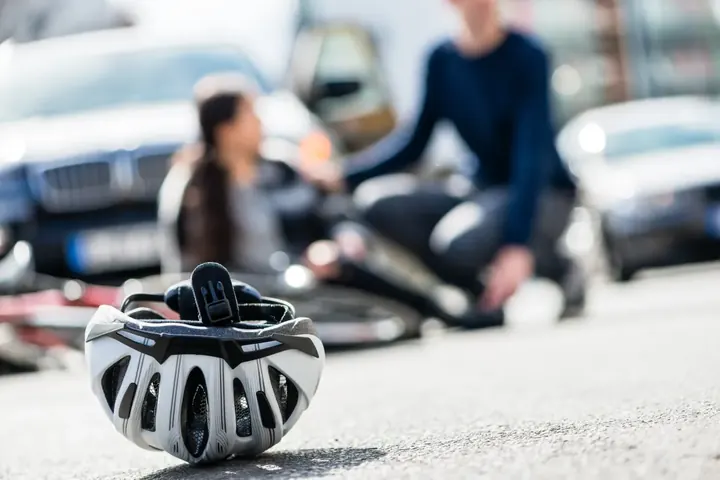
New Mexico is an at-fault state. The driver who caused the crash pays for your losses, and section 66-5-208 of the Mandatory Financial Responsibility Act sets what that driver must carry: $25,000 for one person's injuries, $50,000 for everyone hurt in one accident, and $10,000 for property damage. Senate Bill 319, a 2025 proposal on minimum car insurance amounts, died without a floor vote, so no increase is scheduled.
The $10,000 property limit is the figure to notice. It is the whole fund for your bike and gear, shared with anything else the driver damaged in the same accident.
There is no injury threshold to clear before you can bring a claim, and no personal injury protection either: the act compels liability coverage and nothing else. Until the driver's insurer settles, medical bills go to your health plan, with its deductible and co-insurance. Whether optional medical payments coverage on your own auto policy applies on a bike depends on the policy wording, so ask your insurer in writing.
One more rule shapes what you collect. Under section 41-3A-1, liability is several: each defendant owes only its own percentage. If a jury puts 60% on the driver and 40% on a second party, the driver's insurer owes 60% and the rest must come from the other party.
Fault and How It Reduces a Claim
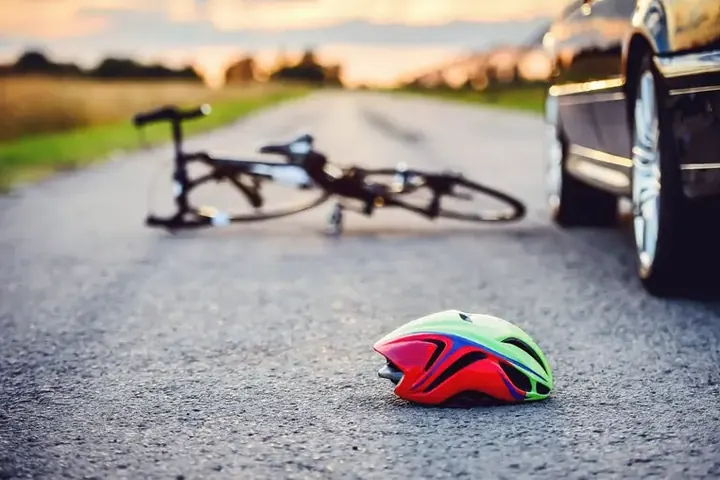
New Mexico's fault rule comes from its Supreme Court, not its legislature. In Scott v. Rizzo, decided in 1981, the court adopted the pure form of comparative negligence. Your recovery is reduced by your percentage of fault, and no percentage ends the claim. A rider 30% at fault for a $100,000 loss collects $70,000. A rider 70% at fault still collects $30,000.
Section 66-3-702 gives a person riding a bicycle on a roadway the rights and duties of a driver. The rules most likely to be raised:
- Lane position. Section 66-3-705 requires riding as near to the right side of the roadway as practicable and no more than two abreast.
- Lights, bell, and brake. Section 66-3-707 requires a white front lamp visible from 500 feet at night, a red rear reflector, a bell or other device audible at 100 feet, and a working brake.
- Stop signs and red lights. Since July 1, 2025, section 66-7-345 lets a cyclist ride through a stop sign or yield sign without stopping when no pedestrian, bicycle, or vehicle with the right of way is approaching. At a red light you must stop first, then may proceed on the same condition.
Rolling a stop sign is no longer a violation in itself. After an intersection crash, the question is whether someone with the right of way was approaching.
On helmets, section 32A-24-5 of the Child Helmet Safety Act is blunt: "Failure to wear a protective helmet shall not limit or apportion damages." The act governs riders under 18. No statute addresses an adult who rode without one, so for adults the question is open.
Hit-and-Run and Uninsured Drivers
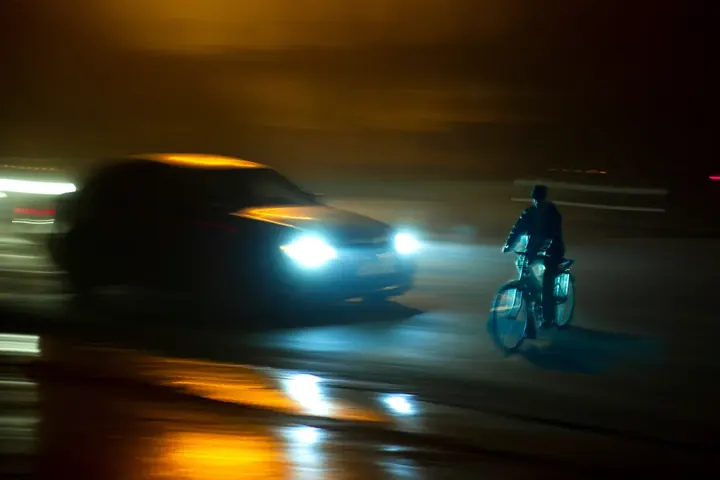
Section 66-5-301 requires every auto liability policy on a vehicle registered or principally garaged in New Mexico to include uninsured motorist coverage, which includes underinsured motorists, unless the named insured rejects it. The floor matches the liability minimums, and you can buy up to your own liability limits.
A valid rejection is hard to produce. Insurance rule 13.12.3.9 NMAC requires it to be made part of the policy, and courts have read coverage back in when the paperwork fell short. In Kileen v. Didio, decided in 2025, the Supreme Court voided a rejection because the insurer had not offered the coverage vehicle by vehicle. A declarations page showing no uninsured motorist coverage deserves a second look.
The state's prescribed endorsement defines the insured as the named insured, a spouse, and relatives in the same household, with no requirement that you be in a car. The Supreme Court said in 1982 that it protects an insured hit as a pedestrian. No decision involving a cyclist was found, so confirm with your insurer.
For a driver who flees, the endorsement covers an unidentified vehicle on "physical contact or attempted physical contact" with you or your property. Two conditions apply: report the crash within 24 hours to a police, peace, or judicial officer or the Motor Vehicle Division, and get a sworn statement to your insurer within 30 days after that.
Courts allow stacking: where a separate premium is charged for each vehicle, the limits add together. The underinsured half is an offset. It applies only when the driver's liability limits are lower than your own uninsured motorist limit, so a minimum policy against a minimum-limits driver pays nothing. The Supreme Court called that coverage illusory in 2022.
The endorsement's property coverage is written around the insured car and the property inside it. Whether it pays for a bicycle is unsettled, so check two things in a bike insurance policy: whether it offers uninsured motorist coverage of its own, and whether crash damage is covered no matter who hit you.
Dooring and Passing Laws
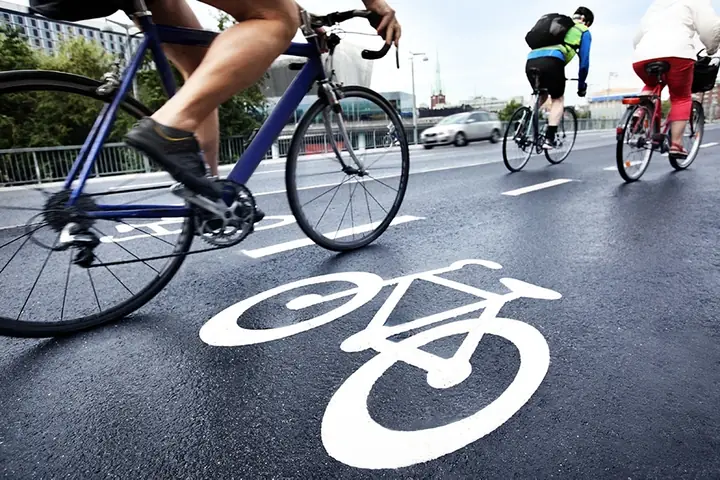
Section 66-7-367 makes dooring a crime. It is a misdemeanor for any person to open a vehicle door on the side near moving traffic unless it is reasonably safe and the door can be opened without interfering with the movement of traffic, or to leave that door open longer than necessary to load or unload passengers. "Any person" reaches a passenger as well as the driver.
Passing is where the code runs out. New Mexico sets no minimum passing distance in feet. Section 66-7-310 requires a driver overtaking a vehicle going the same direction to pass to the left "at a safe distance" and to stay left until safely clear. What counted as safe is argued from the facts.
The legislature did act in 2026. Senate Bill 73, signed March 9, 2026 as chapter 57, defines a vulnerable road user, a person lawfully riding a bicycle included, and requires driver education to spend at least three hours on driving around them. It takes effect January 1, 2027, and it changes what new drivers are taught, not the distance a driver owes you.
E-bikes
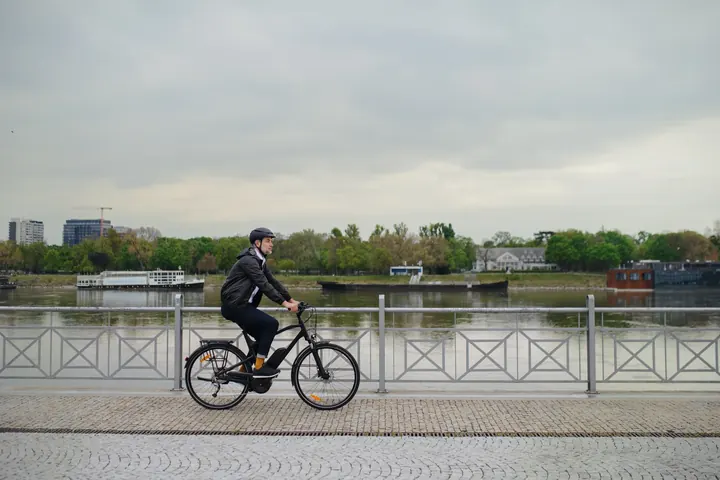
Section 66-1-4.5 has defined the electric-assisted bicycle since July 1, 2023: two or three wheels, fully operable pedals, and an electric motor of no more than 750 watts. Class 1 assists only while you pedal and stops at 20 mph. Class 2 assists whether or not you pedal and stops at 20 mph. Class 3 assists only while you pedal and stops at 28 mph.
Section 66-3-708 requires a permanent label showing the class number, top assisted speed, and motor wattage, and a speedometer on every Class 3. Under section 66-3-709, nobody under 16 may operate a Class 3. The Child Helmet Safety Act covers electric-assisted bicycles, so riders under 18 need a helmet.
A 2023 amendment also took the electric-assisted bicycle out of the code's definition of motor vehicle. The Mandatory Financial Responsibility Act's insurance requirement is written for motor vehicles, so it does not reach your e-bike. After a crash, the same pure comparative negligence rule and three-year deadline apply.
The other side of the line matters as much. A machine that fails the definition and can exceed 20 mph on motor power alone is an "electric mobility device," which the code counts as a motor vehicle. Photograph the label.
One question has no answer in New Mexico statute, insurance rule, or published decisions: whether uninsured motorist coverage on your auto policy applies on an e-bike. Get your insurer's position in writing. In a bike insurance policy, check that your e-bike's class is covered.
Deadlines

New Mexico gives you three years to sue a driver, but a claim against a government body needs written notice within 90 days.
- At the scene
Notify Police Immediately
Section 66-7-206 requires the driver of a vehicle in an accident with an injury, a death, or apparent property damage of $500 or more to notify police immediately: the police department inside a municipality, otherwise the county sheriff or the nearest New Mexico State Police office. Make the call yourself.
- 24 hours, then 30 days
Hit-and-Run Report and Sworn Statement
An uninsured motorist claim against a driver who fled requires a report within 24 hours to a police, peace, or judicial officer or the Motor Vehicle Division, then a sworn statement to your insurer within 30 days.
- Five days
Written Crash Report
Section 66-7-207 requires a driver in an accident with an injury, a death, or $500 or more in property damage to send a written report to the Department of Transportation within five days.
- 90 days
Notice to a Government Body
A claim against the state or a local public body (a city bus, a county truck, a street crew) falls under the Tort Claims Act. Section 41-4-16 requires written notice of the time, place, and circumstances within 90 days. It goes to the Risk Management Division for the state, the mayor for a municipality, the county clerk for a county, or the superintendent for a school district. A wrongful death notice is due within six months.
- Two years
Lawsuit Against a Government Body
Section 41-4-15 bars a tort action against a governmental entity or public employee unless it is filed within two years of the occurrence. A child under seven has until the ninth birthday.
- Three years
Injury Lawsuit
Section 37-1-8 gives you three years to sue for an injury to the person. A wrongful death claim under section 41-2-2 runs three years from the date of death. Under section 37-1-10 a minor has until one year after turning 18.
- Four years
Bike Damage Lawsuit
Section 37-1-4 allows four years for injuries to property, which covers the bike and gear.
The 90-day notice is jurisdictional. Section 41-4-16 says no court has jurisdiction over the claim unless notice was given or the governmental entity had actual notice of the occurrence.
Recovery is capped too. Section 41-4-19 limits a governmental defendant's liability to $300,000 for past and future medical expenses and $400,000 to any one person for all other damages, and it bars punitive damages. Immunity is waived for negligent maintenance of a road or street, but not for a defect in its plan or design.
Evidence to Preserve
With pure comparative negligence every percentage point is money. Collect these.
- The police report number and the agency that took it: municipal police, county sheriff, or State Police.
- Proof of when you reported a hit-and-run, since the 24-hour condition runs from the crash.
- Witnesses or video of a near miss. Attempted contact counts, and it leaves no mark on the bike.
- What was approaching the intersection if you rode through a stop sign or a red light.
- The e-bike label showing class number, top assisted speed, and wattage.
- The driver's name, address, and registration number, which section 66-7-203 requires the driver to give you. Ask for insurance details too.
- Your auto policy's declarations page and any rejection form, with the premium shown for each vehicle, the basis for stacking.
- The damaged bike, unrepaired, with receipts. A $10,000 property limit makes proof of value worth the effort.
Coverage for New Mexico Riders

New Mexico law leaves a rider exposed in four places: a $10,000 property limit, underinsured coverage that pays nothing when both policies sit at the $25,000 minimum, no personal injury protection, and uninsured motorist property coverage written around the car. The Velosurance policy offers the coverages discussed above.
Uninsured Motorist covers losses beyond medical bills, such as lost wages, when the at-fault driver cannot pay.
Medical Payments covers the deductible and out-of-pocket costs your health plan leaves, regardless of the driver's insurance. Choose a limit close to your plan's out-of-pocket deductible.
Liability answers the other side of pure comparative negligence: someone else in the crash can claim against you for your share of it. It covers injury to other people and damage to their property, including the cost of defending a covered lawsuit, with limits from $25,000 to $500,000.
Crash damage to the bike is part of the policy itself: stated value with no depreciation, subject to the deductible, whoever was at fault. Class 1, Class 2, and Class 3 e-bikes are covered like conventional bikes.
Each of these coverages must be on the policy before the crash. Get a quote before the next ride.
Frequently Asked Questions
- How does pure comparative negligence work in a New Mexico bicycle accident claim?
- You recover damages in New Mexico whatever your share of fault, reduced by that share. A rider 30% at fault for a $100,000 loss collects $70,000, and a rider 70% at fault still collects $30,000. One thing to watch: each defendant owes only its own percentage, so a share assigned to a second party has to be collected from that party.
- How long do you have to file a bicycle accident claim in New Mexico?
- You have three years to sue for injuries in New Mexico and four years for damage to your bike. One thing to watch: a claim against the state or a local public body needs written notice within 90 days and a lawsuit within two years.
- What makes a hit-and-run claim work for a cyclist in New Mexico?
- Uninsured motorist coverage on a New Mexico auto policy can pay when the driver flees, and the state's prescribed endorsement counts attempted physical contact as well as actual contact. Report the crash to police within 24 hours and give your insurer a sworn statement within 30 days after that. With one wrinkle: no court decision involving a cyclist was found, so confirm with your insurer that the coverage applies on a bike.
- How does New Mexico's stop-as-yield rule affect a bicycle crash claim?
- Since July 1, 2025 you may ride through a stop sign or yield sign in New Mexico without stopping when no pedestrian, bicycle, or vehicle with the right of way is approaching, and you may proceed through a red light after stopping on the same condition. The caveat worth knowing: if someone with the right of way was approaching, the move counts toward your percentage of fault, so footage and witnesses from the intersection carry weight.
- How are Class 1, Class 2, and Class 3 e-bikes treated after a crash in New Mexico?
- New Mexico keeps Class 1, Class 2, and Class 3 e-bikes out of its definition of motor vehicle, so the same pure comparative negligence rule and three-year deadline apply as on any bicycle. Class 1 assists only while you pedal, up to 20 mph. Class 2 assists whether or not you pedal, up to 20 mph. Class 3 assists only while you pedal, up to 28 mph, for operators 16 and older. The caveat worth knowing: each class is capped at a 750-watt motor, and a machine outside the definition that can exceed 20 mph on motor power alone is treated as a motor vehicle.
Sources
- Scott v. Rizzo, 1981-NMSC-021, 96 N.M. 682, 634 P.2d 1234 (pure comparative negligence)
- NMSA 1978, section 41-3A-1 (several liability)
- NMSA 1978, sections 41-4-5, 41-4-11, 41-4-15, 41-4-16, 41-4-19 (Tort Claims Act) and 41-2-2 (wrongful death)
- NMSA 1978, sections 37-1-4, 37-1-8, 37-1-10 (limitation of actions)
- NMSA 1978, sections 66-5-205, 66-5-208, 66-5-215 (Mandatory Financial Responsibility Act)
- NMSA 1978, section 66-5-301 (uninsured and underinsured motorist coverage) and its official annotations
- 13.12.3 NMAC (uninsured and unknown motorists coverage endorsement)
- NMSA 1978, sections 66-3-701 through 66-3-709 (bicycles and electric-assisted bicycles)
- NMSA 1978, sections 66-1-4.2, 66-1-4.5, 66-1-4.11 (definitions: bicycle, electric-assisted bicycle, electric mobility device, motor vehicle)
- NMSA 1978, sections 66-7-201, 66-7-203, 66-7-206, 66-7-207 (duties and reports after an accident)
- NMSA 1978, sections 66-7-301, 66-7-310, 66-7-345, 66-7-367 (speed, overtaking, stop and yield intersections, opening doors)
- NMSA 1978, sections 32A-24-1 through 32A-24-5 (Child Helmet Safety Act)
- New Mexico Legislature, 2025 Senate Bill 73 (bicycle stops, Laws 2025, chapter 22, effective July 1, 2025)
- New Mexico Legislature, 2026 Senate Bill 73 (driver education on vulnerable road users, Laws 2026, chapter 57, effective January 1, 2027)
- New Mexico Legislature, 2025 Senate Bill 319 (minimum car insurance amounts, not enacted)
- Decisions read in the official annotations to section 66-5-301: Lopez v. Foundation Reserve Ins. Co., 1982-NMSC-034; Montano v. Allstate Indem. Co., 2004-NMSC-020; Arias v. Phoenix Indem. Ins. Co., 2014-NMCA-027; Crutcher v. Liberty Mut. Ins. Co., 2022-NMSC-001; Ullman v. Safeway Ins. Co., 2023-NMSC-030; Kileen v. Didio, 2025-NMSC-038; Montoya v. Dairyland Ins. Co., 394 F. Supp. 1337 (D.N.M. 1975)
This guide is general information about New Mexico law as of the review date above. It is not legal or insurance advice, and it does not create an attorney-client relationship. Laws change and every crash turns on its own facts: talk to a licensed New Mexico attorney about your situation.