
TL;DR:
- New Hampshire uses modified comparative fault: you recover if your share of the blame is 50% or less, reduced by that share, and nothing at 51%.
- Auto insurance is not compulsory in New Hampshire. A policy that exists must carry at least $25,000 per person, $50,000 per crash, and $25,000 for property.
- You have three years to sue for injuries or bike damage, but 60 days to notify a city, town, county, or school district and 180 days to notify a state agency.
- Every New Hampshire auto policy includes uninsured motorist coverage equal to its liability limits, and a hit-and-run claim needs no physical contact with the car.
- Drivers must leave three feet when passing at 30 mph or less and one more foot for every 10 mph above that; opening a door into traffic violates RSA 265:96.
Who Pays After a Crash in New Hampshire
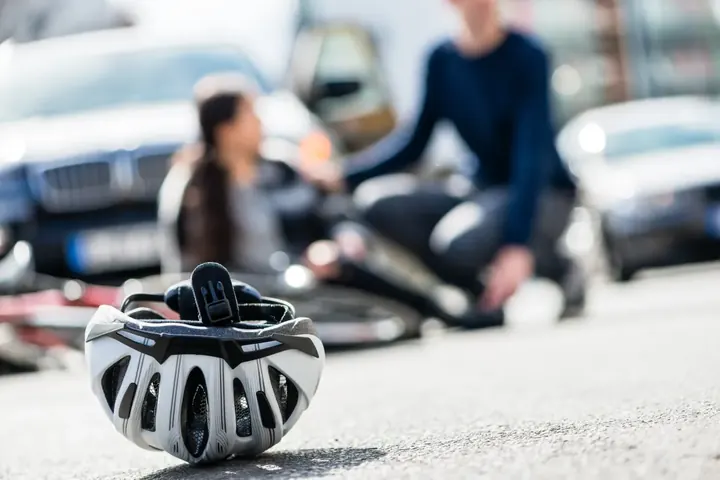
New Hampshire is a fault state. The driver who caused the crash owes you for your injuries and your bike, and there is no personal injury protection and no injury threshold to clear before you can claim.
The catch is that the driver may have no insurance at all. The Division of Motor Vehicles says it plainly: New Hampshire "is not a mandatory or compulsory insurance state." The financial responsibility law in RSA chapter 264 works after the fact. Once a crash involving injury or more than $1,000 in damage is reported, RSA 264:3 has the DMV suspend an uninsured driver's license and registration until security is posted. That pressures the driver without paying you.
When a policy does exist, RSA 259:61 sets its floor: $25,000 for one person's injuries, $50,000 for everyone hurt in the crash, and $25,000 for property damage. Shoulder surgery with rehab costs $15,000 to $40,000, so a single operation can use up a minimum policy before lost income enters the claim.
Your bike and gear are paid from the property damage limit, and one rule here works in your favor. Under RSA 264:18, a liability insurer cannot make you settle the injury claim before it pays the property claim, so the bike can be resolved while you are still in treatment.
RSA 264:16 puts at least $1,000 of medical payments coverage on every private passenger auto policy, but the statute describes it as coverage for the driver and passengers of the insured vehicle. Whether yours follows you onto a bike depends on the policy wording. Ask your auto insurer in writing.
If nobody in your household insures a car, that leaves the driver, your health plan, and whatever you carry on the bike itself.
Fault and How It Reduces a Claim

RSA 507:7-d is the comparative fault statute. Your fault does not bar recovery as long as it "was not greater than the fault of the defendant," or of all defendants combined, and your damages are reduced in proportion. A rider found 30% at fault for a $100,000 loss collects $70,000. A rider found 50% at fault collects $50,000. A rider found 51% at fault collects nothing.
That cliff makes the percentage the whole fight, and the same statute hands you one advantage: the party alleging fault carries the burden of proving it.
It will look for that proof in the rules of the road. RSA 265:143 gives a cyclist all the rights and all the duties of a driver, and the bicycle rules add specifics:
- Lane position. RSA 265:144 requires a rider slower than traffic to keep to the right portion of the way as far as practicable, with exceptions for passing, left turns, going straight where right turns are permitted, and hazards including opening car doors.
- Lights. RSA 266:86 requires a white front lamp visible from 300 feet and a red rear reflector in darkness.
- Reflective clothing. RSA 265:144 requires at least one item of reflective outerwear from a half hour after sunset to a half hour before sunrise.
When more than one party shares the blame, RSA 507:7-e applies. A defendant less than 50% at fault owes only its own share of your damages.
Helmets are an open question. The statutes say who must wear one and are silent on whether riding without one can be used to reduce an adult's damages.
Hit-and-Run and Uninsured Drivers

RSA 264:15 requires every auto liability policy issued for a vehicle registered or principally garaged in New Hampshire to include uninsured motorist coverage, and the limits automatically equal the liability limits you bought. The statute protects the "persons insured" under the policy, so whether that includes you on a bicycle depends on how your policy defines an insured.
The coverage also reaches underinsured drivers, within limits. Under RSA 259:117, an insured car counts as uninsured only to the extent its liability limits are lower than your own uninsured motorist limits. Carry $25,000 and get hit by a driver who also carries $25,000, and the statute gives you nothing more.
On hit-and-runs, New Hampshire law is friendlier than most policies read. In Soule v. Stuyvesant Insurance Co., the state Supreme Court heard the claim of a rider forced to swerve and crash on Mammoth Road in Hooksett by a car that never touched him and never stopped. The insurer's policy demanded physical contact. The court held in 1976 that the legislature wrote no contact requirement into the statute and that the policy clause was void. The current statute still contains none.
The statute sets no deadline for reporting a hit-and-run to police or to your insurer, which means your policy's own notice conditions control. Call the police from the scene and notify your insurer the same day.
RSA 264:15 also requires any release offered to settle an injury claim to warn that signing may forfeit your uninsured motorist benefits. Call your own insurer before you sign one.
None of this pays for the bike. The coverage is for bodily injury, and its only property protection applies when the other driver's insurer is insolvent. Two things to check in a bike insurance policy: whether it offers uninsured motorist coverage of its own, and whether crash damage is covered no matter who hit you.
Dooring and Passing Laws
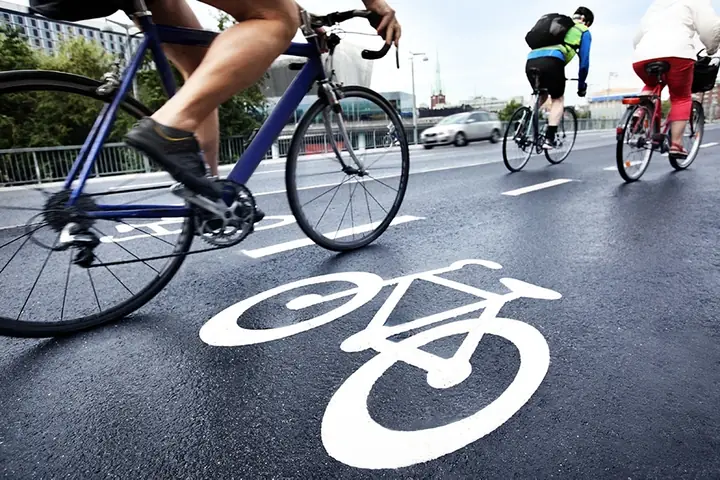
RSA 265:96 is the dooring statute. No person may open a vehicle door on the side available to moving traffic unless it is reasonably safe and can be done without interfering with other traffic, or leave the door open longer than it takes to load or unload passengers. It says "person," so a passenger is covered as well as the driver. The keep-right rule in RSA 265:144 backs you up: it lists "opening doors of parked vehicles" among the hazards that justify riding farther left.
Passing is governed by RSA 265:143-a, in force since January 1, 2009. A driver approaching a cyclist must leave a reasonable and prudent distance, and the statute says what that means: at least three feet at 30 mph or less, with one more foot for every 10 mph above 30. On a 50 mph state road that is five feet.
The fine under RSA 265:153 is $100. Its value is in the civil claim, where a close pass that ends in a crash is a violation you can cite by number.
E-bikes
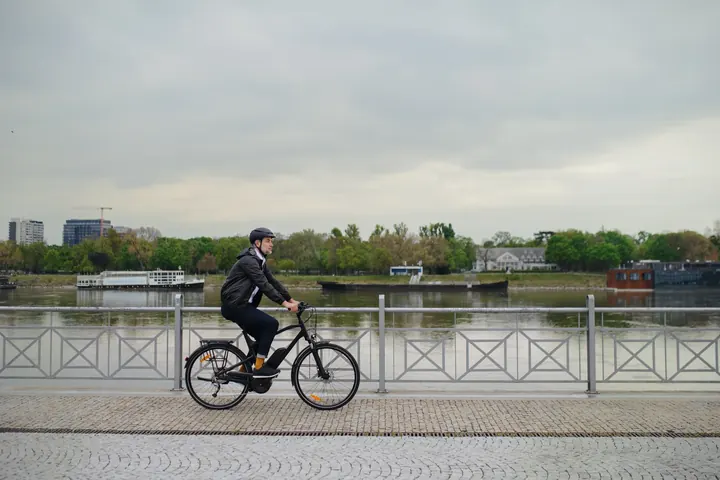
RSA 259:27-a defines an electric bicycle as a pedaled vehicle with a motor of less than 750 watts. Class 1 assists only while you pedal and stops at 20 mph. Class 2 has a motor that can propel the bike on its own and stops assisting at 20 mph. Class 3 assists only while you pedal and stops at 28 mph.
Under RSA 265:144-a, an e-bike rider has the rights and duties of a cyclist, and the bike is exempt from the financial responsibility, license, registration, title, and plate laws. In a crash you are treated as a cyclist: the same fault rule, the same deadlines, the same claim against the driver.
Class 3 carries extra rules. The operator must be at least 16, anyone under 18 on the bike must wear a helmet, the bike needs a speedometer, and it stays off bicycle and multi-use paths unless the path runs within or beside a road or the town or agency in charge allows it.
The label is evidence. Since January 1, 2020, manufacturers must fix a permanent label showing the class, top assisted speed, and motor wattage, and the statute forbids modifying the motor's speed capability without replacing that label.
One question has no clear answer in published New Hampshire authority: whether an auto policy's uninsured motorist or medical payments coverage follows you onto an e-bike. Get your auto insurer's position in writing. In a bike insurance policy, check that your e-bike's class is covered and that the motor is unmodified.
Deadlines

New Hampshire's deadlines run from 15 days to three years, and the two government notice periods are the ones riders miss.
- 15 days
Driver's Written Report to the DMV
Under RSA 264:25, the driver must report in writing to the Division of Motor Vehicles within 15 days when anyone is injured or property damage exceeds $1,000, unless a police officer investigated and filed a report.
- 60 days
Notice to a City, Town, County, or School District
If a local government vehicle or property is involved, RSA 507-B:7 requires notice to the clerk of that governmental unit by registered mail within 60 days, stating the date, time, and location. Late notice defeats the claim only if the government proves substantial prejudice. Damages are capped at $325,000 per person and $1,000,000 per incident under RSA 507-B:4, and a pothole or road defect claim against a municipality must also meet the narrow insufficiency rules of RSA 231:92.
- 180 days
Notice to a State Agency
RSA 541-B:14 requires written notice to the state agency within 180 days, with the date, time, and location. Awards are capped at $475,000 per claimant and $3,750,000 per incident.
- Three years
Injury or Bike Damage Lawsuit
RSA 508:4 gives you three years from the crash to sue for injuries or for damage to the bike and gear. The same three years applies to lawsuits against local governments and to claims against the state. Small claims court hears disputes up to $10,000 under RSA 503:1, which covers most bike-only losses.
For a child, RSA 508:8 allows a personal action to be brought within two years after turning 18. Medical payments coverage on an auto policy has its own clock: under RSA 264:16 it applies only to medical costs incurred in the three years after the injury.
Evidence to Preserve
Evidence in a New Hampshire bike crash maps onto the statutes above. Collect it with them in mind.
- The police report number, from the local department or the State Police. If police did not respond, the DMV expects an Operator Report from the driver.
- The driver's details. RSA 264:25 obliges the driver to give you a name, address, license number, registration, and insurance information at the scene. Photograph all of it, and note if the driver says there is no insurance.
- The speed limit and the road. The passing distance in RSA 265:143-a depends on speed, so photograph the posted limit, the lane width, and the shoulder.
- Your bike as it was: front lamp, rear reflector, the reflective item you were wearing after dark, and for an e-bike the class label. Do not repair or discard the bike until the claim is settled.
- Witnesses. In a no-contact hit-and-run, a disinterested witness is the strongest proof that a car caused the crash.
- Medical records and every bill, including what your health plan paid and what you paid, plus receipts for the bike, helmet, and gear.
- Registered mail receipts and dated copies of any notice sent to a town clerk or a state agency.
Coverage for New Hampshire Riders

New Hampshire's gaps are specific: a driver who was never required to buy insurance, a $25,000 policy when one exists, a fault rule that pays nothing at 51%, and an auto policy that may not treat you as an insured on a bicycle. The Velosurance policy offers the coverages discussed above.
Uninsured Motorist covers losses beyond medical bills, such as lost wages, when the at-fault driver cannot pay.
Medical Payments covers the deductible and out-of-pocket costs your health plan leaves, whatever the driver's insurance does. Choose a limit close to your plan's out-of-pocket deductible.
Liability answers the other side of RSA 507:7-d. If you are blamed for a share of a crash, it covers injury to other people and damage to their property, including the cost of defending a covered lawsuit, with limits from $25,000 to $500,000.
Crash damage to the bike is part of the policy itself. The bike is insured at stated value with no depreciation, subject to the deductible, whoever caused the crash. Class 1, Class 2, and Class 3 e-bikes are covered like conventional bikes.
For any of these coverages to apply, it must be on the policy before the crash. Get a quote and add them before your next ride.
Frequently Asked Questions
- How does fault affect a bicycle accident claim in New Hampshire?
- You can recover damages in New Hampshire when your share of the blame is 50% or less, with the award reduced by that share: a rider 30% at fault for a $100,000 loss collects $70,000. The party alleging your fault carries the burden of proving it. The caveat worth knowing: at 51% the claim is barred, so every traffic rule an insurer can pin on you counts.
- How long do you have to file a bicycle accident claim in New Hampshire?
- You have three years from the crash to sue for injuries or for damage to your bike and gear. One thing to watch: a claim against a city, town, county, or school district needs registered-mail notice to the clerk within 60 days, and a claim against a state agency needs written notice within 180 days.
- What does the at-fault driver's insurance pay after a bike crash in New Hampshire?
- A New Hampshire auto liability policy pays at least $25,000 for one person's injuries, $50,000 per crash, and $25,000 for property, and the insurer cannot hold your bike claim until the injury claim settles. The caveat worth knowing: auto insurance is not compulsory in New Hampshire, so the driver may have no policy.
- How does uninsured motorist coverage work for a New Hampshire cyclist in a hit-and-run?
- Uninsured motorist coverage is built into every New Hampshire auto policy at the same limits as its liability coverage, and a hit-and-run claim does not require the car to have touched you. Call the police from the scene and notify your insurer the same day. With one wrinkle: it pays for bodily injury, so the bike needs separate crash coverage, and you should confirm your policy counts you as an insured on a bicycle.
- How are Class 1, Class 2, and Class 3 e-bikes treated after a crash in New Hampshire?
- New Hampshire gives Class 1, Class 2, and Class 3 e-bike riders the rights and duties of cyclists, so the same fault rule and deadlines apply. Class 1 is pedal assist to 20 mph, Class 2 has a motor that can propel the bike alone and stops assisting at 20 mph, and Class 3 is pedal assist to 28 mph for operators 16 and older. One thing to watch: the motor must be under 750 watts and match the class label on the bike.
Sources
- RSA 507:7-d and 507:7-e (comparative fault, apportionment of damages)
- RSA 259:61 and 264:20 (motor vehicle liability policy, minimum limits)
- RSA 264:3 (security and proof of financial responsibility after a crash)
- RSA 264:15 and 259:117 (uninsured and hit-and-run motor vehicle coverage)
- RSA 264:16 (medical payments coverage)
- RSA 264:18 (required policy provisions, separate property damage settlement)
- RSA 264:25 and 264:29 (conduct after accident, report to the DMV, penalty)
- Soule v. Stuyvesant Insurance Co., 116 N.H. 595 (1976) (no physical contact requirement)
- RSA 265:143 and 265:144 (bicycle rights, duties, helmets, lane position)
- RSA 265:143-a and 265:153 (passing distance, penalties)
- RSA 265:96 (opening and closing vehicle doors)
- RSA 266:86 (bicycle lamp and reflector)
- RSA 259:27-a and 265:144-a (electric bicycles)
- RSA 508:4 and 508:8 (three-year limitation, minors)
- RSA 507-B:1, 507-B:4, and 507-B:7 (claims against cities, towns, counties, and school districts)
- RSA 541-B:1 and 541-B:14 (claims against state agencies)
- RSA 231:90 and 231:92 (municipal liability for highway insufficiencies)
- RSA 503:1 (small claims)
- New Hampshire Division of Motor Vehicles, Accident Records FAQs
This guide is general information about New Hampshire law as of the review date above. It is not legal or insurance advice, and it does not create an attorney-client relationship. Laws change and every crash turns on its own facts: talk to a licensed New Hampshire attorney about your situation.