
TL;DR:
- Nevada is a fault state with modified comparative negligence: your share of the blame cuts your recovery, and at 51% or more you recover nothing under NRS 41.141.
- Minimum auto liability limits are $25,000 per person, $50,000 per crash, and $20,000 for property damage under NRS 485.185.
- You have two years to sue for injuries and three for bike damage; a tort claim against the State or a local government must be filed within two years and is capped at $200,000.
- A hit-and-run uninsured vehicle claim needs physical contact with the car and a prompt report to city police, the county sheriff, or the Nevada Highway Patrol.
- Drivers must change lanes to pass a bike when a second lane is available, or leave at least three feet; a violation that causes a crash is reckless driving.
Who Pays After a Crash in Nevada
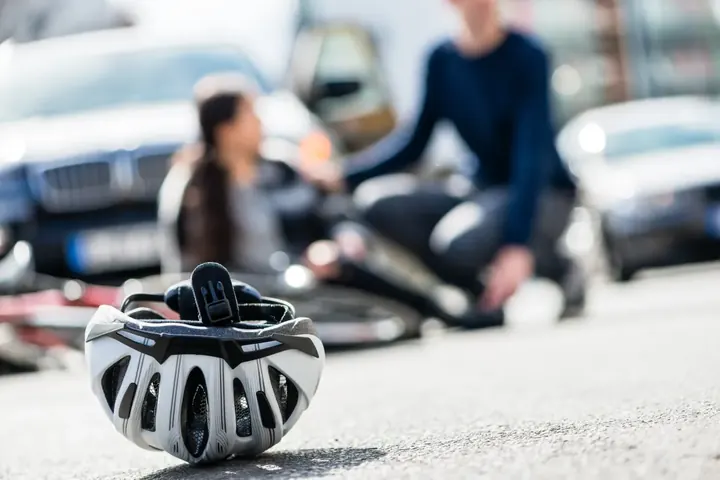
Nevada is a fault state. The driver who caused the crash pays, through the liability insurance that NRS 485.185 requires for every motor vehicle registered here. There is no personal injury protection requirement and no injury threshold to clear: any loss can be claimed against the person responsible.
The required limits are $25,000 for one person's injuries, $50,000 for everyone hurt in the crash, and $20,000 for property damage. Those numbers took effect on July 1, 2018, and the 2025 legislative sessions left them alone.
Shoulder surgery with rehab costs $15,000 to $40,000, so a single operation can exhaust a minimum policy.
Your bike and gear are paid from the driver's $20,000 property damage limit. Your medical bills are paid from the bodily injury limit, usually in one settlement at the end of treatment. Until then your health plan pays, and you carry its deductible and copays.
Medical payments coverage is optional on a Nevada auto policy. NRS 687B.145 requires insurers to offer at least $1,000 of it, and the Nevada Division of Insurance says it pays for injuries from being struck as a pedestrian by a motor vehicle. Whether your insurer treats a cyclist the same way depends on the policy wording, so ask in writing.
If nobody in your household insures a car, there is no auto policy of your own to fall back on.
Fault and How It Reduces a Claim

NRS 41.141 sets the rule: your own negligence does not bar recovery as long as it is "not greater than" the negligence of the parties you are suing. The jury fixes your total damages, then assigns each party a percentage. A rider found 50% at fault for a $100,000 loss collects $50,000. A rider found 51% at fault collects nothing.
So one percentage point can be worth the whole claim. NRS 484B.763 gives a person riding a bicycle on a roadway all the rights and all the duties of a driver, and an insurer will look for a rule you broke. Two come up most:
- Lane position. NRS 484B.777 requires riding as near to the right side of the roadway as practicable, except when you are moving at the speed of nearby traffic, preparing to turn left, or when it would not be safe. Parked cars, surface hazards, and a lane too narrow to share count as unsafe.
- Lights. NRS 484B.783 requires, at night, a white front lamp visible from 500 feet, a red rear reflector, and reflective material or a lamp visible from both sides.
Under NRS 484B.653, a driver who breaks the passing and due care rules of NRS 484B.270 and is the proximate cause of a collision with a cyclist has committed reckless driving: a fine of $250 to $1,000, 50 to 99 hours of community service, and a license suspension of six months to two years on a first offense.
When more than one party is to blame, subsection 4 of NRS 41.141 makes each defendant liable only for its own percentage of the judgment.
Helmets are an open question. Nevada has no bicycle helmet statute, and none says whether riding without one can reduce your damages.
Hit-and-Run and Uninsured Drivers

NRS 690B.020 requires every auto liability policy delivered in Nevada to include uninsured vehicle coverage unless a named insured rejected it in writing, on a form that describes what is being given up. The statute protects "persons insured thereunder" and does not limit the coverage to people inside a car, and its hit-and-run clause speaks of contact "with the named insured." Confirm on your declarations page that it was never rejected, and ask your insurer in writing whether it applies on a bike.
The floor is the bodily injury minimum: $25,000 per person and $50,000 per crash. NRS 687B.145 goes further and makes insurers offer uninsured and underinsured coverage up to your own bodily injury limits. The underinsured half pays the part of your damages that exceeds the at-fault driver's bodily injury limits, up to your own limit.
A hit-and-run claim has two conditions in the statute. The unknown automobile must have made physical contact with you; a rider forced off the road by a car that never touched them does not meet the text. The crash must be reported to the police department of the city where it happened or, outside city limits, to the county sheriff or the Nevada Highway Patrol, within the time the crash-reporting statutes allow: "forthwith" or "immediately." Call from the scene.
Stacking depends on your policy. NRS 687B.145 lets an insurer cap recovery from multiple coverages at the highest single limit, but only in clear, prominently displayed language, and the clause is void if you paid a separate full premium for coverage on the same risk.
None of this pays for the bike: the required coverage is for bodily injury. In a bike insurance policy, check for uninsured motorist coverage of its own and for crash damage cover that applies no matter who hit you.
Dooring and Passing Laws
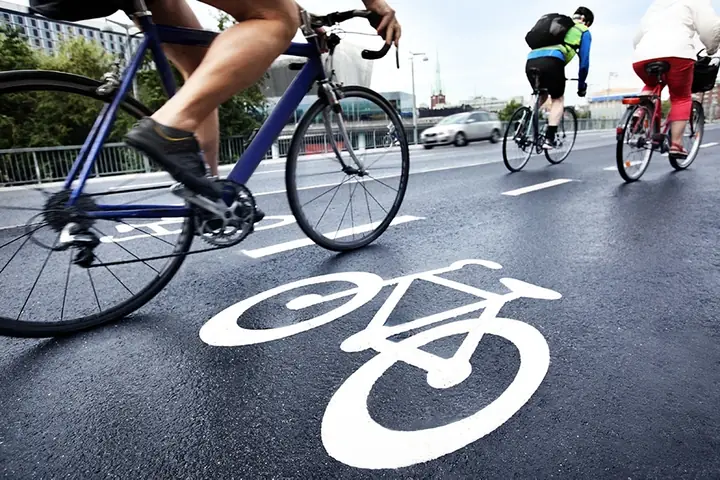
NRS 484B.153 is the dooring statute. A person may not open a vehicle door on the side closest to passing traffic in a way that interferes with moving traffic, or leave that door open longer than it takes to load or unload passengers or cargo. It says "person," not "driver," so a rideshare passenger stepping out on the Las Vegas Strip is bound by it too.
Passing is governed by NRS 484B.270. On a road with more than one lane in your direction, the driver must move into the lane to the immediate left if it is available and reasonably safe. On a one-lane road, the driver must leave at least three feet between any part of the vehicle and the bike, and may cross the center line or pass in a no-passing zone to do it when that is safe.
The same section protects bike lanes. A driver may not enter, stop, stand, park, or drive in a lane provided for bicycles except in listed cases such as reaching a driveway or an emergency, and must yield to riders in it.
Each of those duties is one of the subsections that turns a collision into reckless driving under NRS 484B.653. Assembly Bill 6 of the 2025 special session added a further penalty when the violation happens in an active school zone.
E-bikes

NRS 484B.017 defines an electric bicycle as a device with two or three wheels, fully operable pedals, a seat, and an electric motor of not more than 750 watts. Class 1 assists only while you pedal and stops at 20 mph. Class 2 has a motor that can propel the bike on its own and gives no assistance at 20 mph. Class 3 assists only while you pedal, stops at 28 mph, and must carry a speedometer under NRS 484B.784.
Nevada writes the e-bike out of its motor vehicle law by name. NRS 482.075 and 482.135 exclude it from the definitions used for registration, and NRS 485.050 excludes it from the definition used for compulsory insurance. In a crash you are treated as a cyclist: the same fault rule, the same deadlines, and the same passing protections, which name electric bicycles.
Since January 1, 2022, manufacturers and distributors must fix a permanent label to every e-bike showing its class, top assisted speed, and motor wattage. NRS 484B.784 prohibits modifying the bike to change its speed capability unless the label is replaced to match. A bike that exceeds 750 watts is outside the definition altogether.
One question has no clear answer in Nevada statute: whether an auto policy's uninsured vehicle or medical payments coverage follows you onto an e-bike. Get your auto insurer's position in writing. In a bike insurance policy, check that your e-bike's class is covered.
Deadlines

Nevada's deadlines run from the moment of the crash to three years, and the earliest ones protect the insurance claims that pay first.
- At the scene
Report a Hit-and-Run to Police
NRS 690B.020 ties a hit-and-run uninsured vehicle claim to a report made within the time the crash statutes require, which is immediately. Call city police or, outside city limits, the county sheriff or the Nevada Highway Patrol.
- 10 days
Crash Reports Reach the State
Under NRS 484E.070, the driver must send a crash report to the Department of Motor Vehicles within 10 days when there is an injury or $750 or more in damage, unless a police officer investigated and recorded each party's insurance details. An investigating officer has the same 10 days under NRS 484E.110.
- 60 days
Driver Presumed Uninsured
If no evidence of insurance for the vehicle that hit you reaches the Department of Motor Vehicles within 60 days of a crash with injuries, NRS 690B.020 presumes it was uninsured. That presumption supports a claim on your own uninsured vehicle coverage.
- Two years
Injury or Wrongful Death Lawsuit
NRS 11.190 gives you two years to file a lawsuit for injuries or for a death caused by the wrongful act or neglect of another.
- Two years
Claim Against the State or a Local Government
If a public body is involved, NRS 41.036 requires the tort claim to be filed within two years: with the Attorney General for the State and its agencies, or with the governing body of the city, county, or district. Filing the claim is not a precondition to a lawsuit. NRS 41.035 caps damages at $200,000 per claimant and bars punitive damages.
- Three years
Bike and Gear Damage Lawsuit
NRS 11.190 gives you three years to sue for damage to the bike and gear. Small claims in justice court go up to $10,000 under NRS 73.010.
For a rider under 18, NRS 11.250 does not count the time before the 18th birthday toward these lawsuit deadlines.
The $200,000 cap has an insurance consequence. NRS 687B.145 requires underinsured vehicle coverage to pay actual damages above that cap, up to your own limit.
Evidence to Preserve
Evidence in a Nevada bike crash maps onto the statutes above. Collect it with them in mind.
- The police report number, from the city department, the county sheriff, or the Nevada Highway Patrol, and proof of the time you reported if the driver fled.
- Any citation issued to the driver, with the section number. A citation under NRS 484B.270 or 484B.653 bears directly on the fault percentage.
- The scene: the number of lanes in your direction, lane width, bike lane markings, the parked car's door position, and sight lines. The lane count decides whether the driver owed you a lane change or three feet.
- Your bike as it was: lamp, reflectors, and for an e-bike the class label. Do not repair it until the claim is settled.
- Video from your own camera, nearby businesses, casinos, and transit vehicles. Ask the same day.
- Medical records and every bill, including what your health plan paid.
- Receipts for the bike, upgrades, helmet, and gear, which set the property damage claim.
Coverage for Nevada Riders

The gaps in this guide are predictable: a driver carrying $25,000 of coverage, a driver who is never found, a 51% bar that turns a fault dispute into all or nothing, a $200,000 cap when a public vehicle is involved, and a bike that the required uninsured vehicle coverage does not pay for. The Velosurance policy offers the coverages discussed above.
Uninsured Motorist covers losses beyond medical bills, such as lost wages, when the at-fault driver cannot pay.
Medical Payments covers the deductible and out-of-pocket costs your health plan leaves, whatever the driver's insurance does. Choose a limit close to your plan's out-of-pocket deductible.
Liability answers the other side of NRS 41.141. If you are blamed for a share of a crash, it covers injury to other people and damage to their property, including the cost of defending a covered lawsuit, with limits from $25,000 to $500,000.
Crash damage to the bike is part of the policy itself. The bike is insured at stated value with no depreciation, subject to the deductible, whoever caused the crash. Class 1, Class 2, and Class 3 e-bikes are covered like conventional bikes.
For any of these coverages to apply, it must be on the policy before the crash. Get a quote and add them before your next ride.
Frequently Asked Questions
- How does fault affect a bicycle accident claim in Nevada?
- You can recover damages in Nevada when you share the blame, as long as your negligence is not greater than that of the parties you are suing. A rider found 50% at fault for a $100,000 loss collects $50,000. One thing to watch: at 51% the claim is barred, so a single traffic violation on your part can decide the outcome.
- How long do you have to file a bicycle accident claim in Nevada?
- You have two years from the crash to file an injury lawsuit and three years to sue for damage to your bike and gear. A tort claim against the State or a city or county must also be filed within two years. The caveat worth knowing: damages against a public body are capped at $200,000.
- What does the at-fault driver's insurance pay after a bike crash in Nevada?
- The at-fault driver's liability policy pays for your injuries from its bodily injury limit and for your bike and gear from its property damage limit. The required minimums are $25,000 per person, $50,000 per crash, and $20,000 for property damage. The caveat worth knowing: one surgery can exhaust a minimum policy.
- How does uninsured vehicle coverage work for a Nevada cyclist in a hit-and-run?
- Uninsured vehicle coverage on a Nevada auto policy pays for injuries when the driver flees, provided the car made physical contact with you. Report the crash at once to city police, the county sheriff, or the Nevada Highway Patrol. With one wrinkle: the required coverage is for bodily injury, so the bike needs separate crash coverage.
- How are Class 1, Class 2, and Class 3 e-bikes treated after a crash in Nevada?
- Nevada treats Class 1, Class 2, and Class 3 e-bikes as bicycles and not as motor vehicles, so the same fault rule and filing deadlines apply. Class 1 assists only while you pedal, to 20 mph. Class 2 has a motor that can propel the bike on its own, with no assistance at 20 mph. Class 3 assists only while you pedal, to 28 mph, and carries a speedometer. One thing to watch: a modified bike must have its class label replaced to match.
Sources
- NRS 41.141 (comparative negligence, several liability)
- NRS 41.031, 41.035, and 41.036 (tort claims against the State and political subdivisions, $200,000 cap)
- NRS 11.190 and 11.250 (periods of limitation, minors)
- NRS 73.010 (small claims jurisdiction)
- NRS 485.050, 485.185, and 485.3091 (motor vehicle definition, minimum liability limits)
- NRS 690B.020 (uninsured and hit-and-run vehicle coverage)
- NRS 687B.145 (proration clauses, uninsured and underinsured vehicle coverage, medical payments offer)
- NRS 484B.017 and 484B.784 (electric bicycle classes, labels, modification)
- NRS 484B.153 (opening vehicle doors)
- NRS 484B.270 (passing bicycles, bike lanes, due care), as amended by Assembly Bill 6, 36th Special Session (2025)
- NRS 484B.653 (reckless driving, collisions with cyclists)
- NRS 484B.760 to 484B.783 (operation of bicycles and electric bicycles)
- NRS 482.075 and 482.135 (motor vehicle and vehicle definitions)
- NRS 484E.030, 484E.050, 484E.070, and 484E.110 (crash reporting)
- Nevada Division of Insurance, Automobile Insurance
- Nevada Department of Motor Vehicles, insurance requirements
This guide is general information about Nevada law as of the review date above. It is not legal or insurance advice, and it does not create an attorney-client relationship. Laws change and every crash turns on its own facts: talk to a licensed Nevada attorney about your situation.