
TL;DR:
- Nebraska is an at-fault state with a 50% bar: at 49% negligent you recover 51% of your loss, at 50% you recover nothing.
- Minimum auto liability limits are $25,000 per person, $50,000 per accident, and $25,000 for property. Nebraska has no personal injury protection.
- You have four years to sue for injuries or bike damage, one year to file a written claim with a city or county, and two years to file one with the state.
- Every Nebraska auto policy must include uninsured and underinsured motorist coverage for bodily injury. A hit-and-run with no contact needs a police report and an independent witness.
- Drivers must leave at least three feet when passing a bicycle, and since 2025 must move over a lane or slow down for vulnerable road users. Nebraska has no statewide bicycle helmet law.
Who Pays After a Crash in Nebraska
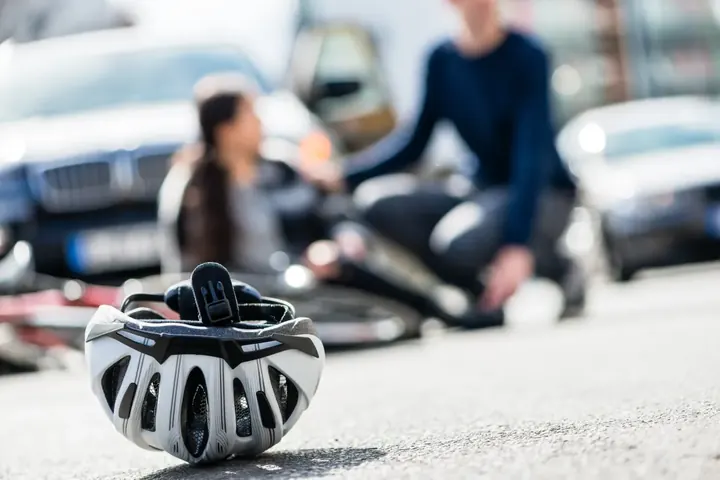
Nebraska is an at-fault state. The driver who caused the crash owes you for your losses, and sections 60-310 and 60-509 of the Nebraska Revised Statutes set the least that driver can carry: $25,000 for one person's injuries, $50,000 for everyone hurt in the accident, and $25,000 for property damage. The 2025 and 2026 sessions left those numbers alone.
No injury threshold stands between you and a claim. Your bike and gear come out of the driver's $25,000 property limit.
Nebraska has no personal injury protection. The Nebraska Department of Insurance lists two coverages as required on an auto policy: liability, and uninsured and underinsured motorist. Medical payments coverage is an optional extra that the department describes as paying for injuries "to you and your passengers." Whether yours pays when you are hit on a bike turns on the policy wording, so ask your insurer in writing.
If no one in your household owns a car, there is no auto policy to fall back on. You are left with the driver's liability coverage, your health plan, and whatever you carry on the bike itself.
Fault and How It Reduces a Claim

Section 25-21,185.09 sets the rule. Your own negligence reduces the award in proportion, and if it is "equal to or greater than the total negligence of all persons against whom recovery is sought," you are barred. A rider found 49% negligent on a $100,000 loss collects $51,000. At 50%, the same rider collects nothing.
When more than one party is to blame, section 25-21,185.10 splits the damages. Each defendant is liable for all of your economic losses, such as medical bills and wages, but only for its own share of noneconomic losses such as pain.
Section 60-6,314 gives a cyclist the rights and duties of a driver, and the other side's insurer will read the bicycle sections looking for percentage points:
- Lane position. Section 60-6,317 requires a rider slower than traffic to keep as near the right edge as practicable. The exceptions cover passing, left turns, hazards, and a lane too narrow to share side by side.
- Single file. The same section bars riding more than single file on a highway.
- Shoulders. You may ride the paved shoulder of a state highway, but must signal and yield when leaving or re-entering the roadway.
- Sidewalks and crosswalks. A rider there has a pedestrian's rights and duties and must yield to people on foot.
- Lights and brakes. Section 60-6,318 requires a front light visible from 500 feet at night, a red rear reflector, and brakes that stop the bike within 25 feet from 10 mph.
Helmets are an open question. Nebraska has no bicycle helmet law, and no statute says whether riding without one can be used against you. Section 60-6,273 limits seat belt evidence to mitigation of damages and caps the reduction at 5%, but it is written for vehicle occupants only.
Hit-and-Run and Uninsured Drivers

Uninsured and underinsured motorist coverage is not optional in Nebraska. Section 44-6408 forbids issuing an auto liability policy without both, at $25,000 per person and $50,000 per accident, and gives the policyholder no way to reject them. Ask in writing and the insurer must sell you up to $100,000 and $300,000.
The statute does not say you must be inside a car. Who counts as an insured away from the car is set by the policy form, so confirm that yours follows you onto a bike.
Section 44-6405 has two routes for a driver who flees. With actual physical contact between the vehicle and you, the vehicle is treated as uninsured. Without contact, as when a car forces you off the road, two conditions apply: the crash was reported to law enforcement as the law requires, and the facts are corroborated by "an independent and disinterested person." Your own account is not enough, so get a witness's name before they leave.
Nebraska's underinsured definition works in your favor. Under sections 44-6406 and 44-6409 the coverage applies when the driver's limits are less than your damages, and it pays the difference up to your own limit. Against a driver with the $25,000 minimum, a $25,000 underinsured limit can add another $25,000.
Section 44-6410 prohibits stacking, so two cars on your policy do not double the limit. The required coverage is for bodily injury only and pays nothing for the bike. And under sections 44-6412 and 44-6413, settling with the driver without your insurer's written consent can forfeit the claim. For an underinsured claim, send notice of the tentative settlement by certified mail; the insurer then has 30 days to match it.
In a bike insurance policy, check for uninsured motorist coverage of its own and for crash damage that is paid no matter who hit you.
Dooring and Passing Laws
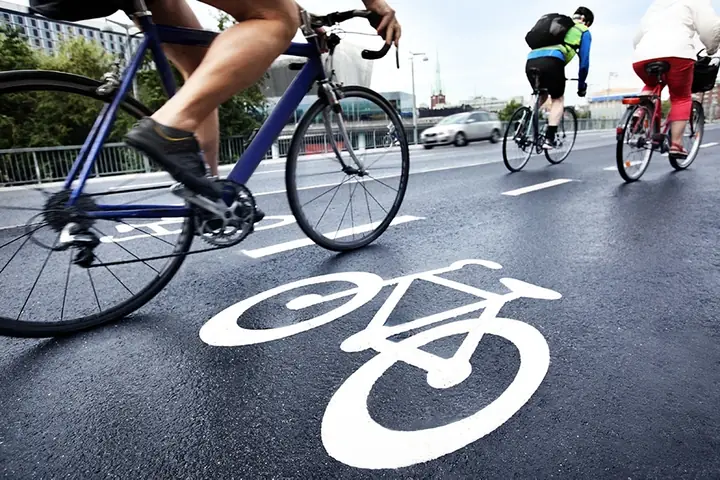
Section 60-6,180 is Nebraska's dooring statute. No person may open a motor vehicle door on the side available to moving traffic "unless and until it is reasonably safe to do so" and it can be done without interfering with traffic. Nor may it stay open longer than necessary to load or unload. "No person" reaches passengers as well as drivers.
Passing has had a number since 2012. Section 60-6,133 requires a driver overtaking a bicycle to leave "a safe distance of no less than three feet clearance, when applicable," and to hold it until safely past.
A second rule arrived in 2025. LB530 created the vulnerable road user, defined in section 60-676.01 to include anyone operating a bicycle or electric bicycle on or along a highway. Under section 60-6,378.02, a driver approaching or passing one must move into a lane at least one lane away where two lanes run the same direction. Where that is not possible, the driver must reduce speed and proceed with due care. A first violation is a traffic infraction, and a second within five years is a Class IIIA misdemeanor. LB977 widened the definition effective July 18, 2026.
The statute grants riders no right to be on a highway in violation of another law, and section 60-6,144 closes freeways to bicycles.
E-bikes
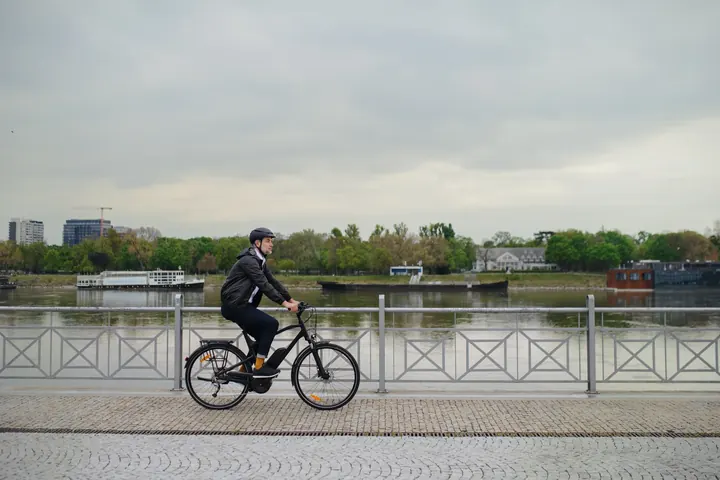
Nebraska adopted the three-class system in 2023 and writes the classes in Roman numerals. Every class needs fully operative pedals and an electric motor of no more than 750 watts that produces no more than one brake horsepower. A Class I (Class 1) e-bike under section 60-614.02 assists only while you pedal and cuts out at 20 mph. A Class II (Class 2) under section 60-614.03 can supply power whether or not you pedal, up to 20 mph. A Class III (Class 3) under section 60-614.04 assists only while you pedal and cuts out at 28 mph.
Section 60-611 makes an electric bicycle a bicycle. Bicycles are carved out of the motor vehicle definitions in the title, registration, operator's license, and financial responsibility acts, so there is no plate, no license, and no compulsory insurance. After a crash you stand where any cyclist stands: the same 50% bar, the same four-year deadline.
The class definitions set no minimum age and no helmet requirement, though section 60-6,317 lets a local authority regulate bicycles further.
Section 60-640 classes "every bicycle with a motor attached except for an electric bicycle" as a motor-driven cycle, the category that holds small motorcycles. A machine over 750 watts, or one that assists past 28 mph, is no longer a bicycle under the Rules of the Road.
One question has no answer in Nebraska statute or Department of Insurance guidance: whether an auto policy's uninsured motorist or medical payments coverage applies to you on an e-bike. Get your insurer's position in writing, and check that a bike insurance policy covers your e-bike's class.
Deadlines

Nebraska's four-year lawsuit deadline is generous, but a claim against a city, county, or school district must be in writing within one year.
- At the scene, then 10 days
Police and the Accident Report
Section 60-697 requires a driver in an injury accident to stop, give name, address, and plate number. If no peace officer investigates, section 60-699 gives the vehicle operator 10 days to report to the Nebraska Department of Transportation any accident with an injury or apparent damage of $2,000 or more, a threshold raised from $1,500 on July 18, 2026.
- One year
Written Claim to a City, County, or School District
A claim against a political subdivision (a city bus, a county truck) falls under the Political Subdivisions Tort Claims Act. Section 13-919 bars the claim forever unless it is made in writing to the governing body within one year. Section 13-905 says to file it with the clerk, secretary, or other official who keeps the subdivision's records, stating the time and place and the facts you know. Suit must begin within two years. Under section 13-906 you cannot sue until the governing body rules, or until six months pass and you withdraw the claim in writing.
- Two years
Claim Against the State, and Wrongful Death
A claim against the State of Nebraska must be made in writing to the Risk Manager within two years under section 81-8,227. The same six-month waiting rule applies before suit. A wrongful death action must be filed within two years after the death under section 30-810.
- Four years
Injury and Bike Damage Lawsuit
Section 25-207 gives you four years to sue for personal injury and the same four years for damage to the bike. An uninsured or underinsured motorist claim is tied to that clock: section 44-6413 ends the coverage once the limitation period on your claim against the driver has expired.
Recovery from a political subdivision is capped by section 13-926 at $1 million per person and $5 million per occurrence. A road-defect claim has its own hurdle: section 13-910 waives immunity for a spot or localized defect, such as a pothole, only if the subdivision had actual or constructive notice in time to repair it.
For a dispute over the bike alone, Small Claims Court hears claims up to $7,500.
Evidence to Preserve
With a 50% bar, evidence in Nebraska does one job above all: it keeps your share of the negligence under half.
- The peace officer's accident report. Section 60-699 makes these reports open to public inspection. A report filed by the driver is not public and cannot be used as evidence of negligence.
- An independent witness, with name and phone number. In a no-contact hit-and-run that witness is a condition of the uninsured motorist claim.
- Passing distance. Camera footage or photos of the pass support the three-foot rule and the move-over rule.
- Your light and rear reflector, photographed on the bike, if the crash happened after dark.
- The e-bike's motor rating and top assisted speed, from the label or the manual.
- The driver's details. Section 60-697 requires name, address, and plate number.
- The damaged bike, unrepaired, with receipts for the bike and gear.
Coverage for Nebraska Riders

Nebraska law leaves a rider exposed in four places: a driver carrying the $25,000 minimum, required uninsured motorist coverage that pays for injuries but not for the bike, no personal injury protection to cover medical bills while fault is sorted out, and a 50% bar that can turn the claim around on you. The Velosurance policy offers the coverages discussed above.
Uninsured Motorist covers losses beyond medical bills, such as lost wages, when the at-fault driver cannot pay.
Medical Payments covers the deductible and out-of-pocket costs your health plan leaves, regardless of the driver's insurance. Choose a limit close to your plan's out-of-pocket deductible.
Liability is the coverage for the day the percentages run against you. If you are held responsible for a crash, it covers injury to other people and damage to their property, including the cost of defending a covered lawsuit, with limits from $25,000 to $500,000.
Crash damage to the bike is part of the policy itself: stated value with no depreciation, subject to the deductible, whoever was at fault. Class 1, Class 2, and Class 3 e-bikes are covered like conventional bikes.
For any of these coverages to apply, it must be on the policy before the crash. Get a quote before the next ride, not after it.
Frequently Asked Questions
- How does the 50% rule work in a Nebraska bicycle accident claim?
- You recover damages in Nebraska as long as your negligence is less than the total negligence of the people you are claiming against, and the award is reduced by your share. A rider found 49% negligent on a $100,000 loss collects $51,000. The caveat worth knowing: at 50% the recovery is zero, so the evidence that sets your percentage decides the claim.
- How long do you have to file a bicycle accident claim in Nebraska?
- You have four years to file suit in Nebraska for injuries and for damage to your bike. One thing to watch: a claim against a city, county, or school district must be made in writing to the governing body within one year, a claim against the state must reach the Risk Manager within two years, and a wrongful death action has two years.
- What makes a hit-and-run claim work for a cyclist in Nebraska?
- Uninsured motorist coverage, which every Nebraska auto policy must include, can pay for your injuries when the driver flees after actual physical contact with you. A crash with no contact also qualifies when it was reported to law enforcement and an independent, disinterested person corroborates what happened. With one wrinkle: whether the coverage follows you onto a bike depends on your policy form, and it pays nothing for the bike.
- How much room must a driver leave when passing a cyclist in Nebraska?
- Nebraska drivers must leave a safe distance of no less than three feet when overtaking a bicycle and hold it until safely past. Since 2025 a driver approaching or passing a cyclist or e-bike rider must also move over one lane where two lanes run the same direction, or reduce speed where that is not possible. Photos or camera footage of the pass help prove a violation.
- How are Class 1, Class 2, and Class 3 e-bikes treated after a crash in Nebraska?
- Nebraska treats Class 1, Class 2, and Class 3 e-bikes as bicycles, so the same 50% rule and four-year deadline apply. Class 1 assists only while you pedal and cuts out at 20 mph, Class 2 can supply power with or without pedaling up to 20 mph, and Class 3 assists only while you pedal and cuts out at 28 mph. The caveat worth knowing: a motor over 750 watts puts the machine outside the bicycle definition.
Sources
- Nebraska Revised Statutes sections 25-21,185.09 and 25-21,185.10 (comparative negligence, multiple defendants)
- Nebraska Revised Statutes section 25-207 (four-year limitation)
- Nebraska Revised Statutes section 30-810 (wrongful death, two years)
- Nebraska Revised Statutes section 25-2802 (Small Claims Court jurisdictional amount)
- Nebraska Revised Statutes sections 13-903, 13-905, 13-906, 13-910, 13-919, 13-926 (Political Subdivisions Tort Claims Act)
- Nebraska Revised Statutes sections 81-8,212, 81-8,213, 81-8,227 (State Tort Claims Act)
- Nebraska Revised Statutes sections 60-310 and 60-509 (minimum auto liability limits)
- Nebraska Revised Statutes sections 44-6401 to 44-6414 (Uninsured and Underinsured Motorist Insurance Coverage Act)
- Nebraska Revised Statutes sections 60-6,314, 60-6,315, 60-6,317, 60-6,318 (bicycles under the Nebraska Rules of the Road)
- Nebraska Revised Statutes sections 60-6,133, 60-6,142, 60-6,144, 60-6,180 (passing, shoulders, freeways, vehicle doors)
- Nebraska Revised Statutes sections 60-676.01 and 60-6,378.02 (vulnerable road users; Laws 2025, LB530; Laws 2026, LB977)
- Nebraska Revised Statutes sections 60-611, 60-614.02, 60-614.03, 60-614.04, 60-618.03, 60-640 (electric bicycle classes; Laws 2023, LB138)
- Nebraska Revised Statutes sections 60-123, 60-339, 60-471, 60-501 (motor vehicle definitions excluding bicycles)
- Nebraska Revised Statutes sections 60-696, 60-697, 60-698, 60-699 (duties and reports after an accident; Laws 2026, LB1126)
- Nebraska Revised Statutes sections 60-6,273 and 60-6,279 (seat belt evidence; motorcycle and moped helmets)
- Legislative Bill 977 (2026), slip law, approved April 14, 2026
- Legislative Bill 530 (2025), slip law, approved June 4, 2025
- Nebraska Department of Insurance, Auto Insurance Guidebook
This guide is general information about Nebraska law as of the review date above. It is not legal or insurance advice, and it does not create an attorney-client relationship. Laws change and every crash turns on its own facts: talk to a licensed Nebraska attorney about your situation.