
TL;DR:
- Missouri is a fault state with pure comparative fault: your share of the blame cuts your recovery by that percentage and never bars it.
- Drivers must carry $25,000 per person, $50,000 per crash, and $25,000 for property damage, plus uninsured motorist coverage of $25,000 and $50,000.
- You have five years to sue for injuries or bike damage and three years for wrongful death, but only 90 days to notify the mayor of a street defect claim in many cities.
- A hit-and-run uninsured motorist claim does not require physical contact with the car under section 379.203.
- Drivers must leave a safe distance when passing, with no fixed number of feet, and Missouri has no statewide bicycle helmet law.
Who Pays After a Crash in Missouri
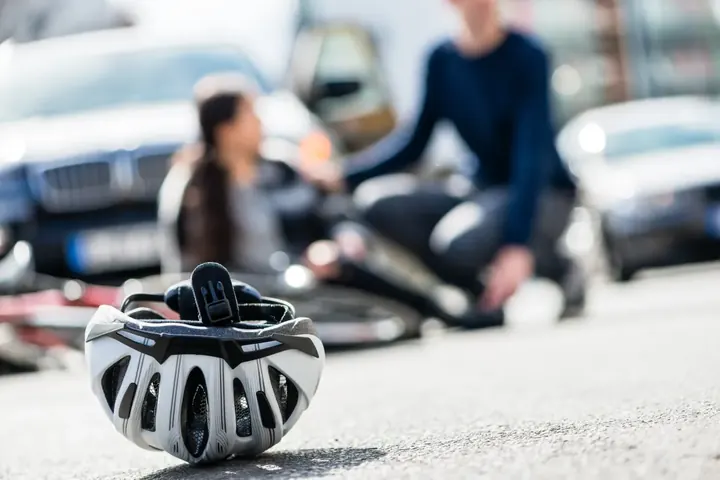
Missouri is a fault state. The driver who caused the crash pays, through the liability insurance that section 303.025 of the Revised Statutes requires every vehicle owner to maintain. There is no personal injury protection here and no threshold to clear before you can bring a claim.
Section 303.190 sets what stands behind that driver: $25,000 for one person's injuries, $50,000 for everyone hurt in the crash, and $25,000 for property damage. Shoulder surgery with rehab costs $15,000 to $40,000, so one operation can use up a minimum-limits policy before lost income enters the claim.
Your bike and gear are paid from the driver's property damage limit. Your medical bills are paid from the bodily injury limit, usually in one settlement at the end of treatment. Until then your health plan pays, and you carry its deductible and copays.
The Department of Revenue names two coverages Missouri law requires on an auto policy: liability and uninsured motorist. Medical payments coverage is not on that list. If your household auto policy has it, whether it follows you onto a bike depends on the policy wording. Ask your auto insurer in writing.
If you own no car and nobody in your household insures one, there is no auto policy of your own to fall back on.
Fault and How It Reduces a Claim

Missouri uses pure comparative fault, a rule the state Supreme Court adopted in Gustafson v. Benda in 1983. Your share of the blame reduces your recovery by the same percentage and never wipes it out. A rider found 30% at fault for a $100,000 loss collects $70,000.
So the percentage is the fight, and Missouri sets the two sides different standards on paper. Section 304.012 requires every person operating a motor vehicle to drive in a careful and prudent manner and to "exercise the highest degree of care." Section 307.188 gives a cyclist all the rights and all the duties of a driver under chapter 304, and an insurer will read the bicycle sections looking for one you broke:
- Lane position. Section 307.190 requires a rider slower than traffic to ride as near the right side of the roadway as is safe, with exceptions for left turns, hazards, one-way streets, and lanes too narrow to share with another vehicle. Section 307.191 lets you use the shoulder instead, always in the direction of traffic.
- Lights. From a half hour after sunset to a half hour before sunrise, section 307.185 requires a white front lamp visible at 500 feet, a rear red reflector or lamp visible at 600 feet, and reflective material or lights on the pedals, shoes, or lower legs and on each side.
When more than one party shares the blame, section 537.067 applies: a defendant found 51% or more at fault can be made to pay the whole judgment. A defendant below 51% owes only its own percentage.
Helmets are an open question. No Missouri statute requires a cyclist to wear one, and nothing in the bicycle sections says whether riding without one can be used to reduce your damages.
Hit-and-Run and Uninsured Drivers

Section 379.203 requires every auto liability policy on a vehicle registered or principally garaged in Missouri to include uninsured motorist coverage, at no less than $25,000 per person and $50,000 per crash. The statute protects "persons insured thereunder" who are legally entitled to recover from the owner or operator of an uninsured vehicle. It does not say the insured must be inside a car, but your policy defines who counts as an insured, so read that definition first.
The same section handles the driver who flees. Your right to claim exists even though the driver and vehicle left before anyone identified them, and it exists "whether or not physical contact was made." A rider forced into a curb by a car that never touched them is inside the text.
The statute sets no deadline for reporting a hit-and-run to police. Your policy will have its own notice conditions, so report the crash the same day and tell your insurer in writing.
In Cameron Mutual Insurance Co. v. Madden in 1976, the Missouri Supreme Court held that policy clauses blocking the stacking of uninsured motorist coverage conflict with section 379.203. Two insured cars can mean two limits. Underinsured motorist coverage is different: no statute requires it.
None of this pays for the bike. Section 379.203 covers bodily injury, sickness, disease, and death. When the driver is gone or uninsured, a bike policy's crash coverage is what replaces the bike.
Two things to check in a bike insurance policy: whether it offers uninsured motorist coverage of its own, and whether crash damage is covered no matter who hit you.
Dooring and Passing Laws

Missouri's dooring rule is not a statewide statute. It sits in section 300.340 of the Model Traffic Ordinance: no person shall open the door of a motor vehicle on the side available to moving traffic unless and until it is reasonably safe to do so, or leave it open longer than necessary to load or unload passengers. Under section 300.600, the model ordinance takes effect only in a city whose legislative body has adopted it. Confirm that the city where you were hit adopted it or has a door ordinance of its own.
Passing is statewide. Section 304.678 requires a driver overtaking a bicycle to "leave a safe distance" and to maintain clearance until safely past. There is no fixed number of feet, so the argument is over what was safe at that speed on that road. A violation is an infraction, and a class C misdemeanor when an accident is involved.
Bike lanes get their own protection in section 300.330, again part of the model ordinance. A parked or standing vehicle may not obstruct a designated bicycle lane, and a driver crossing one to turn must yield to any bicycle in the lane.
E-bikes
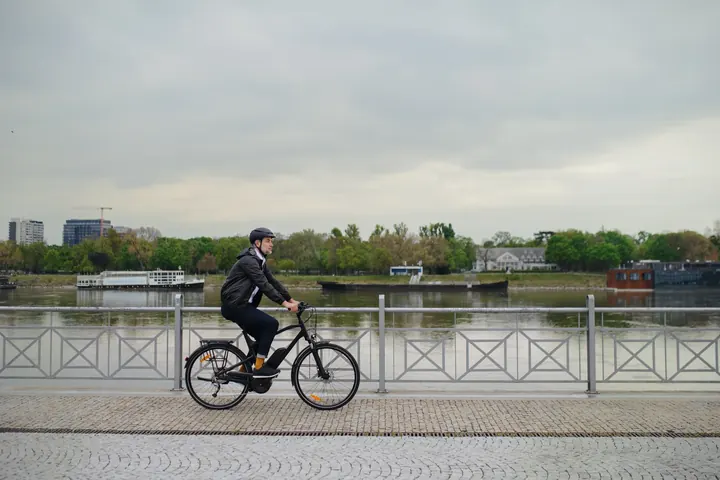
Section 301.010 defines an electric bicycle as a bicycle with fully operable pedals, a saddle or seat, and an electric motor of less than 750 watts. Class 1 assists only while you pedal and stops at 20 mph. Class 2 has a motor that can propel the bike on its own and cannot assist at 20 mph or above. Class 3 assists only while you pedal and stops at 28 mph.
Section 307.194 gives an e-bike rider the rights and duties of a bicycle rider and says an e-bike is not subject to the laws for motor vehicles: no registration, no title, no driver's license, no financial responsibility. The definitions of "motor vehicle" in sections 301.010 and 303.020 both carve electric bicycles out. In a crash you are treated as a cyclist.
Class 3 carries two extra rules. Nobody under 16 may operate one, and it must have a speedometer. Section 307.194 contains no helmet requirement for any class.
Since August 28, 2021, manufacturers must fix a permanent label showing the class, top assisted speed, and motor wattage, and nobody may modify the motor-powered speed capability without replacing it. A machine with a motor of 750 watts or more is outside the definition, and the exemptions in section 307.194 no longer describe it.
One question has no clear answer in published Missouri authority: whether an auto policy's uninsured motorist or medical payments coverage follows you onto an e-bike. Get your auto insurer's position in writing before you rely on it. In a bike insurance policy, check that your e-bike's class is covered.
Deadlines

Missouri's lawsuit deadlines are long, but the notice deadlines that come first are short, and the 90-day one is easy to miss.
- 30 days
Driver's Report to the Department of Revenue
Under section 303.040, the operator or owner of a motor vehicle in a crash with an uninsured motorist that injures someone or does more than $500 in property damage must report it in writing to the director of revenue within 30 days.
- 90 days
Notice to the Mayor for a Street Defect
If a defect in a street, sidewalk, bridge, or thoroughfare caused the crash, section 82.210 bars any action against a city of 100,000 or more people unless written notice reached the mayor within 90 days. Sections 77.600 and 79.480 say the same for third class and fourth class cities, and section 81.060 for special charter cities of 500 to 3,000 people. The notice must state the place, the time, the circumstances of the injury, and that you will claim damages.
- Three years
Wrongful Death Lawsuit
Section 537.100 gives a family three years from the date the claim accrues to file a wrongful death lawsuit.
- Five years
Injury Lawsuit
Section 516.120 gives you five years to file an injury lawsuit against the driver who hit you.
- Five years
Bike and Gear Damage Lawsuit
The same section gives you five years to sue for damage to goods, including the bike and gear. Small claims court hears cases up to $5,000 under section 482.305.
For a rider under 21 when the crash happens, section 516.170 delays the start of the five-year clock until that birthday.
Claims against the state, a county, or a city run through section 537.600, which waives sovereign immunity for two situations: a public employee's negligent operation of a motor vehicle on the job, and a dangerous condition of public property. Section 537.610 caps what a public entity can owe. The cap is adjusted every January and has been above $500,000 per person since 2024.
Evidence to Preserve
Evidence in a Missouri bike crash maps onto the statutes above. Collect it with them in mind.
- The police report number, from the city department, the county sheriff, or the Missouri State Highway Patrol, and the time you reported if the driver fled.
- The driver's license, plate, and insurance card, photographed.
- The scene: lane width, shoulder, bike lane striping, the parked car's door position, and sight lines. Lane width decides whether section 307.190 required you to keep right.
- The city where it happened, and whether it adopted the Model Traffic Ordinance. That decides whether section 300.340 applies.
- Your bike as it was: front lamp, rear reflector or lamp, pedal and side reflectors, working brakes, and for an e-bike the class label. Do not repair or discard the bike until the claim is settled.
- Video from your own camera, nearby businesses, and doorbells. Ask the same day.
- Medical bills and receipts for the bike and gear, including what your health plan paid and what you paid.
- A dated copy of any notice sent to a mayor, with proof of delivery.
Coverage for Missouri Riders

The gaps in this guide are predictable: a driver with $25,000 of coverage, uninsured motorist coverage that exists only if your household insures a car, a health plan deductible that comes due long before any settlement, and a bike that no auto coverage replaces. The Velosurance policy offers the coverages discussed above.
Uninsured Motorist covers losses beyond medical bills, such as lost wages, when the at-fault driver cannot pay. If nobody in your household insures a car, you have no section 379.203 coverage at all, and this is the coverage that takes its place.
Medical Payments covers the deductible and out-of-pocket costs your health plan leaves, whatever the driver's insurance does. Choose a limit close to your plan's out-of-pocket deductible.
Liability answers the other side of pure comparative fault. If you are blamed for a share of a crash, it covers injury to other people and damage to their property, including the cost of defending a covered lawsuit, with limits from $25,000 to $500,000.
Crash damage to the bike is part of the policy itself. The bike is insured at stated value with no depreciation, subject to the deductible, whoever caused the crash. Class 1, Class 2, and Class 3 e-bikes are covered like conventional bikes.
For any of these coverages to apply, it must be on the policy before the crash. Get a quote and add them before your next ride.
Frequently Asked Questions
- How does fault affect a bicycle accident claim in Missouri?
- You can recover damages in Missouri even when you share the blame, because the state uses pure comparative fault. Your recovery drops by your percentage of fault: a rider 30% at fault for a $100,000 loss collects $70,000. One thing to watch: an insurer will read the bicycle sections on lane position and lights looking for a rule you broke to raise that percentage.
- How long do you have to file a bicycle accident claim in Missouri?
- You have five years from the crash to file a lawsuit for injuries or for damage to your bike and gear, and three years for a wrongful death claim. One thing to watch: an injury caused by a street or sidewalk defect in a large, third class, or fourth class city needs written notice to the mayor within 90 days.
- What does the at-fault driver's insurance pay after a bike crash in Missouri?
- The at-fault driver's liability policy pays for your injuries from its bodily injury limit and for your bike and gear from its property damage limit. The minimums are $25,000 per person, $50,000 per crash, and $25,000 for property damage. The caveat worth knowing: one surgery can use up a minimum-limits policy.
- How does uninsured motorist coverage work for a Missouri cyclist in a hit-and-run?
- Uninsured motorist coverage is required on every Missouri auto policy at $25,000 per person and $50,000 per crash, and it applies when the driver flees whether or not the car made physical contact with you. Report the crash the same day and notify your insurer in writing. With one wrinkle: it pays for bodily injury only, so the bike needs separate crash coverage, and your policy decides who counts as an insured.
- How are Class 1, Class 2, and Class 3 e-bikes treated after a crash in Missouri?
- Missouri treats Class 1, Class 2, and Class 3 e-bikes as bicycles, so the same fault rule and filing deadlines apply. Class 1 assists only while you pedal and stops at 20 mph, Class 2 has a motor that can propel the bike on its own up to 20 mph, and Class 3 assists only while you pedal and stops at 28 mph, with operators 16 and older. The caveat worth knowing: a machine with a motor of 750 watts or more is outside the e-bike definition.
Sources
- Gustafson v. Benda, 661 S.W.2d 11 (Mo. banc 1983) (pure comparative fault)
- Cameron Mutual Insurance Co. v. Madden, 533 S.W.2d 538 (Mo. banc 1976) (stacking of uninsured motorist coverage)
- Missouri Revised Statutes section 537.067 (joint and several liability at 51% of fault)
- Missouri Revised Statutes section 304.012 (motorists to exercise the highest degree of care)
- Missouri Revised Statutes sections 303.025, 303.030, and 303.190 (financial responsibility and minimum liability limits)
- Missouri Revised Statutes section 303.040 (accident report to the director of revenue)
- Missouri Revised Statutes sections 379.203 and 379.204 (uninsured and underinsured motorist coverage)
- Missouri Revised Statutes sections 307.180 to 307.193 (bicycle definitions, brakes, lights, rights and duties, lane position, shoulder, penalties)
- Missouri Revised Statutes sections 301.010, 303.020, and 307.194 (electric bicycles)
- Missouri Revised Statutes section 304.678 (distance when overtaking a bicycle)
- Missouri Revised Statutes sections 300.330, 300.340, 300.347, 300.411, and 300.600 (Model Traffic Ordinance: bicycle lanes, vehicle doors, sidewalks, adoption by cities)
- Missouri Revised Statutes section 577.060 (leaving the scene of an accident)
- Missouri Revised Statutes sections 516.120, 516.170, and 537.100 (filing deadlines, minors, wrongful death)
- Missouri Revised Statutes section 482.305 (small claims court jurisdiction)
- Missouri Revised Statutes sections 82.210, 77.600, 79.480, and 81.060 (notice to the mayor for street and sidewalk defect claims)
- Missouri Revised Statutes sections 537.600 and 537.610 (sovereign immunity waivers and liability caps)
- Missouri Department of Commerce and Insurance, Sovereign Immunity Limits by Year (archived June 25, 2025)
- Missouri Department of Revenue, Motor Vehicle Insurance (Financial Responsibility)
- Missouri State Highway Patrol, bicycle safety brochure SHP-446
This guide is general information about Missouri law as of the review date above. It is not legal or insurance advice, and it does not create an attorney-client relationship. Laws change and every crash turns on its own facts: talk to a licensed Missouri attorney about your situation.