
TL;DR:
- Indiana is an at-fault state with a 51% bar: at 50% at fault you recover half, at 51% you recover nothing.
- Minimum auto liability limits are $25,000 per person, $50,000 per accident, and $25,000 for property, with no increase scheduled.
- You have two years to sue for injuries or bike damage, 180 days to give notice to a city, county, or school corporation, and 270 days for the state.
- The 51% rule does not protect you against a governmental entity: contributory negligence applies there, and any fault on your part can end the claim.
- Drivers must give three feet when passing a bicycle or e-bike under Indiana Code section 9-21-8-5. Indiana has no dooring statute and no general bicycle helmet law.
Who Pays After a Crash in Indiana
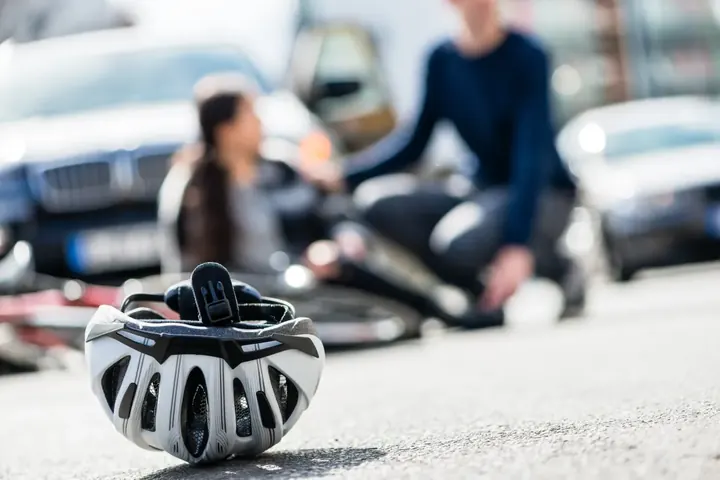
Indiana is an at-fault state. The driver who caused the crash pays, and Indiana Code section 9-25-4-5 sets what that driver must carry: $25,000 for one person's injuries, $50,000 for everyone hurt in the crash, and $25,000 for property damage. The property figure rose from $10,000 on July 1, 2018; the injury figures did not move, and no increase is scheduled.
The Insurance Code has no personal injury protection requirement and no injury threshold to clear before you can bring a claim. Your bike and gear are paid from the driver's $25,000 property limit and your injuries from the bodily injury limit.
Collarbone surgery costs $11,000 to $17,000, and shoulder surgery with rehab $15,000 to $40,000. One operation can use up a $25,000 policy before lost income enters the claim.
Medical payments coverage on an Indiana auto policy is not required by the financial responsibility law. The Indiana Department of Insurance describes it as paying medical bills incurred by you and usually your passengers, so whether yours follows you onto a bike depends on the policy wording. Ask in writing.
If nobody in your household insures a car, that leaves the driver's liability coverage, your health plan, and whatever you carry on the bike itself.
Fault and How It Reduces a Claim

Indiana's Comparative Fault Act draws its line at 51%. Under section 34-51-2-5 your own fault reduces your damages proportionately, and under section 34-51-2-6 you recover nothing once your fault is greater than the fault of everyone else who contributed. A rider 30% at fault for a $100,000 loss collects $70,000. At 51%, the same rider collects zero.
The Act has one exception. Section 34-51-2-2 says it does not apply "in any manner" to tort claims against governmental entities or public employees. In Penn Harris Madison School Corp. v. Howard, the Indiana Supreme Court confirmed in 2007 that the older rule of contributory negligence survives in those cases, a rule that denies any recovery to a plaintiff who was even slightly at fault. Hit by a city bus or a county truck, you are not protected by the 51% line.
Section 9-21-11-2 gives a cyclist the rights and duties of a driver. The rules most likely to be raised:
- Lights. Section 9-21-11-9 requires a white front lamp visible from 500 feet and a red rear lamp or reflector visible from 500 feet, from a half hour after sunset to a half hour before sunrise.
- Lane position. Indiana has no bicycle-specific keep-right statute. Section 9-21-8-2, the general rule for vehicles slower than traffic, calls for the right-hand lane or the right edge, and an insurer may argue it reaches you.
- Red lights. Under section 9-21-3-7, a cyclist stuck at a signal may proceed on red only after a complete stop of at least 120 seconds and only when it is safe.
Helmets are an open question. Indiana has no statute on whether riding without one can count against you. Section 9-19-10-7, which since July 1, 2024 lets defendants use seat belt nonuse to reduce damages, says nothing of helmets.
Hit-and-Run and Uninsured Drivers

Indiana Code section 27-7-5-2 requires every auto liability policy to carry uninsured and underinsured motorist coverage, at limits at least equal to the policy's bodily injury liability limits, unless the named insured rejected it in writing. One named insured's rejection binds everyone on the policy, so check the declarations page.
Uninsured motorist coverage cannot be lower than $25,000 per person and $50,000 per accident. Underinsured motorist coverage cannot be sold below $50,000. Under section 27-7-5-4 it applies when the at-fault driver's limits are lower than your underinsured limit, and section 27-7-5-5 caps the payment at the difference between your per-person limit and what the liable parties paid. With a $50,000 limit against a driver carrying the $25,000 minimum, the most it adds is $25,000.
The statute protects "persons insured under the policy" who are legally entitled to recover from the driver, and does not say you must be in a car. Who counts as insured away from the car is set by the policy form, so confirm that the coverage follows you onto a bike.
For a driver who flees, the chapter is silent. It contains no physical contact rule and no reporting deadline, and it defines an uninsured motor vehicle "subject to the terms and conditions of such coverage." Your policy therefore sets the conditions. Read its definition of a hit-and-run vehicle and its notice clause the day of the crash, and call police from the scene.
None of this pays for the bike. Section 27-7-5-3 limits uninsured motorist property damage to the insured motor vehicle and personal property inside it, and relieves the insurer when the other driver cannot be identified.
Two things to check in a bike insurance policy: whether it offers uninsured motorist coverage of its own, and whether crash damage is covered no matter who hit you.
Dooring and Passing Laws
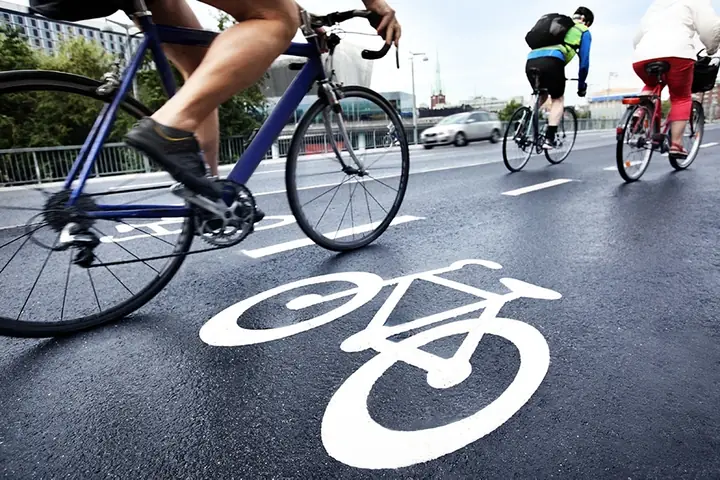
Passing is where Indiana law is specific. Section 9-21-8-5 requires the operator of a vehicle overtaking a bicycle or electric bicycle to allow at least three feet of clearance and to stay out of the original lane until safely clear of the rider. The same section, last amended in 2019, lets a driver pass a bicycle in a no passing zone when it is safe.
Under section 9-21-8-49 a violation is a Class C infraction, and a Class A infraction when it results in bodily injury. In a civil claim, a close pass that ends in a crash is a violation you can cite by number.
Dooring is where the code is thin. Title 9 has no provision on opening a vehicle door into traffic, so a dooring claim rests on ordinary negligence and on section 9-21-8-37, which requires every driver to exercise due care to avoid colliding with a person propelling a human powered vehicle. Expect the insurer to argue about your speed and your distance from the parked cars, and photograph the door and the car's position before anything moves.
Section 9-21-1-3 lets local authorities regulate the operation of bicycles, so sidewalk riding is answered in the municipal code of the place where you crashed.
E-bikes

Indiana Code section 9-13-2-49.2 defines an electric bicycle as a bicycle with fully operable pedals and an assistive motor of not more than 750 watts that fits one of three classes. Class 1 assists only while you pedal and stops at 20 mph. Class 2 has a motor that can propel the bike on its own and stops at 20 mph. Class 3 assists only while you pedal and stops at 28 mph.
Section 9-21-11-13.1 says an electric bicycle is not a motor vehicle and gives its operator the rights and duties of a bicycle operator. The driver's license, financial responsibility, title, and registration laws do not apply. After a crash you stand where any cyclist stands: the same 51% bar, the same two-year deadline, the same three-foot passing rule.
Class 3 carries extra rules. Nobody under 15 may operate one. An operator or passenger under 18 must wear a helmet. A Class 3 is also barred from most bicycle paths that are not next to a road, unless the authority in charge allows it.
Since January 1, 2020, every e-bike must carry a permanent label showing its class, top assisted speed, and motor wattage, and a modification that changes the top assisted speed requires a new label. A motor above 750 watts puts the machine outside the definition and outside the exemptions.
One question has no answer in Indiana statute or Department of Insurance guidance: whether an auto policy's uninsured motorist or medical payments coverage applies to you on an e-bike. Get your insurer's position in writing. In a bike insurance policy, check that your e-bike's class is covered and that the motor matches its label.
Deadlines

Indiana gives you two years to sue a driver. A claim against a city, a county, or the state has to be put in writing within 180 or 270 days.
- At the scene
Police Notice After an Injury Crash
Under Indiana Code section 9-26-1-1.1, a driver in a crash that injures someone must give notice immediately, by the quickest means of communication, to local police, the county sheriff, the nearest state police post, or 911. Get the report number before you leave.
- 180 days
Notice to a City, County, or Other Political Subdivision
A claim against a political subdivision is barred under section 34-13-3-8 unless notice is filed with its governing body within 180 days after the loss. The term covers counties, townships, cities, towns, school corporations, and state educational institutions. Under section 34-13-3-10 the notice must state the circumstances, the extent of the loss, the time and place, the names of those involved, the damages sought, and your address.
- 270 days
Notice to the State
A claim against the state is barred under section 34-13-3-6 unless notice is filed with the attorney general or the state agency involved within 270 days after the loss. The attorney general prescribes the claim form, and the operator of a state vehicle must have copies.
- Two years
Injury, Wrongful Death, and Bike Damage Lawsuit
Section 34-11-2-4 gives you two years from the day the claim accrues to sue for personal injury, and the same two years for damage to the bike and gear. A wrongful death action under section 34-23-1-1 also has two years. A rider under 18 when the claim accrues may sue within two years after turning 18, under section 34-11-6-1.
A tort claim notice is not a lawsuit. Under section 34-13-3-11 the government has 90 days to approve or deny the claim, and silence for 90 days counts as a denial. Section 34-13-3-13 bars a suit until the claim has been denied. Recovery is capped as well: section 34-13-3-4 limits the combined liability of all governmental entities to $700,000 for one person and $5 million per occurrence.
For a dispute over the bike alone, the small claims docket of a circuit or superior court hears claims up to $10,000.
Evidence to Preserve
With a 51% bar against drivers and an any-fault bar against government, evidence in Indiana does one job: it keeps your percentage down.
- The police report number. Under section 9-26-2-2 the officer sends a written report to the Indiana State Police within 24 hours of finishing the investigation.
- The driver's name, address, registration number, and license, which section 9-26-1-1.1 requires the driver to give you, plus the insurance card.
- Who owns the other vehicle. A city, county, township, school corporation, or state educational institution vehicle starts the 180-day clock; a state agency vehicle starts the 270-day clock.
- Your lights, reflector, and e-bike label, photographed on the bike.
- Your auto policy's declarations page and its hit-and-run wording, showing that uninsured and underinsured motorist coverage was never rejected.
- The damaged bike, unrepaired, with receipts for the bike and gear.
Coverage for Indiana Riders

Indiana law leaves a rider exposed in specific places: a driver carrying the $25,000 minimum, a hit-and-run claim that depends on your auto policy's own terms, uninsured motorist property coverage that stops at the car, and a fault rule that turns against you when the other vehicle belongs to a government. The Velosurance policy offers the coverages discussed above.
Uninsured Motorist covers losses beyond medical bills, such as lost wages, when the at-fault driver cannot pay.
Medical Payments covers the deductible and out-of-pocket costs your health plan leaves, whatever the driver's insurance does. Indiana requires no first-party medical coverage on any auto policy, so choose a limit close to your plan's out-of-pocket deductible.
Liability is for the day the percentages run against you. If you are blamed for a crash, it covers injury to other people and damage to their property, including the cost of defending a covered lawsuit, with limits from $25,000 to $500,000.
Crash damage to the bike is part of the policy itself: stated value with no depreciation, subject to the deductible, whether or not the driver is ever found. Class 1, Class 2, and Class 3 e-bikes are covered like conventional bikes.
For any of these coverages to apply, it must be on the policy before the crash. Get a quote and add them before your next ride.
Bicycle Accident Attorneys in Indiana
Velosurance legal partners who represent injured cyclists in Indiana.

Frequently Asked Questions
- How does the 51% rule work in an Indiana bicycle accident claim?
- You recover damages in Indiana as long as your share of the fault is 50% or less, and the award is reduced by that share. A rider 30% at fault for a $100,000 loss collects $70,000. The caveat worth knowing: at 51% the recovery is zero, and against a governmental entity even slight fault on your part can end the claim.
- How long do you have to file a bicycle accident claim in Indiana?
- You have two years in Indiana to file suit for injuries and for damage to your bike and gear. One thing to watch: a claim against a city, county, or school corporation needs written notice within 180 days of the loss, and a claim against the state needs it within 270 days.
- What does the at-fault driver's insurance pay after a bike crash in Indiana?
- The at-fault driver's liability policy pays for your injuries from its bodily injury limit and for your bike and gear from its property damage limit. Indiana's minimums are $25,000 per person, $50,000 per accident, and $25,000 for property. The caveat worth knowing: one operation can use up a $25,000 policy.
- How does uninsured motorist coverage help an Indiana cyclist after a hit-and-run?
- Uninsured motorist coverage is part of every Indiana auto policy unless it was rejected in writing, and it protects the people insured under that policy. Call police from the scene and read your policy's hit-and-run definition and notice clause the same day, because the statute leaves those conditions to the policy. With one wrinkle: its property damage half does not pay for a bike.
- How are Class 1, Class 2, and Class 3 e-bikes treated after a crash in Indiana?
- Indiana treats Class 1, Class 2, and Class 3 e-bikes as bicycles, so the same 51% rule, two-year deadline, and three-foot passing rule apply. Class 1 is pedal assist to 20 mph, Class 2 has a motor that can propel the bike on its own to 20 mph, and Class 3 is pedal assist to 28 mph for operators 15 and older. The caveat worth knowing: a motor above 750 watts puts the bike outside the definition.
Sources
- Indiana Code 34-51-2 (Comparative Fault Act), sections 34-51-2-1, 34-51-2-2, 34-51-2-5, 34-51-2-6, 34-51-2-7, 34-51-2-8
- Penn Harris Madison School Corp. v. Howard, No. 71S05-0511-CV-509 (Ind. Mar. 1, 2007) (contributory negligence in claims against governmental entities)
- Indiana Code 34-11-2-4 and 34-11-6-1 (two-year limitation, legal disabilities); Indiana Code 1-1-4-5 (definition of legal disabilities)
- Indiana Code 34-23-1-1 (wrongful death)
- Indiana Code 34-13-3 (Tort Claims Against Governmental Entities and Public Employees), sections 34-13-3-4, 34-13-3-6, 34-13-3-8, 34-13-3-10, 34-13-3-11, 34-13-3-13
- Indiana Code 34-6-2.1-155 (definition of political subdivision)
- Indiana Code 9-25-4-1, 9-25-4-4, 9-25-4-5 (financial responsibility, minimum liability limits)
- Indiana Code 27-7-5 (uninsured and underinsured motorist coverage), sections 27-7-5-2, 27-7-5-3, 27-7-5-4, 27-7-5-5
- Indiana Code 9-21-8-2, 9-21-8-5, 9-21-8-37, 9-21-8-49 (keep right, overtaking and three-foot clearance, due care, penalties)
- Indiana Code 9-21-11 (bicycles), sections 9-21-11-2, 9-21-11-6, 9-21-11-9, 9-21-11-13.1
- Indiana Code 9-13-2-26.6, 9-13-2-26.7, 9-13-2-26.8, 9-13-2-49.2, 9-13-2-105 (e-bike classes, electric bicycle, motor vehicle definitions)
- Indiana Code 9-21-3-7 (traffic signals, 120-second rule) and 9-21-1-3 (powers of local authorities)
- Indiana Code 9-26-1-1.1, 9-26-2-1, 9-26-2-2 (duties after an accident, investigation, reports)
- Indiana Code 9-19-10-7 (seat belt evidence, causes of action accruing after June 30, 2024)
- Indiana Code 33-28-3-4 and 33-29-2-4 (small claims docket, $10,000)
- Indiana Department of Insurance, Auto Insurance
This guide is general information about Indiana law as of the review date above. It is not legal or insurance advice, and it does not create an attorney-client relationship. Laws change and every crash turns on its own facts: talk to a licensed Indiana attorney about your situation.