
TL;DR:
- The District follows contributory negligence, but the Motor Vehicle Collision Recovery Act lets a cyclist recover after a collision with a motor vehicle unless the cyclist's negligence is greater than the defendants' combined.
- Minimum auto liability limits are $25,000 per person, $50,000 per crash, and $10,000 for property, rising to $50,000, $100,000, and $20,000 as of October 1, 2027 under D.C. Law 26-155.
- You have three years to sue for injuries and three for bike damage, but only six months to give the Mayor written notice of a claim against the District.
- Uninsured motorist coverage is mandatory in every auto policy on a vehicle registered or garaged in the District and treats a driver who cannot be identified as uninsured; personal injury protection is optional and must be elected within 60 days.
- Drivers must give at least 3 feet when passing a bicycle, and no person may open a vehicle door unless it can be done without interfering with bicyclists.
Who Pays After a Crash in District of Columbia
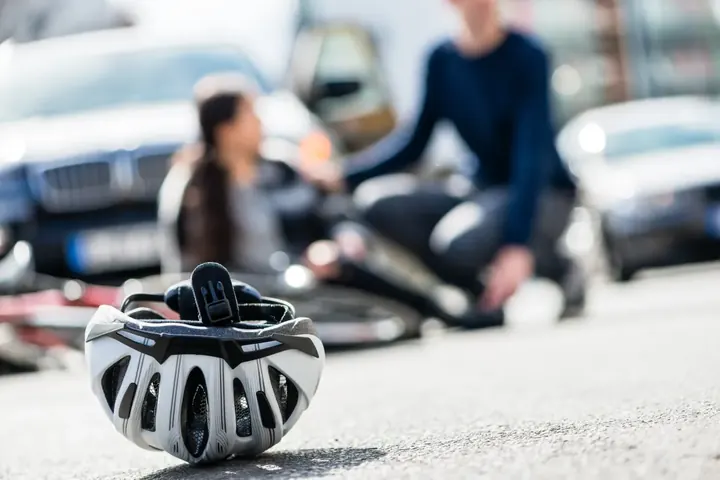
The District runs a hybrid. Under the Compulsory/No-Fault Motor Vehicle Insurance Act, every vehicle registered here must carry liability, property damage, and uninsured motorist coverage, while personal injury protection is an option the insurer must offer and the owner may decline.
D.C. Code section 31-2406 sets the minimums: $25,000 for one person's injuries, $50,000 for everyone hurt in the crash, and $10,000 for property damage. The Motor Vehicle Insurance Modernization Amendment Act of 2026, D.C. Law 26-155, doubles them to $50,000, $100,000, and $20,000 as of October 1, 2027.
Until then, shoulder surgery with rehab at $15,000 to $40,000 can exhaust a $25,000 policy before lost income enters the claim. Your bike and gear come out of the driver's $10,000 property damage limit.
Personal injury protection is the no-fault piece. Section 31-2404 limits its benefits to a victim who is an insured under the policy or an occupant of the insured's vehicle, so a cyclist with no auto policy has none. If you do carry it, the benefits are paid without regard to fault: at least $50,000 for medical and rehabilitation costs and at least $12,000 for lost work. Whether your own policy pays when another driver's car hits you on a bike is not settled by the statute. Ask your insurer in writing.
Taking those benefits has a price. Section 31-2405 gives you 60 days from the crash to elect them. Elect, and you can sue the driver only if your medical or work losses exceed the benefits available, or the injury meets the statute's severity test: substantial permanent scarring or disfigurement, a substantial permanent impairment, or an impairment that keeps you from substantially all of your usual activities for more than 180 continuous days. Make no election and the ordinary liability claim applies.
Fault and How It Reduces a Claim

The District still follows contributory negligence. The D.C. Court of Appeals stated the rule in Massengale v. Pitts in 1999: a plaintiff's contributory negligence is a complete bar to recovery. A person 5% at fault collects nothing.
Cyclists are carved out. The Motor Vehicle Collision Recovery Act of 2016, codified at D.C. Code section 50-2204.52, says the negligence of a pedestrian or "vulnerable user" does not bar recovery after a collision with a motor vehicle unless that negligence was a proximate cause of the injury and greater than the combined negligence of all the defendants. A rider 50% at fault still has a claim. A rider 51% at fault does not.
A 2021 amendment, D.C. Law 23-183, widened the class to anyone on a bicycle, motorized bicycle, electric mobility device, skateboard, or similar device, and to collisions between two vulnerable users or with a pedestrian.
Two limits apply. A claim outside the Act's text is still judged under the all-or-nothing rule. And the Act says when your negligence stops being a bar without saying that your award shrinks by your share of the fault, while leaving joint and several liability and the last clear chance doctrine in place. How a smaller share affects the number is a question for a D.C. attorney.
An insurer will still look for a rule you broke, so know what the rules allow:
- Stop signs. Section 50-2201.04d lets a rider pass a stop sign without stopping when there is no immediate hazard, after yielding to pedestrians and to traffic lawfully in the intersection.
- Sidewalks. 18 DCMR 1201.9 permits sidewalk riding outside the Central Business District, yielding to pedestrians.
- Helmets. Section 50-1605 requires one for riders under 16. Section 50-1606 says failure to wear a helmet "shall not be admissible as evidence in the trial of any civil action" and cannot reduce damages. It sits inside the under-16 helmet law, and its reach to adult riders is not confirmed.
Hit-and-Run and Uninsured Drivers

A driver who hits you must stop. D.C. Code section 50-2201.05c requires a driver in a collision that injures a person to call 911, stay until law enforcement arrives, and give identifying information, including insurance information.
When the driver leaves anyway, or has no insurance, uninsured motorist coverage is the backstop, and in the District it is not optional. Section 31-2406 requires every policy on a vehicle registered or principally garaged here to include it: $25,000 per person and $50,000 per crash for injuries, plus $5,000 for property damage with a $200 deductible. The statute counts a vehicle "whose owner or operator cannot be identified" as uninsured, and it protects the persons insured under the policy without any wording that puts them inside a car.
The statute sets no physical contact requirement and no reporting deadline. Those conditions live in your policy. Read it, have the Metropolitan Police Department take a report at the scene, and notify your insurer in writing.
Underinsured motorist coverage is optional today, and a policy may bar stacking. D.C. Law 26-155 changes that as of October 1, 2027: the mandatory uninsured motorist amounts rise to $50,000, $100,000, and $20,000, and "enhanced" underinsured coverage, which pays its limit with no reduction for what the at-fault driver's insurer paid, is included unless the first named insured waives it in writing.
If you are not insured under anyone's auto policy, none of this exists for you. Two things to check in a bike insurance policy: whether it offers uninsured motorist coverage of its own, and whether crash damage is covered no matter who hit you.
Dooring and Passing Laws

The dooring rule is 18 DCMR 2214.4: "No person shall open any door of a vehicle unless it is reasonably safe to do so and can be done without interfering with moving traffic, bicyclists, or pedestrians." The Bicycle and Pedestrian Safety Amendment Act of 2016 wrote bicyclists into that sentence. It says "person," not "driver," so a rideshare passenger who swings a door into a bike lane has violated it.
Passing is governed by 18 DCMR 2202.10. A driver overtaking a bicycle must leave a safe distance, "but in no case less than 3 feet." Where signs give bicycles the full right-hand lane, section 2202.9 forbids a driver from using that lane to pass you at all.
One statute covers the driver who acts on purpose. Under section 50-1621, a cyclist who is assaulted or battered by a motorist and wins a civil action is entitled to $1,000 in statutory damages or actual damages, whichever is greater, plus reasonable attorney's fees and costs when total damages are under $10,000.
E-bikes
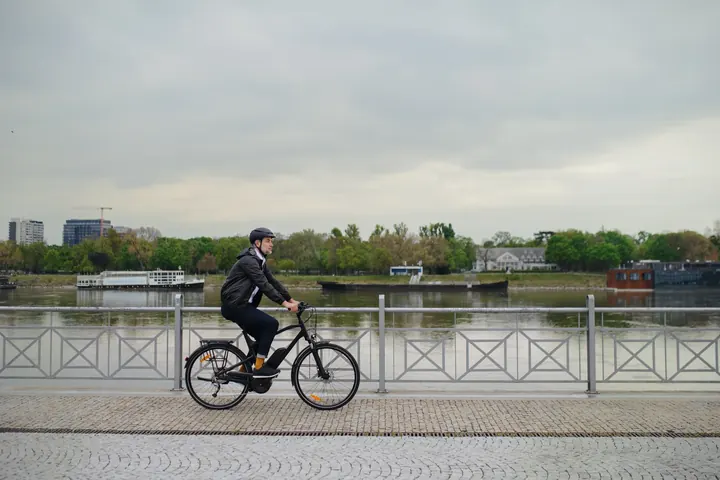
The D.C. Code has no numbered e-bike classes. It has one category, the "motorized bicycle," defined in section 50-2201.02: two or three wheels at least 16 inches in diameter, a post-mounted seat for each rider, fully operative pedals, and a motor incapable of propelling the bike faster than 20 mph on level ground. The definition names no wattage.
A motorized bicycle is not a motor vehicle. The traffic act, the registration law in section 50-1501.01, and the compulsory insurance act in section 31-2402 each exclude it by name. The DMV's chart of non-traditional vehicles lists no license, registration, or insurance requirement, and 18 DCMR 1200.10 sets a minimum age of 16.
In a crash, that status works for you. The Collision Recovery Act lists a motorized bicycle rider as a vulnerable user, so the fault protection that covers a cyclist covers you.
Speed is the edge of the definition. The DMV states that a motorized bicycle operated by motor above 20 mph is treated as a motor-driven cycle and its operator needs a driver's license, and it lists insurance, registration, and a helmet for motor-driven cycles. An e-bike built to assist to 28 mph does not fit the 20 mph definition on its face.
One question has no answer in published District authority: whether an auto policy's uninsured motorist coverage or personal injury protection follows you onto an e-bike. Get your auto insurer's position in writing. In a bike insurance policy, check that your e-bike's top assisted speed is covered and that the motor has not been modified.
Deadlines

The District's deadlines run from 60 days to three years, and the two short ones carry the most risk.
- 60 days
Personal Injury Protection Election
If an auto policy with personal injury protection covers you, D.C. Code section 31-2405 gives you 60 days from the crash to tell the insurer whether you elect its benefits. The insurer must notify you of the period in writing.
- Six months
Written Notice to the Mayor
When the District itself may be liable (a city vehicle, a road defect), section 12-309 bars the lawsuit unless written notice of the approximate time, place, cause, and circumstances is given to the Mayor within six months of the injury. The Office of Risk Management, 441 4th Street NW, Suite 800 South, accepts the notice on the Mayor's behalf. A written Metropolitan Police Department report made in the regular course of duty counts as notice under the statute.
- Two years
Wrongful Death Lawsuit
Section 16-2702 gives the personal representative two years after the death to file.
- Three years
Injury Lawsuit
D.C. Code section 12-301 names no period for a negligence injury, so the three-year period in paragraph (8) applies.
- Three years
Bike and Gear Damage Lawsuit
Section 12-301 gives you three years to sue for damage to personal property. The Small Claims and Conciliation Branch of Superior Court hears money claims up to $10,000.
For a child, section 12-302 starts the three-year clock at age 18. Section 12-309 has no matching exception in its text, so treat the six-month notice as running regardless of age.
Evidence to Preserve
Evidence in a District bike crash maps onto the rules above. Collect it with them in mind.
- The Metropolitan Police Department report. Get a copy and read it. If the District may be liable, check that it states the time, place, cause, and circumstances, because section 12-309 treats a written police report as notice.
- The driver's identifying information, which section 50-2201.02 defines as name, address, phone number, tag number, and insurance information.
- The scene: the parked car's door, the passing gap measured against 3 feet, bike lane markings, and whether the intersection had a stop sign or a signal.
- Your bike as it was: the white front lamp and red rear lamp 18 DCMR 1204.2 requires at night and, for an e-bike, proof that the motor tops out at 20 mph.
- Medical records, every bill, and any video from nearby businesses, requested the same day.
- Dated copies of anything with a clock: your personal injury protection election, and the notice letter to the Office of Risk Management with proof it was received.
- Your bike policy paperwork. D.C. Code section 50-532 lets a bicycle insurer cancel a policy in force more than 60 days only for nonpayment, with 30 days' written notice.
Coverage for District of Columbia Riders

The District's gaps are specific: a driver with $25,000 of coverage, uninsured motorist coverage that exists only if you are insured under an auto policy, and a fault rule that cuts both ways. The Velosurance policy offers the coverages discussed above.
Uninsured Motorist covers losses beyond medical bills, such as lost wages, when the at-fault driver cannot pay. For a rider with no car, it fills the place of the auto coverage section 31-2406 reserves for people insured under an auto policy.
Medical Payments covers the deductible and out-of-pocket costs your health plan leaves, whatever the driver's insurance does. Choose a limit close to your plan's out-of-pocket deductible.
Liability answers the other side of the Collision Recovery Act. The statute that protects you also protects the pedestrian or scooter rider you collide with, so their own mistake may not end their claim against you. Liability covers injury to other people and damage to their property, including the cost of defending a covered lawsuit, with limits from $25,000 to $500,000.
Crash damage to the bike is part of the policy itself. The bike is insured at stated value with no depreciation, subject to the deductible, whoever caused the crash, so you are not waiting on a driver's $10,000 property limit. Class 1, Class 2, and Class 3 e-bikes are covered like conventional bikes.
For any of these coverages to apply, it must be on the policy before the crash. Get a quote and add them before your next ride.
Bicycle Accident Attorneys in District of Columbia
Velosurance legal partners who represent injured cyclists in District of Columbia.
-

John B. Mesirow, Esq - Mesirow & Associates, PLLC
5232 44th Street NW, Suite 3
Washington, DC 20015202 861 8858
Frequently Asked Questions
- How does fault affect a bicycle accident claim in the District of Columbia?
- You can still recover after a collision with a motor vehicle when you share the blame, as long as your negligence is not greater than the combined negligence of the defendants. That protection comes from the Motor Vehicle Collision Recovery Act, D.C. Code section 50-2204.52. One thing to watch: a claim that falls outside the Act is still judged under contributory negligence, where any fault on your part is a complete bar.
- How long do you have to file a bicycle accident claim in the District of Columbia?
- You have three years to file an injury lawsuit and three years to sue for damage to your bike and gear under D.C. Code section 12-301. One thing to watch: when the District itself may be liable, written notice must be given to the Mayor, through the Office of Risk Management, within six months of the injury.
- What does the at-fault driver's insurance pay after a bike crash in the District of Columbia?
- The at-fault driver's liability policy pays for your injuries from its bodily injury limit and for your bike and gear from its property damage limit. The minimums are $25,000 per person, $50,000 per crash, and $10,000 for property, rising to $50,000, $100,000, and $20,000 as of October 1, 2027. The caveat worth knowing: one surgery can exhaust a $25,000 policy.
- How does uninsured motorist coverage work for a cyclist in a District of Columbia hit-and-run?
- Uninsured motorist coverage is built into every auto policy on a vehicle registered or principally garaged in the District, and it treats a driver who cannot be identified as uninsured. The mandatory amounts are $25,000 per person and $50,000 per crash for injuries, plus $5,000 for property damage with a $200 deductible. With one wrinkle: the statute sets no contact rule or reporting deadline, so your policy's conditions control. Get a police report at the scene and notify your insurer in writing.
- How is an e-bike treated after a crash in the District of Columbia?
- An e-bike that fits the District's motorized bicycle definition is treated as a vulnerable user's vehicle, so its rider gets the same fault protection as a cyclist under the Collision Recovery Act. The definition requires fully operative pedals and a motor incapable of more than 20 mph on level ground, and the D.C. Code has no numbered e-bike classes. The caveat worth knowing: the DMV treats a motorized bicycle operated by motor above 20 mph as a motor-driven cycle, which needs a driver's license.
Sources
- D.C. Code sections 50-2204.51 to 50-2204.53 (Motor Vehicle Collision Recovery Act of 2016, as amended by D.C. Law 23-183)
- Massengale v. Pitts, 737 A.2d 1029 (D.C. 1999) (contributory negligence as a complete bar)
- D.C. Code section 31-2406 (required liability, uninsured and underinsured motorist coverage)
- D.C. Law 26-155, Motor Vehicle Insurance Modernization Amendment Act of 2026 (applies as of October 1, 2027)
- D.C. Code sections 31-2402, 31-2404, and 31-2405 (definitions, personal injury protection, 60-day election and lawsuit restriction)
- D.C. Code sections 12-301 and 12-302 (limitation of actions, minors)
- D.C. Code section 12-309 (six-month notice to the Mayor)
- Office of the Attorney General for the District of Columbia, Provide Notice of a Claim Against the District
- D.C. Code section 16-2702 (wrongful death, two years)
- D.C. Code section 11-1321 (Small Claims and Conciliation Branch, $10,000)
- D.C. Code sections 50-1605 and 50-1606 (helmets under 16, helmet evidence in civil actions)
- D.C. Code section 50-2201.02 (definitions: motorized bicycle, electric mobility device, identifying information, rider)
- D.C. Code section 50-2201.04d (riders' safe crossing at intersections)
- D.C. Code section 50-2201.05c (leaving after colliding)
- D.C. Code section 50-1621 (civil action for bicyclists assaulted by a motorist)
- D.C. Code sections 50-531 to 50-535 (consumer protection for bicycle insurance)
- 18 DCMR 2202 (overtaking and passing, 3 feet)
- 18 DCMR 2214 (vehicle doors)
- 18 DCMR 1200, 1201, and 1204 (bicycles and motorized bicycles: age, sidewalks, bike lanes, lights)
- D.C. Department of Motor Vehicles, Non-Traditional Motor Vehicles and chart (revised March 24, 2021)
This guide is general information about District of Columbia law as of the review date above. It is not legal or insurance advice, and it does not create an attorney-client relationship. Laws change and every crash turns on its own facts: talk to a licensed District of Columbia attorney about your situation.