
TL;DR:
- Delaware requires personal injury protection on every registered car: at least $15,000 per person in medical bills and lost earnings, paid regardless of fault to a cyclist the car hits.
- There is no injury threshold for suing the driver, but damages that PIP compensates cannot be claimed a second time in the lawsuit.
- Fault is modified comparative negligence under 10 Del. C. section 8132: your share reduces the award, and a share greater than the driver's bars it.
- You have two years to sue for injuries and two years for bike damage. A claim against the City of Wilmington needs written notice to the Mayor within one year.
- Drivers must change lanes to pass a bicycle or, in a wide single lane, leave at least three feet. Opening a door into traffic violates 21 Del. C. section 4190.
Who Pays After a Crash in Delaware
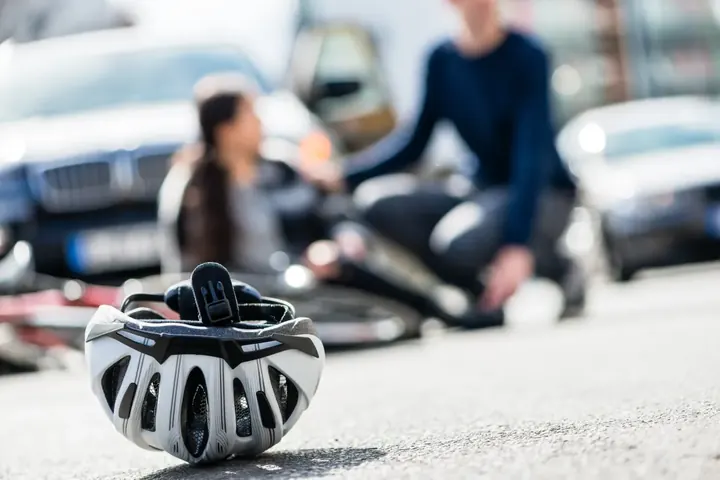
Delaware runs two systems at once. Title 21, section 2118 of the Delaware Code requires every motor vehicle registered in the state to carry personal injury protection, or PIP, which pays regardless of fault. The at-fault driver still owes you everything PIP does not cover, with no injury threshold to clear before you sue.
PIP reaches a cyclist through one sentence. The coverage applies to each occupant of the insured vehicle "and to any other person injured in an accident involving such motor vehicle, other than an occupant of another motor vehicle." You need no car or policy of your own. The claim goes to the insurer of the car that hit you.
The minimum is $15,000 for one person and $30,000 for everyone hurt in the crash. It pays medical bills, net lost earnings, and the cost of services you would have performed yourself, for expenses incurred within two years of the crash. Drivers can buy PIP with a large deductible, but the statute applies it only to the vehicle's owner and household, not to a stranger on a bike.
Section 2118B puts the insurer on a clock: 30 days from your written request and documentation to pay or explain a denial in writing, with interest on late payments starting at 1.5% a month.
One rule surprises riders. Under section 2118(h), you cannot claim from the driver the damages for which PIP compensation is available. The lawsuit is for the rest: expenses beyond the PIP limit, pain and suffering, and the bike.
Behind the driver stands a liability policy with minimums of $25,000 for one person, $50,000 per crash, and $10,000 for property damage under section 2902. Shoulder surgery with rehab costs $15,000 to $40,000, enough to consume the PIP and much of a minimum policy.
Fault and How It Reduces a Claim

Title 10, section 8132 sets the fault rule in a single sentence. Your own negligence does not bar recovery as long as it is "not greater than" the negligence of the defendant, or the combined negligence of all the defendants you sue. Your award is then cut in proportion to your share.
In practice that is a cliff at 50%. A rider found 30% at fault for a $100,000 loss collects $70,000. At 50% the same rider collects $50,000. At 51%, nothing.
Under 21 Del. C. section 4193, a person riding a bicycle has all the rights and all the duties of a driver, so the argument about your share runs through the rules written for bikes:
- Stop signs. Section 4196A lets you slow, yield, and proceed without stopping at a stop sign on a road with two or fewer travel lanes. With three or more lanes, or a vehicle already stopped at the same sign, a complete stop is required.
- Lane position. Section 4196 keeps a slower rider in the right-hand lane. You must move right for overtaking traffic only when the lane is wide enough to share side by side, and then only as far "as judged safe by the operator."
- Lights. Section 4198F requires a white front lamp visible from 500 feet at night and a red rear reflector visible from 600 feet.
Helmets are kept out of the argument. Section 4198K says failure to wear one is not evidence of comparative or contributory negligence in a suit over a crash that injures a rider under 18, and adds that it is not "admissible as evidence in the trial of any civil action."
Drivers face a rule of their own. Under section 4176E, a driver whose traffic violation causes serious physical injury to a vulnerable user, a list that names bicycle and electric bicycle riders, faces a $550 fine and a license suspension of up to one year.
Hit-and-Run and Uninsured Drivers

When the driver flees, the PIP on that car leaves with it. What remains is uninsured vehicle coverage on an auto policy of your own. Title 18, section 3902 requires it in every liability policy on a car registered or principally garaged in Delaware unless a named insured rejected it in writing on the insurer's form. A rejection carries through every renewal.
A hit-and-run vehicle qualifies when it made physical contact "with the insured," which covers a person on a bike, or when it never touched you at all, provided the identity of both the driver and the owner is unknown.
Two conditions are attached. The crash must be reported to the police or the proper governmental authority. And you must notify your insurer of the claim within 30 days, or as soon as practicable after that.
The minimum limits mirror the liability minimums: $25,000 per person, $50,000 per crash, and $10,000 for property damage, the last with a $250 deductible. Whether that property coverage applies to a bicycle depends on the policy wording, so ask your insurer in writing.
Underinsured coverage is a separate offer, available up to $100,000 per person and $300,000 per crash and capped at your own bodily injury limits. It pays only after the driver's limits are exhausted by settlement or judgment. Section 3902(c) rules out stacking: two cars with the same insurer do not double the limit.
If no one in your household insures a car, none of this exists for you. Two things to check in a bike insurance policy: whether it offers uninsured motorist coverage of its own, and whether crash damage to the bike is covered no matter who hit you.
Dooring and Passing Laws
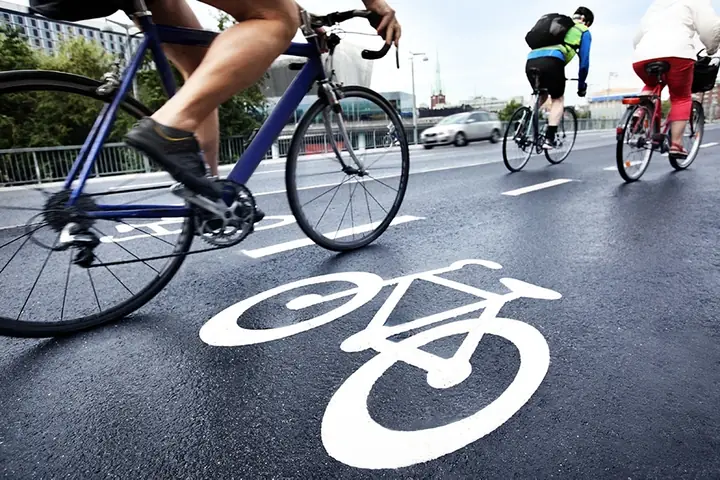
Delaware's passing law, 21 Del. C. section 4116, starts from a lane change, not a number of feet. Where a second lane runs in the same direction, the driver must move completely into it before passing. Where there is one lane each way and it is too narrow to share, the driver must still move completely into the left lane, and only when the no-passing rules allow it.
Three feet is the fallback. It applies only when a single lane is wide enough to share and you are riding in its right part. The driver must then slow down to reduce the speed difference and pass at a reasonable and prudent distance, "which shall in any case never be less than 3 feet."
The dooring statute is section 4190. No person may open a motor vehicle door on the side available to moving traffic unless and until it is reasonably safe and can be done without interfering with other traffic, or leave a door open on that side longer than necessary to load or unload passengers. "No person" includes the passenger climbing out of a rideshare on Market Street.
E-bikes
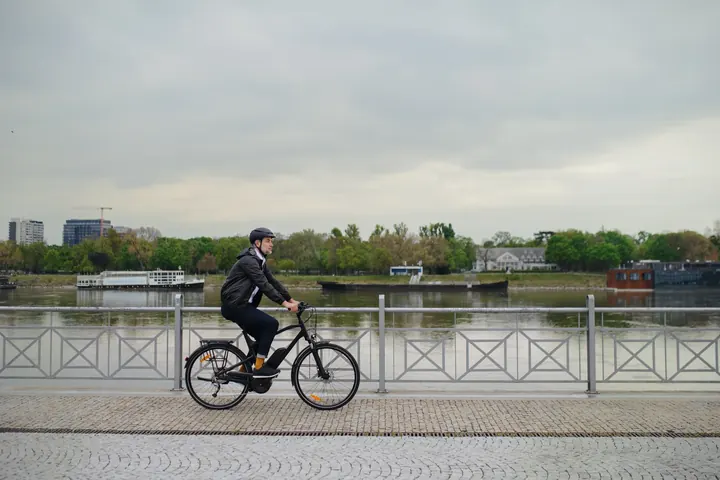
Section 101 of Title 21 defines an electric bicycle as a bike with two or three wheels, fully operable pedals, a saddle, and a motor of 750 watts or less. Class 1 assists only while you pedal and stops at 20 mph. Class 2 has a motor that can propel the bike on its own and stops at 20 mph. Class 3 assists only while you pedal and stops at 28 mph.
Section 4198P gives an e-bike rider the rights and duties of any cyclist and exempts the bike from the Code's insurance, license, registration, and title rules. Class 3 carries extras: no operator under 16, a helmet for every operator and passenger, and a speedometer. Each e-bike must carry a permanent label showing its class, top assisted speed, and wattage, and using the motor on a sidewalk is prohibited.
Above those limits the machine changes category. An electric motor under 2,000 watts that can drive the vehicle past 20 mph on its own, or keep assisting past 28 mph, makes it a moped. Section 4198M requires a driver's license and registration for a moped. House Bill 439, signed September 24, 2026, bars mopeds from bike lanes, sidewalks, and pathways closed to motor traffic.
Title 21 excludes an electric bicycle from its definition of a motor vehicle, so the text of section 2118 points toward an e-bike rider collecting PIP from the car that hit them like any other cyclist. No published appellate opinion or Department of Insurance guidance confirms it, so treat the question as open. In a bike insurance policy, check that your e-bike's class is covered.
Deadlines

Delaware gives you two years for nearly everything, which makes the few shorter clocks easy to overlook.
- Immediately
Police Report
Under 21 Del. C. section 4203, the driver must report a crash to the police immediately when anyone is injured or property damage appears to reach $2,000. A hit-and-run needs a police report to support an uninsured vehicle claim.
- 30 days
Hit-and-Run Notice to Your Insurer
Notify your own auto insurer of a hit-and-run claim within 30 days, or as soon as practicable after that, under 18 Del. C. section 3902.
- One year
Notice to a Local Government
A negligence claim against the City of Wilmington is barred unless the Mayor is notified in writing of the time, place, cause, and character of the injuries within one year, under 10 Del. C. section 8124. Section 4013 lets any other county or municipality set a notice rule by ordinance, so check the local code. Local governments answer for negligent use of their motor vehicles, capped at $300,000 per occurrence unless they carry more insurance, and are immune from road and sidewalk defect claims under section 4011.
- Two years
PIP Expenses
PIP pays expenses incurred within two years of the crash. Bills that could not be presented in time are paid if submitted within 90 days after that.
- Two years
Injury, Wrongful Death, and Bike Damage Lawsuits
10 Del. C. section 8119 gives you two years from the date of injury to sue. Section 8107 sets the same two years for wrongful death and for damage to the bike and gear.
A claim against the State itself, such as a crash with a Department of Transportation truck, falls under the State Tort Claims Act in 10 Del. C. section 4001. That chapter sets no notice deadline, and how far the State can be sued is a question for a Delaware attorney early in the two years.
Evidence to Preserve
A Delaware claim is built around the PIP file, the 50% line, and the lane the driver should have moved into. Collect with those in mind.
- The plate, the driver's insurance card, and the state of registration. A Delaware-registered car carries the PIP that pays your first bills.
- The police report number from the Delaware State Police or the local department.
- The lanes: how many ran in your direction, how wide yours was, and where you were riding in it. Section 4116 turns on those facts.
- Video and witnesses, requested the same day. Your share of fault is the whole case at 51%.
- Your bike as it was: front lamp, rear reflector, and for an e-bike the class label. Keep the bike unrepaired until the claim is settled.
- Every auto policy in your household, with the declarations page showing whether uninsured coverage was rejected.
Coverage for Delaware Riders

Delaware's system pays quickly and runs out early: $15,000 of PIP, a driver who may carry only $25,000 behind it, uninsured coverage that someone in your household may have rejected in writing years ago, and a fault rule that pays nothing at 51%. The Velosurance policy offers the coverages discussed above.
Uninsured Motorist covers losses beyond medical bills, such as lost wages, when the at-fault driver cannot pay.
Medical Payments covers the deductible and out-of-pocket costs your health plan leaves, where the bills land once PIP's $15,000 is spent. Choose a limit close to your plan's out-of-pocket deductible.
Liability covers the claims made against you. It pays covered settlements or judgments and the cost of defending a covered lawsuit, with limits from $25,000 to $500,000.
Crash damage to the bike is part of the policy itself. The bike is insured at stated value with no depreciation, subject to the deductible, whoever caused the crash. Class 1, Class 2, and Class 3 e-bikes are covered like conventional bikes.
For any of these coverages to apply, it must be on the policy before the crash. Get a quote and add them before your next ride.
Frequently Asked Questions
- Who pays medical bills for a cyclist hit by a car in Delaware?
- The insurer of the car that hit you pays first, through the personal injury protection Delaware requires on every registered vehicle. The minimum is $15,000 per person for medical bills and lost earnings, paid regardless of fault, and you do not need a car of your own. One thing to watch: the coverage applies to expenses incurred within two years of the crash.
- How does fault affect a bicycle accident claim in Delaware?
- You can recover damages in Delaware when your negligence is not greater than the driver's, with the award reduced by your share. A rider 30% at fault for a $100,000 loss collects $70,000. The caveat worth knowing: a rider found 51% at fault collects nothing, so evidence about lane position and stop signs carries real weight.
- How long do you have to file a bicycle accident lawsuit in Delaware?
- You have two years from the crash to file a lawsuit for injuries, and two years for damage to your bike and gear. One thing to watch: a negligence claim against the City of Wilmington also needs written notice to the Mayor within one year of the injury.
- How does uninsured motorist coverage work for a Delaware cyclist after a hit-and-run?
- Uninsured vehicle coverage on a Delaware auto policy applies to a hit-and-run that injures you, including one where the car never touched you, provided the driver and owner are both unknown. Report the crash to the police and notify your insurer within 30 days. With one wrinkle: the coverage exists only if it was never rejected in writing.
- How are Class 1, Class 2, and Class 3 e-bikes treated under Delaware law?
- Delaware gives Class 1, Class 2, and Class 3 e-bike riders the rights and duties of any cyclist, with no license, registration, or insurance requirement. Class 1 assists only while you pedal, to 20 mph. Class 2 can run on the motor alone, to 20 mph. Class 3 assists only while you pedal, to 28 mph, for operators 16 and older with a helmet. The caveat worth knowing: a machine that exceeds those limits is a moped, which requires a driver's license and registration.
Sources
- 21 Del. C. section 2118 (required insurance and personal injury protection) and section 2118B (processing and payment of PIP benefits)
- 21 Del. C. section 2902 (minimum liability limits)
- 18 Del. C. section 3902 (uninsured and underinsured vehicle coverage)
- 10 Del. C. sections 8107, 8119, 8124, and 8132 (limitation periods, notice of claim against the City of Wilmington, comparative negligence)
- 10 Del. C. sections 4001 to 4005 (State Tort Claims Act)
- 10 Del. C. sections 4010 to 4013 (County and Municipal Tort Claims Act)
- 21 Del. C. section 101 (definitions: bicycle, electric bicycle, moped, motor vehicle)
- 21 Del. C. section 4116 (overtaking a vehicle or bicycle on the left)
- 21 Del. C. section 4176E (serious physical injury to a vulnerable user)
- 21 Del. C. section 4190 (opening and closing vehicle doors)
- 21 Del. C. sections 4193 to 4198P (operation of bicycles, helmets, mopeds, electric bicycles)
- 21 Del. C. sections 4201 to 4203 (duties of drivers after a collision, police reports)
- House Substitute 1 for House Bill 439, 153rd General Assembly (85 Del. Laws, c. 532, sale of electric mopeds and moped operation)
- Delaware Department of Insurance, Auto Insurance Guide
This guide is general information about Delaware law as of the review date above. It is not legal or insurance advice, and it does not create an attorney-client relationship. Laws change and every crash turns on its own facts: talk to a licensed Delaware attorney about your situation.