
TL;DR:
- Connecticut is a fault state with modified comparative negligence: your share of the blame cuts your recovery, and at 51% or more you recover nothing.
- Minimum auto liability limits are $25,000 per person, $50,000 per crash, and $25,000 for property damage.
- You have two years to sue for injuries or bike damage, but only 90 days to give written notice of a road defect and six months for a claim against a municipal employee.
- Uninsured motorist coverage is mandatory on every Connecticut auto policy and applies to a hit-and-run even without physical contact.
- Drivers must give three feet when passing, and opening a car door into a moving cyclist violates section 14-300j.
Who Pays After a Crash in Connecticut
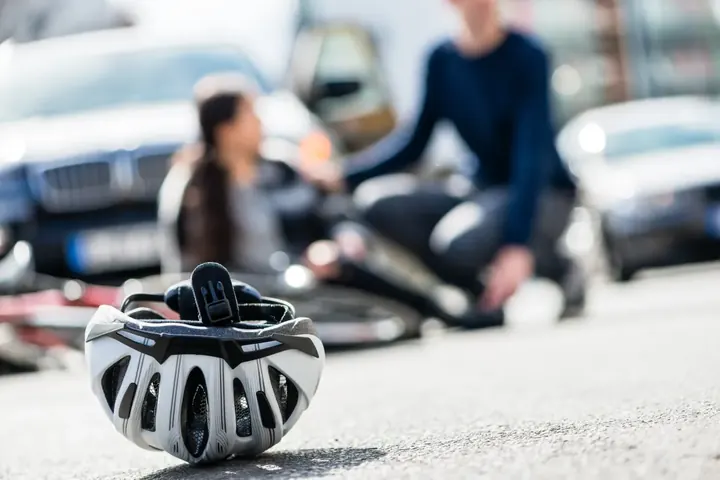
Connecticut is a fault state. The driver who caused the crash pays, through the liability insurance every registered car must carry. The state's no-fault sections were repealed effective January 1, 1994, and the limit on lawsuits went with them.
Section 14-112 sets the minimum limits at $25,000 for one person's injuries, $50,000 for everyone hurt in the crash, and $25,000 for property damage, and section 38a-335 requires every auto liability policy to meet them. The injury limit is thin: shoulder surgery with rehab costs $15,000 to $40,000, so one operation can use it up before lost income enters the claim.
Your bike and gear are paid from the $25,000 property limit. Medical bills come out of the bodily injury limit, usually in one settlement at the end of treatment. Until then your health plan pays, and you carry its deductible and copays.
Medical payments coverage on a Connecticut auto policy is optional. The Insurance Department's minimum provisions describe it as coverage for people hurt "while occupying a motor vehicle," so whether yours follows you onto a bike depends on the policy wording. Ask your auto insurer in writing.
Connecticut's mandatory uninsured motorist coverage lives inside an auto policy. If you own no car and nobody in your household insures one, you have none of it. That leaves the driver's liability coverage, your health plan, and whatever you carry on the bike itself.
Fault and How It Reduces a Claim

Connecticut uses modified comparative negligence. Under section 52-572h, you can recover as long as your negligence is not greater than the combined negligence of the people you are claiming against, and your damages shrink by your percentage. A rider found 30% at fault for a $100,000 loss collects $70,000. A rider found 50% at fault collects $50,000. At 51%, the claim is worth nothing.
That cliff shapes every negotiation. Section 14-286a gives a cyclist every right and every duty of a driver, so the adjuster will read the rules of the road looking for one you broke.
- Lane position. Section 14-286b tells a rider slower than traffic to keep as close to the right side "as is safe, as judged by such person," with exceptions for passing, left turns, hazards, and lanes too narrow to share.
- Lights. Section 14-288 requires a white front lamp visible from 500 feet after dark, a rear reflector visible from 600 feet, and reflective material visible from both sides.
- Sidewalks. On a sidewalk or crosswalk you must yield to pedestrians and give an audible signal before passing, and a town ordinance may ban sidewalk riding outright.
Two rules work in a rider's favor. Under section 14-295, a court may double or treble damages when you plead that the driver deliberately or recklessly violated a listed statute, among them speeding, reckless driving, driving under the influence, and using a handheld phone. Under section 14-286d, a missing helmet on a rider 17 or under cannot be treated as contributory negligence or admitted in a civil case. For adults the statutes are silent, so the question is open.
Hit-and-Run and Uninsured Drivers

Section 38a-336 puts uninsured and underinsured motorist coverage in every Connecticut auto liability policy. The limits match your bodily injury liability limits unless a named insured asked for less on a signed consent form, and they can never drop below $25,000 per person and $50,000 per crash.
The coverage protects the people insured under the policy, and the statute itself speaks of an insured "struck as a pedestrian." No Connecticut statute names cyclists, so confirm with your insurer in writing that yours applies when you are hit on a bike.
A fleeing driver does not have to touch you. In Streitweiser v. Middlesex Mutual Assurance Co., decided in 1991, the state Supreme Court held that uninsured motorist coverage extends to a crash caused by an unidentified vehicle that made no physical contact. Proving the other vehicle caused the crash is still your burden, so report to police at once and find witnesses and video. Your policy sets its own notice conditions: call the insurer the same day.
The underinsured half has a trap. Standard coverage applies only when the driver's liability limits are lower than your own uninsured motorist limits, and your total recovery from all policies cannot exceed those limits. Carry $25,000 and get hit by a driver who also carries $25,000, and it pays nothing. Section 38a-336a requires insurers to offer conversion coverage, which is not reduced by what the driver's insurer paid. Stacking is prohibited: two cars on a policy do not double the limit.
None of this pays for the bike. Section 38a-336 coverage is for bodily injury or death. Two things to check in a bike insurance policy: whether it offers uninsured motorist coverage of its own, and whether crash damage is covered no matter who hit you.
Dooring and Passing Laws

Section 14-300j, added in 2021, is the dooring statute. No person may open a motor vehicle door in a way that causes physical contact with moving traffic, or leave it open longer than it takes to load or unload passengers. "Moving traffic" is defined to include a bicycle or e-bike on the highway and a rider on a sidewalk, shoulder, or bikeway. It says "person," not "driver," so a passenger who swings a door into you has violated it.
The statute has a condition a defense lawyer will use: it protects traffic "traveling at a reasonable rate of speed." Expect questions about how fast you were riding past the parked cars.
Passing is governed by section 14-232. A driver overtaking a person on a bicycle or an electric bicycle must leave a "safe distance," defined as not less than three feet. A violation is an infraction.
Connecticut also has a vulnerable user law. Under section 14-300i, a driver who fails to use reasonable care and causes substantial bodily harm, serious physical injury, or death to a cyclist who was riding with reasonable care can be fined up to $1,000.
E-bikes

Section 14-1 defines an electric bicycle as a bicycle with operable foot pedals and an electric motor of not more than 750 watts. Until October 1, 2026, the text read "fewer than" 750 watts. Public Act 26-24 changed it. Class 1 assists only while you pedal and cuts out at 20 mph. Class 2 has a motor that can propel the bike by itself and cuts out at 20 mph or when you brake. Class 3 assists only while you pedal, up to 28 mph.
Section 14-289k gives an e-bike rider the same rights and duties as any cyclist, and section 14-1 excludes e-bikes from the definition of a motor vehicle. In a crash you are treated as a cyclist, with the same fault rule and deadlines.
Every rider and passenger on an e-bike must wear a helmet, at any age. Nobody under 16 may ride a Class 3, and a Class 3 is barred from bicycle and multiuse trails.
The edge of the definition is where trouble starts. Under section 14-289n, in force since October 1, 2025, a machine with a throttle that can exceed 20 mph on motor power alone is not an e-bike, and neither is one modified or built to be modified past the definition. Sellers of such machines must give buyers a written statement that it is "a type of motor vehicle" and that "your insurance policies might not provide coverage."
One question has no clear answer in published Connecticut authority: whether an auto policy's uninsured motorist or medical payments coverage follows you onto an e-bike. Get your auto insurer's position in writing. In a bike insurance policy, check that your e-bike's class is covered and that the label required by section 14-289l still matches the motor.
Deadlines

Connecticut's deadlines run from 90 days to three years, and the ones aimed at government come first.
- 90 days
Road Defect Notice
If a defective road or bridge caused the crash, section 13a-149 requires written notice to a selectman or the town clerk, or to the city or borough clerk, within 90 days. For a state highway, section 13a-144 sends the same notice to the Commissioner of Transportation. Either way the lawsuit itself is due within two years.
- Six months
Notice to a Municipality
When a municipal employee caused the crash (a town truck, a city bus), section 7-465 requires written notice of your intent to sue, with the time and place, filed with the municipal clerk within six months. The lawsuit is due within two years.
- One year
Claim Against the State
Most claims against the state start with a notice of claim to the Office of the Claims Commissioner within one year under section 4-148. Section 52-556 allows a direct lawsuit when a state employee negligently drove a state-owned, insured vehicle.
- Two years
Injury or Bike Damage Lawsuit
Section 52-584 gives you two years from the date the injury is first sustained or discovered to sue for injuries or for damage to the bike and gear, and never more than three years from the crash. A wrongful death action under section 52-555 is due within two years of the date of death and no more than five years from the crash.
- Three years
Uninsured Motorist Claim
Section 38a-336 bars an auto insurer from requiring a lawsuit or arbitration demand on an uninsured or underinsured motorist claim sooner than three years from the crash.
An underinsured motorist claim often cannot be finished until the driver's insurer has paid its limit. Section 38a-336 lets you stop the policy clock by notifying your own insurer of the claim in writing before the period expires, then suing or demanding arbitration within 180 days after the driver's liability limits are exhausted.
Evidence to Preserve
Evidence in a Connecticut bike crash maps onto the statutes above.
- The police report number, from the local department or the Connecticut State Police. Officers file a uniform accident report whenever someone is hurt or property damage tops $1,000.
- The driver's name, address, license number, and registration number, which section 14-224 obliges a driver to give after a crash, plus a photo of the insurance card.
- The scene: lane width, bike lane markings, the parked car's door position, and sight lines. Lane width decides whether section 14-286b let you leave the right edge.
- Your bike as it was: front lamp, rear reflector, side reflective material, and for an e-bike the class label.
- Video from your own camera, nearby businesses, doorbells, and buses. Ask the same day.
- Medical bills and receipts for the bike and gear, including what your health plan paid and what you paid.
- Proof of delivery for any notice to a town clerk, the Commissioner of Transportation, or the Office of the Claims Commissioner: dated copies and mail receipts.
Coverage for Connecticut Riders

The gaps in this guide are specific to Connecticut: a driver with $25,000 of coverage, underinsured motorist coverage that pays nothing when your limits match the driver's, a fault rule that erases the claim at 51%, and a bike that no auto coverage pays for. The Velosurance policy offers the coverages discussed above.
Uninsured Motorist covers losses beyond medical bills, such as lost wages, when the at-fault driver cannot pay.
Medical Payments covers the deductible and out-of-pocket costs your health plan leaves, whatever the driver's insurance does. Choose a limit close to your plan's out-of-pocket deductible.
Liability answers the other side of comparative fault. If you are blamed for a share of a crash, it covers injury to other people and damage to their property, including the cost of defending a covered lawsuit, with limits from $25,000 to $500,000.
Crash damage to the bike is part of the policy itself. The bike is insured at stated value with no depreciation, subject to the deductible, whoever caused the crash. Class 1, Class 2, and Class 3 e-bikes are covered like conventional bikes.
For any of these coverages to apply, it must be on the policy before the crash. Get a quote and add them before your next ride.
Frequently Asked Questions
- How does fault affect a bicycle accident claim in Connecticut?
- You can recover damages in Connecticut as long as your share of the blame is 50% or less. Your recovery drops by your percentage of fault: a rider 30% at fault for a $100,000 loss collects $70,000. One thing to watch: at 51% the claim is worth nothing, so the insurer will look for a traffic rule you broke.
- How long do you have to file a bicycle accident claim in Connecticut?
- You have two years to file a lawsuit for injuries or for damage to your bike and gear. One thing to watch: a road defect claim needs written notice within 90 days, and a claim against a municipal employee needs written notice to the municipal clerk within six months.
- What does the at-fault driver's insurance pay after a bike crash in Connecticut?
- The at-fault driver's liability policy pays for your injuries from its bodily injury limit and for your bike and gear from its property damage limit. The minimums are $25,000 per person, $50,000 per crash, and $25,000 for property damage. The caveat worth knowing: one surgery can use up a minimum-limits policy.
- How does uninsured motorist coverage work for a Connecticut cyclist in a hit-and-run?
- Uninsured motorist coverage is part of every Connecticut auto policy and applies to a hit-and-run even when the car never touched you. Report the crash to police at once and call your insurer the same day. With one wrinkle: it pays for bodily injury only, so the bike needs separate crash coverage.
- How are Class 1, Class 2, and Class 3 e-bikes treated after a crash in Connecticut?
- Connecticut treats Class 1, Class 2, and Class 3 e-bikes as bicycles, so the same fault rule and filing deadlines apply. Class 1 assists only while you pedal and cuts out at 20 mph, Class 2 has a motor that can propel the bike by itself and cuts out at 20 mph, and Class 3 is pedal assist to 28 mph for riders 16 and older. The caveat worth knowing: a throttle machine that can exceed 20 mph on motor power alone is not an e-bike under section 14-289n.
Sources
- Connecticut General Statutes section 52-572h (comparative negligence, proportionate liability)
- Connecticut General Statutes sections 52-584 and 52-555 (filing deadlines for injury, property damage, and wrongful death)
- Connecticut General Statutes section 14-112 (minimum liability limits)
- Connecticut General Statutes sections 38a-334, 38a-335, 38a-336, and 38a-336a (mandatory auto coverages, uninsured and underinsured motorist coverage, conversion coverage)
- Regulations of Connecticut State Agencies sections 38a-334-1 to 38a-334-10 (minimum provisions for automobile liability policies)
- Streitweiser v. Middlesex Mutual Assurance Co., 219 Conn. 371 (1991) (no physical contact requirement)
- Connecticut General Statutes section 14-1, 2026 Supplement (definitions: electric bicycle classes, motor vehicle, motor-driven cycle)
- Connecticut General Statutes sections 14-232, 14-286, 14-286a, 14-286b, 14-286d, and 14-288, 2026 Supplement (passing, bicycle rights and duties, lane position, helmets, lights)
- Connecticut General Statutes sections 14-289k, 14-289l, and 14-289n, 2026 Supplement (electric bicycles)
- Connecticut General Statutes section 14-108a (uniform accident report)
- Connecticut General Statutes sections 14-224 and 14-295 (evasion of responsibility, double or treble damages)
- Connecticut General Statutes sections 14-300i and 14-300j, 2026 Supplement (vulnerable users, opening vehicle doors)
- Connecticut General Statutes sections 13a-144 and 13a-149 (highway and road defect claims)
- Connecticut General Statutes section 7-465 (claims against municipal employees)
- Connecticut General Statutes sections 4-147 and 4-148 (claims against the state)
- Connecticut General Statutes section 52-556 (state-owned motor vehicles)
- Public Act 25-65 (2025), Office of Legislative Research summary (helmet age)
- Public Act 25-159 (2025), Office of Legislative Research summary (e-bike modification, sales, and trails)
- Public Act 26-24 (2026), sections 26 and 27 (750-watt e-bike definition)
- Connecticut Insurance Department, Auto Insurance: Common Terms
This guide is general information about Connecticut law as of the review date above. It is not legal or insurance advice, and it does not create an attorney-client relationship. Laws change and every crash turns on its own facts: talk to a licensed Connecticut attorney about your situation.