
TL;DR:
- Colorado is a fault state with modified comparative negligence: your share of the blame cuts your recovery by that percentage, and at 50% or more you recover nothing.
- Minimum auto liability limits are $25,000 per person, $50,000 per crash, and $15,000 for property damage under section 10-4-620.
- You have three years to sue over injuries or bike damage caused by a motor vehicle, two years for wrongful death, and 182 days to give written notice of a claim against a public entity.
- Uninsured motorist coverage is in every Colorado auto policy unless rejected in writing, and it adds to the at-fault driver's limits instead of being reduced by them.
- Drivers must give three feet when passing, opening a door into traffic violates section 42-4-1207, and riders 15 and older may treat stop signs as yield signs at 10 mph or less.
Who Pays After a Crash in Colorado
Colorado is a fault state. The driver who caused the crash pays, through the liability insurance that section 10-4-619 requires every vehicle owner to carry. The no-fault part of the insurance code, sections 10-4-701 to 10-4-726, is repealed, so there is no personal injury protection here and no injury threshold to clear before you can bring a claim.
The required limits in section 10-4-620 are low: $25,000 for one person's injuries, $50,000 for everyone hurt in the crash, and $15,000 for property damage. Collarbone surgery costs $11,000 to $17,000, so one operation can take most of a minimum-limits policy before lost income or pain and suffering enter the claim.
Your bike and gear are paid from the driver's $15,000 property damage limit. Your medical bills are paid from the bodily injury limit, usually in one settlement at the end of treatment. Until then your health plan pays, and you carry its deductible and copays.
Colorado adds one first-party layer. Under section 10-4-635, every auto policy includes $5,000 of medical payments coverage unless the named insured rejected it in writing. The statute ties the benefit to injuries arising out of the use of the insured's own vehicle, so whether yours pays when a car hits you on a bike depends on the policy wording. Ask your auto insurer in writing.
If nobody in your household insures a car, that leaves the driver's liability coverage, your health plan, and whatever you carry on the bike itself.
Fault and How It Reduces a Claim
Colorado uses modified comparative negligence. Under section 13-21-111, you recover only if your negligence "was not as great as" the negligence of the person you are claiming against, and your damages shrink in proportion to your share. A rider found 30% at fault for a $100,000 loss collects $70,000. A rider found 50% at fault collects nothing.
That cliff makes the percentage the whole fight. Section 42-4-1412 gives a person on a bicycle or e-bike the rights and duties of any other driver, and an insurer will read the traffic code looking for a rule you broke. The usual candidates are specific:
- Lane position. A rider slower than traffic must use the right-hand lane and, where it is wide enough to share, ride as far right "as judged safe by the bicyclist." The statute says you are not required to ride through hazards at the road's edge or without a reasonable safety margin.
- Stop signs and red lights. Section 42-4-1412.5 makes the safety stop legal statewide for riders 15 and older. You may treat a stop sign as a yield sign at 10 mph or less, and a red light as a stop sign, after yielding to traffic and pedestrians.
- Lights. Between sunset and sunrise, section 42-4-221 requires a white front lamp visible from 500 feet, a red rear reflector visible from 600 feet, and side reflectors or a side-visible light.
When more than one party shares the blame, section 13-21-111.5 makes each defendant owe only its own percentage of your damages.
Helmets carry less risk than riders assume. Section 42-4-1412 says a Class 3 helmet violation is not negligence in a civil injury claim, and in Dare v. Sobule (1984) the Colorado Supreme Court barred evidence of a motorcyclist's bare head to show negligence or reduce damages. No published opinion applying that holding to a bicycle was found.
Hit-and-Run and Uninsured Drivers
Section 10-4-609 requires every auto liability policy delivered in Colorado to include uninsured motorist coverage unless the named insured rejected it in writing. In DeHerrera v. Sentry Insurance Co. (2001), the Colorado Supreme Court held that an insurer cannot deny this coverage to the named insured or a resident relative based on the vehicle they occupied; the injured person in that case was on a motorcycle. The same reasoning should carry the coverage onto a bicycle. Check your declarations page to confirm it was never rejected.
The underinsured half is unusually generous. Under section 10-4-609, the coverage is "in addition to" the at-fault driver's liability insurance and pays the gap between that driver's limits and your damages, up to your own limit. It cannot be reduced by a setoff for liability payments, medical payments coverage, or health insurance. Carry $100,000, get hit by a driver with the $25,000 minimum, suffer $90,000 in damages, and your policy owes the remaining $65,000.
The minimum is $25,000 per person and $50,000 per crash. One policy covering several cars for a single premium may be limited to paying once per crash.
For a driver who flees, the statute contains no physical contact requirement and no reporting deadline. The official annotations to section 10-4-609 report a 1974 Court of Appeals decision, Farmers Insurance Exchange v. McDermott, striking down a policy's physical contact clause. Your policy still sets its own notice conditions, so call the police from the scene and tell your insurer the same day.
None of this pays for the bike. Section 10-4-610, the property damage version, covers only the motor vehicle described in the policy. Two things to check in a bike insurance policy: whether it offers uninsured motorist coverage of its own, and whether crash damage is covered no matter who hit you.
Dooring and Passing Laws
Section 42-4-1207 is Colorado's dooring statute. No person may open a motor vehicle door on the side available to moving traffic until it is reasonably safe and can be done without interfering with other traffic, or leave it open longer than it takes to load or unload passengers. It says "person," so a rideshare passenger is covered as well as a driver.
Passing is governed by section 42-4-1003. A driver overtaking a bicyclist must leave at least three feet between the right side of the vehicle, "including all mirrors or other projections," and the left side of the rider.
Colorado stacks two more statutes on top. Section 42-4-1008.5 makes it careless driving to steer unnecessarily close to, toward, or near a bicyclist. Section 42-4-1402.5, the vulnerable road user law, applies when careless driving causes serious bodily injury to a cyclist: a class 1 misdemeanor traffic offense that exposes the driver to license suspension, a restitution order, and up to 320 hours of public service.
A citation under any of these sections is a numbered violation you can put in front of the driver's insurer.
E-bikes
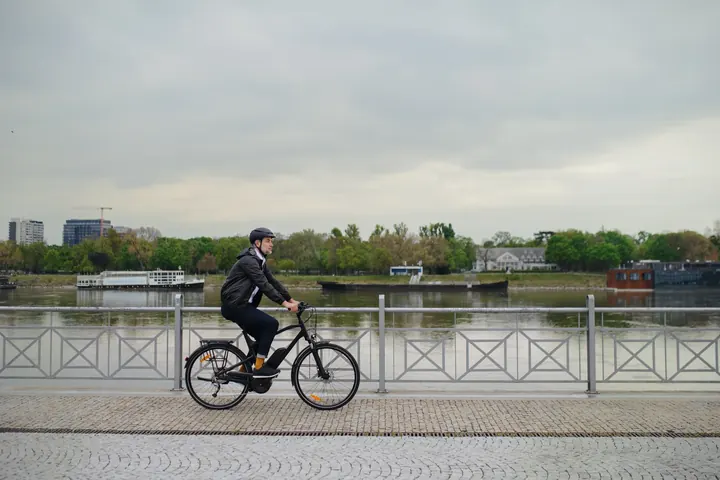
Section 42-1-102 defines an electrical assisted bicycle as a vehicle with two or three wheels, fully operable pedals, and a motor of no more than 750 watts. Class 1 assists only while you pedal and stops at 20 mph. Class 2 assists whether or not you pedal and stops at 20 mph. Class 3 assists only while you pedal and stops at 28 mph.
The same section excludes e-bikes from the definition of a motor vehicle. In a crash you are treated as a cyclist: the same 50% bar, the same deadlines, the same claim against the driver.
Class 3 has extra rules in section 42-4-1412. Nobody under 16 may operate one, riders and passengers under 18 must wear a helmet, and bike paths are closed to it unless the path is within a street or the local authority permits it.
The edge of the definition moved on August 6, 2025, when HB 25-1197 took effect. A vehicle modified so that it no longer fits a class is not an e-bike, and neither is one built to be easily reconfigured out of its class by a switch, a software setting, or an app. Sellers of such machines must now disclose in writing that the vehicle is "a type of motor vehicle" and that "your insurance policies may not provide coverage for crashes" involving it.
Whether an auto policy's uninsured motorist or medical payments coverage follows you onto an e-bike has no published Colorado answer that we could find. Get your auto insurer's position in writing, and check that a bike insurance policy covers your e-bike's class.
Deadlines

Colorado's deadlines run from the day of the crash to three years, and the 182-day government notice is the one riders miss.
- Immediately
Driver's Notice to Police
Section 42-4-1606 requires the driver in any crash involving injury or property damage to give immediate notice to the nearest police authority. Call from the scene yourself.
- 182 days
Notice of Claim Against a Public Entity
If a public entity or its employee is involved (a city bus, a county truck, a dangerous road condition), section 24-10-109 of the Colorado Governmental Immunity Act requires written notice within 182 days after the injury is discovered. Send it to the attorney general for a state claim, or to the governing body or its attorney for any other entity, by registered or certified mail with return receipt. Missing the deadline bars the claim forever. You cannot sue until the entity denies the claim or 90 days pass.
- Two years
Wrongful Death and Public Entity Lawsuits
Section 13-80-102 gives two years for a wrongful death lawsuit, and the same section lists actions against a public entity or its employee. Subsection (2), amended in 2026, allows four years when the death was caused by vehicular homicide and the driver left the scene.
- Three years
Injury and Bike Damage Lawsuit
Section 13-80-101 gives you three years to sue for bodily injury or property damage arising out of the use of a motor vehicle.
- Three years
Uninsured Motorist Lawsuit or Arbitration
Section 13-80-107.5 gives three years to sue your own insurer or demand arbitration in writing on an uninsured or underinsured motorist claim.
The three-year clock starts when both the injury and its cause are known or should have been known, under section 13-80-108. For a child under 18 with no legal representative, section 13-81-103 pauses the general deadlines; do not count on that pause for the 182-day government notice.
Small claims court hears cases up to $7,500 under section 13-6-403, which covers many bike-only losses.
Evidence to Preserve
Evidence in a Colorado bike crash maps onto the statutes above.
- A police report. Section 42-4-1412 requires the local law enforcement agency to complete a report on request for any injury crash involving a bicycle or e-bike, even when no motor vehicle was involved. Ask for it.
- The driver's name, address, and registration number, which section 42-4-1603 requires the driver to give you, plus a photo of the insurance card.
- The scene: lane width, the parked car's door position, and where the car's mirror was relative to you. Lane width decides whether section 42-4-1412 required you to keep right.
- Your speed at any stop sign, from a bike computer or ride file. The safety stop protects you only at 10 mph or less.
- Your bike as it was: front lamp, rear reflector, and for an e-bike the class label and an unmodified motor. Do not repair or discard it until the claim is settled.
- Certified mail receipts for any notice to a public entity.
Coverage for Colorado Riders

Colorado's gaps are specific: a driver carrying $25,000 of coverage, an auto policy whose uninsured motorist coverage was rejected in writing years ago, a health plan deductible that comes due long before any settlement, and a 50% fault bar that can turn you from claimant into defendant. The Velosurance policy offers the coverages discussed above.
Uninsured Motorist covers losses beyond medical bills, such as lost wages, when the at-fault driver cannot pay.
Medical Payments covers the deductible and out-of-pocket costs your health plan leaves, whatever the driver's insurance does. Choose a limit close to your plan's out-of-pocket deductible.
Liability answers the other side of the 50% bar. If you are blamed for a crash, it covers injury to other people and damage to their property, including the cost of defending a covered lawsuit, with limits from $25,000 to $500,000.
Crash damage to the bike is part of the policy itself. The bike is insured at stated value with no depreciation, subject to the deductible, whoever caused the crash. Class 1, Class 2, and Class 3 e-bikes are covered like conventional bikes.
For any of these coverages to apply, it must be on the policy before the crash. Get a quote and add them before your next ride.
Bicycle Accident Attorneys in Colorado
Velosurance legal partners who represent injured cyclists in Colorado.
-

Megan Hottman - Hottman Law Office, P.C.
1211 Avery Street, Suite 103
Golden, CO 80403866 590 2837
Frequently Asked Questions
- How does fault affect a bicycle accident claim in Colorado?
- You can recover damages in Colorado as long as your share of the fault is under 50%, because the state uses modified comparative negligence. Your recovery drops by your percentage of fault: a rider 30% at fault for a $100,000 loss collects $70,000. One thing to watch: a rider found 50% at fault collects nothing, so every traffic rule the insurer says you broke counts.
- How long do you have to file a bicycle accident claim in Colorado?
- You have three years to file a lawsuit over injuries or bike damage caused by a motor vehicle in Colorado. One thing to watch: a claim against a public entity needs written notice within 182 days after the injury is discovered, and a wrongful death lawsuit must be filed within two years.
- What does the at-fault driver's insurance pay after a bike crash in Colorado?
- The at-fault driver's liability policy pays for your injuries from its bodily injury limit and for your bike and gear from its property damage limit. Colorado's required minimums are $25,000 per person, $50,000 per crash, and $15,000 for property damage. The caveat worth knowing: one surgery can take most of a minimum-limits policy.
- How does uninsured motorist coverage work for a Colorado cyclist?
- Uninsured motorist coverage on a Colorado auto policy pays for your injuries when the driver has no insurance or too little, and it adds to the at-fault driver's limits instead of being reduced by them. It is part of every auto policy unless the named insured rejected it in writing. With one wrinkle: it pays for bodily injury only, so the bike needs separate crash coverage.
- How are Class 1, Class 2, and Class 3 e-bikes treated after a crash in Colorado?
- Colorado treats Class 1, Class 2, and Class 3 e-bikes as bicycles and excludes them from the definition of a motor vehicle, so the same fault rule and filing deadlines apply. Class 1 assists only while you pedal and stops at 20 mph, Class 2 assists whether or not you pedal and stops at 20 mph, and Class 3 assists only while you pedal and stops at 28 mph. The caveat worth knowing: a bike modified so that it no longer fits a class is not an e-bike under the statute.
Sources
- Colorado Revised Statutes 2026, official title files (Office of Legislative Legal Services)
- C.R.S. 13-21-111 and 13-21-111.5 (comparative negligence, pro rata liability)
- C.R.S. 13-80-101, 13-80-102, 13-80-107.5, and 13-80-108 (filing deadlines and accrual)
- C.R.S. 13-81-101 and 13-81-103 (minors and other persons under disability)
- C.R.S. 13-6-403 (small claims court limit)
- C.R.S. 10-4-609 and 10-4-610 (uninsured and underinsured motorist coverage)
- C.R.S. 10-4-619 and 10-4-620 (compulsory coverage, minimum liability limits)
- C.R.S. 10-4-635 (medical payments coverage)
- C.R.S. 24-10-106, 24-10-109, and 24-10-114 (Colorado Governmental Immunity Act)
- C.R.S. 42-1-102(28.5) and (58) (electrical assisted bicycle and motor vehicle definitions, as amended by HB 25-1197)
- C.R.S. 42-4-221 (bicycle and e-bike equipment, labels, seller disclosures)
- C.R.S. 42-4-1003 and 42-4-1008.5 (three-foot passing, crowding a bicyclist)
- C.R.S. 42-4-1207 (opening vehicle doors)
- C.R.S. 42-4-1402 and 42-4-1402.5 (careless driving, vulnerable road users)
- C.R.S. 42-4-1412 and 42-4-1412.5 (operation of bicycles and e-bikes, safety stop)
- C.R.S. 42-4-1603 and 42-4-1606 (driver's duties after a crash)
- DeHerrera v. Sentry Insurance Co., 30 P.3d 167 (Colo. 2001) (uninsured motorist coverage not tied to the vehicle occupied)
- Dare v. Sobule, 674 P.2d 960 (Colo. 1984) (helmet non-use inadmissible in a motorcycle case)
This guide is general information about Colorado law as of the review date above. It is not legal or insurance advice, and it does not create an attorney-client relationship. Laws change and every crash turns on its own facts: talk to a licensed Colorado attorney about your situation.