
TL;DR:
- Arizona is a fault state with pure comparative negligence: your share of the blame cuts your recovery by that percentage and does not bar it.
- Minimum auto liability limits are $25,000 per person, $50,000 per crash, and $15,000 for property on policies issued or renewed since July 1, 2020.
- You have two years to sue for injuries or bike damage, but a claim against a public entity needs a notice of claim within 180 days and a lawsuit within one year.
- Uninsured motorist coverage is optional on Arizona auto policies; a hit-and-run claim needs no physical contact if you can corroborate that the unidentified vehicle caused the crash.
- Drivers must leave at least three feet when passing a bicycle under section 28-735, and section 28-905 prohibits opening a car door into moving traffic.
Who Pays After a Crash in Arizona
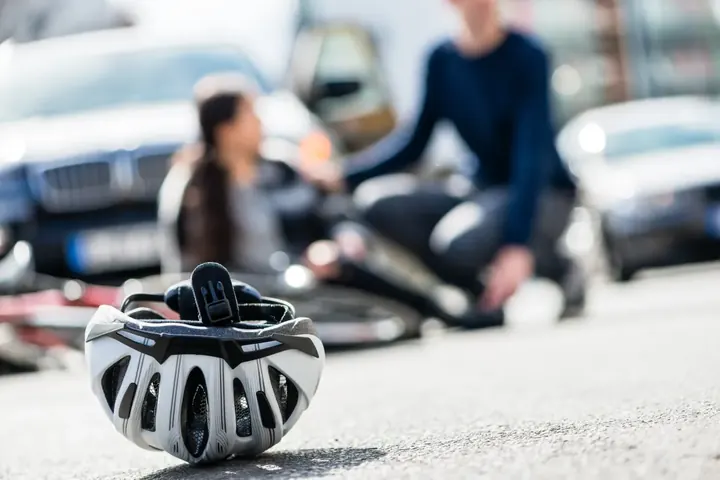
Arizona is a fault state. The driver who caused the crash pays, through the liability insurance that A.R.S. section 28-4135 requires for every motor vehicle on an Arizona highway. There is no personal injury protection here and no injury threshold to clear before you can bring a claim.
The money behind that driver is set by section 28-4009. For a policy issued or renewed since July 1, 2020, the minimums are $25,000 for one person's injuries, $50,000 for everyone hurt in the crash, and $15,000 for property damage. Shoulder surgery with rehab costs $15,000 to $40,000, so one operation can exhaust a minimum policy before lost income enters the claim.
Your bike and gear are paid from the driver's $15,000 property limit. Your medical bills come from the bodily injury limit, usually in one settlement at the end of treatment. Until then your health plan pays, and you carry its deductible and copays.
Medical payments coverage on an Arizona auto policy is optional. The Department of Insurance and Financial Institutions describes it as covering you or passengers in your vehicle, so whether yours follows you onto a bike depends on the policy wording. Ask your insurer in writing.
If nobody in your household insures a car, there is no auto policy to fall back on. That leaves the driver's liability coverage, your health plan, and whatever you carry on the bike itself.
Fault and How It Reduces a Claim

Arizona uses pure comparative negligence. Under section 12-2505, your own negligence is always a question for the jury, and a finding against you does not bar the claim: your damages are reduced in proportion to your fault. A rider found 30% at fault for a $100,000 loss collects $70,000. A rider found 80% at fault still collects $20,000. The statute withholds that protection from a claimant who intentionally, wilfully, or wantonly caused the injury.
Section 12-2506 adds a second rule. Each defendant owes only its own percentage, and the jury may assign fault to people who are not in the lawsuit at all. A share placed on a driver who was never identified is a share nobody pays.
So the percentage is the fight. Section 28-812 gives a cyclist on a roadway or shoulder every right and duty of a driver, and an insurer will look for a rule you broke:
- Lane position. Section 28-815 requires a rider slower than traffic to keep as close as practicable to the right-hand curb or edge, except when passing, preparing a left turn, avoiding hazards, or riding in a lane too narrow to share side by side.
- Lights. Section 28-817 requires, at night, a white front lamp visible from 500 feet and a red rear reflector.
Section 28-812 also contains a protection: a civil traffic violation on a bicycle cannot be counted against your driver license or used by an insurer to raise your auto rates.
Helmets are an open question. Arizona has no statewide bicycle helmet law, and no statute says whether riding without one can reduce an adult's damages.
Hit-and-Run and Uninsured Drivers

Uninsured motorist coverage is optional in Arizona. Section 20-259.01 requires every auto insurer to offer uninsured and underinsured motorist coverage in writing, at limits up to your liability limits, and lets the named insured decline. If you bought it, the minimum is $25,000 per person and $50,000 per crash. The statute says the coverage "extends to and covers all persons insured under the policy" and contains no requirement that you be in a car. Whether your policy follows you onto a bicycle is a question of its wording, so read the declarations page and ask.
Underinsured coverage is a separate purchase. Under subsection G it applies to the difference between your total damages and the at-fault driver's liability limits, so it sits on top of what that driver's insurer pays.
Subsection H lets an insurer restrict you to one policy or coverage of your choice when several apply. In Franklin v. CSAA General Insurance in 2023, the Arizona Supreme Court held that the policy must say so expressly. On July 6, 2026, in State Farm v. Balzan, it held that named insureds who buy policies jointly count as "one insured" under that clause.
A hit-and-run claim does not require physical contact. Subsection M asks for corroboration that the unidentified vehicle caused the crash: any additional testimony, fact, or evidence that supports your account. A witness or camera footage is the usual source. The statute sets no police-report deadline, but your policy may, so call from the scene.
Under section 12-555, written notice of the claim must reach your insurer within three years of the crash.
None of this pays for the bike: section 20-259.01 defines the coverage as damages for bodily injury or death. In a bike insurance policy, check whether it offers uninsured motorist coverage of its own and whether crash damage is covered no matter who hit you.
Dooring and Passing Laws

Section 28-905 is Arizona's dooring statute. A person may not open a door on a motor vehicle unless it is reasonably safe and can be done without interfering with the movement of other traffic, and may not leave a door open on the traffic side longer than necessary to load or unload a passenger. It says "person," so it reaches passengers as well as drivers.
Passing is governed by section 28-735. A driver overtaking a bicycle must leave a safe distance of not less than three feet until the vehicle is safely past. When a violation causes a collision, the civil penalty is up to $500 for serious physical injury and up to $1,000 for a death.
That section has a catch. The penalties do not apply when the cyclist is injured in a vehicular traffic lane while a designated bike lane or path is "present and passable." Photograph any debris, parked car, or broken pavement that made the bike lane unusable.
Bike lanes get their own protection. Under section 28-815, a designated bicycle lane is for the exclusive use of bicycles, and no one may drive, stop, or park a vehicle in it except in an emergency or to cross into a road or driveway.
E-bikes
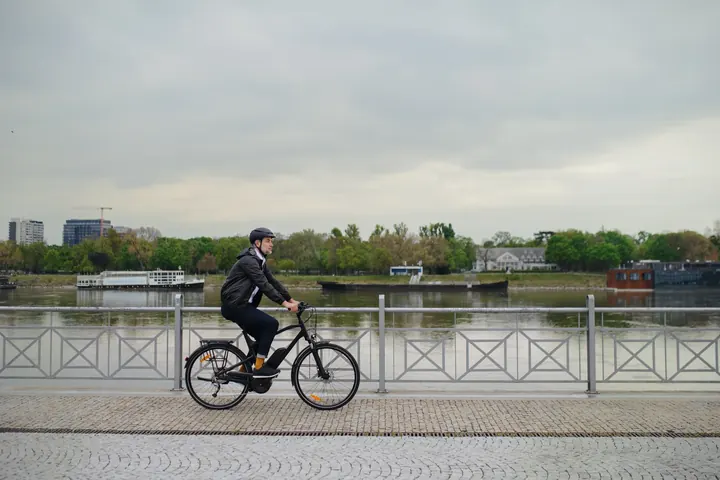
Section 28-101 defines an electric bicycle as a bicycle or tricycle with fully operable pedals and an electric motor of less than 750 watts. Class 1 assists only while you pedal and stops at 20 mph. Class 2 can be propelled by the motor alone and stops assisting at 20 mph. Class 3 assists only while you pedal and stops at 28 mph.
Section 28-819 gives an e-bike rider the rights and duties of a bicycle rider and exempts the bike from title, registration, driver license, and vehicle insurance rules. Section 28-101 excludes it from the definition of "motor vehicle." In a crash you are treated as a cyclist, with the same fault rule and deadlines.
Paths are the main difference between classes. Class 1 and Class 2 e-bikes may use bicycle and multiuse paths unless the local authority prohibits them. A Class 3 e-bike may not, unless the path is within or next to a roadway or the local authority allows it. Since January 1, 2019, manufacturers must label each e-bike with its class, top assisted speed, and wattage.
Section 28-819 lets local authorities regulate further, so check your city's code. Two 2026 bills that would have capped e-bike speeds on paths, SB 1008 and SB 1073, did not become law.
A motor of 750 watts or more puts a machine outside the definition and every exemption above. Whether an auto policy's uninsured motorist or medical payments coverage follows you onto an e-bike has no clear answer in Arizona authority; get your insurer's position in writing.
Deadlines

Arizona's deadlines run from the moment of the crash to three years, and the 180-day notice of claim against a public entity is the one riders miss.
- Immediately
Police Notice From the Scene
Section 28-666 requires the driver in any crash with an injury to notify the local police, the county sheriff, or the nearest highway patrol office immediately. Call as well, so an officer writes the report.
- 180 days
Notice of Claim Against a Public Entity
If a public entity or public employee is involved (a city bus, a county truck, a road defect), section 12-821.01 requires a notice of claim within 180 days after the claim accrues, filed with the person authorized to accept service for that entity. It must state the facts and a specific amount for which the claim can be settled. A late claim is barred. The claim is deemed denied 60 days after filing if no written denial arrives sooner.
- One year
Lawsuit Against a Public Entity
Section 12-821 requires any lawsuit against a public entity or public employee to be filed within one year after the claim accrues.
- Two years
Injury, Wrongful Death, or Bike Damage Lawsuit
Section 12-542 gives you two years to sue for injuries, for a death, or for damage to the bike and gear. For bike-only losses, the small claims division hears claims up to $5,000 under section 22-503 and the justice court up to $10,000 under section 22-201.
- Three years
Written Notice of an Uninsured Motorist Claim
Section 12-555 requires written notice to your insurer within three years of the crash for an uninsured or underinsured motorist claim. An underinsured claim also requires a claim with the driver's insurer or a lawsuit against the driver within the two-year period. If the claim does not settle, you have three years from your notice to request arbitration or sue.
For a child, the two-year clock does not run until age 18 under section 12-502. For claims against public entities, section 12-821.01 lets a minor file the notice of claim within 180 days after turning 18.
Evidence to Preserve
Evidence in an Arizona bike crash maps onto the statutes above. Collect it with them in mind.
- The police report number. Under section 28-667, the investigating officer must write a report for any crash with an injury, and a person involved in the crash can request a copy from the agency.
- The driver's name, address, and registration number, which section 28-663 obliges the driver to give you, plus a photo of the insurance card.
- Corroboration if the driver fled: witness names and phone numbers, and video from nearby businesses and doorbells. Ask the same day.
- The scene: lane width, the bike lane and anything blocking it, the parked car's door, and the gap the driver left. Lane width decides whether section 28-815 required you to keep right.
- Your bike as it was: front lamp, rear reflector, brakes, and for an e-bike the class label. Do not repair or discard it until the claim is settled.
- Medical bills and receipts for the bike and gear, including what your health plan paid and what you paid.
- Dated copies and proof of delivery for a notice of claim or a written notice to your insurer.
Coverage for Arizona Riders

Arizona's gaps are specific: a driver with $25,000 of coverage, uninsured motorist coverage that the state leaves optional on your own auto policy, a fault rule that lets a jury move part of the blame onto a driver who was never found, and a bike that no auto coverage pays for. The Velosurance policy offers the coverages discussed above.
Uninsured Motorist covers losses beyond medical bills, such as lost wages, when the at-fault driver cannot pay.
Medical Payments covers the deductible and out-of-pocket costs your health plan leaves, whatever the driver's insurance does. Choose a limit close to your plan's out-of-pocket deductible.
Liability answers the other side of comparative fault. If you are blamed for a share of a crash, it covers injury to other people and damage to their property, including the cost of defending a covered lawsuit, with limits from $25,000 to $500,000.
Crash damage to the bike is part of the policy itself. The bike is insured at stated value with no depreciation, subject to the deductible, whoever caused the crash. Class 1, Class 2, and Class 3 e-bikes are covered like conventional bikes.
For any of these coverages to apply, it must be on the policy before the crash. Get a quote and add them before your next ride.
Bicycle Accident Attorneys in Arizona
Velosurance legal partners who represent injured cyclists in Arizona.

Frequently Asked Questions
- How does fault affect a bicycle accident claim in Arizona?
- You can recover damages in Arizona even when you share the blame, because the state uses pure comparative negligence. Your recovery drops by your percentage of fault: a rider 30% at fault for a $100,000 loss collects $70,000. One thing to watch: each defendant pays only its own share, and a jury can assign part of the fault to someone who is not in the lawsuit.
- How long do you have to file a bicycle accident claim in Arizona?
- You have two years to file a lawsuit for injuries or for damage to your bike and gear. One thing to watch: when a city, county, or state agency is involved, a notice of claim is due within 180 days and the lawsuit within one year.
- What does the at-fault driver's insurance pay after a bike crash in Arizona?
- The at-fault driver's liability policy pays for your injuries from its bodily injury limit and for your bike and gear from its property damage limit. On policies issued or renewed since July 1, 2020, the minimums are $25,000 per person, $50,000 per crash, and $15,000 for property. The caveat worth knowing: one surgery can use up a minimum policy.
- How does uninsured motorist coverage work for an Arizona cyclist in a hit-and-run?
- Uninsured motorist coverage on an Arizona auto policy can pay for your injuries when the driver flees, and the car does not have to touch you. You need corroboration that the unidentified vehicle caused the crash, such as a witness or camera footage, and written notice to your insurer within three years. With one wrinkle: the coverage is optional in Arizona and pays for bodily injury only, so confirm it is on your policy and cover the bike separately.
- How are Class 1, Class 2, and Class 3 e-bikes treated after a crash in Arizona?
- Arizona treats Class 1, Class 2, and Class 3 e-bikes as bicycles, so the same fault rule and filing deadlines apply. Class 1 is pedal assist to 20 mph, Class 2 can be propelled by the motor alone and stops assisting at 20 mph, and Class 3 is pedal assist to 28 mph. The caveat worth knowing: a motor of 750 watts or more puts the bike outside the e-bike definition.
Sources
- A.R.S. section 12-2505 (comparative negligence)
- A.R.S. section 12-2506 (several liability, fault of nonparties)
- Arizona Constitution, article 18, sections 5 and 6 (contributory negligence as a jury question; right of action for injuries)
- A.R.S. section 28-4009 (minimum liability limits)
- A.R.S. section 28-4135 (financial responsibility requirement)
- A.R.S. section 20-259.01 (uninsured and underinsured motorist coverage)
- A.R.S. section 12-555 (uninsured and underinsured motorist claim time limits)
- Franklin v. CSAA General Insurance Co., 255 Ariz. 409 (2023)
- State Farm Mutual Automobile Insurance Co. v. Balzan, No. CV-24-0140-PR (Ariz. July 6, 2026)
- A.R.S. section 12-542 (two-year limitation for injury and property damage)
- A.R.S. section 12-502 (effect of minority)
- A.R.S. sections 12-821 and 12-821.01 (claims against public entities)
- A.R.S. sections 22-201 and 22-503 (justice court and small claims limits)
- A.R.S. sections 28-661, 28-663, 28-666, and 28-667 (duties after a crash, police notice, written report)
- A.R.S. section 28-735 (overtaking bicycles)
- A.R.S. sections 28-812, 28-815, and 28-817 (bicycle rights, duties, lane position, equipment)
- A.R.S. section 28-905 (opening vehicle door)
- A.R.S. sections 28-101 and 28-819 (electric bicycles)
- Arizona SB 1008 (2026), bicycles; mobility devices; speed limits (not enacted)
- Arizona Department of Insurance and Financial Institutions, Automobile Insurance consumer information
- Arizona Department of Transportation, Active Transportation Program: Bicycling Helmets, Signs, and Signals
This guide is general information about Arizona law as of the review date above. It is not legal or insurance advice, and it does not create an attorney-client relationship. Laws change and every crash turns on its own facts: talk to a licensed Arizona attorney about your situation.