
TL;DR:
- Alaska is a fault state with pure comparative fault: your share of the blame cuts your recovery by that percentage and never bars it.
- Minimum auto liability limits are $50,000 per person, $100,000 per crash, and $25,000 for property, and vehicles in communities off the road system are exempt from the insurance requirement.
- You have two years to sue for injuries and two years to sue for damage to the bike and gear under AS 09.10.070.
- Uninsured motorist coverage on an Alaska auto policy covers you on a bicycle unless it was rejected in writing; a hit-and-run claim needs direct physical contact and a report within 24 hours.
- State regulations require drivers to pass at a safe distance and to open doors only when it is reasonably safe; Anchorage sets the passing distance at three feet.
Who Pays After a Crash in Alaska
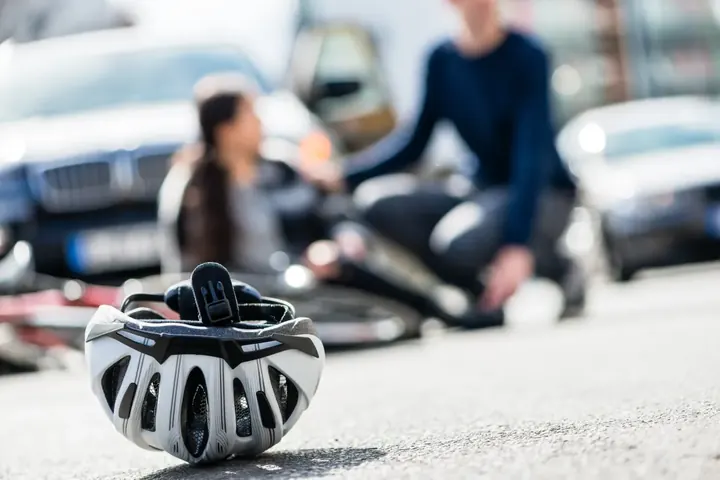
Alaska is a fault state. The driver who caused the crash pays, through the liability insurance that AS 28.22.011 requires. There is no personal injury protection here and no injury threshold to clear before you can sue.
The minimums in AS 28.22.101 are $50,000 for one person's injuries, $100,000 for everyone hurt in the crash, and $25,000 for property damage. Your bike and gear come out of the property limit. Your medical bills come out of the bodily injury limit, usually in one settlement at the end of treatment. Until then your health plan pays, and you carry its deductible and copays.
Alaska has a gap that belongs to its geography. AS 28.22.011 exempts a vehicle from the insurance requirement when it is driven in a place not connected by land to the state highway system or to a road carrying more than 499 vehicles a day, unless its operator was cited in the past five years for a violation worth six or more points. In those communities, a driver with no insurance at all can be fully legal.
Medical Payments coverage on an auto policy is optional. The Division of Insurance's consumer guide says it applies to you and your family when injured by a vehicle "as a pedestrian." It does not mention bicycles there, so ask your auto insurer in writing whether yours pays when you are riding.
If you own no car, there is no auto policy of your own to fall back on. That leaves the driver's liability coverage, your health plan, and whatever you carry on the bike itself.
Fault and How It Reduces a Claim
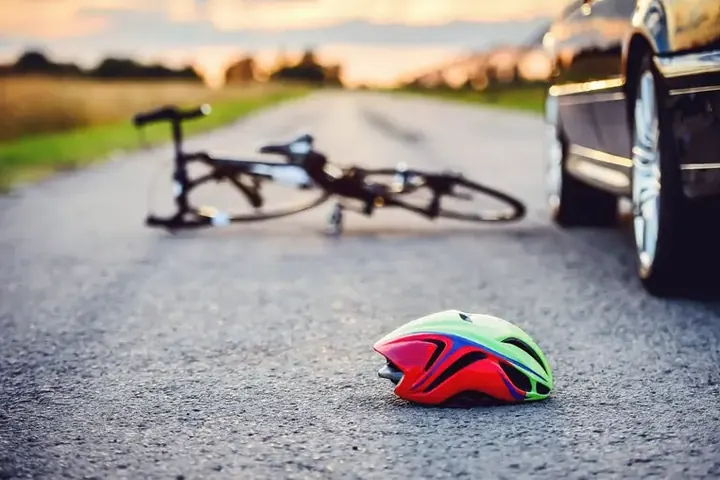
Alaska uses pure comparative fault. Under AS 09.17.060, your contributory fault "diminishes proportionately" what you are awarded "but does not bar recovery." A rider found 30% at fault for a $100,000 loss collects $70,000. A rider found 80% at fault still collects $20,000.
So the percentage is the fight. Regulation 13 AAC 02.385 gives a person riding a bicycle on a roadway all the rights and all the duties of a driver, and an insurer will read the bicycle regulations looking for one you broke. The usual candidates:
- Lane position. 13 AAC 02.400 requires you to ride as near the right side of the roadway as practicable, and to use the shoulder when it is maintained in good condition.
- Sidewalks. Riding on a sidewalk in a business district is prohibited.
- Lights. When vehicle lights are required, 13 AAC 04.320 calls for a white front light visible from 500 feet, and 13 AAC 04.335 for a red rear reflector and reflective material visible from the sides. 13 AAC 04.325 requires a red taillight visible from 500 feet.
- Stop signs. Inside Anchorage, Municipal Code 9.38.030 lets a rider slow to a reasonable speed and stop only if safety requires it.
Two more Alaska rules shape the money. Under AS 09.17.080, each defendant pays only its own percentage of fault, and a jury may assign a share to someone who already settled. And AS 09.17.010 caps pain and suffering at $400,000 or $8,000 for each year of your life expectancy, whichever is greater. For severe permanent physical impairment or severe disfigurement the cap is $1,000,000 or $25,000 a year.
Helmets are an open question. State regulations do not require one, and no statute says whether riding without one can reduce an adult's damages. AS 09.17.900 defines fault to include an "unreasonable failure to avoid an injury," and that is the phrase an insurer will reach for.
Hit-and-Run and Uninsured Drivers
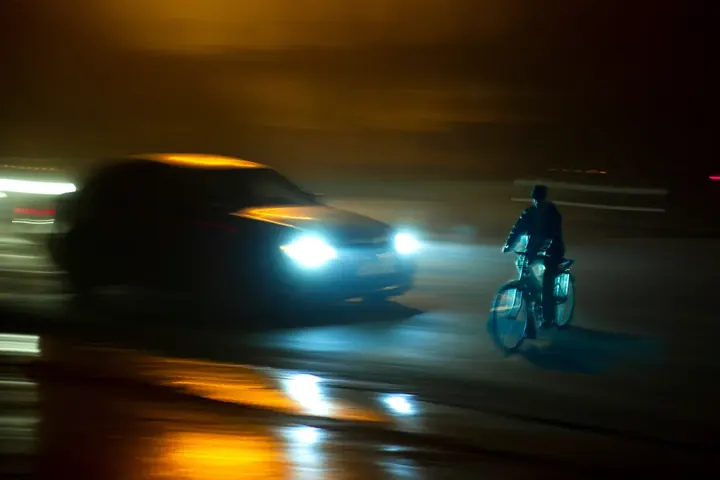
Alaska law puts cyclists into auto insurance by name. AS 28.20.445 directs the Division of Insurance to make sure every policy with uninsured and underinsured motorist coverage states clearly that it covers the insured for injuries sustained "as a pedestrian or bicyclist by a motor vehicle."
The coverage must be offered with every auto liability policy under AS 21.96.020, at no less than $50,000 per person and $100,000 per crash. The buyer can reject it, but only in writing. Without a signed selection or rejection, the Division's consumer guide says, the policy is issued with limits matching the liability limits. Check your declarations page.
The underinsured half is more generous than most riders expect. Once the at-fault driver's limits are used up, AS 28.20.445 has your coverage pay the difference between your damages and what that driver's side paid, up to your own limit. Insurers must also offer higher limits, up to $1,000,000 per person and $2,000,000 per crash. Insuring two cars on one policy does not double the limit.
A hit-and-run has two conditions. When the owner and the driver are both unknown, the coverage pays only where there was direct physical contact. The wording was written around collisions between vehicles, so a rider forced off the road by a car that never touched them should get a lawyer's reading. And if you report the crash to the authorities within 24 hours, the vehicle that fled is presumed uninsured.
None of this pays for the bike. The property half of the coverage is limited by statute to the insured motor vehicle.
Two things to check in a bike insurance policy: whether it offers uninsured motorist coverage of its own, and whether crash damage is covered no matter who hit you.
Dooring and Passing Laws
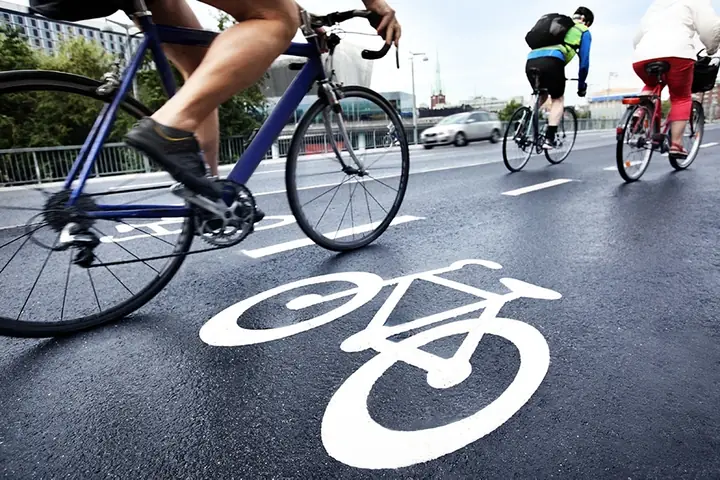
Alaska's dooring rule sits in the Administrative Code, not the statutes. Under 13 AAC 02.495, no person may open the door of a motor vehicle unless it is reasonably safe to do so, without interfering with the movement of other traffic, and no person may leave a door open on the traffic side of a parked vehicle so as to obstruct traffic. It says "person," so a passenger who swings a door into your path has broken it too.
Passing is where state law is thin. 13 AAC 02.065 requires a driver overtaking another vehicle to pass to the left "at a safe distance" and to stay left until safely clear. It names no number of feet. The Department of Transportation and Public Facilities advises at least three feet, but that is advice, not regulation.
Anchorage wrote the number into law. Municipal Code 9.16.030 requires a driver overtaking a vulnerable road user to pass at a safe distance of "not less than three feet." Elsewhere the argument is over what "safe" meant on that road at that speed.
The passing rule also asks something of you. 13 AAC 02.400 requires a cyclist to give way to the right as far as practicable when a driver behind sounds the horn.
E-bikes
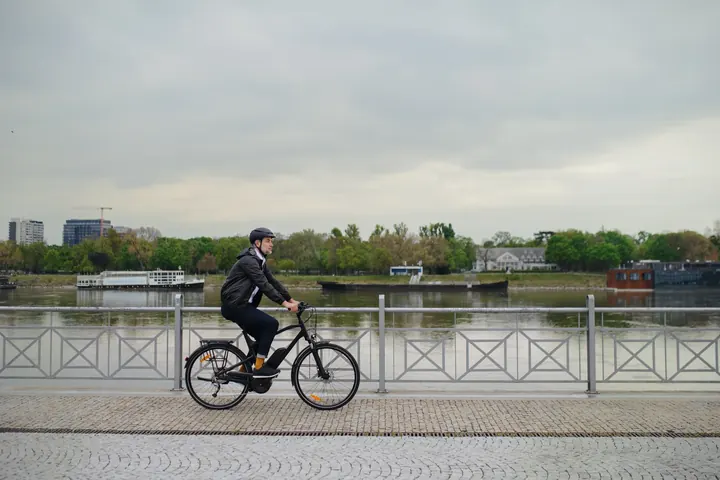
Alaska has no e-bike law. Title 28 does not define an electric bicycle, and state law sets out no classes, no wattage limit, and no speed cutoff. What it has are older definitions that fit badly: 13 AAC 40.010 defines a bicycle as a vehicle "propelled exclusively by human power," and AS 28.90.990 defines a motor vehicle as any vehicle that is self-propelled.
The Legislature tried to fix this. House Bill 8 passed in 2023 and would have defined an electric-assisted bicycle as a bike with working pedals and a motor of no more than 750 watts, treated it as a bicycle, and exempted it from registration. The governor vetoed it on July 20, 2023. No replacement bill appears among the short titles of the 2025 and 2026 sessions.
That leaves real questions open after a crash. The fault rule and the two-year deadline apply to you as they do to anyone hurt on the road. Whether you count as a "bicyclist" under an auto policy's uninsured motorist coverage, and whether the state treats your e-bike as a motor vehicle, has no clear answer in the statutes. Get your auto insurer's position in writing before you rely on it.
In a bike insurance policy, check that your e-bike's motor power and top assisted speed are within what the policy covers, and that the motor has not been modified.
Deadlines

Alaska's deadlines run from the first minutes after the crash to two years, and almost every lawsuit shares the same two-year limit.
- Immediately
Notify Police of the Crash
AS 28.35.080 requires the driver of a vehicle in a crash involving injury, death, or $2,000 or more in property damage to notify the local police department at once, or the Department of Public Safety outside a municipality.
- 24 hours
Report a Hit-and-Run
Report a hit-and-run to the authorities within 24 hours. Under AS 28.20.445, that report creates the presumption that the vehicle that fled was uninsured.
- 10 days
Written Crash Report
A written or electronic report goes to the Department of Administration, and to local police inside a municipality, within 10 days. No report is needed when a peace officer investigated the crash.
- Two years
Injury or Wrongful Death Lawsuit
AS 09.10.070 gives you two years to file a personal injury lawsuit. A wrongful death action under AS 09.55.580 must be filed within two years after the death.
- Two years
Bike and Gear Damage Lawsuit
The same section gives you two years to sue for damage to the bike and gear. Small claims court hears claims up to $10,000 under AS 22.15.040, which covers most bike-only losses.
- Two years
Claim Against the State or a Municipality
AS 09.50.250 allows tort suits against the state and AS 09.65.070 against municipalities. Neither section sets a separate notice-of-claim deadline, so the two-year limit is the working deadline for a crash with a city bus or a state truck. Both sections bar claims based on a discretionary function, the defense you will meet in a road design claim. Ask a lawyer about local claim procedures.
If the injured rider is a child, AS 09.10.140 keeps the time before adulthood from counting against the two-year limit, and it has a separate rule for children hurt before their eighth birthday. Have a lawyer read both subsections against the child's age.
Evidence to Preserve
Evidence in an Alaska bike crash maps onto the rules above.
- The police report number, from the local department or the Department of Public Safety, and proof of the time you reported if the driver fled.
- The driver's name, address, plate, and insurance card, photographed. AS 28.35.060 obliges the driver to give you the first three.
- Proof of contact in a hit-and-run: paint transfer, damage to the bike, torn clothing, witness names.
- The scene: shoulder width and condition, snow or gravel on it, the parked car's door, signs, and sight lines. The shoulder's condition decides whether 13 AAC 02.400 required you to be on it.
- Your bike as it was: front light, taillight, rear and side reflectors, working brakes. Do not repair or discard it until the claim is settled.
- Medical records from the first visit onward, and every bill, including what your health plan paid and what you paid.
- Receipts for the bike, upgrades, helmet, and gear, which set the property damage claim.
Coverage for Alaska Riders
The gaps in this guide are specific to Alaska: a driver with $50,000 of coverage, a driver in an off-road-system community who legally carries none, a hit-and-run with no proof of contact, and uninsured motorist coverage that by statute never pays for a bike. The Velosurance policy offers the coverages discussed above.
Uninsured Motorist covers losses beyond medical bills, such as lost wages, when the at-fault driver cannot pay.
Medical Payments covers the deductible and out-of-pocket costs your health plan leaves, whatever the driver's insurance does. Choose a limit close to your plan's out-of-pocket deductible.
Liability answers the other side of comparative fault. If you are blamed for a share of a crash, it covers injury to other people and damage to their property, including the cost of defending a covered lawsuit, with limits from $25,000 to $500,000.
Crash damage to the bike is part of the policy itself. The bike is insured at stated value with no depreciation, subject to the deductible, whoever caused the crash. Class 1, Class 2, and Class 3 e-bikes are covered like conventional bikes.
For any of these coverages to apply, it must be on the policy before the crash. Get a quote and add them before your next ride.
Frequently Asked Questions
- How does fault affect a bicycle accident claim in Alaska?
- You can recover damages in Alaska even when you share the blame, because the state uses pure comparative fault. Your recovery drops by your percentage of fault: a rider 30% at fault for a $100,000 loss collects $70,000. One thing to watch: each defendant pays only its own percentage, and pain and suffering is capped by AS 09.17.010.
- How long do you have to file a bicycle accident lawsuit in Alaska?
- You have two years to file an injury lawsuit in Alaska, and the same two years to sue for damage to your bike and gear, under AS 09.10.070. A wrongful death action must be filed within two years of the death. One thing to watch: report a hit-and-run to the authorities within 24 hours to protect an uninsured motorist claim.
- What does the at-fault driver's insurance pay after a bike crash in Alaska?
- The at-fault driver's liability policy pays for your injuries from its bodily injury limit and for your bike and gear from its property damage limit. The minimums are $50,000 per person, $100,000 per crash, and $25,000 for property. The caveat worth knowing: vehicles in communities off the road system are exempt from the insurance requirement, so some drivers legally carry none.
- How does uninsured motorist coverage work for an Alaska cyclist in a hit-and-run?
- Uninsured motorist coverage on an Alaska auto policy covers you when a motor vehicle hits you on a bicycle, and a report to the authorities within 24 hours creates the presumption that the driver who fled was uninsured. The coverage must be offered at $50,000 per person or more. With one wrinkle: when the driver is unknown it requires direct physical contact, and it does not pay for the bike.
- How does Alaska law treat an e-bike rider after a crash?
- An e-bike rider has the same pure comparative fault rule and the same two-year filing deadline as anyone hurt on an Alaska road. One thing to watch: state law does not define an electric bicycle, because the 2023 bill that would have done so was vetoed, so get your auto insurer's position on uninsured motorist coverage in writing.
Sources
- Alaska Statutes 09.17.060, 09.17.080, and 09.17.900 (comparative fault, several liability, definition of fault)
- Alaska Statutes 09.17.010 (cap on non-economic damages)
- Alaska Statutes 09.10.070 and 09.10.140 (two-year limitation, minors)
- Alaska Statutes 09.55.580 (wrongful death)
- Alaska Statutes 09.50.250 and 09.65.070 (claims against the state and municipalities)
- Alaska Statutes 22.15.040 (small claims)
- Alaska Statutes 28.22.011 and 28.22.101 (mandatory liability insurance, exemptions, minimum limits)
- Alaska Statutes 28.20.440 and 28.20.445 (liability policy provisions, uninsured and underinsured motorist coverage)
- Alaska Statutes 28.22.201, 28.22.221, and 28.22.231 (uninsured and underinsured motorist coverage)
- Alaska Statutes 21.96.020 (required offer of uninsured and underinsured motorist coverage)
- Alaska Statutes 28.35.050, 28.35.060, and 28.35.080 (duties after a crash, crash reports)
- Alaska Statutes 28.90.990 (Title 28 definitions)
- 13 AAC 02.385 to 02.420 (bicycle regulations)
- 13 AAC 02.065 (overtaking on the left)
- 13 AAC 02.495 (opening vehicle doors)
- 13 AAC 04.320 to 04.340 (bicycle lights, reflectors, and brakes)
- 13 AAC 40.010 (definition of bicycle)
- House Bill 8, 33rd Alaska Legislature (electric-assisted bicycles; vetoed July 20, 2023)
- Anchorage Municipal Code 9.16.030 (three-foot passing)
- Anchorage Municipal Code 9.38.030 and 9.38.200 (stop signs, bicycle helmets)
- Alaska Division of Insurance, Consumer Guide to Automobile Insurance (revised September 2020)
- Alaska Department of Transportation and Public Facilities, Bicycle Travel Tips
This guide is general information about Alaska law as of the review date above. It is not legal or insurance advice, and it does not create an attorney-client relationship. Laws change and every crash turns on its own facts: talk to a licensed Alaska attorney about your situation.