
TL;DR:
- Alabama uses contributory negligence: if your own carelessness contributed to the crash, a merely negligent driver owes you nothing.
- Minimum auto liability limits are $25,000 per person, $50,000 per crash, and $25,000 for property damage.
- You have two years to sue, but only six months to present a claim to a city or town, 12 months for a county, and one year for the state.
- Uninsured motorist coverage comes with every Alabama auto policy unless the named insured rejected it, and a hit-and-run claim does not require physical contact.
- Drivers owe three feet when passing on roads with a bike lane or a limit of 45 mph or less, and only when you ride within two feet of the right shoulder.
Who Pays After a Crash in Alabama
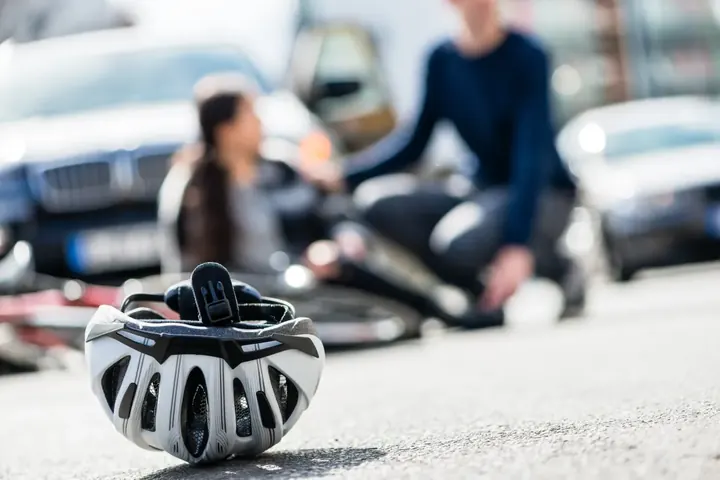
Alabama is a fault state. The driver who caused the crash pays, through the liability insurance that the Mandatory Liability Insurance Act, section 32-7A-4 of the Code of Alabama, requires on every vehicle driven or registered here. Liability is the only coverage that statute requires. There is no personal injury protection and no injury threshold to clear before you can bring a claim.
Section 32-7-6 sets the minimum limits: $25,000 for one person's injuries, $50,000 for everyone hurt in the crash, and $25,000 for property damage. The section was last amended in 2008.
Collarbone surgery costs $11,000 to $17,000, and shoulder surgery with rehab $15,000 to $40,000, so one operation can use up a minimum-limits policy before lost income enters the claim.
Liability money arrives late, usually as one settlement at the end of treatment, and until then your health plan pays while you carry its deductible and copays. In Alabama the settlement may never arrive: the driver's insurer can refuse the whole claim if it can show you were careless too.
Medical payments coverage on an auto policy is optional, and whether yours follows you onto a bike depends on the policy wording. If you own no car and nobody in your household insures one, there is no auto policy of your own to fall back on.
Fault and How It Reduces a Claim

Alabama still uses contributory negligence. If your own negligence contributed to the crash, you recover nothing from a driver who was merely negligent, however small your share. The Alabama Supreme Court was asked to replace the rule with comparative negligence in Golden v. McCurry in 1980 and left the decision to the Legislature. It declined again in Williams v. Delta International Machinery Corp. in 1993.
The defense is not automatic. In Serio v. Merrell, Inc. in 2006, the court called it an affirmative and complete defense on which the defendant bears the burden of proof: that you knew of the dangerous condition, appreciated the danger, and failed to exercise reasonable care.
Section 32-5A-260 gives a cyclist every right and every duty of a driver, so an insurer starts by reading the rules of the road for one you broke:
- Lane position. Section 32-5A-263 requires you to ride as near to the right side of the roadway as practicable and no more than two abreast.
- Bike paths. The same section says that where a usable bicycle path runs beside the roadway, riders must use the path.
- Lights. Section 32-5A-265 requires a white front lamp visible from 500 feet at night, and a red rear reflector.
- Sidewalks. Section 32-5A-52 bars vehicles from sidewalks, and section 32-1-1.1 deems a bicycle a vehicle.
There is one way around the bar. Golden confirms that contributory negligence does not apply to a claim of wantonness, which Serio defines as consciously doing an act, or omitting a duty, knowing that injury will likely or probably result.
Helmets are a narrower fight. Section 32-5A-267 says a violation of the Class 3 e-bike helmet rule is not admissible as evidence of negligence. The under-16 bicycle helmet law, section 32-5A-283, is silent on the point.
Hit-and-Run and Uninsured Drivers

Section 32-7-23 requires every auto liability policy issued in Alabama to include uninsured motorist coverage unless the named insured rejected it. The coverage protects insured persons who are legally entitled to recover from the owner or operator of an uninsured motor vehicle, and nothing in that sentence requires you to be inside a car. In State Farm v. Reaves in 1974, the Alabama Supreme Court held that a policy exclusion narrower than the statute is void. Ask your insurer to confirm in writing that yours applies on a bike.
Underinsured coverage is built into the same section: a vehicle counts as uninsured when its available liability limits are less than your damages. The limits follow section 32-7-6, $25,000 per person and $50,000 per crash unless you bought more, and one policy can stack the primary coverage plus up to two additional vehicles.
A hit-and-run driver counts as uninsured. In State Farm v. Lambert in 1973, the court struck down a policy clause that required physical contact with the fleeing car, holding that an injured person who can prove the accident occurred is entitled to recover. A rider forced off the road by a car that never touched them can claim. The statute sets no reporting deadline, but your policy will, so report to police and your insurer the same day.
Because the coverage pays what you are legally entitled to recover, expect your own insurer to raise contributory negligence. And it pays for bodily injury only, never the bike. In a bike insurance policy, check whether it offers uninsured motorist coverage of its own and whether crash damage is covered whoever hit you.
Dooring and Passing Laws
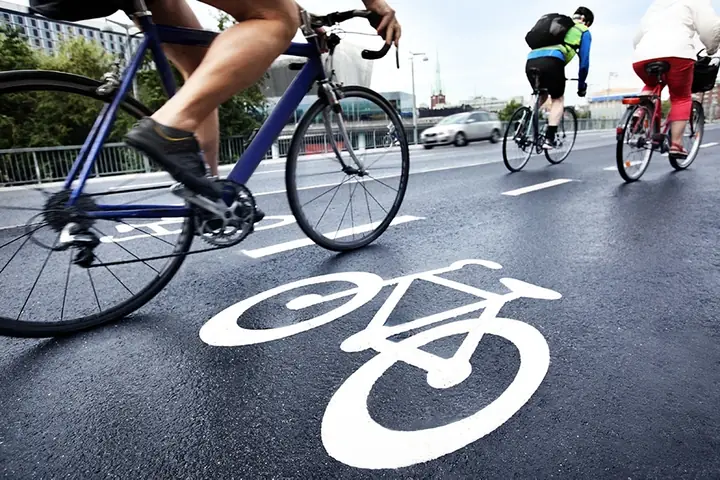
Section 32-5A-54 is the dooring statute. No person may open the door of a motor vehicle on the side available to moving traffic unless it is reasonably safe and can be done without interfering with other traffic, or leave it open longer than necessary to load or unload passengers. It says "person," not "driver," so a passenger stepping out of a rideshare is covered.
Passing is governed by section 32-5A-82, amended in 2015 to define a safe distance around a bicycle as not less than three feet. The definition comes with conditions. It applies on a roadway with a marked bicycle lane, or on one with a marked speed limit of 45 mph or less and no double yellow line. And it applies only when you are riding within two feet of the right shoulder.
Outside those conditions, a driver still owes you a pass "at a safe distance" under the first clause of the same section, with no number attached.
The statute names no special fine, so the general penalty in section 32-5A-8 applies: up to $100 for a first conviction. The larger stake is the civil claim, where your lane position decides whether three feet applied.
E-bikes
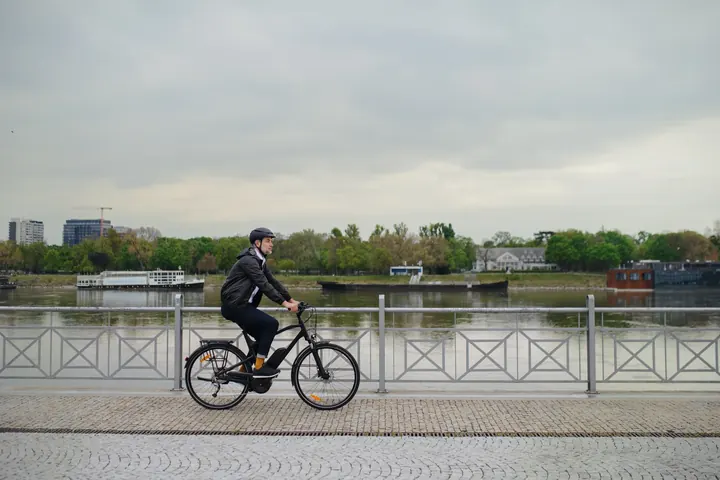
Alabama adopted the three-class system in Act 2021-134. Section 32-1-1.1 defines an electric bicycle as a bike with fully operable pedals, a saddle, and an electric motor of less than 750 watts. Class 1 assists only while you pedal and stops at 20 mph. Class 2 can be propelled by the motor alone and stops assisting at 20 mph. Class 3 is pedal assist to 28 mph.
Section 32-5A-267 gives an e-bike rider the rights and duties of a bicycle rider, and it exempts e-bikes from driver's licenses, registration, plates, financial responsibility, and motor vehicle insurance. In a crash you are treated as a cyclist.
Class 3 carries the extra rules. Nobody under 16 may operate one, every operator and passenger must wear a helmet, and the bike needs a speedometer. After notice and a public hearing, a local government may ban Class 3 from its bicycle and multi-use paths, and Class 1 and Class 2 when it finds that safety requires it.
Since January 1, 2022, every e-bike must carry a permanent label showing its class, top assisted speed, and motor wattage. Changing the motor's speed capability without replacing that label violates the statute. A machine outside the definition is also outside the exemptions: section 32-12-20 treats a bicycle with a motor attached, other than an electric bicycle, as a motor-driven cycle.
One question has no clear answer in published Alabama authority: whether an auto policy's uninsured motorist or medical payments coverage follows you onto an e-bike. Get your auto insurer's position in writing. In a bike insurance policy, check that your e-bike's class is covered and that the motor matches its label.
Deadlines

Alabama's deadlines run from the roadside to two years, and the shortest of the claim deadlines belongs to city hall.
- Immediately
Police Notice From the Scene
Section 32-10-5 requires the driver in any crash that injures someone to notify the local police, the county sheriff, or the state highway patrol at once.
- 30 days
Driver's Written Crash Report
Under section 32-7-5, the driver must report in writing to the Alabama Law Enforcement Agency within 30 days of any crash with an injury or more than $250 in property damage.
- Six months
Claim Against a City or Town
Section 11-47-23 bars a tort claim against a municipality unless it is presented within six months, and section 11-47-192 requires a sworn statement filed with the clerk giving the manner of the injury, the day, time, and place, and the damages claimed. Section 11-47-190 caps recovery at $100,000 per injured person and $300,000 per occurrence.
- 12 months
Claim Against a County
Section 11-12-8 gives you 12 months to present a claim to the county commission, and section 11-12-5 requires it to be itemized. Under section 6-5-20 you cannot sue until the commission disallows the claim; 90 days of silence counts as a disallowance.
- One year
Claim Against the State
A claim for injury done by the state or one of its agencies goes to the Board of Adjustment and must be presented within one year under section 41-9-65.
- Two years
Injury, Death, or Bike Damage Lawsuit
Section 6-2-38 gives you two years to sue for an injury and two years from the death for wrongful death. Treat two years as the deadline for the bike and gear as well: the same section covers any injury to the person or rights of another, and the six-year period in section 6-2-34 is for trespass. The small claims docket of district court hears cases up to $6,000.
For a rider under 19, section 6-2-8 pauses the two-year clock until the 19th birthday, with an outer limit of 20 years. Section 11-12-8 gives a minor 12 months after turning 19 to present a county claim, but the six-month municipal statute has no such clause.
Evidence to Preserve
In a contributory negligence state, evidence does two jobs: it proves what the driver did and it shuts down the argument about what you did.
- The crash report. Section 32-10-7 requires the investigating officer to file one on the state's uniform form, and a person involved in the crash is entitled to a copy.
- The driver's name, address, registration number, and license, which section 32-10-2 requires the driver to give you.
- Your position on the road: distance from the right shoulder, bike lane markings, the posted speed limit, and the center line. Those four facts decide whether the three-foot rule applied.
- Your equipment as it was: front lamp, rear reflector, working brake, and for an e-bike the class label. Do not repair or discard the bike until the claim is settled.
- Witnesses and video from your own camera, nearby businesses, and doorbells. In a hit-and-run with no contact, this is how you prove the accident occurred.
- Medical records and bills from the first visit onward, and receipts for the bike, helmet, and gear.
- A stamped copy of any claim filed with a city clerk, a county commission, or the Board of Adjustment, with the date it was received.
Coverage for Alabama Riders

Alabama's gaps are specific: a driver with $25,000 of coverage, a driver who is never found, an auto policy whose uninsured motorist coverage was rejected years ago, and a fault rule that lets the driver's insurer pay nothing if you were careless at all. The Velosurance policy offers the coverages discussed above.
Uninsured Motorist covers losses beyond medical bills, such as lost wages, when the at-fault driver cannot pay.
Medical Payments covers the deductible and out-of-pocket costs your health plan leaves, whatever the driver's insurer decides. Choose a limit close to your plan's out-of-pocket deductible.
Liability is the other side of contributory negligence. If you are blamed for a crash, it covers injury to other people and damage to their property, including the cost of defending a covered lawsuit, with limits from $25,000 to $500,000.
Crash damage to the bike is part of the policy itself. The bike is insured at stated value with no depreciation, subject to the deductible, whoever caused the crash. Class 1, Class 2, and Class 3 e-bikes are covered like conventional bikes.
For any of these coverages to apply, it must be on the policy before the crash. Get a quote and add them before your next ride.
Frequently Asked Questions
- How does fault affect a bicycle accident claim in Alabama?
- You can recover from the at-fault driver when the crash was the driver's doing alone, and the driver's side carries the burden of proving otherwise. The caveat worth knowing: Alabama uses contributory negligence, so if your own carelessness contributed to the crash, a driver who was merely negligent owes you nothing. That bar does not apply to a claim of wantonness.
- How long do you have to file a bicycle accident claim in Alabama?
- You have two years to file a lawsuit for your injuries, and you should treat two years as the deadline for the bike as well. One thing to watch: a claim against a city or town must be presented within six months, a claim against a county within 12 months, and a claim against the state within one year.
- What does the at-fault driver's insurance pay after a bike crash in Alabama?
- The at-fault driver's liability policy pays for your injuries from its bodily injury limit and for your bike and gear from its property damage limit. Alabama's minimums are $25,000 per person, $50,000 per crash, and $25,000 for property damage. The caveat worth knowing: one surgery can use up a minimum-limits policy.
- How does uninsured motorist coverage work for an Alabama cyclist in a hit-and-run?
- Uninsured motorist coverage on an Alabama auto policy can pay for your injuries when the driver flees, even if the car never touched you, provided you can prove the accident occurred. Report to police and to your insurer the same day. With one wrinkle: it pays for bodily injury only, so the bike needs separate crash coverage.
- How are Class 1, Class 2, and Class 3 e-bikes treated after a crash in Alabama?
- Alabama gives riders of Class 1, Class 2, and Class 3 e-bikes the rights and duties of bicycle riders, so the same fault rule and deadlines apply. Class 1 is pedal assist to 20 mph, Class 2 can be propelled by the motor alone and stops assisting at 20 mph, and Class 3 is pedal assist to 28 mph. One thing to watch: Class 3 requires a helmet for every rider and an operator who is at least 16.
Sources
- Golden v. McCurry, 392 So. 2d 815 (Ala. 1980) (contributory negligence retained; no defense to wantonness)
- Williams v. Delta International Machinery Corp., 619 So. 2d 1330 (Ala. 1993) (contributory negligence retained)
- Serio v. Merrell, Inc., 941 So. 2d 960 (Ala. 2006) (elements and burden of contributory negligence; wantonness)
- State Farm Fire and Casualty Co. v. Lambert, 291 Ala. 645 (1973) (hit-and-run physical contact clause void)
- State Farm Automobile Insurance Co. v. Reaves, 292 So. 2d 95 (Ala. 1974) (exclusions narrower than the uninsured motorist statute are void)
- Ex parte Capstone Building Corp., 96 So. 3d 77 (Ala. 2012) (two-year period for negligence and wantonness)
- Code of Alabama section 32-7A-4 (Mandatory Liability Insurance Act)
- Code of Alabama sections 32-7-5 and 32-7-6 (crash report to the director; minimum liability limits)
- Code of Alabama section 32-7-23 (uninsured motorist coverage)
- Code of Alabama sections 32-10-2, 32-10-5, and 32-10-7 (driver's duties after a crash; crash reports)
- Code of Alabama sections 32-5A-260, 32-5A-263, and 32-5A-265 (bicycle rights, duties, lane position, equipment)
- Code of Alabama sections 32-5A-52, 32-5A-54, 32-5A-82, and 32-5A-8 (sidewalks, vehicle doors, passing, penalties)
- Code of Alabama sections 32-5A-283 and 32-5A-285 (bicycle helmets for riders under 16)
- Code of Alabama sections 32-1-1.1, 32-5A-267, and 32-12-20 (electric bicycles; motor-driven cycles)
- Code of Alabama sections 6-2-8, 6-2-34, and 6-2-38 (filing deadlines; minors)
- Code of Alabama sections 11-47-23, 11-47-190, and 11-47-192 (claims against cities and towns)
- Code of Alabama sections 6-5-20, 11-12-5, and 11-12-8 (claims against counties)
- Code of Alabama sections 41-9-62 and 41-9-65 (State Board of Adjustment)
- Code of Alabama section 12-12-31 (small claims)
- Alabama Department of Insurance, automobile insurance questions (minimum limits)
This guide is general information about Alabama law as of the review date above. It is not legal or insurance advice, and it does not create an attorney-client relationship. Laws change and every crash turns on its own facts: talk to a licensed Alabama attorney about your situation.